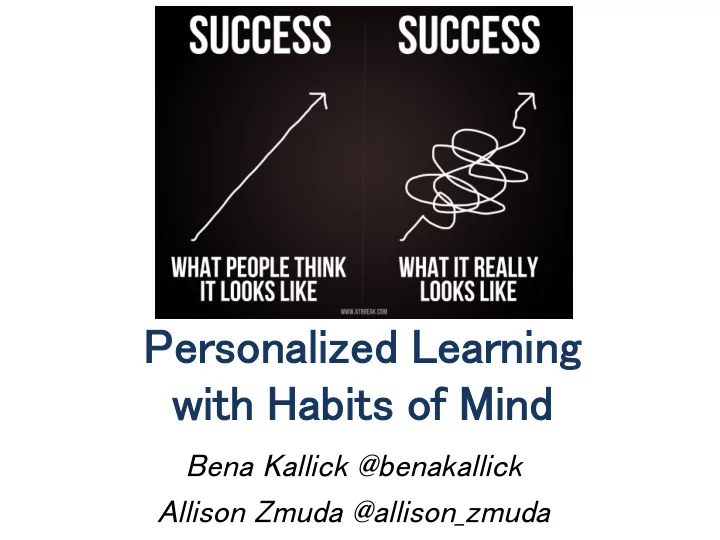
SLIDE 1
Personalized Learning with Habits of Mind
Bena Kallick @benakallick Allison Zmuda @allison_zmuda
SLIDE 2 Keeping You at the Center
problem-solving
teaching
sharing
SLIDE 3 Purposeful Interactions
www.learningpersonalized.com/PLandHOM
- Twitter #: (add for ASCD)
– Add Bena to the conversation: @benakallick – Add Allison to the conversation: @allison_zmuda
- Mentimeter polling
- Collaborative time: listen, examine, create
SLIDE 4 WHAT DO LYFT, GOLDIEBLOX, AND SCHOOL HAVE IN COMMON?
4
SLIDE 5 Simon Sinek’s Golden Circle
5
SLIDE 6 “A ride whenever you need one.”
6
SLIDE 8 Current Why of Most Schools
“To graduate college and career ready citizens.”
8
SLIDE 9 Disrupting Efficiency Model
9
SLIDE 10 Disrupting Efficiency Model
“There’s no competitive advantage today in knowing more than the person next to you. The world doesn’t care what you know. What the world cares about is what you can do with what you know.”
— Tony Wagner
10
SLIDE 12 What Learners Don’t Want
remember, recall and regurgitate.
learn for the sake
learning made easy; rather, we want it to mean something.
12
SLIDE 13 Impact of Disengagement
- Two out of three respondents (67% in each
year) are bored at least every day in class in high school.
- Approximately half of the students (51% in
2007, 50% in 2008) are bored every day.
- Approximately one out of every six students
(16% in 2007, 17% in 2008) are bored in every class.
- Only 2% in each year report never being bored.
- E. Yazzie-Mintz (2009). Engaging the Voices of Students
13
SLIDE 14
SLIDE 15 Out of the Mouths of Students
“The only difference between me, the 95% student, and that guy sitting in the back of the room, is I have learned how to remember, recall and regurgitate and he hasn’t, can’t or won’t.” —Grade 12 student “Let me tell you what school is like for me. Blah blah, blah blah. Test Friday.” — Grade 12 student
15
SLIDE 16
Real Engagement
When students choose to invest (and reinvest) their attention and effort in the pursuit of a learning goal.
SLIDE 17 Learning in a Contemporary World
Messy problems Dizzying amount
Growing intolerance for reflection Struggling on what matters Making sense of humanity and human nature
17
SLIDE 18
PERSONALIZED LEARNING WITH HABITS OF MIND
SLIDE 19 Reimaging Our Schools Create a culture of relevant learning.
19
SLIDE 20 What Learners Do Want
- We want to do work that makes a difference to
us and to our world.
- We want to do work that is relevant, meaningful
and authentic.
- We want to be engaged intellectually.
- We want stronger relationships with our
teachers, with each other and with our communities.
- We want feedback in time to help us learn and in
time do something about it.
20
SLIDE 21 Effective Engagement excerpted Infographic from ABS, McCrindle (Madden, 2014)
Previous Genera-ons Genera-on Z/α Verbal Visual Sit and Listen Try and See Teacher Facilitator Job Security Flexibility Commanding CollaboraEng Curriculum-Centered Learner-Centered Closed Book Exams Open Book World Books and Paper Glass and Devices
21
SLIDE 22 Our Definition of Personalized Learning
“Personalized learning is a progressively student-driven model where students deeply engage in meaningful, authentic, and rigorous challenges to demonstrate desired
— Zmuda, Curtis and Ullman (2015)
22
SLIDE 23 How would you like your students, your peers, your faculty to be? www.menti.com 39 82 20
23
- What do you see them doing?
- What do you hear them saying?
- How are they feeling?
SLIDE 24 Compare to Habits of Mind
- Persisting
- Managing impulsivity
- Listening with
understanding and empathy
- Thinking flexibly
- Thinking about thinking
- Striving for accuracy
- Questioning and posing
problems
to new situations
- Finding humor
- Thinking and
communicating with clarity and precision
- Gathering data through all
senses
innovating
wonderment and awe
- Taking responsible risks
- Thinking interdependently
- Remaining open to
continuous learning
SLIDE 25
Definition of Habits of Mind
Characteristics of what intelligent people do when they are confronted with problems, the resolutions to which are not immediately apparent. — Costa and Kallick (2008)
SLIDE 26 How They Fit Together
If personalized learning is the
pedagogical structure for learning, then explicit thinking behaviors are required: Habits of Mind.
SLIDE 27 Growing Capacity by Design
27
SLIDE 28 Relevant Learning Clarity AuthenEcity Perceived Capacity to Succeed
How To Reimagine Teaching and Learning
28
SLIDE 29 Relevant Learning Clarity AuthenEcity Perceived Capacity to Succeed
How To Reimagine Teaching and Learning
29
SLIDE 30 Short Term, Long Term Clarity
Quiet questions in the mind of the student:
asking me to do?
asking me to do it?
30
SLIDE 31 Relevant Learning Clarity AuthenEcity Perceived Capacity to Succeed
How To Reimagine Teaching and Learning
31
SLIDE 32 Power of Authenticity
ü Authentic problems, challenges, issues, ideas ü Authentic opportunities to network, monitor progress, determine next steps ü Authentic forms for performance ü Authentic audiences for presentation and refinement
32
SLIDE 33 Relevant Learning Clarity AuthenEcity Perceived Capacity to Succeed
How To Reimagine Teaching and Learning
33
SLIDE 34 Student Perception: Balancing Act
34
SLIDE 35 Teacher Perception: Honoring Students by Design
me?
need?
work specifically for you to help you reach the learning goal?
35
SLIDE 38 Phases of Change
38
What is it? How does it affect me? How do I begin? How do I stay motivated? How do I get others interested in/ supportive
How are we working together to grow the idea? How do we share the results? What new ideas, policies, and practices emerge?
PERSONAL TEAM SYSTEM
SLIDE 39 STATEMENT #1 True STAND UP False STAY SEATED
Personalized learning requires a huge investment in technology.
39
What do you think?
SLIDE 40 What do you think?
STATEMENT #2 True STAND UP False STAY SEATED
Personalized learning means that every student has their own individualized learning plan.
40
SLIDE 41 What do you think?
STATEMENT #3 True STAND UP False STAY SEATED
Personalized learning expects a significant level
students.
41
SLIDE 42 What do you think?
STATEMENT #4
True STAND UP False STAY SEATED
In a personalized learning classroom, the teacher is more
less of an instructor.
42
SLIDE 43 What do you think?
STATEMENT #5 True STAND UP False STAY SEATED
Personalized learning is not appropriate for students with special needs.
43
SLIDE 44
Recommendation #1
Get off the treadmill.
SLIDE 45
Recommendation #2
Stop and smell the roses and take a look around.
SLIDE 46
Recommendation #3
Be curious about something. What makes you wonder?
SLIDE 47
Recommendation #4
Be inspired by an idea and go for it.
SLIDE 48
Recommendation #5
Contribute something to the world.
SLIDE 49
Recommendation #6
Celebrate the journey.
SLIDE 50 “The future belongs to a very different kind of person with a very different kind of mind — creators and empathizers, pattern recognizers and meaning makers.” — Daniel Pink
50
SLIDE 51
Resources
www.learningpersonalized.com www.habitsofmindinstitute.org Contact: allison@allisonzmuda.com kallick.bena@gmail.com