
SLIDE 1
Question 3 (a)
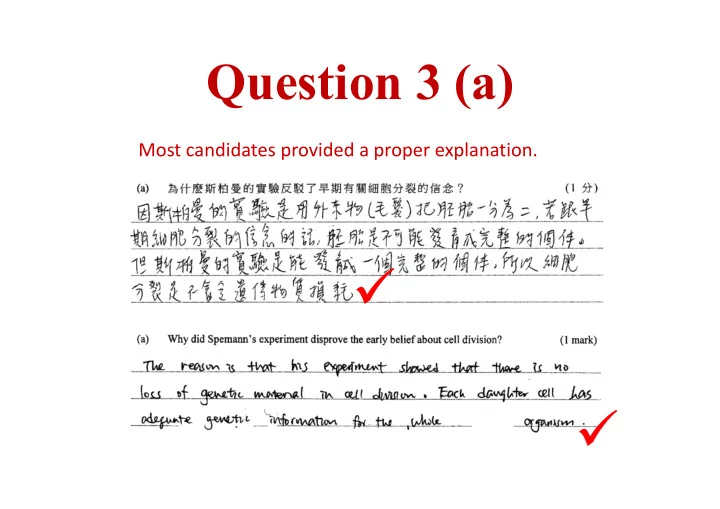
Most candidates provided a proper explanation.
Question 3 (a) Some candidates did not refer to the experiment. - - PowerPoint PPT Presentation
Question 3 (a) Most candidates provided a proper explanation. Question 3 (a) Some candidates did not refer to the experiment. Question 3 (a) Some candidates did not understand the experiment. Question 3 (a) Some
Most candidates provided a proper explanation.
Some candidates did not refer to the experiment.
Some candidates did not understand the experiment.
Some candidates wrongly interpreted that Spemann developed complete organisms from the hair cells!
Some candidates did not refer to the example.
Candidates were not familiar with, or had some difficulty in understanding, the statement.
Many candidates mixed up mitosis with meiosis. They thought that homologous chromosomes separated during mitosis. Some candidates did not distinguish between the terms “chromatin”, “chromatid” and “chromosomes”. 錯別字:復製 複製什麼?
錯別字:複雜 染色單體分離
Some candidates mixed up protein synthesis and DNA replication.
requirements for low-power drawings and gave cellular details in their drawings.
shown in the photomicrograph and gave wrong labels.
wording from the questions and used this as their title.
Some drawings were irrelevant.
whole stem section were drawn
no title no label gave cellular details
gave cellular details
gave cellular details
failed to recognise different tissues
Which parts were being labelled?
simply copied wording from the questions and used this as their title misspelt epidermis as epithelium 4 vascular bundles failed to recognize sclerenchyma
labelled the pith as the cortex
2 vascular bundles
Title
attention to the proportions of different tissues in the stems.
photomicrograph, many candidates recited their knowledge about support in plants. Only very few candidates made reference to the
How do the tissues provide support?
did not pay attention to the proportion of the supporting tissues
failed to recognise different tissues
wrong function of phloem
failed to recognise different tissues
failed to recognise different tissues
Which was the major mean of support?
did not pay attention to the proportion of xylem in the stem
candidates’ knowledge of the characteristics of insect-pollinated flowers.
two observable features.
Thursday, November 27, 2014 2014 HKDSE BIOLOGY Q8 & Q10 35
Thursday, November 27, 2014 2014 HKDSE BIOLOGY Q8 & Q10 36
Thursday, November 27, 2014 2014 HKDSE BIOLOGY Q8 & Q10 37
Thursday, November 27, 2014 2014 HKDSE BIOLOGY Q8 & Q10 38
Thursday, November 27, 2014 2014 HKDSE BIOLOGY Q8 & Q10 39
Thursday, November 27, 2014 2014 HKDSE BIOLOGY Q8 & Q10 40
candidates were able to point out which type of flower would be more readily pollinated.
half of them were able to provide a proper explanation.
Thursday, November 27, 2014 2014 HKDSE BIOLOGY Q8 & Q10 41
Thursday, November 27, 2014 2014 HKDSE BIOLOGY Q8 & Q10 42
Thursday, November 27, 2014 2014 HKDSE BIOLOGY Q8 & Q10 43
link this up with the idea
pollination between
different types of primrose.
failed to elaborate on its importance to increase genetic variation in the next generation.
Thursday, November 27, 2014 2014 HKDSE BIOLOGY Q8 & Q10 44
Thursday, November 27, 2014 2014 HKDSE BIOLOGY Q8 & Q10 45
Thursday, November 27, 2014 2014 HKDSE BIOLOGY Q8 & Q10 46
misinterpreted the graph as showing the distribution of neurones on the retina rather than in the visual centre.
the question highlighted different types of photoreceptor cells, many candidates simply referred to cone cells and rod cells.
Thursday, November 27, 2014 2014 HKDSE BIOLOGY Q8 & Q10 47
that there are three different types of cone cells for colour vision and that each type of cone cell would send nerve impulses to the visual centre,
the necessity of having more neurones to analyse the signals from different types of cone cells.
Thursday, November 27, 2014 2014 HKDSE BIOLOGY Q8 & Q10 48
Thursday, November 27, 2014 2014 HKDSE BIOLOGY Q8 & Q10 49
Thursday, November 27, 2014 2014 HKDSE BIOLOGY Q8 & Q10 50
Thursday, November 27, 2014 2014 HKDSE BIOLOGY Q8 & Q10 51
Thursday, November 27, 2014 2014 HKDSE BIOLOGY Q8 & Q10 52
not aware that the image seen will only make sense with reference to previously stored memory.
Thursday, November 27, 2014 2014 HKDSE BIOLOGY Q8 & Q10 53
Thursday, November 27, 2014 2014 HKDSE BIOLOGY Q8 & Q10 54
Thursday, November 27, 2014 2014 HKDSE BIOLOGY Q8 & Q10 55
Thursday, November 27, 2014 2014 HKDSE BIOLOGY Q8 & Q10 56
Thursday, November 27, 2014 2014 HKDSE BIOLOGY Q8 & Q10 57