Primary Clarification Step Evaluation Implementation of 3M - - PowerPoint PPT Presentation

primary clarification step evaluation
SMART_READER_LITE
LIVE PREVIEW

Primary Clarification Step Evaluation Implementation of 3M - - PowerPoint PPT Presentation

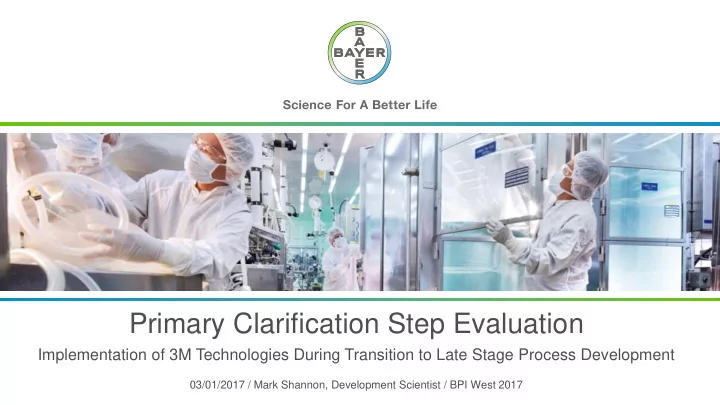
Primary Clarification Step Evaluation Implementation of 3M Technologies During Transition to Late Stage Process Development 03/01/2017 / Mark Shannon, Development Scientist / BPI West 2017 Page 1 Biologics Development at Bayer


slide-1
SLIDE 1

Page 1

03/01/2017 / Mark Shannon, Development Scientist / BPI West 2017

Implementation of 3M Technologies During Transition to Late Stage Process Development
Primary Clarification Step Evaluation

slide-2
SLIDE 2

Page 2

Agenda

  • Biologics Development at Bayer
  • Overview of Early Stage Primary Clarification Process
  • Assessment of Phase 1 Depth Filter Performance
  • Assessment of 3M Zeta Plus™ Depth Filter Performance
  • Additional Benefits of 3M Zeta Plus™
  • Emphaze™ Hybrid Purifier
  • Looking Forward
  • Primary Clarification Step Evaluation • 03/01/2017
slide-3
SLIDE 3

Page 3

Bayer

Our Business Areas

  • Primary Clarification Step Evaluation • 03/01/2017
slide-4
SLIDE 4

Page 4

The Bay Area: Bayer’s Biotechnology Hub

We are one of the largest biotech employers in the Bay Area

  • Primary Clarification Step Evaluation • 03/01/2017

Berkeley Development & Manufacturing Mission Bay Research

slide-5
SLIDE 5

Page 5

Process Development at Bayer Berkeley – Biological Development (BD)

  • Primary Clarification Step Evaluation • 03/01/2017

The BD group at Bayer has the overall responsibility for the CMC development of new biological entities. Process development covers all areas from the expression construct to the final drug product including process development for commercial manufacturing and technical support for commercial product supply. Furthermore, BD supplies Preclinical/Clinical Development with drug products for their studies. The development and validation of analytical methodologies for in-process release, product comparability testing, and drug product release testing as well as the generation of drug product related regulatory and GMP documentation are additional responsibilities

  • f BD.
slide-6
SLIDE 6

Page 6

Early development

  • Fast
  • Cheap
  • Predictive of

commercial success

Challenges for Early and Late Stage Process Development

  • Primary Clarification Step Evaluation • 03/01/2017

Late development

  • Pressure to launch
  • Robust
  • Well characterized
  • Low CoG
slide-7
SLIDE 7

Page 7

A Phase 1 clinical process was developed utilizing existing materials and methods for primary clarification. As the project moved towards late stage development, process improvement evaluation was performed on the Phase 1 clinical clarification process with the objectives of:

  • Improving step yield
  • Improving upon cell culture impurity removal
  • Increasing process flow rates
  • Decreasing burden on capture

chromatography

Evaluation of Initial Phase 1 Primary Clarification Process

  • Primary Clarification Step Evaluation • 03/01/2017
slide-8
SLIDE 8

Page 8

  • Clarification of HCCF with uncharged depth

filters (1.5 -20 µm) at a conservative process flow rate (Flux: ~30 LMH) based on observed pressure at bench scale.

  • Filter surface area also sized conservatively to

accommodate potential scale-up load variability.

  • Buffer chase step executed to minimize product

loss from hold-up in the depth filter housings.

  • Resulting impurity levels (HCD and HCP) in

CCCF are high.

  • CCCF loaded directly onto capture column.
  • Results are acceptable but there is substantial

area for improvement.

Overview of Primary Clarification Step

Phase 1 Process Before Evaluation

  • Primary Clarification Step Evaluation • 03/01/2017
slide-9
SLIDE 9

Page 9

Phase 1 Clarification Performance with Single Stage, Uncharged Depth Filters

  • Primary Clarification Step Evaluation • 03/01/2017

Four Phase 1 clinical lots of the product (IgG2) produced using the single stage, uncharged depth filters resulting in a) approximately 80% step yield due to high filter area requirements, and b) limited host cell impurity removal and resultant high burden on capture chromatography.

20 40 60 80 100 1 2 3 4

Step Yield (%)

0% 25% 50% 75% 100% 125% 150% 175% 1 2 3 4

Host Cell DNA

0% 50% 100% 150% 1 2 3 4

Host Cell Protein

slide-10
SLIDE 10

Page 10

Evaluation at Transition to Late Stage Development 3M Zeta Plus™ Filters Evaluated

  • Primary Clarification Step Evaluation • 03/01/2017

Various sizes of 3M Zeta Plus depth filters were tested with a two stage system ultimately implemented.

  • Stage 1 – 05SP01A - sized (10 – 1.5 µm)

to remove cells and large cellular debris

  • Stage 2 – 60ZB05A – smaller nominal

pore size (3 – 0.2 µm) along with a positively charged membrane for improved DNA clearance

  • Development evaluation showed an

increase in both the filter loading capacity and flux rate

slide-11
SLIDE 11

Page 11

  • Process moved to 2 stage

depth filtration: Stage 1 05SP01A - to remove major cell mass, Stage 2 60ZB01A - charged properties for DNA removal.

  • Filter sizing evaluation:

Required filter surface area ↓ by 10%.

  • Process flow rate set point ↑ by

25% based on pressure/flow

  • bserved.

Modified Primary Clarification Process

2 Stage, 3M Zeta Plus™ Depth Filters

  • Primary Clarification Step Evaluation • 03/01/2017
slide-12
SLIDE 12

Page 12

Primary Clarification Performance with Two-Stage, Charged Depth Filters

  • Primary Clarification Step Evaluation • 03/01/2017

One clinical lot of the product was produced using the two stage, charged 3M filters resulting in a) an increase of 10% step yield due to decreased filter area requirements, and b) a significant reduction in HCD due to the charged properties of the Stage 2 filters.

20 40 60 80 100 Phase 1 Avg. 3M Zeta Plus

Step Yield (%)

0% 20% 40% 60% 80% 100% Phase 1 Avg. 3M Zeta Plus

Host Cell DNA

0% 20% 40% 60% 80% 100% 120% 140% Phase 1 Avg. 3M Zeta Plus

Host Cell Protein However, no observed improvement in HCP level of HCCF pool.

slide-13
SLIDE 13

Page 13

Additional Observed Benefits of Change to 3M Zeta Plus™ Depth Filters

  • Primary Clarification Step Evaluation • 03/01/2017

The change to 3M depth filters also provided benefits for Scale-Up considerations:

  • An approximate 25% increase in process flow rate capabilities resulting in shorter

run times.

  • Lower capsule requirements with a decreased footprint for process equipment.
  • Maintained comparable cost per batch consumable requirements.

0% 50% 100% 150% Phase 1 Avg. 3M Zeta Plus

Process Flow Rate

0% 20% 40% 60% 80% 100% Phase 1 Avg. 3M Zeta Plus

Consumable Cost/Batch

5 10 15 Phase 1 Avg. 3M Zeta Plus

Capsule Req./Batch

slide-14
SLIDE 14

Page 14

Further Optimization of Primary Clarification 3M Emphaze™

  • Primary Clarification Step Evaluation • 03/01/2017

Next Step: Integration of Emphaze hybrid purifier technology. Potential process advantages:

  • Significant reduction (~30%) of HCP
  • Virtually clear HCD (4-5 LRV) prior to capture step
  • Not pressure/flow limited allowing variable surface area scaling (Multiple Stage 1 Filters/1 x Emphaze)
  • Potential to remove a polishing step and go to a streamlined, 2 chrom. step purification process.
slide-15
SLIDE 15

Page 15

Primary clarification step for 3 projects was evaluated with and without Emphaze and demonstrated significant reduction of both HCD and HCP. HCD levels in the CCCF are

  • ften below 100 ppb. HCP levels in the CCCF across projects were between 25-40%

lower after Emphaze.

Significant Impurity Clearance in CCCF

Demonstrated with 3M Emphaze™

  • Primary Clarification Step Evaluation • 03/01/2017

0.0% 20.0% 40.0% 60.0% 80.0% 100.0%

% HCP in CCCF after Emphaze

0.0% 20.0% 40.0% 60.0% 80.0% 100.0% 1 - No Emphaze 1 - w/Emphaze 2 - No Emphaze 2 - w/Emphaze

% HCD in CCCF after Emphaze

<0.02%

slide-16
SLIDE 16

Page 16

Next Steps in Primary Clarification Optimization

  • Primary Clarification Step Evaluation • 03/01/2017

Where is the tipping point for value added by depth filtration assemblies versus complexity and cost? Does an elaborate clarification train make sense? Goal: Combine 2 stages of filter media without separation via manifolds in order to maximize the nominal pore size and surface chemistry combinations used. Can we make a 05SP + 60ZB or 10 SP + 90ZB within a single capsule? Another step on the way to a shorter, simpler purification process.

60ZB 05SP

slide-17
SLIDE 17

Page 17

Summary

The implementation of 3M Zeta Plus depth filters improved the primary clarification process for a late stage project by:

  • Increased HCD clearance and Process Flow Rate
  • Decreased Filter Area Requirements
  • But, no observed improvement in HCP clearance

Further improvement with the Emphaze Hybrid Purifier:

  • Substantial increase in both HCD and HCP clearance
  • No observed pressure/flow limitations

As we move forward, the goal to maximize combinations of pore sizes and surface chemistries while minimizing operational complexity is key with an eye on removing polishing steps from processes wherever possible

  • Primary Clarification Step Evaluation • 03/01/2017
slide-18
SLIDE 18

Page 18

Questions?

slide-19
SLIDE 19

Page 19

Forward-Looking Statements

This presentation may contain forward-looking statements based on current assumptions and forecasts made by Bayer management. Various known and unknown risks, uncertainties and other factors could lead to material differences between the actual future results, financial situation, development or performance of the company and the estimates given here. These factors include those discussed in Bayer’s public reports which are available on the Bayer website at http://www.bayer.com/. The company assumes no liability whatsoever to update these forward- looking statements or to conform them to future events or developments.

  • Primary Clarification Step Evaluation • 03/01/2017
slide-20
SLIDE 20

Page 20

Thank you