Resources: nc160D.sog.unc.edu 2 1 11/12/2019 Regional Workshops - - PDF document

resources nc160d sog unc edu
SMART_READER_LITE
LIVE PREVIEW

Resources: nc160D.sog.unc.edu 2 1 11/12/2019 Regional Workshops - - PDF document

11/12/2019 Master Clerks Academy November 14, 2019 Adam Lovelady 1 Resources: nc160D.sog.unc.edu 2 1 11/12/2019 Regional Workshops 3 Outline 1. Background and Implementation 2. Planning Requirement 3. Jurisdiction & Boards 4.


slide-1
SLIDE 1

11/12/2019 1

Master Clerks Academy November 14, 2019 Adam Lovelady

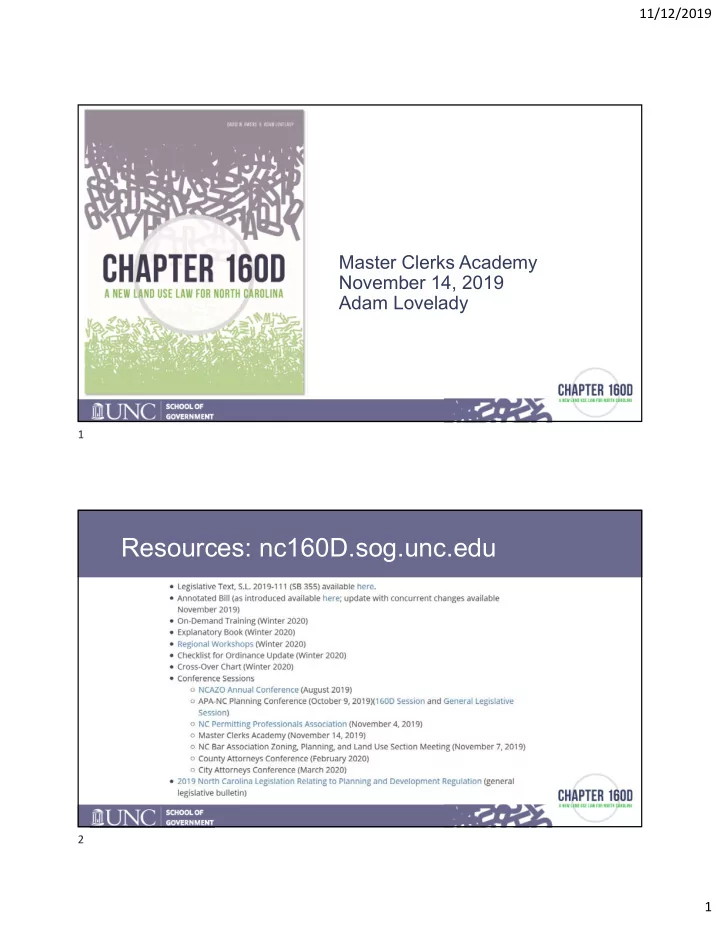
Resources: nc160D.sog.unc.edu

1 2
slide-2
SLIDE 2

11/12/2019 2

Regional Workshops Outline

  • 1. Background and Implementation
  • 2. Planning Requirement
  • 3. Jurisdiction & Boards
  • 4. Administration and Record Keeping
  • 5. Types of Decisions
  • 6. Land Use Decision Procedures
  • 7. Vested Rights and Permit Choice

3 4

slide-3
SLIDE 3

11/12/2019 3

Origin of Proposal

  • Developed as “good government” clarification, simplification,

modernization by the NC Bar Association’s Zoning, Planning, and Land Use Section

  • Multi-year review and comment by local governments,

development community, land use lawyers

Delayed Effective Date

Chapter 160D effective 1/1/21 Comprehensive Plan requirement effective 7/1/22

5 6

slide-4
SLIDE 4

11/12/2019 4

Comprehensive Plan Requirement

Clarification and Changes in Chapter 160D

New Requirement

Article 5 of Chapter 160D In order to impose zoning regulations, a local government must have a comprehensive plan Grace period until July 1, 2022

7 8

slide-5
SLIDE 5

11/12/2019 5

“reasonably maintain”

1960s 1970s 1980s 1990s 2000s 2010s . . .

Plan Coordination

  • May be coordinated with other plans

(CAMA, functional plans, regional plans)

9 10

slide-6
SLIDE 6

11/12/2019 6

Jurisdiction & Boards

Clarification and Changes in Chapter 160D

Geographic Jurisdiction

  • No change in basic allocation between cities and counties
  • County can adopt development regulation for ETJ if city fails to

adopt comparable city regulation there

  • Simplify county ETJ appointments to city boards

11 12

slide-7
SLIDE 7

11/12/2019 7

Geographic Jurisdiction

  • Can accept and process applications and hold hearings in

anticipation of jurisdiction shift; final decision after shift

  • Can mutually agree that one jurisdiction will handle

development regulation if city or county boundaries split a parcel

Boards

  • Must maintain minutes for each board
  • Require oath of office for all board members
  • Allow rules of procedure for each board (must maintain and

post to website)

  • Clarify appointment process
  • Must have planning board to make recommendations on zoning

amendments

13 14

slide-8
SLIDE 8

11/12/2019 8

Administration of Development Ordinances

Clarification and Changes in Chapter 160D

  • Art. 4 General Administrative Authority

Prior law

  • Administrative authority

was scattered or inferred Article 4

  • Staffing and administration of

development regulations

  • Development approvals (permits)
  • Determinations
  • Enforcement authority
  • Appeals
  • Quasi-judicial procedures

Article 4. Administration, Enforcement, and Appeals.

15 16

slide-9
SLIDE 9

11/12/2019 9

Maps

  • Official maps may be

incorporated by reference (specific map or most recent)

  • Clerk or other specified office

must maintain for public inspection

  • Current and past zoning maps
  • Current maps incorporated by

reference

  • Paper or digital format is

allowed

New Staff Conflicts of Interest

  • Not make a decision if
  • the outcome would have a direct, substantial, and readily identifiable

financial impact on the staff person

  • the staff person has a close familial, business, or other associational

relationship with the applicant or other person subject to the decision

  • Prior standard is preserved
  • No financial or employment interest in development in the jurisdiction
  • No work inconsistent with duties to local government

17 18

slide-10
SLIDE 10

11/12/2019 10

Minor Modifications

  • Staff authorized to make modifications to
  • Development Approvals
  • Special Use Permits
  • Conditional Zoning
  • Defined in the ordinance; parameters for amount of change
  • No change in permitted uses or the density
  • Major modification goes through standard approval process

Types of Land Use Decisions

Clarification and Changes in Chapter 160D

19 20

slide-11
SLIDE 11

11/12/2019 11

Comparison

Legislative Quasi‐Judicial Administrative

Character General policy decision by elected

  • fficials

Based on discretionary standards and evidence in the record Generally based on objective standards Example Zoning Amendment; Conditional Zoning Variance; Special Use Permit Notice of Violation; Zoning Permit Hearing Legislative Evidentiary Typically none sometimes Administrative Hearing Decision‐ Maker Governing board Typically appointed board Typically staff

Legislative Zoning Quasi‐Judicial Conditional Use Permit Conditional Use District Zoning Cond’l Zoning

21 22

slide-12
SLIDE 12

11/12/2019 12

Uniform Terminology and Streamlined Process

  • “Special Use Permit”
  • Quasi-judicial approval with site-specific conditions
  • Replaces conditional use permit and special exception
  • “Conditional Zoning”
  • Legislative approval with site-specific conditions
  • Replaces conditional use district zoning
  • End of Conditional Use District Zoning
  • Transition for existing approvals

Land Use Decision Procedures

Clarification and Changes in Chapter 160D

23 24

slide-13
SLIDE 13

11/12/2019 13

Legislative: Notice and Hearing

  • Must hold hearing for all development regulations with

published notice

  • Clarify “abutting properties” for mailed notice
  • Clarify timing for posted notices
  • Same 10-25 day as mailed notice

Legislative: Plan Consistency

  • Simplify plan consistency statements
  • Can do with single motion
  • Minutes can suffice if no formal statement
  • Delete requirement to use one of three forms of consistency

statement

  • FLUM deemed amended, not entire plan

25 26

slide-14
SLIDE 14

11/12/2019 14

Legislative: Reasonableness

  • Only mandatory for zoning map amendments, optional for other

amendments

  • Factors set out
  • Can combine plan consistency and reasonableness statements

Legislative: Voting

  • Simple majority vote on municipal first reading of development

regulation amendments

  • Defines prohibited “close family relationship” for legislative,

quasi-judicial, and staff conflicts

27 28

slide-15
SLIDE 15

11/12/2019 15

Quasi-Judicial: Uniform Procedures

  • Same rules for all quasi-judicial by any board
  • Continuation of hearing allowed
  • Meeting packets allowed
  • Administrative packet entered as evidence
  • Anyone may be allowed to present relevant evidence, but only

parties may cross-examine, object, etc.

  • Advisory review allowed, but may not be used as evidence for

decision

Permit Choice and Vested Rights

Clarification and Changes in Chapter 160D

29 30

slide-16
SLIDE 16

11/12/2019 16

Permit Choice

Subdivision Application Rule Change Application Review (applicant chooses old or new rules) Permit Application Rule Change Applicant select rules Zoning Rules Stormwater Rules Driveway Rules 18 months

Permit Choice Appeals

  • Aggrieved party may seek court order compelling compliance;

set for immediate hearing

  • Mandatory attorneys’ fees for “action inconsistent with, or in

violation of” permit choice of vested rights

31 32

slide-17
SLIDE 17

11/12/2019 17

Vested Rights

Permit Approval Rule Change

Project Can Continue As Approved

Vested Rights

Types and Terms of Vesting

  • Building Permit (6 months)
  • Development Approval (1 year)
  • Site-Specific Vesting Plan (2-5 years)
  • Multi-Phase Development (7 years)
  • Development Agreement (per agreement)
  • Common Law Vested Rights (reasonable)

33 34

slide-18
SLIDE 18

11/12/2019 18

Vested Rights and Continuing Review

  • Landowner must comply with requirements
  • Local government may revoke the original approval for failure to

comply with applicable terms, conditions, or development regulations

  • Rights continue for set time after discontinuation of

development (12 months in 160D; 24 months in Part I)

For additional resources, training options, and more, visit:

nc160D.sog.unc.edu

35 36