
SLIDE 1
Slides for Lecture 23
ENCM 501: Principles of Computer Architecture Winter 2014 Term Steve Norman, PhD, PEng
Electrical & Computer Engineering Schulich School of Engineering University of Calgary
3 April, 2014
ENCM 501 W14 Slides for Lecture 23
slide 2/19
Previous Lecture
◮ introduction to cache coherency protocols
ENCM 501 W14 Slides for Lecture 23
slide 3/19
Today’s Lecture
◮ MSI protocol for cache concurrency ◮ snooping to support MSI and similar protocols ◮ race conditions at ILP and TLP levels ◮ use of locks to manage TLP races ◮ introduction to ISA support for locks
Related reading in Hennessy & Patterson: Sections 5.2, 5.5
ENCM 501 W14 Slides for Lecture 23
slide 4/19
Quick review: Caches in multi-core systems
These points were made in the previous lecture:
◮ In a writeback cache in a uniprocessor (one-core,
no SMT) system, possible states of a cache block are invalid, clean, or dirty.
◮ For that writeback cache in a uniprocessor system, block
states usually change as a result of loads and stores processed within the single core. (Messy detail: Actions such as DMA by I/O devices can also change states of blocks.)
◮ In a multicore system, one of many possible choices for
sets of possible cache block states is MSI: modified, shared, or invalid. State changes in a cache in one core may be triggered by actions in another core.
ENCM 501 W14 Slides for Lecture 23
slide 5/19
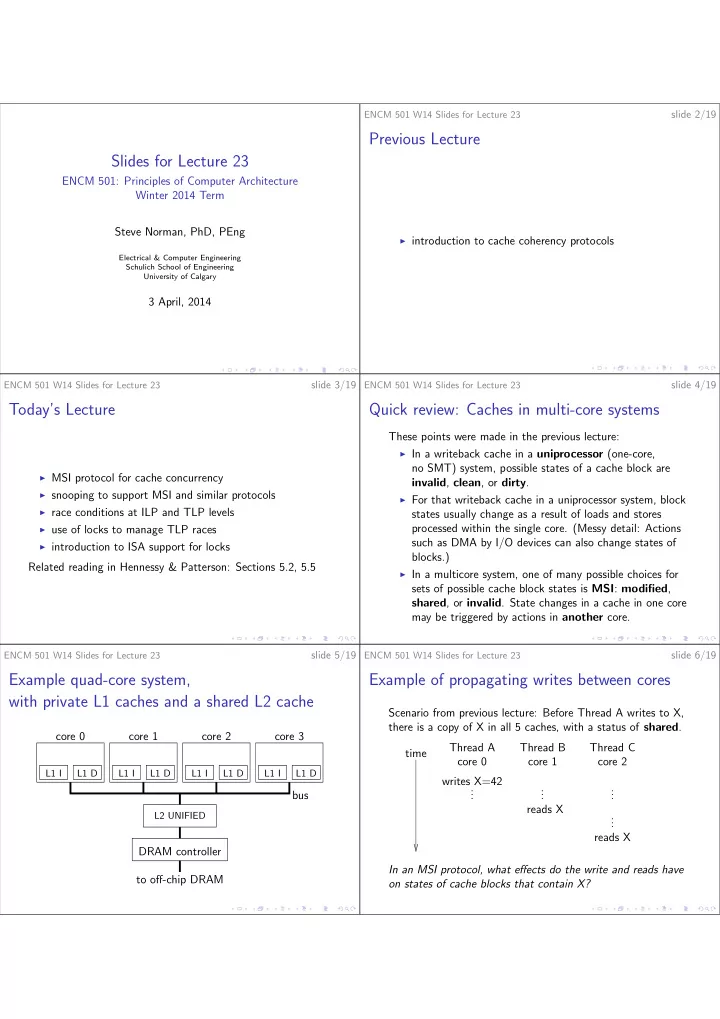
Example quad-core system, with private L1 caches and a shared L2 cache
L1 I L1 D
core 0
L1 I L1 D
core 1
L1 I L1 D
core 2
L1 I L1 D
core 3 bus
L2 UNIFIED
DRAM controller to off-chip DRAM
ENCM 501 W14 Slides for Lecture 23
slide 6/19
Example of propagating writes between cores
Scenario from previous lecture: Before Thread A writes to X, there is a copy of X in all 5 caches, with a status of shared. Thread A core 0 Thread C core 2 Thread B core 1 time writes X=42 . . . . . . reads X . . . reads X . . . In an MSI protocol, what effects do the write and reads have
- n states of cache blocks that contain X?