
SLIDE 1
Slides for Lecture 27
ENEL 353: Digital Circuits — Fall 2013 Term Steve Norman, PhD, PEng Electrical & Computer Engineering Schulich School of Engineering University of Calgary 13 November, 2013 ENEL 353 F13 Section 02 Slides for Lecture 27 slide 2/19Previous Lecture
Detailed discussion of an example from the textbook: the traffic light controller FSM. ENEL 353 F13 Section 02 Slides for Lecture 27 slide 3/19Today’s Lecture
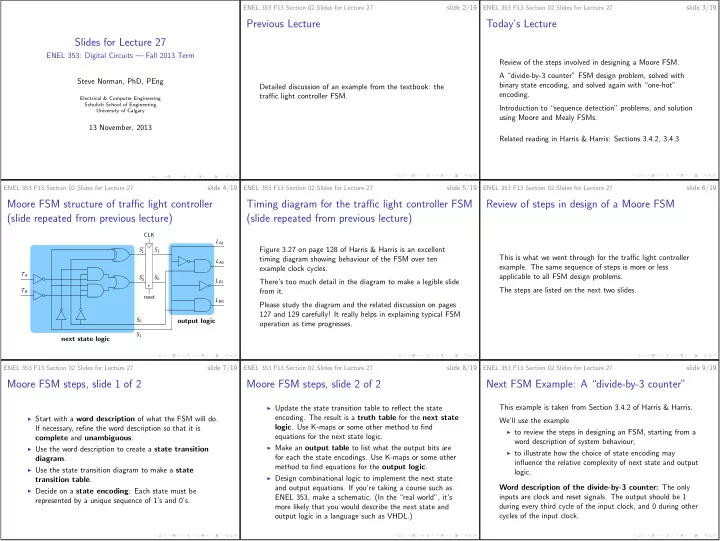
Review of the steps involved in designing a Moore FSM. A “divide-by-3 counter” FSM design problem, solved with binary state encoding, and solved again with “one-hot” encoding. Introduction to “sequence detection” problems, and solution using Moore and Mealy FSMs. Related reading in Harris & Harris: Sections 3.4.2, 3.4.3 ENEL 353 F13 Section 02 Slides for Lecture 27 slide 4/19Moore FSM structure of traffic light controller (slide repeated from previous lecture)
LA1 LB1 LB0 LA0 S′ 1 S1 reset TA TB S′ S0 CLK r S1 S0 next state logic- utput logic
Timing diagram for the traffic light controller FSM (slide repeated from previous lecture)
Figure 3.27 on page 128 of Harris & Harris is an excellent timing diagram showing behaviour of the FSM over ten example clock cycles. There’s too much detail in the diagram to make a legible slide from it. Please study the diagram and the related discussion on pages 127 and 129 carefully! It really helps in explaining typical FSM- peration as time progresses.
Review of steps in design of a Moore FSM
This is what we went through for the traffic light controller- example. The same sequence of steps is more or less
Moore FSM steps, slide 1 of 2
◮ Start with a word description of what the FSM will do. If necessary, refine the word description so that it is complete and unambiguous. ◮ Use the word description to create a state transition diagram. ◮ Use the state transition diagram to make a state transition table. ◮ Decide on a state encoding: Each state must be represented by a unique sequence of 1’s and 0’s. ENEL 353 F13 Section 02 Slides for Lecture 27 slide 8/19Moore FSM steps, slide 2 of 2
◮ Update the state transition table to reflect the state- encoding. The result is a truth table for the next state
- logic. Use K-maps or some other method to find
- utput logic in a language such as VHDL.)
Next FSM Example: A “divide-by-3 counter”
This example is taken from Section 3.4.2 of Harris & Harris. We’ll use the example ◮ to review the steps in designing an FSM, starting from a word description of system behaviour; ◮ to illustrate how the choice of state encoding may influence the relative complexity of next state and output logic. Word description of the divide-by-3 counter: The only inputs are clock and reset signals. The output should be 1 during every third cycle of the input clock, and 0 during other cycles of the input clock.