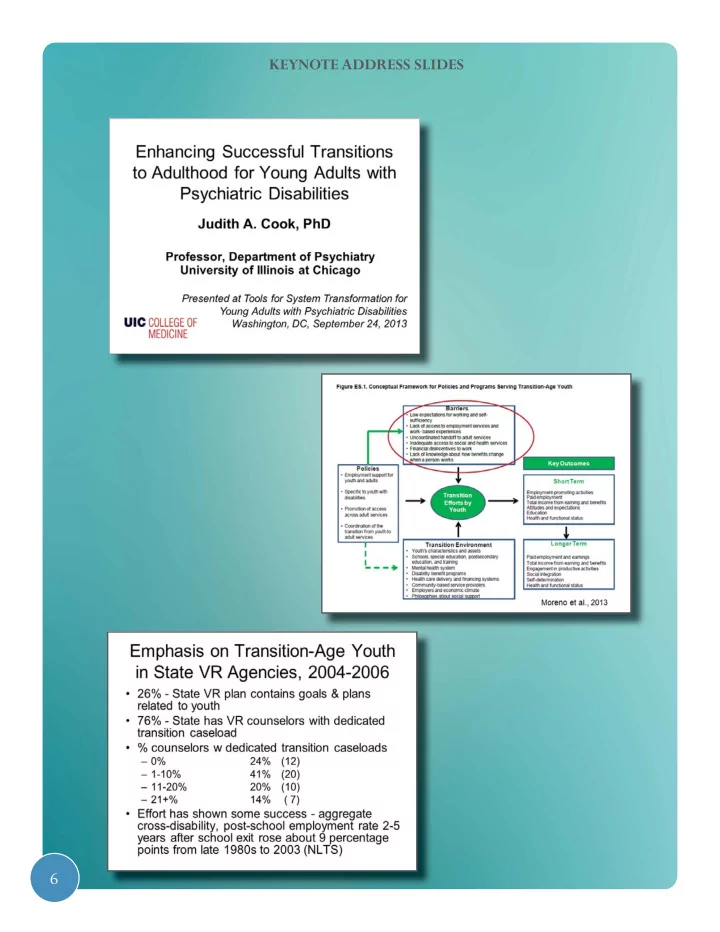
6 KEYNOTE ADDRESS SLIDES 7 KEYNOTE ADDRESS SLIDES 8 KEYNOTE - - PDF document

6
SMART_READER_LITE
LIVE PREVIEW

6 KEYNOTE ADDRESS SLIDES 7 KEYNOTE ADDRESS SLIDES 8 KEYNOTE - - PDF document

KEYNOTE ADDRESS SLIDES 6 KEYNOTE ADDRESS SLIDES 7 KEYNOTE ADDRESS SLIDES 8 KEYNOTE ADDRESS SLIDES 9 KEYNOTE ADDRESS SLIDES 10 KEYNOTE ADDRESS SLIDES 11 KEYNOTE ADDRESS SLIDES Judith Cook Keynote SoS References January 8th 2014 1.


slide-1
SLIDE 1

6

KEYNOTE ADDRESS SLIDES

slide-2
SLIDE 2

7

KEYNOTE ADDRESS SLIDES

slide-3
SLIDE 3

8

KEYNOTE ADDRESS SLIDES

slide-4
SLIDE 4

9

KEYNOTE ADDRESS SLIDES

slide-5
SLIDE 5

10

KEYNOTE ADDRESS SLIDES

slide-6
SLIDE 6

11

KEYNOTE ADDRESS SLIDES

slide-7
SLIDE 7

12

KEYNOTE ADDRESS SLIDES

Judith Cook Keynote SoS References January 8th 2014

  • 1. Ben-Shalom,
  • Y. & Mamun, A.A. (2013). Return-to-

work outcomes among Social Security Disability Insurance Program beneficiaries. Mathematica Policy Research Working Paper, Document No. WP13-20.

  • 2. Ben-Shalom,

Y., Stapleton, D., Phelps, D., Bardos, M. (2012). Longitudinal Statistics for New Supplemental Security Income Beneficiaries, Final Report. Mathematica Reference Number: 08977.933.

  • 3. Berry, H.G. & Caplan, L.J. (2010). Employment and

Earnings Growth Among Transition-Age Supplemental Security Income Program Participants. Journal of Disability Policy Studies, 21(3), 152-159.

  • 4. Bradley, H. & Devadason, R. (2008). Fractured

Transitions: Young Adults Pathways into Contemporary Labour Market. Sociology, 42:1, 119-136.

  • 5. Fuller, S. (2008). Job mobility and wage trajectories for

men and women in the United States. American Sociological Review, 73, 158-183.

  • 6. Goodwin, J. & O’Connor, H. (2005) ‘Exploring

Complex Transitions: Looking Back at the ‘Golden Age’ of From School to Work’, Sociology 39(2): 201-220.

  • 7. Honeycutt, T., Thompkins, A., Bardos, M., Stern, S.

(2013). State Differences in the Vocational Rehabilitation Experiences of Transition-Age Youth with Disabilities. Project #: 40112.305, Mathematica Working Paper WP 2013-02.

  • 8. Loprest, P

. & Wittenburg,D. (2007). Post Transition Experiences of Former Child SSI Recipients. Social Service Review, 4, 583-608.

  • 9. Lockard, C.B. & Wolf, M. (2012). Occupational

employment projections to 2020. Monthly Labor Review, 135(1), 84-108.

  • 10. Marrone, J., & Taylor, S. (2013). Serving youth with

psychiatric disabilities in public vocational rehabilitation. Focal Point: Youth, Young Adults, & Mental Health. Education & Employment, Summer 27(1).

  • 11. Moreno, L., Honeycutt, T., McLeod, S., & Gill, C.

(2013). Lessons for Programs Serving Transition-Age Youth: A Comparative Analysis of the U.S. and 10 Other Countries in the Organization for Economic Co-operation and Development (OECD). Washington, DC: Mathematica Policy Research. Project No. 40112.306.

  • 12. NLTS (On Slide 3) Sanford, C., Newman, L., Wagner,

M., Cameto, R., Knokey, A.-M., and Shaver, D. (2011). The Post-High School Outcomes of Young Adults With Disabilities up to 6 Years After High School. Key Findings From the National Longitudinal Transition Study-2 (NLTS2) (NCSER 2011-3004). Menlo Park, CA: SRI International.

  • 13. Sennett, R. (1998). The corrosion of character: the personal

consequences of work in the new capitalism.W . W . Norton, London, UK.