Particle Filtering Sometimes |X| is too big to use exact inference - - PowerPoint PPT Presentation

particle filtering
SMART_READER_LITE
LIVE PREVIEW

Particle Filtering Sometimes |X| is too big to use exact inference - - PowerPoint PPT Presentation

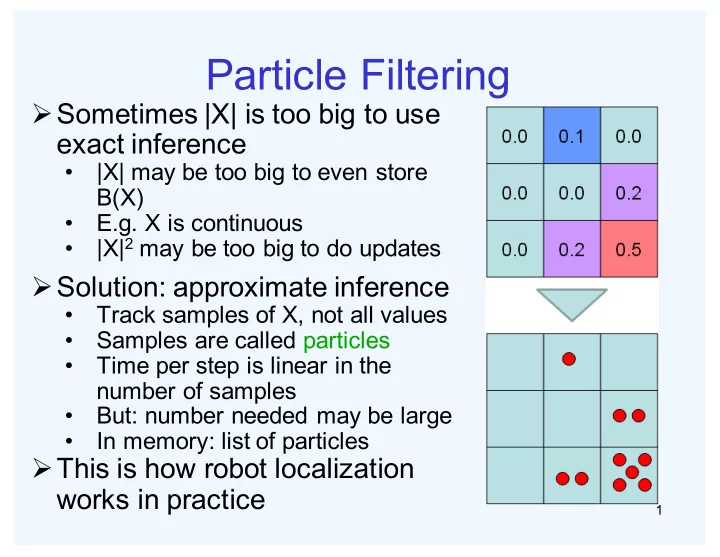
Particle Filtering Sometimes |X| is too big to use exact inference |X| may be too big to even store B(X) E.g. X is continuous |X| 2 may be too big to do updates Solution: approximate inference Track samples of X, not


slide-1
SLIDE 1

Particle Filtering

1

ØSometimes |X| is too big to use exact inference

  • |X| may be too big to even store

B(X)

  • E.g. X is continuous
  • |X|2 may be too big to do updates

ØSolution: approximate inference

  • Track samples of X, not all values
  • Samples are called particles
  • Time per step is linear in the

number of samples

  • But: number needed may be large
  • In memory: list of particles

ØThis is how robot localization works in practice

slide-2
SLIDE 2

ØElapse of time

B’(Xt)=Σxt-1p(Xt|xt-1)B(xt-1) ØObserve B(Xt) ∝p(et|Xt)B’(Xt)

ØRenormalize

B(xt) sum up to 1

2

Forward algorithm vs. particle filtering

Forward algorithm Particle filtering

  • Elapse of time

x--->x’

  • Observe

w(x’)=p(et|x)

  • Resample

resample N particles

slide-3
SLIDE 3

Today

3

ØSpeech recognition

  • A massive HMM!

ØIntroduction to machine learning

slide-4
SLIDE 4

Speech and Language

4

ØSpeech technologies

  • Automatic speech recognition (ASR)
  • Text-to-speech synthesis (TTS)
  • Dialog systems

ØLanguage processing technologies

  • Machine translation
  • Information extraction
  • Web search, question answering
  • Text classification, spam filtering, etc…
slide-5
SLIDE 5

Digitizing Speech

5

slide-6
SLIDE 6

The Input

6

ØSpeech input is an acoustic wave form

Graphs from Simon Arnfield’s web tutorial on speech, sheffield: http://www.psyc.leeds.ac.uk/research/cogn/speech/tutorial/

slide-7
SLIDE 7

7

slide-8
SLIDE 8

The Input

8

ØFrequency gives pitch; amplitude gives volume

  • Sampling at ~8 kHz phone, ~16 kHz mic

ØFourier transform of wave displayed as a spectrogram

  • Darkness indicates energy at each frequency
slide-9
SLIDE 9

Acoustic Feature Sequence

9

ØTime slices are translated into acoustic feature vectors (~39 real numbers per slice) ØThese are the observations, now we need the hidden states X

slide-10
SLIDE 10

State Space

10

Øp(E|X) encodes which acoustic vectors are appropriate for each phoneme (each kind of sound) Øp(X|X’) encodes how sounds can be strung together ØWe will have one state for each sound in each word ØFrom some state x, can only:

  • Stay in the same state (e.g. speaking slowly)
  • Move to the next position in the word
  • At the end of the word, move to the start of the next word

ØWe build a little state graph for each word and chain them together to form our state space X

slide-11
SLIDE 11

HMMs for Speech

11

slide-12
SLIDE 12

Transitions with Bigrams

12

slide-13
SLIDE 13

Decoding

13

ØWhile there are some practical issues, finding the words given the acoustics is an HMM inference problem ØWe want to know which state sequence x1:T is most likely given the evidence e1:T: ØFrom the sequence x, we can simply read off the words

( ) ( )

1: 1:

* 1: 1: 1: 1: 1:

argmax | argmax ,

T T

T T T x T T x

x p x e p x e = =

slide-14
SLIDE 14

Machine Learning

14

ØUp until now: how to reason in a model and how to make optimal decisions ØMachine learning: how to acquire a model on the basis of data / experience

  • Learning parameters (e.g. probabilities)
  • Learning structure (e.g. BN graphs)
  • Learning hidden concepts (e.g. clustering)
slide-15
SLIDE 15

Parameter Estimation

15

ØEstimating the distribution of a random variable ØElicitation: ask a human ØEmpirically: use training data (learning!)

  • E.g.: for each outcome x, look at the empirical rate of

that value:

  • This is the estimate that maximizes the likelihood of the

data

( ) ( )

count total samples

ML

x p x =

( ) ( )

,

i i

L x p x

θ

θ =∏

( )

1 3

ML

p r =

slide-16
SLIDE 16

Estimation: Smoothing

16

ØRelative frequencies are the maximum likelihood estimates (MLEs) ØIn Bayesian statistics, we think of the parameters as just another random variable, with its own distribution

( ) ( )

count total samples

ML

x p x =

( ) ( )

argmax | argmax

ML i i

p X p X

θ θ θ

θ θ = =

( ) ( ) ( ) ( ) ( ) ( )

argmax | argmax | argmax |

MAP

p X p X p p X p X p

θ θ θ

θ θ θ θ θ θ = = =

????

slide-17
SLIDE 17

Estimation: Laplace Smoothing

17

ØLaplace’s estimate:

  • Pretend you saw every outcome
  • nce more than you actually did

( ) ( )

ML LAP

p X p X = =

pLAP x

( ) =

c x

( )+1

c x

( )+1

! " # $

x

= c x

( )+1

N + X

slide-18
SLIDE 18

Estimation: Laplace Smoothing

18

ØLaplace’s estimate (extended):

  • Pretend you saw every outcome

k extra times

  • What’s Laplace with k=0?
  • k is the strength of the prior

ØLaplace for conditionals:

  • Smooth each condition

independently:

( ) ( ) ( )

,0 ,1 ,100 LAP LAP LAP

p X p X p X = = =

( ) ( )

,

=

LAP k

c x k p x N k X + +

( ) ( ) ( )

,

, | =

LAP k

c x y k p x y c y k X + +

slide-19
SLIDE 19

Example: Spam Filter

19

Ø Input: email Ø Output: spam/ham Ø Setup:

  • Get a large collection of

example emails, each labeled “spam” or “ham”

  • Note: someone has to

hand label all this data!

  • Want to learn to predict

labels of new, future emails

Ø Features: the attributes used to make the ham / spam decision

  • Words: FREE!
  • Text patterns: $dd, CAPS
  • Non-text:

senderInContacts

  • ……
slide-20
SLIDE 20

Example: Digit Recognition

20

Ø Input: images / pixel grids Ø Output: a digit 0-9 Ø Setup:

  • Get a large collection of example

images, each labeled with a digit

  • Note: someone has to hand label

all this data!

  • Want to learn to predict labels of

new, future digit images

Ø Features: the attributes used to make the digit decision

  • Pixels: (6,8) = ON
  • Shape patterns:

NumComponents, AspectRation, NumLoops

  • ……
slide-21
SLIDE 21

A Digit Recognizer

21

ØInput: pixel grids ØOutput: a digit 0-9

slide-22
SLIDE 22

Naive Bayes for Digits

22

ØSimple version:

  • One feature Fij for each grid position <i,j>
  • Possible feature values are on / off, based on whether

intensity is more or less than 0.5 in underlying image

  • Each input maps to a feature vector, e.g.
  • Here: lots of features, each is binary valued

ØNaive Bayes model: ØWhat do we need to learn?

→ F

0,0 = 0 F 0,1 = 0 F 0,2 =1 F 0,3 =1 F 0,4 = 0 F 15,15 = 0

p Y | F

0,0F 15,15

( )∝ p Y ( )

p F

i, j |Y

( )

i, j

slide-23
SLIDE 23

General Naive Bayes

23

ØA general naive Bayes model: ØWe only specify how each feature depends on the class ØTotal number of parameters is linear in n

Y × F

n

parameters

p Y,F

1Fn

( ) =

p Y

( )

p F

i |Y

( )

i

Y parameters n × Y × F parameters

slide-24
SLIDE 24

Inference for Naive Bayes

24

ØGoal: compute posterior over causes

  • Step 1: get joint probability of causes and evidence
  • Step 2: get probability of evidence
  • Step 3: renormalize

p Y, f1 fn

( ) =

p y1, f1 fn

( )

p y2, f1 fn

( )

 p yk, f1 fn

( )

! " # # # # # # $ % & & & & & &

p y1

( )

p fi | c1

( )

i

p y2

( )

p fi | c2

( )

i

 p yk

( )

p fi | ck

( )

i

" # $ $ $ $ $ $ $ $ % & ' ' ' ' ' ' ' '

p f

1 f n

( )

p Y | f1 fn

( )

slide-25
SLIDE 25

General Naive Bayes

25

ØWhat do we need in order to use naive Bayes?

  • Inference (you know this part)
  • Start with a bunch of conditionals, p(Y) and the p(Fi|Y) tables
  • Use standard inference to compute p(Y|F1…Fn)
  • Nothing new here
  • Estimates of local conditional probability tables
  • p(Y), the prior over labels
  • p(Fi|Y) for each feature (evidence variable)
  • These probabilities are collectively called the parameters of

the model and denoted by θ

  • Up until now, we assumed these appeared by magic, but…
  • … they typically come from training data: we’ll look at this now
slide-26
SLIDE 26

Examples: CPTs

26

1 0.1 2 0.1 3 0.1 4 0.1 5 0.1 6 0.1 7 0.1 8 0.1 9 0.1 0.1

( )

p Y

( )

3,1

| p F

  • n Y

=

1 0.05 2 0.01 3 0.90 4 0.80 5 0.90 6 0.90 7 0.25 8 0.85 9 0.60 0.80

( )

5,5

| p F

  • n Y

=

1 0.01 2 0.05 3 0.05 4 0.30 5 0.80 6 0.90 7 0.05 8 0.60 9 0.50 0.80

slide-27
SLIDE 27

Important Concepts

27

Ø Data: labeled instances, e.g. emails marked spam/ham

  • Training set
  • Held out set
  • Test set

Ø Features: attribute-value pairs which characterize each x Ø Experimentation cycle

  • Learn parameters (e.g. model probabilities) on training set
  • (Tune hyperparameters on held-out set)
  • Compute accuracy of test set
  • Very important: never “peek” at the test set!

Ø Evaluation

  • Accuracy: fraction of instances predicted correctly

Ø Overfitting and generalization

  • Want a classifier which does well on test data
  • Overfitting: fitting the training data very closely, but not

generalizing well