TDDE25 Integer F 2 Natural Chap 1: Data Storage Types of Numbers - - PowerPoint PPT Presentation

tdde25
SMART_READER_LITE
LIVE PREVIEW

TDDE25 Integer F 2 Natural Chap 1: Data Storage Types of Numbers - - PowerPoint PPT Presentation

Types of Numbers What is a number? Complex Russian Dolls Model Real Rational TDDE25 Integer F 2 Natural Chap 1: Data Storage Types of Numbers Number Systems Representation in Computers https://www.ida.liu.se/~TDDE25/index.en.shtml


slide-1
SLIDE 1

TDDE25

Fö 2 Chap 1: Data Storage Types of Numbers Number Systems Representation in Computers

https://www.ida.liu.se/~TDDE25/index.en.shtml

https://liuonline.sharepoint.com/sites/Lisam_TDDE25_2020HT_FZ

What is a number?

1

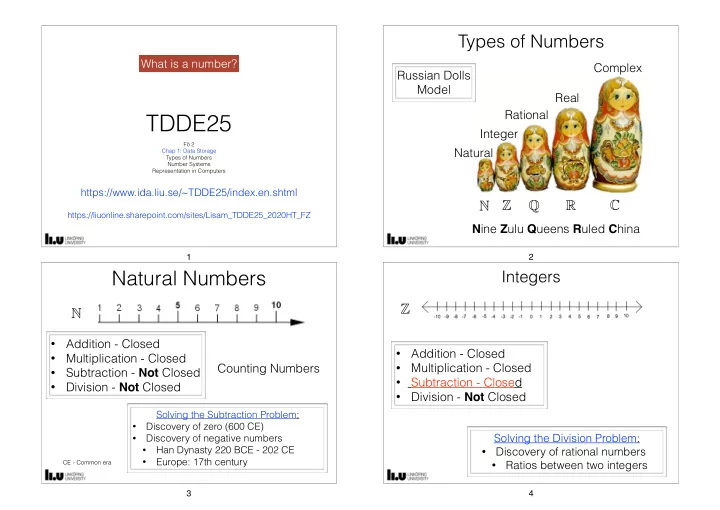
Types of Numbers

Natural Integer Rational Real Complex Russian Dolls Model Nine Zulu Queens Ruled China

N Z Q R C

2

Natural Numbers

  • Addition - Closed
  • Multiplication - Closed
  • Subtraction - Not Closed
  • Division - Not Closed

N

Counting Numbers

Solving the Subtraction Problem:

  • Discovery of zero (600 CE)
  • Discovery of negative numbers
  • Han Dynasty 220 BCE - 202 CE
  • Europe: 17th century

CE - Common era

3

Integers

  • Addition - Closed
  • Multiplication - Closed
  • Subtraction - Closed
  • Division - Not Closed

Solving the Division Problem:

  • Discovery of rational numbers
  • Ratios between two integers

Z

4

slide-2
SLIDE 2

Rational Numbers

  • Addition - Closed
  • Multiplication - Closed
  • Subtraction - Closed
  • Division - Closed

Rational numbers are dense. Between any two of them, you can always find another!

  • Between 0 and 1 there an infinite number of rationals!

Q

Numerator Denominator

Numerator, Denominator are integers The denominator can not be 0

5

Decimal Representation of Fractions

Rational numbers are simple quantities:

  • They can be understood in finite terms;
  • Yet they can be used to represent quantities as

small or as large as we please

Fractions are ultimately periodic: after a certain point the infinite sequence of digits consists of some finite sequence of digits repeated indefinitely!

Decimal Representation

1 3 = 0.333333333 . . . , 29 12 = 2.416666666 . . . , 9 7 = 1.285714285714285 . . . , 237 148 = 1.60135135135 . . .

6

Are the Rational Numbers Adequate?

Since the rationals are dense, do we need any other quantity

  • r can we even fit anything more on the number line?

?

What is the length of the diagonal of the unit square?

c2 = a2 + b2 = 12 + 12 = 1 + 1 = 2

c2 = 2 c = √ 2

Can not be expressed as the ratio of two integers! It is an irrational number!

Q

7

Real Numbers

Real Numbers = Rational Numbers + Irrational Numbers

An irrational number is any number that can not be expressed as a ratio a/b where a and b are integers and b is not equal to 0

√ 2 = 1.4142135623730950488016887 . . .

In decimal notation an irrational number is any number that can not be represented as terminating or or eventually repeating decimals. (Not Ultimately Periodic)

Recall : In decimal notation a rational number is any number that can be represented as terminating or eventually repeating decimals. (Ultimately Periodic)

R

8

slide-3
SLIDE 3

Some Special Real Numbers

Some important irrational numbers in engineering!

π = C

d

π = 3.141592653589793238462643383279 . . . e = 2.7182818284590452353602874713526 . . .

→∞

  • eln(x) = x

ln(ex) = x

Euler’s number

e = 1 + 1

1 + 1 1×2 + 1 1×2×3 + 1 1×2×3×4 + · · ·

× ×

e = limn→∞

  • 1 + 1

n

n

Infinite Process!

Since they are important numbers, we will want to represent them in a computer!

9

Countability

Q R

Dense Continuous

Q R

Countable Uncountable

Continuum Hypothesis (Cantor) - There is no set whose cardinality is strictly between that of the (positive) integers and that of the real numbers.

Are some infinite sets bigger than others? ℕ ⊆ ℚ ⊂ ℝ

10

Number Systems

The base of a system specifies the number of digits used

Numbers are written and manipulated using positional notation.

Base-10: Decimal number system: Digits 0-9

Base-2: Binary number system: Digits: 0-1 Base-8: Octal number system: Digits: 0-7 Base-16: Hexadecimal number system: Digits: 0-9, Letters: A-F

Each position represents a power of 10 11

Number Systems

⊂ ⊂ 7365 = 7 × 10³ + 3 × 10² + 6 × 101 + 5 × 100

Lets generalize from base 10 to any base:

× × × × dn × Bn−1 + dn−1 × Bn−2 + · · · + d2 × B1 + d1

× × · · · × If a number in the base-B number system has n digits, it is represented as the following polynomial, where di represents the digit in the i-th position

7 x 10³ + 3 x 10² + 6 x 101 + 5

7365: n = 4

12

slide-4
SLIDE 4

Binary Number System

× × × × dn × Bn−1 + dn−1 × Bn−2 + · · · + d2 × B1 + d1

Decimal: Base-10:

×

− ×

· · · × dn × 10n−1 + dn−1 × 10n−2 + · · · + d2 × 101 + d1 ⊂ ⊂ 7365 = 7 × 10³ + 3 × 10² + 6 × 101 + 5 × 100

Binary: Base-2:

1101 = 1 × 23 + 1 × 22 + 0 × 21 + 1 × × × dn × 2n−1 + dn−1 × 2n−2 + · · · + d2 × 21 + d1

13

From Binary to Decimal

× × × dn × 2n−1 + dn−1 × 2n−2 + · · · + d2 × 21 + d1

How about from Decimal to Binary?

14

From Decimal to Binary

  • 1. Divide the value by 2 and record the remainder.
  • 2. As long as the quotient obtained is not 0, continue

to divide the newest quotient by two and record the remainder

  • 3. Now that the quotient of 0 has been obtained, the

binary representation of the original value consists

  • f the remainders listed from right to left in the order they were

recorded.

Translate 13 to binary:

Divide by 2 quotient is 6 Continue Record the remainder Divide by 2 quotient is 3 Continue Record the remainder Record the remainder Divide by 2 quotient is 1 Continue Divide by 2 quotient is 0 Stop Record the remainder

13 =

15

Hexadecimal System

× × × × dn × Bn−1 + dn−1 × Bn−2 + · · · + d2 × B1 + d1

Hexadecimal Base-16:

×

− ×

· · · × dn × 16n−1 + dn−1 × 16n−2 + · · · + d2 × 161 + d1

0 0 0000 1 1 0001 2 2 0010 3 3 0011 4 4 0100 5 5 0101 6 6 0110 7 7 0111 8 8 1000 9 9 1001 A 10 1010 B 11 1011 C 12 1100 D 13 1101 E 14 1110 F 15 1111 Hex! Decimal! Binary!

  • Since there are only 10 decimal digits but the

base is 16, we need additional digits: A,B,C,D,E,F

  • Hexadecimal is shorthand notation for long

patterns of bits.

  • Each group of 4 bits can be represented by a

single symbol.

  • 8 bits: 2 digits, 16 bits: 4 digits, 32 bits, 8 digits

10100011 becomes A3 A 3

2 + 1 8 + 2

16

slide-5
SLIDE 5

Some Examples

What is 11000011 in hexadecimal notation? What is 11111101 in hexadecimal notation? C 3 F D What is E6 in decimal notation? 1110 0110 E*161 + 6*160 = 230 14*161 + 6*160 = 230

0 0 0000 1 1 0001 2 2 0010 3 3 0011 4 4 0100 5 5 0101 6 6 0110 7 7 0111 8 8 1000 9 9 1001 A 10 1010 B 11 1011 C 12 1100 D 13 1101 E 14 1110 F 15 1111 Hex! Decimal! Binary!

27 + 26 + 25 + 22 + 21 = 230

17

Information Storage and Processing

Goal: To understand how all modern computing systems and computation using such systems are based on binary numbers and operations on them! Computers execute binary computations. Any information we process is ultimately encoded and stored as binary numbers!

Images Video Sound Symbols Text

Any process on data is ultimately encoded and stored as binary numbers!

18

BITS - Binary Digits

Information in a computer is encoded as patterns of 1’s and 0’s.

Information = Bits + Context

The context provides an interpretation of the bit patterns! The same bit pattern can mean different things.

For instance, a numerical value, character or a program instruction!

Logical Computations 1= true 0= false And, Or Not

Context: Logic

Numerical Computations

Addition, Subtraction Multiplication, Division

1

Context: Numbers

19

BITS and BYTES

Byte = 8 bits

Binary 000000002 to 111111112 Decimal: 010 to 25510 Hexadecimal 0016 to FF16

Most computers use blocks of 8 bits, or bytes, as the smallest addressable unit of memory

0 0 0000 1 1 0001 2 2 0010 3 3 0011 4 4 0100 5 5 0101 6 6 0110 7 7 0111 8 8 1000 9 9 1001 A 10 1010 B 11 1011 C 12 1100 D 13 1101 E 14 1110 F 15 1111 Hex! Decimal! Binary!

20

slide-6
SLIDE 6

Memory: Use Metric Prefixes

What is a Googol?

1080

What is a current estimate of atoms in the “observable” universe?

10100

21

Bytes and Words

  • Nominal size of integer-values data
  • Including addresses
  • Many recently current machines use 32 bits (4 byte words)
  • Limits addresses to 4GB
  • Becoming too small for memory intensive applications
  • A majority of current machines (previously high-end systems) use 64 bits (8 byte

words)

  • Potential address space

bytes

  • INTEL x86-64 machines support 48-bit addresses (256TB)
  • Core i7 supports 48-bit virtual address space/ 52-bit physical address space (4PB)
  • Machines support multiple data formats
  • Fractions or multiples of word size
  • Always integral number of bytes

≈ 1.8 𝗒 1019

A Machine has “Word Size”

22

Storage: Main Memory

Memory Cell: is a unit of memory (usually a byte), organized in a bit order: Virtual Memory: Programs refer to virtual addresses

  • Conceptually, it is a very large array of bytes.
  • System is actually implemented with a hierarchy of different memory types.

Address: A “name” that uniquely identifies one cell in the computer’s main memory

  • The names are actually numbers.
  • These numbers are assigned consecutively starting at zero.
  • Numbering the cells in this manner associates an order with the memory cells
  • • •!

00•••0 FF•••F

Byte Oriented Memory Organization

23

Word Oriented Memory Organisation

! Addresses&Specify&Byte&

Loca2ons&

! Address&of&first&byte&in&word& ! Addresses&of&successive&words&differ&

by&4&(328bit)&or&8&(648bit)& 0000 0001 0002 0003 0004 0005 0006 0007 0008 0009 0010 0011 32-bit! Words! Bytes! Addr.! 0012 0013 0014 0015 64-bit! Words!

Addr ! =! ?? Addr ! =! ?? Addr ! =! ?? Addr ! =! ?? Addr ! =! ?? Addr ! =! ?? 0000 0004 0008 0012 0000 0008

Number of Bytes

32 bit words 32 bit words 32 bit words 32 bit words 64 bit words 64 bit words

24

slide-7
SLIDE 7

Measuring Memory Capacity

  • Kilobyte: 210 bytes = 1024 bytes

– Example: 3 KB = 3 times1024 bytes

  • Megabyte: 220 bytes = 1,048,576 bytes

– Example: 3 MB = 3 times 1,048,576 bytes

  • Gigabyte: 230 bytes = 1,073,741,824 bytes

– Example: 3 GB = 3 times 1,073,741,824 bytes

My MacBook Pro: 16GB of main memory 750GB of secondary memory (flash disk)

25

Representing Unsigned Integers in Computers

B2U(X) = xi ⋅2 i

i=0 w−1

[0001]! [0101]! [1011]! [1111]!

0! 1! 2! 3! 4! 5! 6! 7! 8! 9! 10! 11!12!13!14!15!16!

23 = 8! 22 = 4! 21 = 2! 20 = 1!

Unsigned Integers

BinaryToUnsigned

×

− ×

· · · × B2U(0001) = 0 × 23 + 0 × 22 + +0 × 21 + 1 = 0 + 0 + 0 + 1 = 1 B2U(0101) = 0 × 23 + 1 × 22 + +0 × 21 + 1 = 0 + 4 + 0 + 1 = 5 B2U(1011) = 1 × 23 + 0 × 22 + +1 × 21 + 1 = 8 + 0 + 2 + 1 = 11 B2U(1111) = 1 × 23 + 1 × 22 + +1 × 21 + 1 = 8 + 4 + 2 + 1 = 15

w= # of bits UMin = 0

000…0

UMax = 2w – 1

111…1

Numeric Range

w=4

26

Representing Unsigned Integers in various Machine Memory

Decimal: !15213 Binary: 0011 1011 0110 1101 Hex: 3 B 6 D

long int C = 15213;

00 00 00 00 6D 3B 00 00 x86-64! 3B 6D 00 00 Sun! 6D 3B 00 00 IA32!

! Big$Endian$

! Least&significant&byte&has&highest&address&

! Li*le$Endian$

! Least&significant&byte&has&lowest&address&

! Example$

! Variable&x&has&47byte&representa9on&0x01234567& ! Address&given&by&&x&is&0x100& Byte Byte Byte Byte

Big Endian Little Endian

0x100 0x101 0x102 0x103

01 23 45 67

0x100 0x101 0x102 0x103

67 45 23 01 Big Endian! Little Endian! 01 23 45 67 67 45 23 01

27

Representing Signed Integers in Computers

X" B2T(X)& B2U(X)& 0000" 0" 0001" 1" 0010" 2" 0011" 3" 0100" 4" 0101" 5" 0110" 6" 0111" 7" –8" 8" –7" 9" –6" 10" –5" 11" –4" 12" –3" 13" –2" 14" –1" 15" 1000" 1001" 1010" 1011" 1100" 1101" 1110" 1111" 0" 1" 2" 3" 4" 5" 6" 7"

Given 4 bits of memory, we can represent 24 unsigned numbers (24 - 1 if 0 is not included) Suppose we wanted to represent both positive and negative numbers in memory……. Signed numbers

We would need to find an efficient mapping between

  • ur binary numbers and roughly

positive numbers and negative numbers

24/2 24/2 Let’s do that!

28

slide-8
SLIDE 8

Encoding -6 Two’s Complement Notation using 4 bits

Start with the binary representation of 6 29

Two’s Complement Examples

X" B2T(X)& B2U(X)& 0000" 0" 0001" 1" 0010" 2" 0011" 3" 0100" 4" 0101" 5" 0110" 6" 0111" 7" –8" 8" –7" 9" –6" 10" –5" 11" –4" 12" –3" 13" –2" 14" –1" 15" 1000" 1001" 1010" 1011" 1100" 1101" 1110" 1111" 0" 1" 2" 3" 4" 5" 6" 7"

Comparison with Unsigned

Negative numbers always have a 1 in the most significant digit

30

Representing Signed Integers in Computers

Two’s Complement Encoding

B2T(X) = −xw−1 ⋅2w−1 + xi ⋅2i

i=0 w−2

Sign Bit

[0001]! [0101]! [1011]! [1111]!

0! 1! 2! 3! 4! 5! 6! 7! 8!

– 23 = –8! 22 = 4! 21 = 2! 20 = 1!

–8!–7!–6!–5!–4!–3!–2!–1!

× × × B2T(0001) = −0 × 23 + 0 × 22 + +0 × 21 + 1 = 0 + 0 + 0 + 1 = 1 B2T(0101) = 0 × 23 + 1 × 22 + +0 × 21 + 1 = 0 + 4 + 0 + 1 = 5 B2T(1011) = −1 × 23 + 0 × 22 + +1 × 21 + 1 = −8 + 0 + 2 + 1 = −5 B2T(1111) = −1 × 23 + 1 × 22 + +1 × 21 + 1 = −8 + 4 + 2 + 1 = −1

1 = negative Int 0 = positive Int TMin = –2w–1 100…0 TMax = 2w–1 – 1 011…1

Numeric Range

Half of

  • 1

2w

w=4

31

Representing Signed Integers in various Machine Memory

6D 3B 00 00 IA32, x86-64! 3B 6D 00 00 Sun!

int A = 15213;

93 C4 FF FF IA32, x86-64! C4 93 FF FF Sun!

int B = -15213;

Two’s Complement Representation

long int C = 15213;

00 00 00 00 6D 3B 00 00 x86-64! 3B 6D 00 00 Sun! 6D 3B 00 00 IA32! Decimal: !15213 Binary: 0011 1011 0110 1101 Hex: 3 B 6 D Decimal: !-15213 Binary: 1111 1111 1111 1111 1100 0100 1001 0011 Hex: F F F F C 4 9 3

Little Endian Big Endian

32

slide-9
SLIDE 9

Addition & Subtraction converted to Two’s Complement

For addition:

  • Same algorithm as for

binary addition.

  • any extra carry bit

generated on the left is truncated.

  • addition of any

combination of signed integers uses the same algorithm and circuitry!

The Payoff!

For subtraction:

  • negate the number subtracted

and then add both together.

  • subtraction of any combination
  • f signed integers uses the

same algorithm and circuitry for addition plus an additional circuit for negation of an integer!

Example: 7 - 5

33

Numeric Ranges of Integer Representations

Unsigned Values UMin = 0

000…0

UMax = 2w – 1

111…1

! W" ! 8" 16" 32" 64" UMax" 255! 65,535! 4,294,967,295! 18,446,744,073,709,551,615! TMax" 127! 32,767! 2,147,483,647! 9,223,372,036,854,775,807! TMin"

  • 128!
  • 32,768!
  • 2,147,483,648!
  • 9,223,372,036,854,775,808!

! !

Two’s Complement Values TMin = –2w–1

100…0

TMax = 2w–1 – 1

011…1

For Different Word Sizes

[Bits]

Half

34

Representing Signed Integers in Excess Notation

  • Select pattern length to be used

4

  • Write down all different patterns

in the order they would appear if counting from bottom up.

  • Pick the 1st pattern with 1 as

most significant bit to represent 0

  • Patterns preceding 0 are used

for -1, -2, -3 ...

  • Patterns proceeding 0 are used

for 1, 2, 3, ...

If the pattern length is x, the difference between the bit pattern value and the value represented is 2x-1 x=4, excess-8 notation, x= 5, excess-16 notation

1111 = 15 : 15 − 7 = 8 = 23

35

Representing Fractions (Rational Numbers)

Radix Point

2i# 2i$1# 4# 2# 1# 1/2# 1/4# 1/8#

2$j#

bi# bi$1# •••# b2# b1# b0# b$1# b$2# b$3# •••# b$j#

  • • •!

! Representa6on#

! Bits#to#right#of#“binary#point”#represent#frac6onal#powers#of#2# ! Represents#ra6onal#number:#

  • • •!

36

slide-10
SLIDE 10

Division & Multiplication

Radix Point

Shifting the radix point 1 position to the left has the effect of dividing the number by 2. Shifting the radix point 1 position to the right has the effect of multiplying the number by 2.

101.11 = 5 3/4 10.111 = 2 7/8 1011.1 = 11 1/2

Shifting the decimal point 1 position to the left has the effect of dividing the number by 10. Shifting the decimal point 1 position to the right has the effect of multiplying the number by 10.

145.238 14.5238 1452.38

Base-10 Base-2

Decimal Point

37

Representable Numbers

! Limita&on)

! Can)only)exactly)represent)numbers)of)the)form)x/2k) ! Other)ra&onal)numbers)have)repea&ng)bit)representa&ons)

! Value

)Representa&on)

! 1/3

)0.0101010101[01]…2

! 1/5

)0.001100110011[0011]…2

! 1/10

)0.0001100110011[0011]…2

Assuming finite length encodings:

Can approximate with increasing accuracy by lengthening the binary representation

So, we must eventually truncate!

38

Floating Point Representation

Representing a real value in a computer:

  • The sign - positive or negative
  • The mantissa - consists of digits in the value with the radix

point assumed to the left

  • The exponent - which determines how the radix point is

shifted relative to the mantissa (can be positive or negative)

The representation is called floating point because the number of digits is fixed but the radix point floats.

  • a positive exponent shifts the radix point to the right
  • a negative exponent shifts the radix point to the left

Let’s Assume an 8-bit fixed representation (usually much larger 64 bits):

  • sign: 1 bit,
  • exponent: 11 bits,
  • mantissa: 52 bits

39

Decoding the value 01101011

1 1 0 1 11

Exponent encoded in excess-4

1 1 1 .

Extract Mantissa

1 1 0

Extract Exponent Interpret in excess-4

2

1 1 1 .

Move radix point to the right 2

2+0+1/2+1/4 = 2 3/4

Translate to decimal form Check sign bit 0 is positive 1 is negative

+ 2 3/4

2.75

40

slide-11
SLIDE 11

Decoding the value 00111100

1 0 1 1 1 0 0

Exponent encoded in excess-4

1 1 0 0 .

Extract Mantissa

0 1 1

Extract Exponent Interpret in excess-4

  • 1

0/2+1/4+1/8 = 3/8

Translate to decimal form Check sign bit 0 is positive 1 is negative

+ 3/8

1 0 0 1

Move radix point to the left 1

.

0.375

41

Encoding the value 1 1/8 (1.125)

Exponent encoded in excess-4

. 0 1 1

Encode the number in binary notation Encode sign bit 0 is positive 1 is negative Copy the pattern into the mantissa (left to right)

Starting with leftmost 1

1 0 1 1 0 1 1 0 1 .

Imagine the radix point to the left of the mantissa value

Determine direction and length to move radix point to recover the original binary number

1 to the right (+1)

1 0 1

Encode in exponent field using excess notation

1 0 1

42

Truncation Errors: Encoding the value 2 5/8 (2.625)

Exponent encoded in excess-4

Encode sign bit 0 is positive 1 is negative

1 1 0 .

Imagine the radix point to the left of the mantissa value

Determine direction and length to move radix point to recover the

  • riginal binary number

2 to the right (+1)

1 1 0

Encode in exponent field using excess notation

1 1 0 1 . 0 1

Encode the number in binary notation

1

2+1/2+1/8=2 5/8

Copy the pattern into the mantissa (left to right)

Starting with leftmost 1

1 1 0 1 1 0

Must truncate the rightmost 1 (1/8)

Result: 01101010 = 2 1/2 Truncation or Rounding error!

43

Truncation Errors

Can cause significant problems in applications requiring high precision! There are many more repeating decimal numbers in binary than in decimal notation. Example: 1/10 Arithmetic with accumulated rounding errors can be problematic: 8 bit representation: 2 1/2 + 1/8 + 1/8 is not the same as 1/8 + 1/8 + 2 1/2 !!

Topic: Numerical Analysis 44

slide-12
SLIDE 12

Worrying about precision

! Single'precision:'32'bits' ! Double'precision:'64'bits' ! Extended'precision:'80'bits'(Intel'only)'

s exp frac 1 8-bits 23-bits s exp frac 1 11-bits 52-bits s exp frac 1 15-bits 63 or 64-bits

to

Precision: 7 decimal digits

10−37 1038

Single Precision

  • Encodes very small real numbers

and very large real numbers

  • very accurate precision to 7

decimals...

45

IEEE Floating Point Standard

! IEEE#Standard#754#

! Established#in#1985#as#uniform#standard#for#floa;ng#point#arithme;c#

! Before#that,#many#idiosyncra;c#formats#

! Supported#by#all#major#CPUs#

! Driven#by#numerical#concerns#

! Nice#standards#for#rounding,#overflow,#underflow# ! Hard#to#make#fast#in#hardware#

! Numerical#analysts#predominated#over#hardware#designers#in#defining#

standard#

46

The High Cost of Floating Point Overflow!

Sadly, the primary cause was found to be a piece of software which had been retained from the previous launcher’s systems and which was not required during the flight of Ariane 5. The software was used in the Inertial Reference System (SRI) to calculate the attitude of the

  • launcher. In Ariane 4, this software was allowed to continue functioning during the first 50

seconds of flight as it could otherwise delay launching if the countdown was halted for any

  • ther reason, this was not necessary for Ariane 5. Additionally, the software contained implicit

assumptions about the parameters, in particular the horizontal velocity that was safe for Ariane 4, but not Ariane 5. The failure occurred because the horizontal velocity exceeded the maximum value for a 16 bit unsigned integer when it was converted from it's signed 64 bit representation. This failure generated an exception in the code which was not caught and thus propagated up through the processor and ultimately caused the SRI to fail. The failure triggered the automatic fail-

  • ver to the backup SRI which had already failed for the same reason. This combined failure

was then communicated to the main computer responsible for controlling the jets of the rocket, however, this information was misinterpreted as valid commands. As a result of the invalid commands, the engine nozzles were swung to an extreme position and the launcher was destroyed shortly afterwards. Ariane 5 was designed by the European Space Agency (ESA) as a replacement for the successful Ariane 4 launcher. The intention was to create a reliable, high capacity, launch vehicle for ESA that could be used to support their contribution to the International Space Station as well as a range of other commercial and scientific launches. On June 4, 1996, the US$500 million space craft was launched for the first time

47