Paolo Privitera (Photo image: particle tracks in a DAMIC CCD ) - - PowerPoint PPT Presentation

paolo privitera photo image particle tracks in a damic
SMART_READER_LITE
LIVE PREVIEW

Paolo Privitera (Photo image: particle tracks in a DAMIC CCD ) - - PowerPoint PPT Presentation

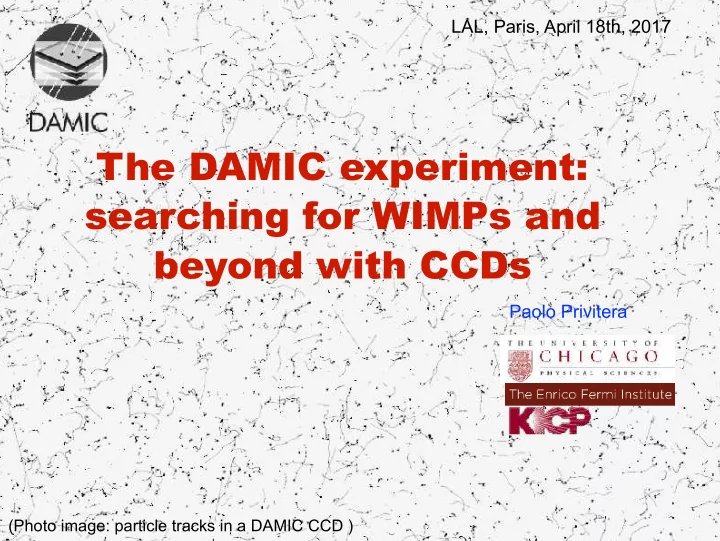
LAL, Paris, April 18th, 2017 The DAMIC experiment: searching for WIMPs and beyond with CCDs Paolo Privitera (Photo image: particle tracks in a DAMIC CCD ) Dark Matter WIMPs 101 1) Mass and energy in the Universe DM 0.3


slide-1
SLIDE 1

Paolo Privitera

The DAMIC experiment: searching for WIMPs and beyond with CCDs

LAL, Paris, April 18th, 2017

(Photo image: particle tracks in a DAMIC CCD )
slide-2
SLIDE 2

Dark Matter WIMPs 101 


1)

Astrophysical evidence for DM: Galaxy rotation curve, lensing , CMB Mass and energy in the Universe

ρDM ≈ 0.3 GeV/cm3 2) WIMP “miracle”:

a Weakly Interacting Massive Particle in thermal equilibrium with SM particles in the early universe. To give the

  • bserved DM density, interactions and

masses must be close to weak-scale <𝛕 v> ≈ 3x10-26 cm3/s ≈ 1 / (20 TeV)2

freeze-out

slide-3
SLIDE 3

3)

5) Coherent elastic scattering

Milky Way motion

4) WIMP kinetic energy in the

Earth (detector) frame ½ mχ vo

2 ≈ 30 keV

(mχ = 100 GeV ) Low energy interaction with matter

WIMP nucleus mχ mN Detection of nucleus recoil WIMP escapes detector (weakly interacting) vo vR ER

λχ ≈ 10 F

6)

Eχ Eχ Silicon

vo ≈ 10-3 c

slide-4
SLIDE 4

4

Experimental challenges

Cryostat support in the Veto water tank

Xenon 1T

Cryostat

  • Massive target-detector
  • Ultra-pure target (radioactive contaminants)
  • Low energy threshold (tens of keV vs MeV in neutrino physics)
  • Low background (deep underground; material screening and

selection)

slide-5
SLIDE 5

5

7)

ER Nuclear recoil ionization efficiency (quenching factor)

Edet

Ee

Edet

e R

electron Nucleus recoil

Take a nucleus and an electron of the same energy (ER = Ee). In general, Edet < Edet (the nucleus dissipates its energy through mechanisms other than ionization) “Lindhard theory”

R e

Xe

For a given detector (“electron”) energy threshold, the nuclear recoil energy threshold depends on the QF. Essential to measure.

slide-6
SLIDE 6

WIMP exclusion plot

6

mχ ≈ mN

Detector energy threshold, resolution and QF

ER ≈ Eχ•r

r =

Eχ= 0.5 mχ v2 ER≈ 0.5 mN v2

slide-7
SLIDE 7

7 > Tons mass – Xenon Kg mass – low threshold

Next generation WIMP frontier

slide-8
SLIDE 8

8

Beyond the WIMP paradigm

A’ 𝛿

𝜗

  • “Dark QED” models

kinetically mixed hidden photon A’

, p , p

  • A rich, unexplored DM phenomenology :

A’ massive or light, 𝜓 (elastic) scalar, Dirac fermion; (inelastic) scalar, Majorana fermion ≈

x kinematic terms

ER = ½ mχ vo

(+ quenching factor)

2

≈ 1 keVnr mχ ≈ few GeV

  • Nuclear recoils
  • Electron recoils:

the e- (not 𝜓) sets the typical momentum transfer vo

(outer shell electron) (does not depend on mχ , can explore MeV DM masses!)

slide-9
SLIDE 9

9

light A’ ( mA’ ≈ mχ ) ultra-light A’

freeze-in from thermal SM bath

slide-10
SLIDE 10

10

Charge-Coupled-Devices

250 µm thick CCDs with enhanced IR sensitivity developed at LBNL Dark Energy Survey Camera NA32 CERN 1984-86

slide-11
SLIDE 11

11

DAMIC enabled by

slide-12
SLIDE 12

How a CCD works


p-type Si n-type Si (buried channel) Si oxide (insulator) Metal gate Metal-Oxide-Semiconductor capacitor

+V

  • -
  • +

+ +

  • -
  • electron-hole pairs

generated by a photon

  • r ionizing particle

(3.6 eVee / e-hole pair)

A CCD is an array of MOS capacitors

slide-13
SLIDE 13

1 2 3 1 2 3 1 2 3 1 2 3

Output amplifier

Charge motion serial register Charge motion

“vertical clocks” “horizontal clocks” (faster)

Charge transfer

1 2 3

CCD in action

slide-14
SLIDE 14

time

Correlated Double Sampling (CDS)

CCD pixel charge readout

V pixel

Reset pulse (inject noise charge) Summing well pulse (inject pixel charge)

pedestal signal

(signal – pedestal) cancels the reset noise (and also other correlated noise) Performed analogically in standard CCD readouts

10-100 µs

slide-15
SLIDE 15

1) High-resistivity (1011 donors/cm3) extremely pure silicon

15

2) Fully-depleted over several 100s µm (typical CCDs few tens of µm)

Float-zone Si

Why Dark Matter in CCDs ?

  • Detection of point-like

energy deposits from nuclear recoils induced by WIMP interactions (10 keV Si ion range 200 A)

slide-16
SLIDE 16

16

CCD Wire bonds Clocks, Bias, and Signal cable Copper frame 6 cm 3) Sizable mass a DAMIC CCD 6 cm x 6 cm, 16 Mpixel (15 µm x 15 µm) has a record thickness of 675 µm and 5.9 g mass 2k x 4k

First DAMIC CCDs from DECam!

DAMIC100 currently taking data at the SNOLAB underground laboratory

slide-17
SLIDE 17

17 blank (taken after exposure) exposure

  • Very long exposures (8 hours!) to

minimize the n. of noise pixels above the energy threshold 4) Unprecedented low energy threshold

  • Lower threshold, higher WIMP

recoil rate (exponential),

  • small mass detector competitive
  • Negligible noise contribution from dark current fluctuations (dark current < 0.001 e/

pixel/day with CCD cooled at 120 K). Readout noise dominant contribution.

  • A readout noise of ≈ 2 e- is

achieved by slow CCD readout (≈ 10 min / 16 Mpix image).

3.6 eV to produce 1 e-hole pair 1.2 eV band gap SNOLAB data

slide-18
SLIDE 18

18

5) Unique spatial resolution: 3D position reconstruction and particle ID The charge diffuses towards the CCD pixels gates, producing a “diffusion- limited” cluster σ ≈ Z : fiducial volume definition and surface event rejection

single muon track

a muon piercing a 675 µm thick DAMIC CCD

X-rays from

55Fe

slide-19
SLIDE 19

19

  • “Worms” straggling

electrons

  • Straight tracks: minimum

ionizing particles

  • MeV charge blobs:

alphas

  • Diffusion-limited clusters:

low-energy X-rays, nuclear recoils

  • CCD spatial resolution

provides a unique handle to the understanding of the background

slide-20
SLIDE 20

SNOLAB

20

BBC documentary, Dancing in the Dark: the end of Physics

Creighton Mine #9

Sudbury, Canada Nickel-Copper active mine

in the cage, dropping at 50 km/h

  • ut for a nice walk…

2 km underground

slide-21
SLIDE 21

21

Abandon all hope, ye who enter here Inferno, Canto III, Dante

slide-22
SLIDE 22

22 entering the lab get ready for a shower nice dress! coffee……

slide-23
SLIDE 23

23

DAMIC R&D program in the J-Drift hall started in early 2013

DAMIC at SNOLAB

CAB, FIUNA, Fermilab, LPNHE, SNOLAB, U Chicago, U Michigan, U Zürich, UFRJ, UNAM

slide-24
SLIDE 24

24

DAMIC @ SNOLAB

slide-25
SLIDE 25

Response to electrons

Al Si O σ ≈ 21 eV Energy loss in gates and SiO2 < 2 µm / 675 µm Tritium

]

ee

Ionization signal [keV

1 −

10 1 10 )

ee

k( E) / k( 5. 9 keV 0.96 0.98 1 1.02 1.04 1.06 1.08 X-rays Optical photons

Linearity demonstrated for signals <10 e-

slide-26
SLIDE 26

57Co source

122 keV 136 keV

photo-electric absorption

Single-scatter Compton spectrum

39.5 keV 47.5 keV

Compton edges

Very large dynamic range

Fluorescence

Gamma-rays

Si K-shell Si L-shell

slide-27
SLIDE 27

Nuclear recoil calibration

UChicago

24 keV neutrons from 9Be(γ,n) reaction

3 GeV WIMP Sb-Be MCNP simulation

Ee ≈ 0.2 Er (Lindhard)

slide-28
SLIDE 28

Nuclear recoil spectrum

  • “Neutron-on” with BeO (n+γ)

“neutron-off” with Al (only γ) Clear signal from neutron- induced nuclear recoils

60 eVee

  • Nuclear recoil ionization

efficiency from adjusting MC Er to Ee spectrum

  • single recoil spectrum
  • systematic uncertainties

are small, dominated by 9% uncertainty on total predicted rate

bkg-subtracted

3.2 keVr

slide-29
SLIDE 29

Nuclear-recoil ionization efficiency in silicon

deviation from Lindhard theory observed – crucial for low-mass WIMP searches with silicon detectors

slide-30
SLIDE 30

Background, background, background

  • Lead shielding to stop

environmental γ rays Inner 2” shielding made of ancient lead to avoid bremmstrahlung γs from 210Pb β-decay (22 yrs half-life)

Spanish galleon (Chicago) Roman ship (Modane, France)

  • Material selection and

cleaning: copper machining, “secret” recipe etching (surface bkg)

50 Bq/kg <0.02 Bq/kg

Radioactive!

slide-31
SLIDE 31

Background tour-de-force

  • Since 2013 background reduced by >103
  • ≈ 5 dru achieved before DAMIC100 installation (similar to competitors)

In the last year:

  • Seven interventions at

SNOLAB.

  • Nitrogen purge

installation (Radon).

  • Improvements in

treatment of copper surfaces.

  • Suppression of

background from thermal neutron captures in copper.

  • Mitigation of

background from condensation e.g. 3H.

  • Background rate may be smaller in

DAMIC100: new CCD box and packages, roman lead

slide-32
SLIDE 32

DAMIC background characterization

32

6050 6052 6054 6056 6058 6060 6062 6064 6066 488 490 492 494 496 498 500 502 504 500 100 150 200 250 300 350 400 450 500

RUNID= 345, EXTID= 6, cluster_id= 1801

6050 6052 60546056 6058 6060 6062 60646066 488 490 492 494 496 498 500 502 504 50 10 15 20 25 30 35 40 45 50

RUNID= 490, EXTID= 6, cluster_id= 1345

6048605060526054605660586060606260646066 488 490 492 494 496 498 500 502 504 506 500 100 150 200 250 300 350 400 450 500

RUNID= 491, EXTID= 6, cluster_id= 1388

E = 5.4 MeV E = 6.8 MeV E = 8.8 MeV 1 2 3 1 2 3 Δt = 17.8 d Δt = 5.5 h Three α at the same location! α + β

Bragg peak

Powerful method to measure U/Th bkg in the bulk – ppt limits

Not seen

Example

  • f

2015 JINST 10 P08014

slide-33
SLIDE 33

Dark Matter search with R&D data

  • R&D focused on background reduction and CCD operation.
  • We also took a small amount of data to be used for a first limit.

Background ≈ 30 dru (now 5 dru!). Exposure ≈ 0.6 kg day. Goal: develop search tools and demonstrate CCD science potential

  • Part of exposure (0.23 kg day) taken with hardware binning

1x1 3x3 α-β events

charge of several pixels can be added together before moving it to the readout node some loss of spatial resolution but improved signal to noise (same readout noise but more charge in a binned pixel)

55Fe source:

improved energy resolution

slide-34
SLIDE 34

Dark Matter search with R&D data

Measure E and σxy for every cluster event.

Spectrum consistent with Compton scattered electrons in fiducial region: No WIMP signal

slide-35
SLIDE 35

Exclusion limit

slide-36
SLIDE 36

Hidden photon DM search

hidden photon absorption would produce mV / 3.6 eV charge carriers in silicon: HP sensitivity in the charge distribution

  • nly readout

noise in the

  • verscan rows

readout noise + leakage current + Hidden Photon NOTE: 1x100 binning

mV

slide-37
SLIDE 37

Hidden photon limit

PRL 118, 141803

1 week of data of 1 CCD

kinetic mixing parameter

Lowest leakage current ever achieved in a Si detector 10-21 A/cm2 !

slide-38
SLIDE 38

38

DAMIC now

  • Already achieved radioactive background (5 dru) and a low

threshold (≈10 e-) performance.

  • Stack of 16 Mpixel CCDs: DAMIC100 in current SNOLAB

vacuum vessel and shielding.

  • Installation took place in January, results with ≈ 10 kg day of data

expected in 2017.

  • Ongoing R&D for thicker, larger-area CCDs for a lower-noise,

lower-background kg-size detector.

  • A kg-size experiment with 0.1 dru background and ≤ 2e- threshold

DAMIC-1K

  • To lead the exploration of WIMPs and dark sector candidates in the

low-mass DM parameter space

slide-39
SLIDE 39

39

DAMIC-1K and WIMPs

WIMP mass [GeV c-2] WIMP-nucleon σ [cm2] D A M I C ( 2 1 6 ) DAMIC-1K Nth = 2 e- DAMIC-1K

(taking same assumptions of SuperCDMS)

SuperCDMS-HV Si forecast

(arXiv:1610.00006v1)

Nth = 0.2 e-

DAMIC-1K not limited by 32Si bkg.

slide-40
SLIDE 40

40

DAMIC-1K and dark sector

slide-41
SLIDE 41

41

DAMIC-1K and dark sector

Complementary to accelerator searches!

slide-42
SLIDE 42

42

DAMIC-1K and dark sector

hidden photon DM

slide-43
SLIDE 43

DAMIC-1K technical challenges

  • A kg-size DAMIC can be built with the existing technology

Silicon wafer

6k x 6k pixels, 1 mm thick ≈ 20 g / CCD ≈ 50 CCDs / 1 Kg

DAMIC100 4k x 4k

DALSA has confirmed the feasibility fabrication of these larger and thicker CCDs

  • Background

from a few dru to a fraction of dru. external bkg.: improved design, materials (e.g. electroformed copper), strict procedures (silicon storage underground, radon, surface contamination) internal bkg.: cosmogenic 32Si (in the amosphere) and tritium (in the silicon)

DAMIC-1K vessel at PNNL

slide-44
SLIDE 44

44

DAMIC-1K background

  • Cosmogenic 32Si rate has been measured by DAMIC to be ≈

80/kg/day and will be accurately measured by DAMIC100

  • Cosmogenic tritium expected to

be the dominant bkg. for DAMIC-1K. A measurement of its rate may be within reach of the current DAMIC detector at SNOLAB (so far only estimates are used for forecasts) ≈ 1 dru (dominant bkg. in SuperCDMS); rejected in DAMIC-1K by spatial correlations

spectrum measured in the lab

slide-45
SLIDE 45

45

DAMIC-1K sub-e- noise

  • Readout noise

After Correlated Double Sampling the noise is dominated by 1/f noise in the CCD amplifier

  • CDS transfer function

Frequency x Pixel Time

slide-46
SLIDE 46

46

DAMIC-1K sub-e- noise

  • Skipper readout

Non-destructive measurement of the charge! Measure the charge fast (kill 1/f noise) and N times (noise ≈ 1/√N)

slide-47
SLIDE 47

47

Skipper unprecedented sensitivity demonstrated

  • n a small size DAMIC

CCD (Fermilab)

1/√N

DAMIC-1K sub-e- noise

slide-48
SLIDE 48

Potential applications and ongoing R&D

48

  • fast identification of hot particles in swipes

(for subsequent analysis)

  • Nuclear forensics
  • non-destructive analysis through

gamma, beta and alpha spectroscopy

  • Identification of a single nuclide

the analysis of nuclear materials recovered from either the capture of unused materials, or from the radioactive debris following a nuclear explosion, to identify of the sources of the materials and the industrial processes used to obtain them.

Our CCDs can provide:

slide-49
SLIDE 49

49

Errors in computer chips (memory & logic) that do not cause permanent damage Induced by passage of energetic ionizing radiation through the sensitive volume of chips Can be a major reliability problem in servers, laptops, smart phones, pacemakers, electronics Alpha particles from chip packaging (ceramic, underfill, interconnects, contamination)

  • Soft Error Rate (SER)

We have measured emissivity of many materials (e.g. copper, silicon, ancient lead, kapton, epoxy, etc.) down to 0.2 α / (khr cm2) with properties unique to our CCDs: capability to locate the origin of the emission; alpha identification even with degraded energy; detection of beta and gamma in addition to alpha particles

More and more important with scaling of technology (shrinking dimensions)

Reliable measurements of ultra-low alpha emissivity required

slide-50
SLIDE 50

50

Conclusions

  • In the last two years DAMIC has established the CCD technology as

a competitive technique for the search of low-mass Dark Matter particles

  • DAMIC-1K, a kg-size CCD detector with low background and sub-

electron noise, will explore a new large parameter space, scrutinizing the WIMPs paradigm, as well as dark sector candidates with sensitivity comparable to accelerator searches

  • The DAMIC-1K detector is an incremental step of proven

technologies (larger size CCD, sub-electron noise). It will work as specified.

  • DAMIC-1K possible locations: SNOLAB (Canada),

Modane (France), SURF (USA), Gran Sasso Laboratory (Italy)

  • The CCD technology developed for DAMIC has wider applications:

coherent neutrino scattering, nuclear forensics, soft errors