Overview of Water Resources (Part 2): Groundwater in Sonoma Valley - - PowerPoint PPT Presentation

overview of water resources part 2 groundwater in sonoma
SMART_READER_LITE
LIVE PREVIEW

Overview of Water Resources (Part 2): Groundwater in Sonoma Valley - - PowerPoint PPT Presentation

. Overview of Water Resources (Part 2): Groundwater in Sonoma Valley Marcus Trotta, PG, CHg Principal Hydrogeologist Sonoma County Water Agency Sonoma Valley Groundwater Sustainability Agency October 23, 2017 www.sonomacountywater.org Part


slide-1
SLIDE 1

.

www.sonomacountywater.org
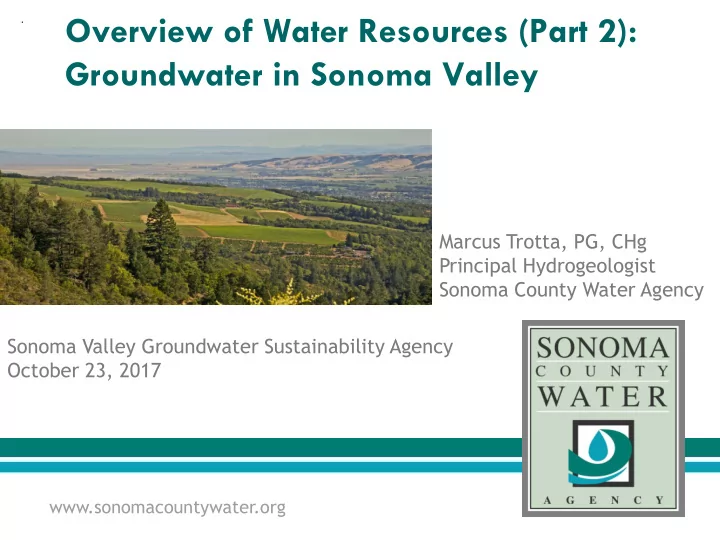
Overview of Water Resources (Part 2): Groundwater in Sonoma Valley

Marcus Trotta, PG, CHg Principal Hydrogeologist Sonoma County Water Agency Sonoma Valley Groundwater Sustainability Agency October 23, 2017

slide-2
SLIDE 2
  • Recycled Water Resources
  • Water Conservation Programs
  • Russian River Water Resources
  • Groundwater Resources
  • Climate Change Impacts & Considerations
  • Integrated Water Resource Management

Part 1 Recap

slide-3
SLIDE 3

Presentation Overview

  • 1. Background on Groundwater Science
  • 2. Sonoma Valley Groundwater Studies
  • 3. Voluntary Groundwater Management Planning
  • Basin Advisory Panel Insights and Recommendation
  • 4. Groundwater Sustainability Plan Requirements

and Data Needs

  • 5. Next Steps
  • 6. Questions & Discussion

s

slide-4
SLIDE 4

Hydrologic Cycle

US Geological Survey Circular 1139

slide-5
SLIDE 5

Groundwater – Surface Water Connection

“Gaining Stream”

Groundwater Affects Stream Flow “Gaining Stream”

High Groundwater Levels Groundwater Maintains Stream Flow

Courtesy The Nature Conservancy

slide-6
SLIDE 6

Pumping Lowers Groundwater Levels Stream Loses Flow to Groundwater

“Losing Stream”

Groundwater – Surface Water Connection Groundwater Affects Stream Flow “Losing Stream”

Pumping Lowers Groundwater Levels Stream Loses Flow to Groundwater

Courtesy The Nature Conservancy

slide-7
SLIDE 7

Key Findings/Outcomes:

  • Complex Geology
  • Higher salinity/brackish groundwater in southern Sonoma Valley
  • Increased pumping since early 1980s
  • Areas of declining groundwater levels
  • Development of Groundwater Flow Models

Sonoma Valley Groundwater Studies

USGS, 1960 DWR, 1982 USGS, 2006 SVGMP, 2014

slide-8
SLIDE 8

Sonoma Valley Water Use

  • Urban demand primarily met through

imported Russian River water

  • Agricultural and Rural Residential demand

primarily met through local groundwater

  • At least 2,200 groundwater wells

Local Groundwater 59% Imported Water (Russian River) 26% Local Surface Water 8% Recycled Water 7% Agriculture 55% Rural Residential 27% Municipal 5% Commercial 3% Mutual 6% Irrigated Turf 4%

Estimated Groundwater Use: 10,500 Acre-Feet (2012) Estimated Total Water Use: 17,900 Acre-Feet (2012)

slide-9
SLIDE 9

Sonoma Valley Hydrogeologic Setting

Complex Geology:

  • Intermixed sedimentary and volcanic

deposits

  • Layers have been uplifted, tilted and faulted

Sonoma Valley Groundwater Basin

slide-10
SLIDE 10

10

Sonoma Valley Groundwater Management Program

  • Convened Stakeholder Group in June

2006 – Basin Advisory Panel

  • Agricultural alliances, environmental
  • rganizations, water purveyors, and

residential groundwater users

  • Voluntary AB3030/SB1938 Groundwater

Management Plan Adopted by Sonoma County Water Agency, City of Sonoma & Valley of the Moon Water District in Late 2007

  • Non-Regulatory and Collaborative Process
slide-11
SLIDE 11

Program Activities

Groundwater-Level and Streamflow Monitoring Monitoring Well Construction & Data Collection Involvement of Community Stakeholders Groundwater Model Update and Initial Alternatives Analyses

slide-12
SLIDE 12

Voluntary Groundwater- Level Monitoring

  • 90 - New Wells since 2007
  • 152 - Wells with Synchronized

Monitoring

  • Groundwater Levels Only
  • Track and Assess Seasonal

and Long-term Trends

slide-13
SLIDE 13

Sonoma Valley Groundwater Basin Sonoma Valley Groundwater Basin

slide-14
SLIDE 14
slide-15
SLIDE 15

Salinity In Groundwater is a Concern

Salinity Sources:

  • Historical Brackish Water Beneath

Tidal Marshlands

  • Thermal Water
  • Deep Groundwater from Older

Formations

slide-16
SLIDE 16

Groundwater Important Provider of Flow to Streams

Discharge Segments

(Groundwater flows into Stream)

  • Most of Sonoma Creek
  • Most of Calabazas
  • Lower reaches of Fryer and

Nathanson

Recharge Segments

(Stream recharges Groundwater)

  • Sonoma Creek near Kenwood
  • Carriger
  • Upper reaches of Fryer and

Nathanson

  • Portion of Felder Creek

May 2010

Sonoma Valley Groundwater Basin

slide-17
SLIDE 17

Basin Advisory Panel Recommended Management Strategies

CONSERVATION

  • f Urban, Non-

Urban, & Agriculture

WATER REUSE

use to offset groundwater pumping

GROUNDWATER BANKING

Russian River winter-time water to recharge groundwater basin

STORMWATER

to recharge groundwater

slide-18
SLIDE 18

Alternatives Analysis to Address Groundwater Depletion

  • Identification of potential technical, regulatory, land use and institutional response

action alternatives: a) Additional water supply (stormwater capture, aquifer storage and recovery, and increased water reuse); b) Water use efficiency and conservation programs c) Increased data collection and reporting; d) Implementation of land use strategies; e) Regulatory responses; and f) Institutional approaches.

  • Identification of preliminary screening criteria, including technical feasibility,

regulatory and community acceptance, relative cost, and environmental benefits.

  • Simulation of baseline future model scenarios that incorporate a range of climate

futures, population growth and potential land use changes.

slide-19
SLIDE 19

Groundwater Flow Model

Integrated Hydrologic Model

  • Climatically driven agricultural

demands

  • Improved streamflow simulation
  • Incorporation of surface water

diversions

  • Recycled Water deliveries
  • Representation of land use trends

and changes

  • Uncertainty analysis to better

understand and convey applicability and limitations of the model Example Model Uses

  • Estimate hydrologic budget
  • Identify recharge areas
  • Evaluate water-resource

management strategies

  • Evaluate climate-change impacts
  • Evaluate effects of changes in land-

use

slide-20
SLIDE 20

SV BAP Insights and Recommendations

  • 1. Give

Prompt Attention to Areas

  • f

Declining Groundwater Levels in southern Sonoma Valley

  • 2. Continue and Expand Monitoring Programs
  • 3. Importance
  • f

Contributing Watershed Areas to Groundwater Sustainability

  • 4. Close Coordination with Land-Use Planning
  • 5. Expand Level of Community Outreach
slide-21
SLIDE 21

SV BAP Insights and Recommendations

  • 6. Incorporate and expand Analyses of Potential

Solutions to Address Groundwater Depletion Areas

  • 7. Support Pursuit of Strategies from the Original Plan
  • 8. Set Goals to Achieve and Sustain a Healthy Basin

Beyond the January 2015 Requirement in SGMA

  • 9. Represent Multiple and Diverse Interests in Sonoma

Valley 10.Continue Involvement and Transfer of Intellectual Knowledge of the SVGMP Panel and TAC

slide-22
SLIDE 22

Groundwater Sustainability Plan Requirements

  • DWR developed requirements and regulations - 2016
  • Require significant level of technical work
  • Avoid “significant and unreasonable” undesirable results for

the following sustainability indicators:

  • Chronic lowering of groundwater levels
  • Reduction of groundwater storage
  • Seawater intrusion
  • Degraded water quality
  • Land subsidence
  • Depletions of interconnected surface water that have adverse

impacts on beneficial uses of the surface water

  • Require setting of measureable thresholds and objectives

for each sustainability indicator

  • Identify projects and actions needed to achieve sustainability
slide-23
SLIDE 23

Draft GSP Work Plan Objectives

  • Meet SGMA requirements - establish criteria and management

actions to achieve and maintain sustainable groundwater.

  • Build on strong technical foundation established through previous

technical studies and voluntary groundwater management activities.

  • Provide opportunity for significant public and community

engagement and integrate the perspectives and address the needs

  • f the many diverse users and uses of groundwater resources

within the basin.

  • Leverage local resources through continued regional coordination

and information sharing.

slide-24
SLIDE 24

Phased Approach to GSP Development

Six General Phases following DWR’s GSP Regulations

  • 1. Plan Area and Basin Setting
  • 2. Sustainable Management Criteria
  • 3. Sustainability Progress Monitoring Program
  • 4. Proposed Project and Management Actions
  • 5. GSP Implementation Costs, Detailed Schedule, and Reporting
  • 6. Compile Complete GSP and Prepare for Adoption

All phases will be developed through iterative process with input from Advisory Committee, GSA Board and community members

slide-25
SLIDE 25

New Requirements vs Existing Information:

Plan Area and Basin Setting Example – Groundwater Conditions

Example of Required GSP Component* Information available from existing GMP or studies Additional GSP Requirements

Groundwater Conditions Description of groundwater elevation trends over time, groundwater elevation hydrographs and contour maps, groundwater quality data. Annual and cumulative change in groundwater storage based

  • n groundwater-level changes, description and map of known

groundwater contamination sites and plumes, rates and map

  • f land subsidence (as applicable) identification of

interconnected surface waters and groundwater dependent ecosystems and estimates on timing and quantity of stream depletions.

*Represents one of many required GSP components

slide-26
SLIDE 26

Key Data Needs and Challenges

  • Improved water use estimates for rural groundwater users (rural

domestic and agriculture), which comprise over an estimated 80% of the total groundwater use.

  • Depth-dependent water level and water quality data to improve

understanding of the hydrogeology and better define relationships between the shallow and deeper aquifer systems.

  • Improved information is needed about well location, lithology and

construction to better understand Basin hydrogeology and improve the groundwater model.

  • Additional modeling of future projected conditions that simulate

the impacts of climate change, land use changes, hydrology, and changes in demands.

slide-27
SLIDE 27

Key Data Needs and Challenges

  • More information to address potential depletion of

interconnected surface water from groundwater pumping

  • Identifying undesirable results as defined in SGMA and

establishing quantifiable thresholds.

  • Transitioning from a voluntary groundwater management plan to

a new plan with regulatory authority will require extensive public

  • utreach and community engagement.
slide-28
SLIDE 28

Next Steps

  • 1. Share

information and coordinate with newly formed Advisory Committee

  • 2. Complete Work Plan for GSP Development for Prop 1 Grant

Application Submittal by November 13, 2017

  • 3. Assess and Scope Near-term monitoring and data needs
  • 4. Develop Community Engagement Plan
  • 5. Prepare and File Initial Notice of GSP Preparation
  • 6. Initiate Development of GSP – must be filed with DWR by

January 2022

slide-29
SLIDE 29

Questions and Discussion

http://www.sonomacountygroundwater.org