and design V.S.Neary, K.A. Haas, J.A. Colby OMER& ISIJSA - - PowerPoint PPT Presentation

and
SMART_READER_LITE
LIVE PREVIEW

and design V.S.Neary, K.A. Haas, J.A. Colby OMER& ISIJSA - - PowerPoint PPT Presentation

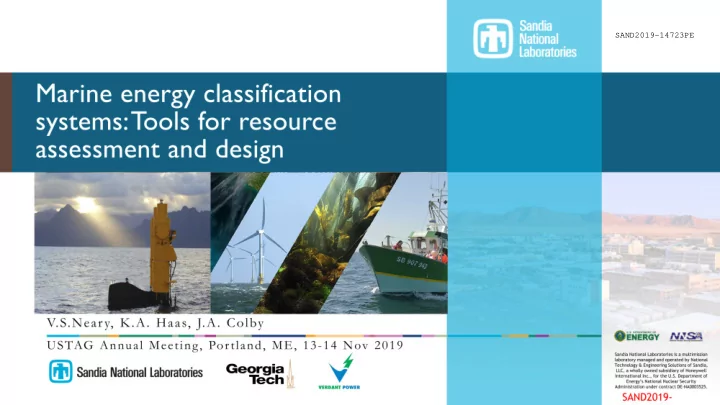
SAND2019-14723PE Marine energy classification systems:Tools for resource assessment and design V.S.Neary, K.A. Haas, J.A. Colby OMER& ISIJSA USTAG Annual Meeting, Portland, ME, 13-14 Nov 2019 Sandia National Laboratories


slide-1
SLIDE 1

Marine energy

classification

systems:Tools for resource

assessment and

design

V.S.Neary,

K.A. Haas,

J.A.

Colby

USTAG

Annual Meeting,

Portland,

ME,

13-14 Nov 2019

10

  • 1-

1

)

Sandia National Laboratories

Tech

Geora V

VERDANT POWER

OMER& ISIJSA

Sandia National Laboratories

is a multimission

laboratory

managed and

  • perated by

National Technology

Et Engineering

Solutions

  • f

Sandia, LLC,

a

wholly

  • wned

subsidiary

  • f

Honeywell International

Inc., for

the U.S. Department

  • f

Energy's National Nuclear Security Administration under contract DE-NA0003525.

SAND2019-

SAND2019-14723PE

slide-2
SLIDE 2

I Motivation/Goal

Build

marine energy

classification

systems

that,

like wind,

codify

and

support

resource assessment, design

and

device-type

certification

for

wave and

tidal

energy

devices Resource

classification -

support

project

siting, feasibility,

and

scoping

studies, regional

energy

planning

Device

classification - codify

and

streamline device design, device-

type

certification,

product-line

development and manufacturing

2

slide-3
SLIDE 3

Wave

resource

classification

  • Main parameter,

wave

power, J

(kW/m),

Class

I, 11, 111, W

  • Subclass

parameter,

T

p,

peak

period

bandwidth,

delineates three

WEC

resonant bandwidths

1,

local

wind

seas,

0<Tp<7

2,

short-period swell,

7

11

1p 10

3,

long-period swell,

10<T

p

  • Related

standards Wave

resource assessment

and

characterization, IEC

TS

62600-101:2015-06

WEC

power

performance assessment,

IEC

TS

62600-100:2012-08

POWER

CLASS

I 22.8<J II

5.7<J22.8

III

1.1q5.7

IV 1

O<Tp<7 I(1)

II(1) III(1)

IV(1)

2

I(2) II(2)

III(2)

IV(2)

3

1O<Tp

I(3) II(3)

III(3)

IV(3)

co

80

Classification System

2

— dominant

period

band

70 60

  • 25

)

50

_1 40

30 20 10

  • 200
  • 180

r

1

"

1

Power

class

11

.

E1

1111.

r

'

(2)

  • El

(3)

ED

  • 160
  • 140
  • 120

Longitude

  • 100
  • 80
  • 60

S. Ahn, K. A. Haas, V. S. Neary,

Wave

energy resource

classification

system

for US coastal

waters,

Ren

&

Sust Energy Rev, 104, 54-68, 2019.

https://doi.org/10.1016/j.rser.2019.01.017

3

slide-4
SLIDE 4

Tidal resource

classification:

Preliminary

  • Main parameter,

tidal power

density,

(kW/m2); Class

I, II, III, IV

N

11 VI 3

2A1 19 LJ U-i

Pm

j =

1

  • Subclass

parameter

TBD, A, a

constraint

  • n

the

theoretical resource

Multiple levels

TBD

  • Related

standards

Tidal resource

assessment and

characterization, IEC

TS

62600- 201:2015-04

TEC

power

performance assessment,

IEC

TS

62600-200:2013-05

Power

Class

I

Pm >2

/I 1<Prn <2

m

0.5<Pm <1

w

Pm <0.5

1

A>

TBD

1(1) II(1) III(1) IV(1)

2

TBD

<

A

<TBD

/(2) II(2) III(2)

IV (2)

3

A

<

T

B D

1(3)

I I (3)

111(3)

IV (3)

OVW

Use model data from

US

Tidal

Energy

RA

13 12 43

00 43.08 43.08 43.07 43.05

005

43.04 43.03

  • 70.8
  • 70.78 -70.7e -70.74 -70.72 -70.7 -70.88 .70..0

Longitude

4

Z. Defne

et

al.,

"National

geodatabase

  • f

tidal

stream power resource

in USA,"

Renew

Energy,

16(5), pp.

3326-3338, 2012.

slide-5
SLIDE 5

5

I Tidal resource

classification:

Preliminary

  • Relate

the

mean

power,

P

m

(kW/m2

)

to the

mean

velocity,

V m (m/s) Power

Class /

P >

2

11

1

< P < 2

III O.

5 <

P <

1

IV

P <

O.

5

Mean

Velocity

  • V. 1.3

1.05< V.<

1.

3

0.8

< V. <

1.

05

V. <

O.

8

1

A

>

T

BD

1(1) 11(1)

1141) IV (1)

2

T

BD <

A

<

T

BD

I (2)

11(2) III(2)

IV (2)

3

A

<

T

BD

/(3) 11(3) 111(3)

IV (3)

1800 1600 1400 1200

a>

(

2

1000

2_

,

8

800

O

600 400 200

4 6 8

1 1 2

1.4

Vm

(m/s)

th

1.6 1.8

2

Classes

can be

delineated based

  • n

the

mean

velocity

1

  • 1
slide-6
SLIDE 6

I Tidal resource

classification:

Preliminary

US West

Coast

61

5 Cook

Inlet

61 60.5

a)

  • c)

D

:' 60

ro

_

1

59.5

59

58.5

  • 155
  • 154
  • 153
  • 152

Longitude

  • 151
  • 150
  • 149
  • 120

46 US

East

Coast

  • 44

42 40

m/s

1

cl

40.8 40.78 40.76

a)

  • 40.74

m

co

_1 40.72

40.7 40.68 40.66

......-5

,

  • 74.02 -74 -73.98-73.96-73.94-73.92
  • 73.9
  • 73.88

Longitude

I

1.3

/1

1.05

Ill 08

/17

,.•

slide-7
SLIDE 7

I WEC

classification:

Preliminary

  • Main parameter,

Hs(ref)

=

li

s(50)

(m),

50-year

return H

s,

Class

I, 11, 111

  • Note

H

s(nean)

=

CHS(50)

for

distinct

wave

climates

  • Subclass

parameter,

T

p,

peak

period

bandwidth,

delineates three

energy

transfer mechanisms

(normal

  • perations)

1,

local

wind

seas,

O<Tp<7

2,

short-period swell,

7<Tp<10

3,

long-period swell,

1O<T

p

  • Related

technical specs, standards

Design requirements for marine

energy systems,

IEC

TS

62600-2:2016-08 Environmental

conditions

a

environmental Loads, DNV-RP-C205:2014

Class I

II Href

(m)

t

15 1

O<Tp<7

I(1)

2 7'1

1 1

, 10

I(2)

3

1O<Tp

I(3)

72°N 60°N 48°N 36°N 24°N

175 °W 150°W 125

°W

100°W 75°W

Geographical

distribution of

Hs50

(m)

for US Coast

[Neary et

al.

2019]; Alaska

site,

H5(50-12 m

18 16 14 12 10

8 6 4 2

Hs(ref)(site)

12

m

SITE

T

p

(site)—Class

3

CLASS

1(3)

15 0.5 1

15 2 mean

1- g(m)

Regional correlations extreme

and mean wave

heights

[Neary et

al.

2018]; Alaska

site,

HS(mpapr2.8 m

T

p band

is Class

3

Specified

by

designer

2.5

13 35

Extreme

DLC

based

  • n

Hs(ref) =

15

m

Normal

DLC

based

  • n

H

s

(

mean

)

= 2.8

m, 1O<T

p

7

slide-8
SLIDE 8

TEC

classification:

Preliminary

  • Main parameter,

Vref

(m/s), max,3-min avg

current for

extreme

design load

case (DLC);

Class

1, 11, 111

  • Subclass

parameter, l„

f

,

turbulence

intensity

@

1.5 m/s A,

high,

0.15<

l„

f 0.20

B, moderate,

0.10<

I ref 0.15

C, low,

I ref 0.10

  • Related

technical specs, standards

Design requirements for marine

energy systems,

IEC

TS

62600-2:2016-08 Environmental

conditions

Et environmental

Loads, DNV-RP-C205:2014

  • FY20

studies:

Reviewing turbulence measurements database with NREL to

identify

trends Standard method for determining maximum current

speed,

e.g., 1-percentile

current

TEC Class

U„

f

(m/s)

A

B

C

2.5

2

1.5 0.5

aP

45 40 35

;T: 30

25

"

12n

5

/ref

(-)

@1.5

m/s

I 3.5

II 2.5 III 1.5

0.20 0.15 0.10

w,

1 07/141/, 07/15/1

Date (rn h at

HH (m

ASL)

,:-.

0.5 1 1.5 2 2 5 IIe (111561)

V

ref

(Site)

— 2.4 m/s

ref

(site)-0.18

10.5 0.45 0.4 0.35

3

0..2

2 5

0.15

1

0.05 /15/11 07/17/11

  • h

at

QB (m ASL)

Specified by

engineer

RITE

site,

East

River: Variation

  • f

hub

height

mean

current

speed

  • black

(Gunawan, Neary and

Colby 2014)

Vref

(site)

  • 2.4

m/s RITE

site,

East

River: Variation

  • f

hub

height turbulence intensity with

mean

current

speed (Gunawan, Neary and Colby 2014)

jref(site)

  • 0.18

RITE SITE

CLASS

IIA

Design

for V

ref

=

2.5 m/s,

I

ref

=

0.20

8

slide-9
SLIDE 9

I Proposed motions

The

US

TAG

is asked

to

endorse

and

deliver

the following proposal to

TC

114

for the

integration

  • f

classification

systems

into

  • standards. This

proposal

would be

discussed

and approved

at

the

TC

114

Plenary

Meeting

in April

2020: 1)

Update

the

Scope

  • f

Work

  • f

AHG

8

to include the

integration

  • f

classification

systems

into

TC

114

  • documents. AHG

8

would

  • versee

the coordination

and

integration

  • f

classification

systems

across

TC

114.

2)

The

following

Maintenance

Teams

would

consider incorporation

  • f

classification

systems in

their

Technical

Specifications

during

their

maintenance

cycle:

  • MT

62600-2: Design,

TS

62600-2:2019-10

{Ed. 2}

  • WAVE

AND

TIDAL CONDITIONS

CLASSIFICATION

  • MT

62600-101:

Wave

resource

characterization,

TS

62600-101:2015-06

{Ed. 1}

  • WAVE

RESOURCE

CLASSIFICATION

  • MT

62600-201: Tidal

resource

characterization,

TS

62600-201:2015-04

{Ed. 1}

  • TIDAL

RESOURCE

CLASSIFICATION 9

slide-10
SLIDE 10

10 1

ACKNOWLEDGEMENTS:

This study

benefited

from

review

and

input

from

project steering

committee

members

chaired

by Dr. Bryson

Robertson,

Oregon

State University.

Sandia National Laboratories

is a

multi-mission laboratory

managed and

  • perated

by

National

Technology and

Engineering

Solutions

  • f

Sandia,

LLC.,

a wholly

  • wned

subsidiary

  • f

Honeywell

International, Inc., for

the U.S.

Department

  • f

Energy's National Nuclear

Security

Administration

under

contract

DE-NA0003525.

This

presentation describes

  • bjective

technical

results and analysis.

Any

subjective

views

  • r
  • pinions

that

might be

expressed in the paper

do

not

necessarily

represent the views

  • f

the U.S.

Department

  • f

Energy

  • r

the United

States Government.

Thank

you

Contact: vsneary@sandia.gov or

khaas@gatech.edu

slide-11
SLIDE 11

11 r References:

I.

Troen,

E.

L.

Petersen, European Wind Atlas. Riso National Laboratory, Roskilde,

Denmark,

1989.

Wind

turbines

  • Part

1:

Design

requirements,

IEC TS

61400-1:2019-02. P. Veers,

private

communication, Nov. 2018. Marine energy

  • Wave,

tidal

and

  • ther

water current converters

  • Part

2:

Design requirements

for marine energy systems,

IEC TS

62600-2:2019-10. Marine energy

  • Wave,

tidal

and

  • ther

water current converters

  • Part

101:

Wave

energy resource assessment

and

characterization,

IEC TS

62600-101:2015- 06. Marine energy

  • Wave,

tidal

and

  • ther

water Marine energy

  • Wave,

tidal

and

  • ther

water

IEC TS

62600-100:2012-08. Marine energy

  • Wave,

tidal

and

  • ther

water

TS

62600-200:2013-05. current converters current converters current converters

  • Part

201: Tidal energy resource assessment and

characterization,

IEC TS

62600-201:2015-04.

  • Part

100:

Electricity

producing

wave

energy converters

  • Power

performance assessment,

  • Part

200:

Electricity

producing

tidal

energy converters

  • Power

performance assessment,

IEC

S.

Ahn, K. A.

Haas, V.

S.

Neary,

"Wave

energy resource

classification system

for

US

coastal waters,"

Ren

Sust Energy Rev,

vol.

104, pp. 54-68, 2019.

Z. Defne

et

al.,

"National geodatabase

  • f

tidal

stream

power

resource in

USA,"

Renew Energy,

vol.

16, no. 5, pp. 3326-3338, 2012.

V.

S.

Neary,

R.

G.

Coe,

J.

Cruz,

K.

Haas,

GBacelli, Y.

Debruyne,

S.

Ahn,

V. Nevarez,

"Classification

systems for

wave

energy resources and

WEC

technologies,"

Int.

Marine Energy

Journal, vol.

1, no. 2, pp. 71-79, 2018.

V.

S.

Neary,

B. E.

Seng,

Z.

Yang,

NAllahdadi,

R. He,

T.

Wang, "Model

performance

'D

redi cting

extreme wave

heights for project

risk

assessment

and

WEC

design,"

European

Wave

and

Tidal

Energy Conference

(EWMC),

Naples,

Italy,

201c. B.

Gunawan,

V.

S.

Neary,

J.

Colby, "Tidal energy resource assessment in the East River

tidal strait

near Roosevelt Island,

New

York,

New

York."

Renew

Energy,

vol.

71, pp. 509-517, 2014. Neary, Haas, and Colby "Marine Energy

Classification

Systems: Tools for resource assessment

and

design," presented at the

Eutopean

Wave

and

Tidal

Energy

Conference, 2019.