
SLIDE 1
Course 02429 Analysis of correlated data: Mixed Linear Models Module 6: Model diagnostics Per Bruun Brockhoff
DTU Compute Building 324 - room 220 Technical University of Denmark 2800 Lyngby – Denmark e-mail: perbb@dtu.dk
Per Bruun Brockhoff (perbb@dtu.dk) Mixed Linear Models, Module 6 Fall 2014 1 / 32
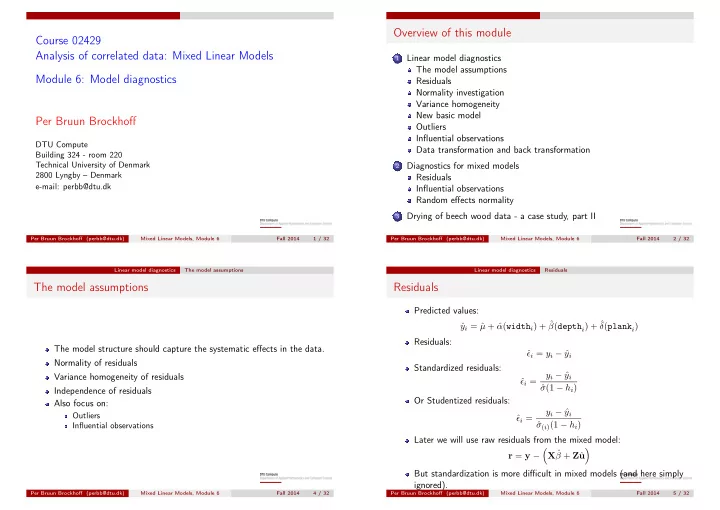
Overview of this module
1
Linear model diagnostics The model assumptions Residuals Normality investigation Variance homogeneity New basic model Outliers Influential observations Data transformation and back transformation
2
Diagnostics for mixed models Residuals Influential observations Random effects normality
3
Drying of beech wood data - a case study, part II
Per Bruun Brockhoff (perbb@dtu.dk) Mixed Linear Models, Module 6 Fall 2014 2 / 32 Linear model diagnostics The model assumptions
The model assumptions
The model structure should capture the systematic effects in the data. Normality of residuals Variance homogeneity of residuals Independence of residuals Also focus on:
Outliers Influential observations
Per Bruun Brockhoff (perbb@dtu.dk) Mixed Linear Models, Module 6 Fall 2014 4 / 32 Linear model diagnostics Residuals
Residuals
Predicted values: ˆ yi = ˆ µ + ˆ α(widthi) + ˆ β(depthi) + ˆ δ(planki) Residuals: ˆ ǫi = yi − ˆ yi Standardized residuals: ˆ ǫi = yi − ˆ yi ˆ σ(1 − hi) Or Studentized residuals: ˆ ǫi = yi − ˆ yi ˆ σ(i)(1 − hi) Later we will use raw residuals from the mixed model: r = y −
- Xˆ
β + Zˆ u
- But standardization is more difficult in mixed models (and here simply
ignored).
Per Bruun Brockhoff (perbb@dtu.dk) Mixed Linear Models, Module 6 Fall 2014 5 / 32