
SLIDE 1
Overview of the Lower Yuba River Overview of the Lower Yuba River - - PowerPoint PPT Presentation
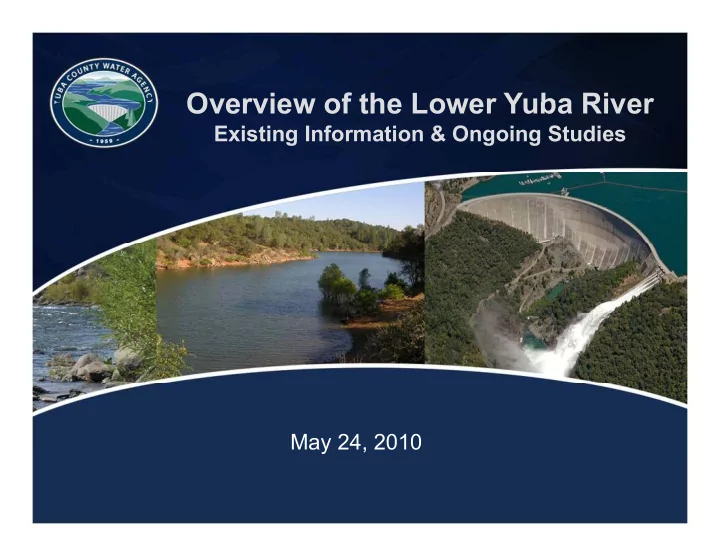
Overview of the Lower Yuba River Overview of the Lower Yuba River Existing Information & Ongoing Studies May 24, 2010 y Lower Yuba River Englebright Dam to Feather River Confluence Confluence C Control point for the t l i t f th
Englebright Dam to Feather River Confluence Confluence
3
1852 & 1893 changed and 1852 & 1893 changed and defined the current Goldfields area
dominated by dredger tailings reworked from hydraulic mine waste waste
hydraulic waste began in 1902
Marigold
g p
Lower Yuba River Overview 2010
Reach The Narrows Above Dagurre Point Dam Below Daguerre Point Dam Backwater Reach (RM 24 to about RM 22) (About RM 22 to RM 11.5) (RM 11.5 to RM 3.5) (RM 3.5 to RM 0) Species prickly/riffle sculpin Sacramento sucker speckled dace steelhead/rainbow Trout Chinook salmon Sacramento pikeminnow American shad tule perch striped bass Pacific lamprey hardhead green sunfish green sunfish bluegill mosquitofish redear sunfish California roach smallmouth bass Legend Most Abundant Abundant Rare Not Present
field studies and data collection reports, 20 other relevant documents (plans policies historical accounts and regulatory documents (plans, policies, historical accounts, and regulatory compliance), 14 ongoing data collection, monitoring and evaluation activities for the lower Yuba River Accord Monitoring evaluation activities for the lower Yuba River Accord Monitoring and Evaluation Program (M&E Program), and 4 other data collection and monitoring programs. g p g
Lower Yuba River Overview 2010
Available Field Studies and Data Collection Reports
by R. Rogers, CDFG Region 2, Rancho Cordova, California.
Memorandum, prepared by R. Rogers, CDFG Region 2, Rancho Cordova, California. , p p y g , g , ,
prepared for the State of California Resources Agency, Department of Fish and Game, Sacramento, CA.
Resources Agency, CDFG, Stream Evaluation Report No. 91-1. February 1991.
River Fisheries Issues. Prepared for the California State Water Resources Control Board Water Rights Hearing on Lower Yuba River February 22-25 and March 6-9, 2000.
Lower Yuba River Overview 2010
p g p Prepared for the Fish and Game Commission. Habitat Conservation Division, Native Anadromous Fish and Watershed Branch. October 2002.
Lower Yuba River Water Transfer Monitoring Reports 2001 2004 Lower Yuba River Water Transfer Monitoring Reports 2001-2004
Water From Yuba County Water Agency to DWR, Year 2001. Prepared for Yuba County Water Agency and the State Water Resources Control Board by EDAW.
County Water Agency by Surface Water Resources, Inc. January 28, 2003.
C t W t A b S f W t R I County Water Agency by Surface Water Resources, Inc.
Monitoring and Evaluation Plan. November 2003. Lower Yuba River Redd Dewatering and Fry Stranding Study 2007 Annual Report (JSA 2007) and Lower Dewatering and Fry Stranding Study 2007 Annual Report (JSA 2007) and Lower Yuba River Redd Dewatering and Fry Stranding Study 2008 Annual Report (JSA 2008).
Lower Yuba River Overview 2010
, ( y y ), and Juvenile Central Valley Steelhead Trout (Oncorhynchus mykiss), Life History Survey: Annual Data Report 2003-2004. CDFG Annual Report, Rancho Cordova, CA.
T (O h h ki ) d h Fi h i h L Y b Ri C lif i Trout (Oncorhynchus mykiss) and other Fishes in the Lower Yuba River, California. UC Davis Thesis.
(Oncorhynchus tshawytscha) and Juvenile Central Valley Steelhead Trout (Oncorhynchus tshawytscha), and Juvenile Central Valley Steelhead Trout (Oncorhynchus mykiss), Life History Survey: Annual Data Report 2004-2005. CDFG Annual Report, Rancho Cordova, CA.
Prepared for Yuba County Water Agency by Jones and Stokes Associates, Inc.
Specific Run Size Estimates. Scale Aging Program, CDFG.
Specific Run Size Estimates. Scale Aging Program, CDFG
Lower Yuba River Overview 2010
NMFS 2007 Bi l i l O i i th O ti f E l b i ht d D P i t
Dam on the Yuba River, California. File Number 151422-SWR-2006-SA00071:MET (PCTS # 2007/01232). November 21, 2007.
Massa, D. 2008. Lower Yuba River Chinook Salmon Escapement Survey: October 2007 – January 2008. California Department of Fish and Game Annual Report, North Central Region, Chico, CA.
Hi t f St lh d d R i b T t C t d i Ri f th C t l V ll History of Steelhead and Rainbow Trout Captured in Rivers of the Central Valley,
(Oncorhynchus mykiss) in the Lower Yuba River, California. ICF International. March (Oncorhynchus mykiss) in the Lower Yuba River, California. ICF International. March 2010.
Oncorhynchus mykiss in the California Central Valley. Final report for California Department of Fish and Game Contract # PO485303. University of California, Santa Cruz and NOAA Southwest Fisheries Science Center.
Lower Yuba River Overview 2010
Other Relevant Documents
Agency, CDFG, Sacramento, California. November 1993.
E R Gerstung F W Fisher and P B Moyle 1996 Historical and Yoshiyama, R.M., E.R. Gerstung, F.W. Fisher, and P.B. Moyle. 1996. Historical and present distribution of Chinook salmon in the Central Valley Drainage of California. In: Sierra Nevada Ecosystem Project, Final Report to Congress, vol. 111, Assessments, Commissioned Reports, and Background Information (University of California, Davis, Centers for Water and Wildland Resources 1996) Centers for Water and Wildland Resources, 1996).
tshawytscha) in the Sacramento River Drainage. Candidate Species Status Report 98-
River Development Project (FERC No. 2246). Prepared by Yuba County Water Agency, Surface Water Resources Inc., and Jones and Stokes Associates. December 2000.
Lower Yuba River Overview 2010
G
Present Distribution of Chinook Salmon in the Central Valley Drainage of California. In Contributions to the Biology of Central Valley Salmonids, California Fish and Game, Bulletin 179, Volume 1. Salmonid Symposium, Bodega Bay, California. October 22-24, 199 R d ll B di 1997, Randall Brown, editor.
2002 Fisheries Studies – Analysis of Potential Benefits to Salmon and Steelhead from Improved Fish Passage at Daguerre Point Dam. Prepared for CDWR and USACE by p g g p y ENTRIX, Inc. and J. Monroe. March 2003.
2002 water resources studies. Prepared for CDWR and USACE by ENTRIX, Inc. June 2003 2003.
Concepts Evaluation. Prepared for ENTRIX, Inc. by W. Rodgers, Inc. September 2003.
Powerplant Flow Bypass System Project. November 2003.
Lower Yuba River Overview 2010
Project (FERC No. 2246) Proposed License Amendment. Prepared for Yuba County Water Agency, Federal Energy Regulatory Commission, and National Marine Fisheries Services by Surface Water Resources, Inc.
Anadromous Fish Habitat Restoration: Multi-Agency Plan to Direct Near-Term Implementation of Prioritized Restoration and Enhancement Actions and Studies to Achieve Long-Term Ecosystem and Watershed Management Goals. Prepared by Lower g y g p y Yuba River Fisheries Technical Working Group. Funded by CALFED and Yuba County Water Agency. October 2005.
Ri D l t P j t Li A d t f F d l E R l t River Development Project License Amendment for Federal Energy Regulatory Commission License No. 2246, Located on the Yuba River in Yuba County, California, and Its Effects on Threatened Central Valley Spring-Run Chinook Salmon (Oncorhynchus Tshawytscha) and Central Valley Steelhead (O. Mykiss), in Accordance With S ti 7 f th E d d S i A t f 1973 A A d d N b 4 With Section 7 of the Endangered Species Act of 1973, As Amended. November 4, 2005.
Lower Yuba River Overview 2010
G f f C
steelhead/rainbow trout spawning in the Yuba River. Draft report prepared by the Energy Planning and Instream Flow Branch of the USFWS, Sacramento, CA. April 19, 2007.
Framework for Assessing Viability of Threatened and Endangered Chinook Salmon and Steelhead in the Sacramento-San Joaquin Basin. San Francisco Estuary & Watershed q y Science Volume 5: California Bay-Delta Authority Science Program and the John Muir Institute of the Environment.
th P d L Y b Ri A d P d f th D t t f W t the Proposed Lower Yuba River Accord. Prepared for the Department of Water Resources, Bureau of Reclamation and Yuba County Water Agency by HDR|SWRI. June 2007.
Gard, M. 2008a. Flow habitat relationships for juvenile spring/fall run Chinook salmon and steelhead/rainbow trout rearing in the Yuba River. Draft report prepared by the Energy Planning and Instream Flow Branch of the U.S. Fish and Wildlife Service, Sacramento, CA, dated August 12, 2008.
Lower Yuba River Overview 2010
2008b Sensitivity analysis for flow habitat relationships for steelhead/rainbow
trout spawning in the Yuba River. Draft report prepared by the Energy Planning and Instream Flow Branch of the U.S. Fish and Wildlife Service, Sacramento, CA, dated October 17, 2008.
River Winter-run Chinook Salmon and Central Valley Spring-run Chinook Salmon, and the Distinct Population Segment of Central Valley Steelhead. National Marine Fisheries S i S th t R i l Offi S t C lif i O t b 2009 Service, Southwest Regional Office, Sacramento, California. October 2009.
Run Chinook Salmon and California Central Valley Steelhead. November 2009.
Lower Yuba River Overview 2010
Ongoing Data Collection, and Monitoring and Evaluation Activities
Evaluation Evaluation
Lower Yuba River Overview 2010
The Lower Yuba River Accord The Lower Yuba River Accord
Programs
Cover, Riparian, Acoustic tagging underway
web site
with PG&E & YCWA)
Infrastructure
y
system Personnel
NGO’s) PG&E NGO s), PG&E
VAKI Riverwatcher
Deep water redd Acoustic tracking, Genetic Samples Substrate mapping p methodology testing VAKI system upgrades Map compilation & Substrate mapping Riparian mapping Mesohabitat mapping St di F ll 2010 dd Map compilation & completion, additional tasks Annual reports (5)
Escapement survey &
Annual reports (5) Updates to field study protocols Outline restoration pilots Redd surveys Outline restoration pilots
Draft Long Term Work Plan
July 2009 32
relationships with
Fish populations
Lower Yuba River Accord
Overview and Update 2010
“…sufficient water at all times to pass through a fishway… over, around, or through the dam, to keep in good condition any fish that may be planted or exist below the dam.”
Previous definitions of “good condition”
Withi th t t f dj di ti f i t fl (P t h C k)
exist below the dam. The critical term “good condition” is not defined in the Fish and Game Code
McElhany et al. 2000
Lower Yuba River Accord Overview and Update 2010
ADULT ABUNDANCE ADULT PRODUCTIVITY JUVENILE ABUNDANCE JUVENILE PRODUCTIVITY ADULT ADULT JUVENILE JUVENILE
ADULT
ADULT DIVERSITY ADULT SPATIAL STRUCTURE
JUVENILE
JUVENILE DIVERSITY JUVENILE SPATIAL STRUCTURE
Define Analytics
Measures of VSP Parameters and Flows and Water Temperatures
Performance Indicators Analytics
ADULT ABUNDANCE
1) Stable or increasing trend (regression slope ≥ 0) in multi-year total annual run sizes. 2) Stable or increasing trend (regression slope ≥ 0) in multi-year
1) Differentiate spring, fall, and late fall-run Chinook salmon 2) Estimate annual abundance of spring, fall, and late fall-run Chinook of hatchery and natural
2) Stable or increasing trend (regression slope ≥ 0) in multi year naturally-produced annual run sizes. 3) No sustained declines spanning multiple generations. 4) M lti l i t d ( i l ) ≥ th
3) Estimate annual abundance of steelhead of hatchery and natural-origin 4) Examine multi-year trends in the total, and hatchery and natural-origin abundance estimates of each run of Chinook and steelhead
4) Multi-year annual run size trends (regression slope) ≥ other Central Valley rivers. 5) Low to moderate extinction risk due to population decline
(Lindley et al. 2007).
5) Compare multi-year trends in annual abundance estimates of each run of adult Chinook in the lower Yuba River with other Central Valley rivers 6) Evaluate extinction risk of Chinook and steelhead populations in the lower Yuba River due to population decline
( y )
6) Low to moderate extinction risk due to hatchery straying
(Lindley et al. 2007).
p p 7) Evaluate extinction risk of natural-origin Chinook and steelhead populations due to hatchery straying
37
Analytics
ADULT ABUNDANCE
2) Estimate annual abundance of spring-, fall-, and late fall-run Chinook of hatchery and natural origin
Estimate the annual abundance of spring-run and fall-run Chinook using the Estimate the annual abundance of spring run and fall run Chinook using the modified Schaefer method and run differentiation (Carcass Survey), and harvest (Angler Survey). Use otolith microstructure and microchemistry, and CWT analyses (Carcass Use otolith microstructure and microchemistry, and CWT analyses (Carcass Survey) to calculate the proportion of hatchery-origin spring- and fall-run Chinook, applied to abundance estimates. Estimate the abundance of hatchery-origin late fall-run Chinook immigrating past Estimate the abundance of hatchery origin late fall run Chinook immigrating past DPD using the annual abundance estimate and observed adipose fin-clipped fish (Vaki Riverwatcher System).
ADULT ABUNDANCE
Analytics 3) Estimate the annual abundance of steelhead of hatchery and natural-origin
Estimate the annual abundance by summing the number of steelhead passing DPD (Vaki Riverwatcher System) redds below DPD (Redd Survey) and DPD (Vaki Riverwatcher System), redds below DPD (Redd Survey) and applied spawner / redd ratio, and harvest (Angler Survey). Estimate the abundance of hatchery-origin steelhead by applying the proportion
annual abundance estimate.
Lower Yuba River Accord Overview and Update 2010
Analytics
ADULT ABUNDANCE
4) Examine multi-year trends in the total, and hatchery and natural-origin abundance estimates of each run of Chinook and steelhead
Examine whether the total, and hatchery and natural-origin abundance estimates , y g change over time using linear regression. Determine if the slope parameter of the multi-year annual run size regression analysis is significantly ≠ 0 for each run of hatchery and natural-origin Chinook y g y y g and steelhead.
Lower Yuba River Accord Overview and Update 2010
Analytics
ADULT ABUNDANCE
5) Compare multi-year trends in annual abundance estimates of each run of adult Chinook in the lower Yuba River with other Central Valley rivers
Obtain annual abundance estimates of each run in Central Valley rivers from Obtain annual abundance estimates of each run in Central Valley rivers from GRANDTAB. Examine multi-year trends for each run in Central Valley rivers using linear regression analysis regression analysis. Test for significant differences in slope parameters of the regression analyses for each run using an Analysis of Covariance approach.
Lower Yuba River Accord Overview and Update 2010
Analytics
ADULT ABUNDANCE
6) Evaluate extinction risk of Chinook and steelhead populations in the lower Yuba River due to population decline
Evaluate extinction risk based on population decline criteria, incorporating growth rate (percent per year) and population size (Lindley et al 2007). rate (percent per year) and population size (Lindley et al. 2007). Run size ≤ 250 or precipitous decline (decline within last 2 generations to ≤ 500, or > 500 but declining at a rate ≥ 10% per year) 250 < run size ≤ 2,500 or chronic declining trend or depression (decline in High risk : Moderate risk : run size ≤ 500 but now stable) Run size > 2,500 and no declining trend apparent or probable Low risk :
Lower Yuba River Accord Overview and Update 2010
Analytics
ADULT ABUNDANCE
7) Evaluate extinction risk of natural-origin Chinook and steelhead populations
due to hatchery straying (Lindley et al. 2007)
Calculate the average fraction of naturally-spawning fish of hatchery- origin over 1-4 generations. Compare average fractions to those fractions that indicate the extinction risk for the natural-origin population based upon specific hatchery and geographic origin.
Lower Yuba River Accord Overview and Update 2010
Flow and Temperature Relationships
40 45 8/1/08 9/1/08 10/1/08 11/1/08 12/1/08 1/1/09 2/1/09 3/1/09 Date AveADULT ABUNDANCE
1) Evaluate “attraction” flows and water temperatures on the straying of salmonids (Vaki Riverwatcher System, Carcass Surveys) 2) Compare the magnitude of flows and water temperatures with 2) Compare the magnitude of flows and water temperatures with
3) Compare water temperatures to water temperature suitability index values for immigration, spawning and embryo incubation (Vaki Riverwatcher System, Redd Surveys)
Lower Yuba River Accord Overview and Update 2010
ADULT ABUNDANCE ADULT PRODUCTIVITY JUVENILE ABUNDANCE JUVENILE PRODUCTIVITY ADULT ADULT JUVENILE JUVENILE
ADULT
ADULT DIVERSITY ADULT SPATIAL STRUCTURE
JUVENILE
JUVENILE DIVERSITY JUVENILE SPATIAL STRUCTURE
45
Define Analytics
Measures of VSP Parameters and Flows and Water Temperatures
Ot lith S l Ti CWT S li
y
Lower Yuba River Accord Overview and Update 2010
Marysville
Lower Yuba River Accord Overview and Update 2010
Photo courtesy of Dr. Greg Pasternack, UCD Lower Yuba River Accord Overview and Update 2010
acoustic tagged during 2010
Lower Yuba River Accord Overview and Update 2010
Lower Yuba River Accord Overview and Update 2010
Lower Yuba River Accord Overview and Update 2010
Lower Yuba River Accord Overview and Update 2010
Lower Yuba River Accord Overview and Update 2010
Lower Yuba River Accord Overview and Update 2010
Lower Yuba River Accord Overview and Update 2010
Lower Yuba River Accord Overview and Update 2010
Lower Yuba River Accord Overview and Update 2010