Yuba IRWM/RWMG Meeting, May 20, 2020 ( Thank you for Joining us! - - PowerPoint PPT Presentation

yuba irwm rwmg meeting may 20 2020
SMART_READER_LITE
LIVE PREVIEW

Yuba IRWM/RWMG Meeting, May 20, 2020 ( Thank you for Joining us! - - PowerPoint PPT Presentation

Yuba IRWM/RWMG Meeting, May 20, 2020 ( Thank you for Joining us! Please ensure your phone is muted until directed for Q&A ) Agenda: 1. Welcome 2. Announcements 3. Yuba IRWM Project Readiness for expected stimulus money 4. Update


slide-1
SLIDE 1

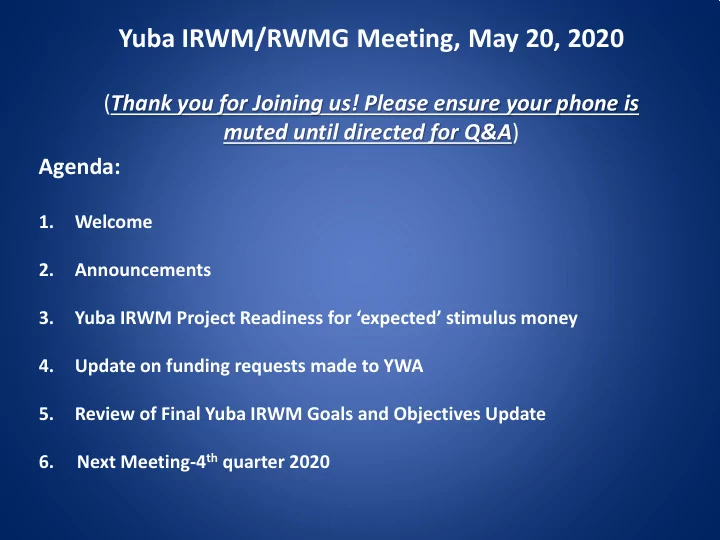
Yuba IRWM/RWMG Meeting, May 20, 2020

(Thank you for Joining us! Please ensure your phone is muted until directed for Q&A) Agenda:

1. Welcome 2. Announcements 3. Yuba IRWM Project Readiness for ‘expected’ stimulus money 4. Update on funding requests made to YWA 5. Review of Final Yuba IRWM Goals and Objectives Update

  • 6. Next Meeting-4th quarter 2020
slide-2
SLIDE 2

Yuba IRWM Funding Announcements:

  • Both Yuba IRWM Round 1 Implementation Applications

were recommended by DWR for full funding!

  • Recommendations are out for public comment
  • YWA was the applicant and fiscal agent for both

applications

  • Table below includes a summary of each application

Yuba IRWM Implementation Grant Applications Sponsor(s)/Projects YWA Role Funding Recommendation Mountain County Funding Area IRWM Round 1 Appl. (Prop 1): Improving Water Storage in the Upper Yuba Watershed

  • 1. NYWD: Fire and Drinking Water Storage

Improvement Applicant and Fiscal Agent; Grant admin cost share $33,123 $692,115 (exclusive of YWA cost share for grant admin) Sacramento River Funding Area IRWM Round 1 Appl (Prop 1): Water-Related Systems Improvements in the Yuba IRWMP SRFA

  • 1. OPUD: Water Meter Installation and

Water Distribution Improvement Projects

  • 2. City of Wheatland: Comprehensive

Drinking Water Project

  • 3. LCWD: Wastewater System Upgrade and

Energy Efficiency

  • 4. RD784: Improving Flood Protection Project

Applicant and Fiscal Agent; Grant admin cost share $110,000; $1.4 million cost share to OPUD; $700,000 cost share to Wheatland $4.28 million (exclusive of collaborator provided match and cost share). Total cost share/match=$3.79 million Total Cost=~$8 million

slide-3
SLIDE 3

Yuba IRWM Project Readiness for ‘expected’ stimulus money

  • Expect federal/state stimulus money for ‘shovel-ready’

projects (timing and details unknown)

  • Expect similar roll out as the ARRA (American Recovery and

Reinvestment Act 2009) funding which focused on shovel-ready projects and did not require some permitting

  • Please provide any new or updated project detail for the

IRWM Plan (via short form process)

  • Please provide better detail on project tasks, especially

planning vs. implementation detail, schedule and budgets

slide-4
SLIDE 4

Update on funding requests made to Yuba Water Agency

  • Yuba Water Agency requests all general grant and Bill Shaw grant requests

be submitted via their online form accessible at https://www.yubawater.org/233/Apply-for-a-Grant.

  • All General Grants submittals must include a letter stating that the project

has been accepted into the Yuba IRWM Plan and include the IRWM Project Short Form as an attachment

  • Contact Jim Mitrisin at YWA with any questions on your submittal

(jmitrisin@yubawater.org)

  • The Water Agency is highly interested in supporting planning and design

via direct grants to get Yuba IRWM stakeholder projects shovel-ready and more competitive for external grant programs

slide-5
SLIDE 5

Final Revisions to Yuba IRWMP Goals and Objectives

May 20, 2020 Reminder: Draft edits were approved at the October 2019 RWMG meeting

slide-6
SLIDE 6

Goal 1: Ensure adequate and reliable water supply that meets the diverse needs of the region

1.1 Protect, maintain, and enhance surface water and groundwater supplies for the region’s multiple uses, including drinking water, agricultural, environmental, and recreational uses 1.2 Improve water supply system capacity, flexibility, and efficiency, including, but not limited to, optimizing existing water storage, upgrading and retrofitting aging infrastructure, and developing new infrastructure, where necessary 1.3 Promote water conservation and water use efficiency by instituting various techniques including, but not limited to, groundwater recharge, conjunctive management, irrigation efficiencies, municipal water conservation, water recycling and reuse 1.4 Promote disaster preparedness and conservation planning efforts to ensure sufficient water supplies in the event of drought, fire, earthquake, or other disaster 1.5 Promote regional education and outreach regarding water supply issues and needs
slide-7
SLIDE 7

Goal 2: Protect, restore, and enhance water quality for water users and in support of healthy watersheds

2.1 Protect and improve water quality by mitigating for urban, agricultural, and wildland (sediment) runoff 2.2 Minimize water quality impacts from flood, effluent discharge, and wastewater spills 2.3 Promote recreational activities and programs that minimize or have no impacts to water quality 2.4 Promote healthy, forested watersheds to protect and improve water quality 2.5 Maintain and improve water quality required to protect and restore freshwater ecosystems, fisheries, and groundwater-dependent habitat 2.6 Support regulatory compliance with current and future state and federal water quality standards 2.7 Protect public and ecosystem health from the physical and chemical hazards of Abandoned Mine Lands

slide-8
SLIDE 8

Goal 3: Preserve and restore watershed health and promote environmental stewardship

3.1 Steward healthy forests through fire and fuels management, erosion control measures, and wetland restoration to reduce the threat of wildfire and improve watershed health 3.2 Identify and manage for aquatic and terrestrial invasive species and their impact on water supply infrastructure and watershed health 3.3 Recover endangered and threatened fish species through habitat restoration and by providing access to historic habitat, wherever feasible 3.4 Enhance floodplain function and wildlife habitat while achieving multiple flood management benefits and maintaining public safety 3.5 Promote watershed-level remediation of legacy mining toxins 3.6 Support environmental protections to ensure the sustainability of economically, ecologically, and culturally significant species, ecosystems, and communities 3.7 Steward the region’s biodiversity and ecological resources that directly provide

  • pportunities for public access, recreation, and education while maintaining the co-

equal objectives of flood protection and preservation of agricultural lands

slide-9
SLIDE 9

Goal 4: Enhance regional economic development

4.1 Promote regional collaboration to support a strong, diversified Yuba County economy and improve the well-being of Yuba County residents 4.2 Promote comprehensive recreation planning and implementation with a focus on regional economic development 4.3 Enhance river access points to encourage recreational use while preserving flood control/water storage infrastructure and managing for human impacts to watershed health 4.4 Create river recreational corridor linkages while enhancing migration corridors for plants and animals 4.5 Explore opportunities to increase water-dependent tourism throughout the region while building local communities’ capacity to manage their recreational amenities 4.6 Protect and restore working landscapes, particularly ranch/ag lands, and the watershed benefits they provide 4.7 Promote regulations that support local and regional economic resiliency by working with and among regulatory agencies to: 1) reduce regulatory conflicts, 2) ensure consistent enforcement of regulations, and 3) reduce costs and difficulty of meeting regulatory compliance

slide-10
SLIDE 10

Goal 5: Support efforts to improve public safety

5.1 Promote regional and interregional collaboration and planning to improve emergency preparedness and emergency response for drought, wildfire, flood, and other disaster events 5.2 Support integrated flood management to protect public safety and provide other benefits, such as improved floodplain functionality, habitat protection, recreation, and economic development 5.3 Support efforts to improve Yuba County levees to achieve the state’s Urban Level

  • f Flood Protection (ULOP) requirement to provide 200-year levees to urban areas

5.4 Reduce flood risk in rural/agricultural areas through a combination of structural and nonstructural actions 5.5 Support healthy forest initiatives to reduce the threat of wildfire 5.6 Support collaborative efforts with the Yuba County Watershed Protection & Fire Safe Council and other entities to increase wildfire protection levels and promote watershed health

slide-11
SLIDE 11

Goal 6: Address climate vulnerabilities and reduce greenhouse gas emissions

6.1 Support efforts to reduce greenhouse gas emissions in the region, particularly those related to water management operations 6.2 Improve data, modeling, and technical analyses to better understand the impacts

  • f climate change on regional and interregional water supply and watershed

health 6.3 Increase system flexibility and resiliency to adapt to climate variability 6.4 Promote alternative energy and energy efficiency throughout the region 6.5 Promote education about climate change/variability and its impacts on water management and watershed health throughout the region 6.6 Promote regional and interregional collaboration to implement climate change adaptive management strategies

slide-12
SLIDE 12

Goal 7: Promote equitable distribution of resources to disadvantaged communities and Tribes across the region

7.1 Support DAC and Tribal project development/implementation activities by providing ongoing outreach, proposal, and funding development assistance and training 7.2 Prioritize ongoing participation of DACs and Tribes in the Regional Water Management Group 7.3 Promote regional education and outreach in collaboration with DACs and Tribes

slide-13
SLIDE 13
  • Next Meeting-4th quarter 2020 (unless something arises that we need to

meet on)

  • Contact
  • Joanna Lessard (joanna.lessard@fishsciences.net) or Katie Burdick

(katie@burdico.net) with any general questions or concerns

  • New or updated projects details should be sent to Elizabeth Herrera

(elizabeth.herrera@fishsciences.net)

  • Questions on your funding memo analysis can be directed to Susan

Robinson (srobinsongs@frontier.com)

Thank you for attending!