
SLIDE 1
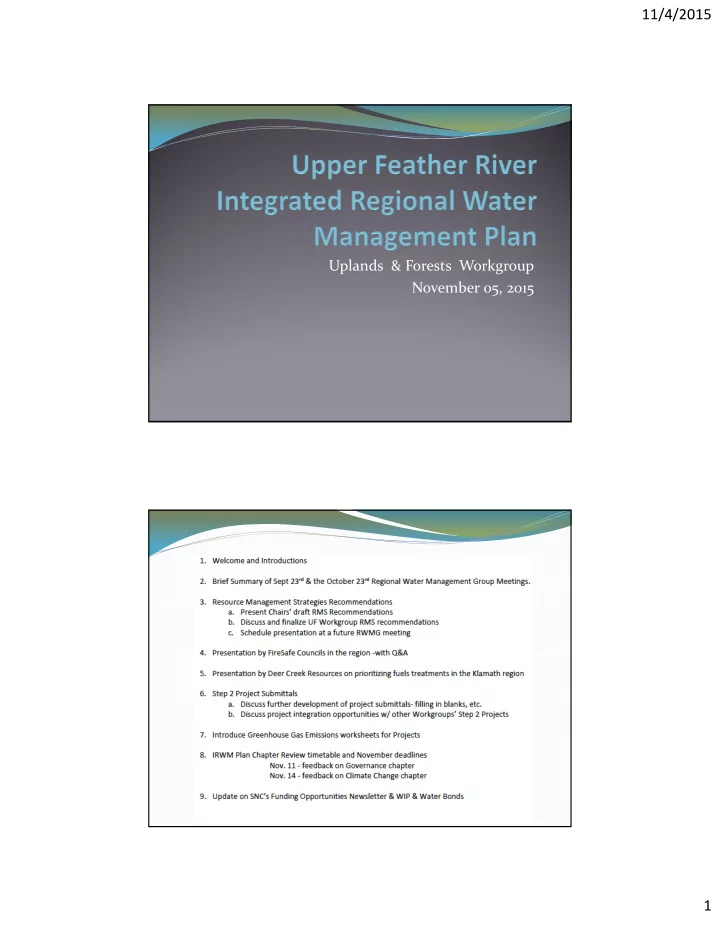
11/4/2015 Uplands & Forests Workgroup November 05, 2015 1 - - PDF document
11/4/2015 Uplands & Forests Workgroup November 05, 2015 1 11/4/2015 Summary of RWMG Meetings Project Status 34 signatories to MOU ; Butte County meeting Chapter Review Process Step 2 Project Submittals Capacity
Project Status
34 signatories to MOU ; Butte County meeting
Chapter Review Process Step 2 Project Submittals Capacity Building Project Selection Criteria Meeting packets and video available on
Next RWMG meeting
December 4, 1pm
December 4th presentation to RWMG
Increase communication between land use planners
Plan for growth in a way that conserves water resources
Direct development away from undeveloped mountain
Develop watershed information and strategies to
The Natural Resources Agency and California Environmental Protection Agency should support an integrated approach to achieve the maintenance of stable watersheds where sediment yield mimics the natural sediment production that would occur in the absence of anthropogenic conditions. Federal and State governments should support development of guidelines to identify when geomorphic assessments of streams for watershed stability are appropriate to prevent undue delays in processing permits and ensure that studies are scaled to project size. Where required, all responsible agencies should utilize a common GIS mapping framework and support sediment and flow monitoring programs to determine the sediment yields from a watershed and sediment budgets for downstream areas that include consistent monitoring protocols for scientifically defensible data of comparable quality throughout the state.
Welcome and take it away Nils, Chuck and Tom!!!!
Presentation by Deer Creek Resources, LLC. Thanks Zeke. We have no RMS Recommendations on introducing low intensity fire except as a potential O&M tool to maintaining forest fuels thinning projects in the Regional thinning project. The tribal representatives will address this topic too.
Category Number of Projects Agricultural Land Stewardship 13 Floodplains/Meadows/Waterbodies 15 Municipal Services 39 Tribal Advisory Committee 5 Uplands/Forest 9 Total 81
Workgroup Coordinators to help with Project
Complete GHG emissions worksheet Strengthen Step 2 Proposals Identify Integration opportunities Review All Workgroup RMS Recommendations
Focus on strategic considerations and multiple benefit
Front load the project development effort by focusing
J.
Contribution of the project in adapting to the effects of climate change in the region
compared to project alternatives
the IRWM Plan
Summary: The Upper Feather River Tribal Review
Project provides a mechanism for relevant Upper Feather River (UFR) Tribe(s), the Maidu Summit Consortium and/or Tribal Review Committee to evaluate and provide recommendations to each project submitted to the UFR RWMG to incorporate Traditional Ecological Knowledge (TEK). Project reviewers will be comprised of Tribal Environmental Directors, Tribal Elders, and other persons with knowledge of Traditional Practices and sustainability.
Organization: Maidu Summit Consortium Contact: Trina Cunningham
Summary: The purpose of the project is to:
1.
Reduce catastrophic wildfire in overstocked forests through forest thinning
2.
Restore the forest hydrograph by reducing the rate of conifer evapotranspiration, and
3.
Reduce conifer interception of rain and snow and enhance the infiltration of soil moisture by increasing spacing of dominant and codominant overstory trees. The phased, cooperative project will be designed and implemented at a broad, multi-ownership, landscape level.
Organization: Soper Company Contact: Ryan J. McKillop
Organization: Collins Pine Company Contact: Jay Francis Summary: This study will use a before/after control
Organization: Cal Poly – San Luis Obispo Contact: Christopher Surfleet Summary: Quantifying the response of meadow restoration
assists forest, range, and agricultural land managers determine the effect of their investment in meadow restoration. This study is using a before after control intervention (BACI) study design to study the hydrologic change conifer removal from a historic meadow (Marian Meadow). We have been measuring soil moisture, groundwater levels, and soil hydric characteristics for two years prior to meadow restoration and currently have funding for study one year following meadow restoration.
This application is requesting funding to increase the length of
study by two years.
Project Level
Suggested streamlined process
1.
Develop chapters
2.
Internal staff review
3.
Release for 30 day comment period
4.
Comments addressed and revisions made as appropriate
5.
Complex questions brought to RWMG during chapter presentation Schedule target
Public Draft Plan – April/May
Individual MOU entities send comment letters to the
The workgroup as a group develops comments? Other approaches?
Funding Opportunities Newsletter, WIP, and water bond
Workgroup activities for the rest of year 2 (No 2015-
All Workgroups Capacity Building/Implementation
Workshop?
Future workgroup meetings? Chapter review
Next RWMG meeting – December 4, 1pm Workgroup Chair Update
Present RMS Recommendations & Discuss Projects
Integration: e.g.:
considered potentially linked, e.g. . (MS-2 (Turner Springs), MS-32 (Quincy CSD), ALS-4 (Invasive Weeds), ALS (fire water storage), TAC-2 (Humbug vegetation).
waterbodies, etc. (e.g. UF-6 (municipal) & UF-1 and UF-2 for meadows, and UF-12 (regional scale) for municipal, meadows and waterbodies.)
proposals that could be incorporated into to regional monitoring and data proposals, (e.g. Lidar (UF-13), Watershed monitoring (FWM-6), Groundwater monitoring (MS-13), TEK (TAC-6), and weather stations (ALS-8), etc..
educational content. and focus
Website: http://featherriver.org Mike DeLasaux, Workgroup Chair: mjdelasaux@ucdavis.edu John Sheehan, Workgropu Alternate: johnjo@psln.com Leah Wills, Workgroup Coordinator: UFR.uplands@gmail.com