Salmon management and Sport fishing a Swedish perspective - 2012 - - PowerPoint PPT Presentation

salmon management and sport fishing
SMART_READER_LITE
LIVE PREVIEW

Salmon management and Sport fishing a Swedish perspective - 2012 - - PowerPoint PPT Presentation

Salmon management and Sport fishing a Swedish perspective - 2012 Torne river Kalix river Rne river Pite river by river Byske river % of commercial catch in River the Baltic Sea 2011 56 Torne and Kalix rivers 7 Indalslven 5


slide-1
SLIDE 1

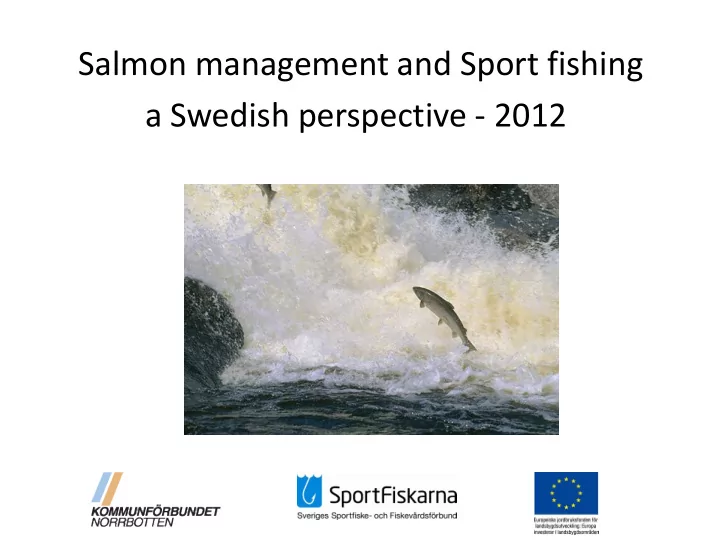
Salmon management and Sport fishing a Swedish perspective - 2012

slide-2
SLIDE 2

Torne river Kalix river Råne river Pite river Åby river Byske river

slide-3
SLIDE 3

% of commercial catch in the Baltic Sea 2011 River 56 Torne and Kalix rivers 7 Indalsälven 5 Luleälven 4 Vindelälven 4 Byskeälven 3 Skellefteälven 3 Iijoki 2 Ångermanälven 2 Simojoki 2 Åbyälven 2 Oulujoki 1 Emån 1 Umeälven 1 Råneälven 1 Neumunas 1 Ljungan 1 Dalälven 1 Mörrumsån 1 Parnu

slide-4
SLIDE 4

Postsmolt survival is decreasing Longline fishing has increased

Longline fishing effort Baltic Sea geardays per year ICES

1990 1995 2000 2005 10 20 30 40 50 60

Post-smolt survival

Year Survival (%) Wild salmon Reared salmon

500000 1000000 1500000 2000000 2500000 3000000 2007 2008 2009 2010 2011

Trend for wild salmon?

slide-5
SLIDE 5

8890 8479 4607 3891 6561 3163 6489 6838 6173 3192 2562 8232 863 1378 1418 1628 1012 544 518 723 1048 532 597 1017

2000 4000 6000 8000 10000

2001 2002 2003 2004 2005 2006 2007 2008 2009 2010 2011 *2012

Salmon at fish ladders Pite- and Kalix river

*Preliminary

slide-6
SLIDE 6

Problems

  • Previous Salmon management saw rivers as only

smolt production units and Salmon catch is localized to coast and sea phase.

  • That results in a biologically unsound fishery where

catch is practised on mixed river stocks. Therefore weak river stocks are having extreme difficulties recovering.

  • Even in ”strong rivers” the number of returning

Salmon is too small to allow for the development of Salmon fishing tourism.

slide-7
SLIDE 7

Even strong rivers currently cannot develop sport fishing tourism. Baltic Salmon rivers are uncompetitive as sport fishing destinations

7,1 4 0,22 1,8 0,5 0,35 0,3 0,4 0,11 0,1 0,06 0,03 1 2 3 4 5 6 7 8

Salmon per sport fisherman and day 2011-2012

slide-8
SLIDE 8

www.roxtons.com

Due to low salmon returns and river catches Baltic Salmon rivers are not on the map as sport fishing destinations

slide-9
SLIDE 9

Present management is preventing development and income possibilities for river basins

  • Fishing on the River Tweed generates 21.7 million € annually to the local

economy and directly supports 487 full-time jobs. Anglers each spend on average 228 € per day in the area compared to just 61.8 € by other (non- fishing) visitors to the area.

  • Fishing on the River Spey generates 14 million € annually to the local

economy and directly supports 401 full-time jobs.

  • Sport fishing in Canada for Atlantic salmon generated more than 97 million

€ 2010

  • Sport fishing in Scotland generates 132.5 million € annually and more than

2 500 full-time jobs.

  • Ireland 11 million € generated by sport fishing for Salmon 2003. 42% of

sport fishermen are overseas tourists.

  • Normal price for fishing for Salmon at better fishing camps in Russia starts

at 6 300 € per week.

(Tweed fishery board, Spey fishery board, Swedish agency for regional and economic growth)
slide-10
SLIDE 10

EU Commission´s proposed multiannual plan for Baltic Salmon

Total allowable catch (TAC) at sea shall not exceed the 0,1 fishing mortality rate. This still allows for a continuation of mixed stock fisheries at sea including weak rivers. Sweden has stopped its sea fishery – protecting its small scale coastal fishery. When will Finland do the same?

slide-11
SLIDE 11

Sea fishery on mixed salmon stocks is a fishery on weak and endangered populations.

(Salmon at Hednäs located at 40 km of 170km)

slide-12
SLIDE 12

EU´s proposed multiannual plan for Baltic Salmon Reared salmon restocking will be phased out within 7 years. This if a the river does not have possibility of free migration and suitable habitat. This means that compensatory releases of ca. 3,7 million smolt in Sweden and Finland could stop = 2 x Torne river at 100 % smolt production

slide-13
SLIDE 13

Hydro electric industry should always compensate for the damage they cause. Releases should only be seen as a last resort and should be phased out but only when compensation can be achieved by river restoration or creation of salmon habitat equal to direct restocking.

EU´s proposed multiannual plan for Baltic Salmon

slide-14
SLIDE 14

Åby river 2010-2011 0 strayers detected at fish ladder Kalix river 2008-2011 1 strayer detected of 25 000 fish Byske river max 5 strayers per year of total rod catch of approx. 300 fish per year

Is straying a Problem? How big a problem?

Straying reared salmon = Adipose fin clipped Wild salmon with adipose fin

slide-15
SLIDE 15

The recreational value of sport fishing based upon reared salmon?

  • Älvkarleby had approx. 13 500 fishing days 2010 and has approx.

21 600 fishing days during a good salmon year. The total value of fishing tourism to Älvkarleby was ca. 1,75 million € 2010.

  • Skellefte river within Skellefteå has ca. 11 000 fishing days per year.

Within city and easily available fishing appreciated by users including immigrants, unemployed and socially at risk.

  • Lule river at Boden has ca. 12 000 fishing days per year. Tourism

value ca. 700 000 € per year.

slide-16
SLIDE 16
  • Baltic Salmon management should be based upon the

principal that wild salmon should be allowed to return to their home river for reproduction and harvest based upon each rivers specific capacity. Close the mixed stock fishery.

  • Create a goal for numbers of returning spawners for each

river.

  • Smolt productions short term goal must be at least 90 % of

potential, long term goal 100%. Salmon Management Future Goals What sportfishing needs for development

slide-17
SLIDE 17

Current Regulation of Sportfishing in Sweden

National Reglations

  • 1 Salmon per fisherman and day
  • Closed fishing during Spawning season
  • Start date for sportfishing in weak salmon rivers
  • Regulation of trolling fishery?

Local Regulations and Policy

  • Catch no kill for salmon e.g. Kåge river
  • Catch no kill for sea trout e.g. Ängesån river
slide-18
SLIDE 18

Future Regulation of recreational fishing in Sweden?

Greater need for local regulations:

  • Seasonal bag limit for total number of salmon

per sport and house hold fisherman.

  • Regulation of trolling fishery.
  • Regulation of sea trout fishing in northern

rivers and associated coastal areas. Sweden has since 2006 seasonal closure of gillnet fishing in shallow coastal waters. Finland?

slide-19
SLIDE 19

Without a just and share of the future Salmon

resource important stake holders such as fisheries owners within river valleys see no value in the very resource they have a key part in managing.

slide-20
SLIDE 20

The Norrbotten Association

  • f Local Authorities
  • Number of inhabitants: 253 000, 2.6

citizens per km² - 117 citizens per km2 EU average.

  • Area: 98 249 km², 16th largest country in

EU, 25 % of Sweden's area.

Kiruna Haparanda Pajala Överkalix Piteå Kalix Luleå Gällivare Jokkmokk Arjeplog Arvidsjaur Älvsbyn Boden Övertorneå