
SLIDE 1
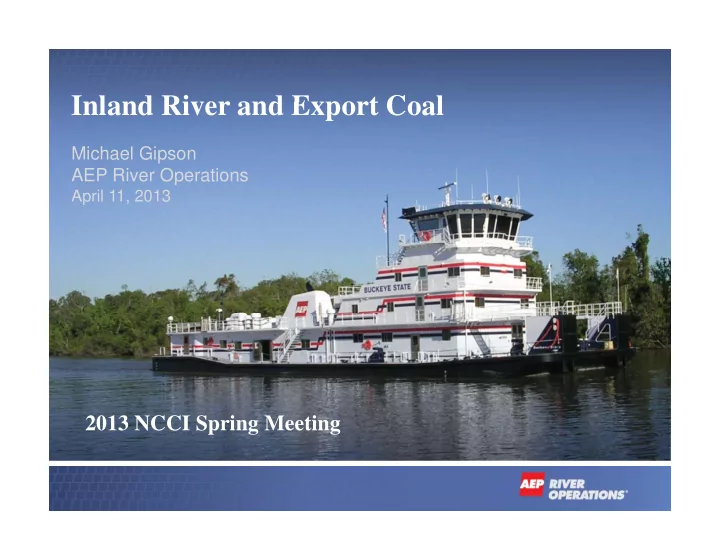
Inland River and Export Coal Inland River and Export Coal
Michael Gipson AEP River Operations AEP River Operations
April 11, 2013
Inland River and Export Coal Inland River and Export Coal Michael - - PowerPoint PPT Presentation
Inland River and Export Coal Inland River and Export Coal Michael Gipson AEP River Operations AEP River Operations April 11, 2013 2013 NCCI Spring Meeting One of the Nations Leading Barge Companies AEP River Operations is a
Michael Gipson AEP River Operations AEP River Operations
April 11, 2013
AEP River Operations is a fully-integrated barge line that delivers over 74 million tons of dry cargo for our customers each year. AEP River Operations’ fleet of boats and barges
Mi li Chi Mil k d Pitt b h Minneapolis, Chicago, Milwaukee, and Pittsburgh.
AEP t t AEP Ri O ti t it l d AEP entrusts AEP River Operations to manage its coal and consumable supply chain to its power generation fleet on the Ohio River.
2
Full-service Inland Waterways carrier
3, 63
Regional Operations
Gulf Operations
3
Convent Fleet
two dry docks two dry docks
p g g p capabilities
State of the Art Training Facility:
4
5
Reduced emissions by 40% Reduced emissions by 40% Increased reliability, fewer repair-related delays Decreased fuel consumption by 15% Advanced safety features d a ced sa ety eatu es Increased amenities for maximum crew comfort
6
About 600 million tons of cargo move each year on the U.S. inland waterways, most
About 600 million tons of cargo move each year on the U.S. inland waterways, most
L k & D Si Lock & Dam Sites
One of America’s largest dry cargo carriers
Approximately 75 million tons pp y shipped in 2012
In 2010 our Inland Waterways system moved close to 600 million tons of freight valued at The average cost savings of $11.00/ton, when compared to rail and truck, means the Inland Waterways System saved the million tons of freight valued at more than $180 billion. Waterways System saved the nation ~ $6 Billion in transportation costs in 2010!
9
1.0 1.0
95.3 95.3
1,609.6 1,609.6
10
12
40 x 2,100 = 84,000 tons per tow 25 x 1,452 = 36,300 tons per tow
13
Boats move more slowly: 50 Boats move more slowly: 50 miles per day vs. 200 miles per day Delays for passing through narrowed channels (one way traffic) Lost nearly 200 boat days to river closures in August and September September Increased barge maintenance costs costs
15
November 2012 Upper Missouri November 2012 Upper Missouri River reservoirs are low, so USCOE stops river flow Anticipation of water levels would Anticipation of water levels would drop below 9’ draft the first part of December Rock removal at mile 78 and mile Rock removal at mile 78 and mile 46 (Rock Pinnacles), possible complete late Feb. 2013 Industry concerns of halting barge Industry concerns of halting barge traffic, divert tonnage to Ohio River
invest large sums to increase the Gulf capacity for export coal
begins to increase tonnage and tightens capacity opens up door capacity, opens up door for export out of Gulf.
markets began to markets began to recover, with high gas prices, US coal demand should remain high.
18
continue with strong growth which increases their demand for coal
and global demand, will continue high demand for US Coal
Panama Canal expansion will increase tons through the Gulf for Asian market and Mexico.
19
OECD – Organization for Economic Cooperation and Development Source: U.S. EIA
Mi h l Gi Michael Gipson Sales Representative Office – (636) 530-2441 mbgipson@aepriverops.com g p @ p p