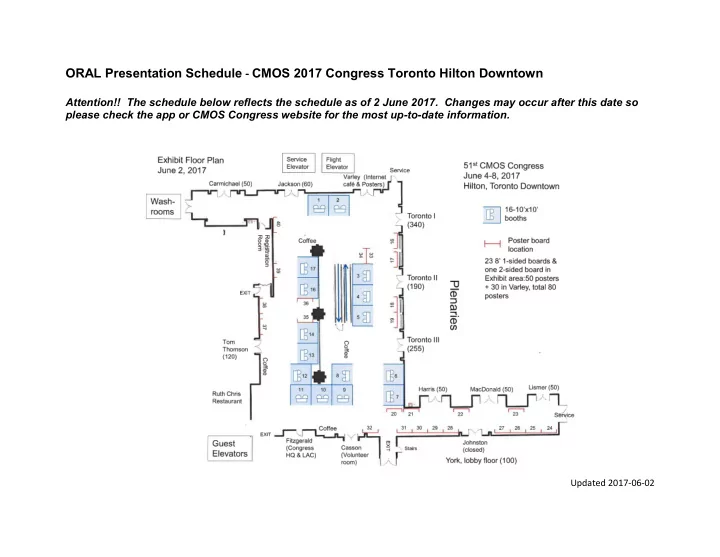
SLIDE 1
ORAL Presentation Schedule - CMOS 2017 Congress Toronto Hilton Downtown
Attention!! The schedule below reflects the schedule as of 2 June 2017. Changes may occur after this date so please check the app or CMOS Congress website for the most up-to-date information.
Updated 2017-06-02
SLIDE 2 Monday June 5 Oral Presentation Schedule THEME SESSION TITLE Presenter Time Room Plenaries Plenary The Future of the Weather Enterprise with a Look Back over the Past David Grimes 9:00 Toronto Plenaries Plenary Sponsor and Exhibitor Presentations Peter Taylor 9:40 Toronto Plenaries Plenary Water Futures in Changing Cold Regions Howard Wheater 9:50 Toronto Parallel Sessions 11:00-12:30 Climate Data Assimilation, Ensemble Prediction, and Intrinsic Predictability - Part 1 Depicting the Predictable Patterns of Asian and Western Pacific Climate
- n Seasonal and Subseasonal Time
Scales Song Yang 11:00 York Climate Data Assimilation, Ensemble Prediction, and Intrinsic Predictability - Part 1 A practical scheme of the sigma- point Kalman filter for high- dimensional systems Youmin Tang 11:15 York Climate Data Assimilation, Ensemble Prediction, and Intrinsic Predictability - Part 1 Determining the spectrum of the nonlinear local Lyapunov exponents in a multidimensional chaotic system Ruiqiang Ding 11:30 York Climate Data Assimilation, Ensemble Prediction, and Intrinsic Predictability - Part 1 Verification of convective-scale ensemble forecasts system during the OLYMPEX (Olympics Experiment) field campaign in Washington State during December 2015 Jonathan Doyle 11:45 York Climate Data Assimilation, Ensemble Prediction, and Intrinsic Predictability - Part 1 Study of Nonlinear Forcing Singular Vector on Tropical Cyclone predictability Xiaohao Qin 12:00 York
SLIDE 3 Climate Data Assimilation, Ensemble Prediction, and Intrinsic Predictability - Part 1 Key observing locations for advancing beyond the winter predictability barrier of Indian Ocean dipole events Rong Feng 12:15 York Climate Hydro- meteorological extremes in a changing climate: improved tools for downscaling – Part 1 The representation of extreme
- rographic precipitation events in an
intermediate complexity atmospheric model Ethan Gutmann 11:00 Toronto I Climate Hydro- meteorological extremes in a changing climate: improved tools for downscaling - Part 1 High-resolution dynamical downscaling of precipitation and temperature over western Canada by Pseudo-Global Warming method using WRF model Zilefac Elvis Asong 11:30 Toronto I Climate Hydro- meteorological extremes in a changing climate: improved tools for downscaling - Part 1 The diurnal cycle of summertime precipitation over Alberta using a convection-permitting model Lucia Scaff 11:45 Toronto I Climate Hydro- meteorological extremes in a changing climate: improved tools for downscaling - Part 1 Very high-resolution (1-km) dynamical downscaling of continental scale 4-km WRF regional climate simulation and its evaluation in Central U.S. Zhe Zhang 12:00 Toronto I Interdisciplinary and others A Transdisciplinary Approach to Future Earth The economics of disaster management Paul Kovacs 11:00 Toronto III Interdisciplinary and others A Transdisciplinary Approach to Future Earth Weather Extremes and Human Health: Adaptation to Protect Canadians in a Changing Climate Peter Berry 11:00 Toronto III Interdisciplinary A Transdisciplinary Future Earth, Future Transport Jean Andrey 11:00 Toronto III
SLIDE 4 and others Approach to Future Earth Interdisciplinary and others A Transdisciplinary Approach to Future Earth Transdisciplinary approaches of the Future Earth Ocean Knowledge- Action Network David Oram 11:00 Toronto III Interdisciplinary and others A Transdisciplinary Approach to Future Earth Addressing the Transdisciplinary Approach through Global Research Programs Gordon McBean 11:00 Toronto III Interdisciplinary and others A Transdisciplinary Approach to Future Earth Toward seamless weather-climate and environmental prediction Gilbert Brunet 11:00 Toronto III Interdisciplinary and others Remote Sensing of the Atmosphere and Surface from Space
A Summary of Canadian Progress in Spatial Heterodyne Spectroscopy (SHS) Gordon Shepherd 11:00 Thomson Interdisciplinary and others Remote Sensing of the Atmosphere and Surface from Space
Long-Term, Episodic and Quasi- periodic CO Events as Seen in the MOPITT Dataset. James Drummond 11:15 Thomson Interdisciplinary and others Remote Sensing of the Atmosphere and Surface from Space
ACE-FTS satellite measurements of HCN in the upper troposphere to N<sub><small>2</small></sub>O in the lower thermosphere Patrick Sheese 11:30 Thomson Interdisciplinary and others Remote Sensing of the Atmosphere and Surface from Space
Studies in support of greenhouse gas
- bservations in the Arctic and boreal
regions from a highly elliptical orbit (HEO) mission Joseph Mendonca 11:45 Thomson Interdisciplinary and others Remote Sensing of the Atmosphere and Surface from Space
The Orbiting Carbon Observatory-2 Debra Wunch 12:00 Thomson Interdisciplinary and others Remote Sensing of the Atmosphere and Surface from Space
Overview and Validation Results from the Canadian Atmospheric Chemistry Experiment (ACE) Satellite Mission Kaley Walker 12:15 Thomson Oceans Physical Conservation laws and inertial- Nicolas Grisouard 11:00 Carmichael -
SLIDE 5 Oceanography
symmetric instability Jackson Oceans Physical Oceanography
Ekman boundary layers in a large- scale gravity current experiment Shahrzad Davarpanah Jazi 11:15 Carmichael - Jackson Oceans Physical Oceanography
Surface tides in the Strait of Georgia near the Fraser River plume Mark Halverson 11:30 Carmichael - Jackson Oceans Physical Oceanography
Convective instabilities in internal solitary waves of depression shoaling
Gustavo Rivera 11:45 Carmichael - Jackson Oceans Physical Oceanography
Instability properties under a model mode-1 internal tide. John Segreto 12:00 Carmichael - Jackson Oceans Physical Oceanography
A conceptual model of the ocean
- verturning circulation with two
closed basins and a reentrant channel. Louis- Philippe Nadeau 12:15 Carmichael - Jackson Weather High-Impact Weather and Climate - Part 1 "The Future of High-Impact Weather Forecasting" the human forecaster versus computer modelling Jerry Shields 11:00 Toronto II Weather High-Impact Weather and Climate - Part 1 The Severe Weather Outbreak of the Summer: 2 August 2015 Steve Knott 11:30 Toronto II Weather High-Impact Weather and Climate - Part 1 Without Warning: An Ingredients- Based Investigation of the 2016 Windsor Ontario Tornado Eyad Atallah 11:45 Toronto II Weather High-Impact Weather and Climate - Part 1 Spatial Verification of Lightning Forecasts Made During the Toronto 2015 Pan Am Games Dominiqu e Brunet 12:00 Toronto II Weather High-Impact Weather and Climate - Part 1 Signatures of Tornadoes seen with VHF Windprofiler Radars Wayne Hocking 12:15 Toronto II Parallel Sessions 14:00-15:30 Atmosphere Clouds: Microphysics, Sensitivity of Tropical Cyclone Intensification to Axisymmetric Heat Georgina Paull 14:00 Toronto III
SLIDE 6 Aerosols, and Radiation Sources: The Role of Different Microphysical Properties Atmosphere Clouds: Microphysics, Aerosols, and Radiation Turbulence effect on cloud droplet collision: how does the droplet size distribution evolve in cumulus clouds? Sisi chen 14:15 Toronto III Atmosphere Clouds: Microphysics, Aerosols, and Radiation Measuring and Modeling Nonlinear Diffusion in Single Aerosol Particles Ali Moridnejad 14:30 Toronto III Atmosphere Clouds: Microphysics, Aerosols, and Radiation Impact of Saharan dust aerosols on radiation and cloud microphysics
- ver the tropical east Atlantic Ocean
Abdulla Mamun 14:45 Toronto III Atmosphere Clouds: Microphysics, Aerosols, and Radiation Internal Mixing of Black Carbon Aerosols and Its impact on Climate Jiangnan Li 15:00 Toronto III Atmosphere Clouds: Microphysics, Aerosols, and Radiation A sensibility study of the impacts of ice multiplication process in predicting high ice water content condition by Canadian high- resolution NWP model Zhipeng Qu 15:15 Toronto III Climate Data Assimilation, Ensemble Prediction, and Intrinsic Predictability - Part 2 An improved 2015 El Niño hindcast using the CNOP approach to
- ptimize initial conditions and model
parameters in a coupled model Rong-Hua Zhang 14:00 York Climate Data Assimilation, Ensemble Prediction, and Intrinsic Predictability - Part 2 Developing a 2D Hybrid Data Assimilation System for Surface Analysis Zheng Wang 14:15 York Climate Data Assimilation, Ensemble Prediction, and Improved ensemble-mean forecasting of ENSO events by a zero-mean stochastic error model of Fei Zheng 14:30 York
SLIDE 7
Intrinsic Predictability - Part 2 an intermediate coupled model Climate Data Assimilation, Ensemble Prediction, and Intrinsic Predictability - Part 2 Role of sensitive physical parameter combinations in reducing simulation and forecast errors of sensible heat flux and latent heat flux in China Guodong Sun 14:45 York Climate Data Assimilation, Ensemble Prediction, and Intrinsic Predictability - Part 2 The formulation of vector weights in localized particle filter Zheqi Shen 15:00 York Climate Data Assimilation, Ensemble Prediction, and Intrinsic Predictability - Part 2 A study of predictability of a heavy rainfall event in steep domains by using BVs and ESVs Feifan Zhou 15:15 York Climate Hydro- meteorological extremes in a changing climate: improved tools for downscaling - Part 2 A 50-member ensemble from a regional climate model at 12- km resolution to address local impacts from natural variability and extreme events under climate change Martin Leduc 14:00 Toronto I Climate Hydro- meteorological extremes in a changing climate: improved tools for downscaling - Part 2 Multivariate quantile mapping bias correction: An N-dimensional probability density function transform for climate model simulations of multiple variables Alex Cannon 14:30 Toronto I Climate Hydro- meteorological extremes in a changing climate: improved tools for downscaling - Part 2 The Added Value of Convection- permitting Simulations for Dynamically Downscaling Precipitation Extremes Andre Erler 14:45 Toronto I Climate Hydro- Evaluation of the added value of high Médéric St-Pierre 15:00 Toronto I
SLIDE 8
meteorological extremes in a changing climate: improved tools for downscaling - Part 2 resolution in the Canadian Regional Climate Model for freezing rain Climate Hydro- meteorological extremes in a changing climate: improved tools for downscaling - Part 2 Probabilistic Projections of Regional Climatic Changes Through an Ensemble Modeling Approach Gordon Huang 15:15 Toronto I Interdisciplinary and others Planetary Atmospheres, Oceans and Ice - Part 1 Trace gas retrievals for the ExoMars Trace Gas Orbiter Atmospheric Chemistry Suite mid-infrared channel Kevin Olsen 14:00 Thomson Interdisciplinary and others Planetary Atmospheres, Oceans and Ice - Part 1 The GEM-Mars General Circulation Model for Mars Lori Neary 14:15 Thomson Interdisciplinary and others Planetary Atmospheres, Oceans and Ice - Part 1 Characterizations of Martian Water- Ice Cloud Crystal Geometries From Phase Functions Derived Using MARCI Image Data Brittney Cooper 14:30 Thomson Interdisciplinary and others Planetary Atmospheres, Oceans and Ice - Part 1 Inter-annual and diurnal variability in clouds observed from MSL over two Martian years Jacob Kloos 14:45 Thomson Interdisciplinary and others Planetary Atmospheres, Oceans and Ice - Part 1 Dust within Gale Crater, Mars: Observations from the Mars Science Laboratory Casey Moore 15:00 Thomson Interdisciplinary and others Planetary Atmospheres, Oceans and Ice - Part 1 Estimating the Altitude of Martian Clouds at the Mars Science Laboratory Rover Landing Site Charissa Campbell 15:15 Thomson Oceans Physical Interannual Variability of Global Neil Tandon 14:00 Carmichael -
SLIDE 9 Oceanography
Overturning Circulation Dominated by Pacific Variability Jackson Oceans Physical Oceanography
The variations of the Atlantic Meridional Overturning Circulation from an eddy-resolving North Atlantic model Zeliang Wang 14:15 Carmichael - Jackson Oceans Physical Oceanography
Long-term versus decadal-scale variability in deep-water ventilation in the Labrador Sea Igor Yashayaev 14:30 Carmichael - Jackson Oceans Physical Oceanography
Interannual to decadal variability of the upper ocean over the northeast Pacific Patrick Cummins 14:45 Carmichael - Jackson Oceans Physical Oceanography
Dynamics of Quasi-Geostrophic Meddy-Type Vortices Benjamin Storer 15:00 Carmichael - Jackson Oceans Physical Oceanography
The Stability of the Gulf of Oman Current Francis Poulin 15:15 Carmichael - Jackson Weather High-Impact Weather and Climate - Part 2 The 2013 Billion Dollar Flash Flood in Toronto - Challenges for Operational Forecasting and Nowcasting David Sills 14:00 Toronto II Weather High-Impact Weather and Climate - Part 2 A Case Study on Snow Squall Lines in comparison with Warm Season Squall Lines Brandon Taylor 14:15 Toronto II Weather High-Impact Weather and Climate - Part 2 Automated Forecast Products for Arctic Blizzard Conditions William Burrows 14:30 Toronto II Weather High-Impact Weather and Climate - Part 2 High-resolution wind fields using an
- ptical flow technique for GOES-
R/ABI Robert Rabin 14:45 Toronto II Weather High-Impact Weather and Climate - Part 2 Applying New Satellite Techniques and Products for Forecasting Rapid Cyclogenesis and Extratropical Transition of Tropical Cyclones Michael Folmer 15:00 Toronto II Weather High-Impact Weather and Size Matters with Hurricanes: A New Component for a Hurricane Scale Athena Masson 15:15 Toronto II
SLIDE 10
Climate - Part 2 Tuesday June 6 Oral Presentation Schedule THEME SESSION TITLE Presenter Time Room Plenaries Plenary An Introduction to the GOES-R Satellite Series Steven Goodman 8:30 Toronto Plenaries Plenary Exhibitor Presentations Peter Taylor 9:10 Toronto Plenaries Plenary "OK Granny, listen up.." Claire Martin 9:20 Toronto Parallel Sessions 10:30-12:00 Air Quality Climate Change, Air Quality and Interconnections to Human Health Air Quality Forecasting in Canada and worldwide: past, present and future Veronique Bouchet 10:30 Jackson Air Quality Climate Change, Air Quality and Interconnections to Human Health Coordinating Climate and Air Quality Policies through Inclusion of Air Quality Co-benefits of GHG Reduction Amir Hakami 11:00 Jackson Air Quality Climate Change, Air Quality and Interconnections to Human Health Quantifying Environmental Damages from Pavement Management Activities Filzah Nasir 11:30 Jackson Air Quality Climate Change, Air Quality and Interconnections to Human Health Mitigating climate change’s impact on human health through photocatalytic air pollution control Stephanie Shaw 11:45 Jackson Atmosphere General Session - Atmosphere The May 4, 2016 Fort McMurray Pyrocumulonimbus Bob Kocht- ubajda 10:30 Carmichael Atmosphere General Session - Atmosphere Synoptic controls on orographic precipitation distributions during OLYMPEX Daniel Kirshbaum 10:45 Carmichael Atmosphere General Session - Atmosphere Source apportionment of aerosols on Sable Island, Nova Scotia, Canada Loay Jabre 11:00 Carmichael
SLIDE 11
Climate Climate Variability and Predictability - Part 1 Pacific-Atlantic interactions heat up: Evidence from El Nino and Mid- latitude Blobs Jin-Yi YU 10:30 Thomson Climate Climate Variability and Predictability - Part 1 Impact of cloud radiative effects on midlatitude jet variability in an aquaplanet GCM Oliver Watt-Meyer 11:00 Thomson Climate Climate Variability and Predictability - Part 1 Variations of Mid-Oceanic Troughs and Associated Atmospheric Teleconnection Patterns: Roles of Tropical SST and Arctic Sea Ice Song Yang 11:15 Thomson Climate Climate Variability and Predictability - Part 1 Changing association of Northern Hemisphere teleconnection patterns with ENSO Nicholas Soulard 11:30 Thomson Climate Climate Variability and Predictability - Part 1 Teleconnection over Afro-eurasia and Influence of Tropical Sea Surface Temperature on It Shan He 11:45 Thomson Interdisciplinary and others Atmosphere, Ocean and Climate Dynamics - Part 1 The Fully Nonlinear Stratified Geostrophic Adjustment Problem Aaron Coutino 10:30 Toronto III Interdisciplinary and others Atmosphere, Ocean and Climate Dynamics - Part 1 Internal Solitary Wave Generation: Effects of a Mean Background Current Kevin Lamb 10:45 Toronto III Interdisciplinary and others Atmosphere, Ocean and Climate Dynamics - Part 1 Upper ocean physical and biological response to Typhoon Cimaron (2006) in the South China Sea Yujuan Sun 11:00 Toronto III Interdisciplinary and others Atmosphere, Ocean and Climate Dynamics - Part 1 Scaling estimates of tracer flux though a submarine canyon Karina Ramos- Musalem 11:15 Toronto III Oceans Canada's Three Oceans: Evolving Science in the Arctic, Atlantic and Pacific Oceans Modelled Arctic Freshwater Components from Dissolved Barium and δ18O Susan Allen 10:30 Toronto II Oceans Canada's Three Oceans: Evolving Science in the Spatial and temporal variability of internal wave energy and its potential effect on mixing in the Canadian Melanie Chanona 10:45 Toronto II
SLIDE 12 Arctic, Atlantic and Pacific Oceans Arctic Ocean Oceans Canada's Three Oceans: Evolving Science in the Arctic, Atlantic and Pacific Oceans Quantifying the impact of internal tide mixing on shelf-basin exchange in a numerical model of the Arctic Ocean Jacquie- Lee Thibault 11:00 Toronto II Oceans Canada's Three Oceans: Evolving Science in the Arctic, Atlantic and Pacific Oceans The Arctic hydrosphere-cryosphere complex: a dynamic nexus of biogenic dimethysulfide production during summer. Martine Lizotte 11:15 Toronto II Oceans Canada's Three Oceans: Evolving Science in the Arctic, Atlantic and Pacific Oceans Role of Increasing Barents Sea Flux
- n the Intermediate Circulation in the
Canada Basin Susan Allen 11:30 Toronto II Oceans Canada's Three Oceans: Evolving Science in the Arctic, Atlantic and Pacific Oceans Labrador Sea Water formation rate and its impact on the meridional
Charlene Feucher 11:45 Toronto II Weather Coupled Environmental Prediction The New Coupled Global Deterministic Prediction System: Sensitivity of Operational NWP Forecasts to Coupling with an Ice- Ocean Model Greg Smith 10:30 Governor General Weather Coupled Environmental Prediction Developing a dynamical-statistical
- bservation operator for SST data
assimilation Sam Pimentel 10:45 Governor General Weather Coupled Environmental Prediction Variational Computation of Sensible and Latent Heat Flux over Lake Superior Zuohao Cao 11:00 Governor General Weather Coupled Environmental Prediction Validation of the operational Regional Model Prediction System of the Gulf
- f St. Lawrence with in situ
Denis Gilbert 11:15 Governor General
SLIDE 13 temperature and salinity data from an autonomous profiler. Weather Coupled Environmental Prediction Subseasonal Forecast of Arctic Sea Ice Concentration Lei Wang 11:30 Governor General Weather Coupled Environmental Prediction Skillful regional prediction of Arctic sea ice on seasonal timescales Mitch Bushuk 11:45 Governor General Weather Monitoring - Renewal and Modernization MSC - Atmospheric Monitoring - Training Needs Assessment John MacPhee 10:30 Toronto I Weather Monitoring - Renewal and Modernization Designing Monitoring Networks to Better Understand the Past and Predict the future: The Meteorological Service of Canada's Needs Index Decision Support Model and the Collaborative Monitoring Initiative Alexander Zucconi 10:45 Toronto I Weather Monitoring - Renewal and Modernization Data Management Systems Tom Kralidis 11:00 Toronto I Weather Monitoring - Renewal and Modernization Marine Transformation Laura Medeiros 11:15 Toronto I Weather Monitoring - Renewal and Modernization Replacement of the Canadian Weather Radar Network Peter Leibiuk 11:30 Toronto I Weather Monitoring - Renewal and Modernization Upper Air Automation Patti Edwards 11:45 Toronto I Atmosphere Recent Advances in Remote Sensing of the Atmosphere - Part 1 An intercomparison of simultaneous island and aircraft overflight
- bservations of aerosols and trace
gases as part of the NASA North Atlantic Aerosols and Marine Ecosystems Study (NAAMES). Mark Gibson 11:15 Carmichael
SLIDE 14 Atmosphere Recent Advances in Remote Sensing of the Atmosphere - Part 1 Spatiotemporal Variability of Ammonia over North America from CrIS Satellite Observations Mark W. Shephard 11:30 Carmichael Atmosphere Recent Advances in Remote Sensing of the Atmosphere - Part 1 Impact of far infrared measurements
- n analyses of temperature and
humidity Laurence Coursol 11:45 Carmichael Parallel Sessions 14:00-15:30 Air Quality Measurements and modeling of air pollution - Part 1 Canadian Air Quality Modelling Platform for Policy Emission Reduction scenarios Sophie Cousineau 14:00 Jackson Air Quality Measurements and modeling of air pollution - Part 1 Carbon Monoxide Over Canada as Seen from the MOPITT instrument James Drummond 14:30 Jackson Air Quality Measurements and modeling of air pollution - Part 1 Quantifying emissions of CO and NO<sub>x</sub> using satellite
- bservations of multiple chemical
species Xuesong Zhang 14:45 Jackson Air Quality Measurements and modeling of air pollution - Part 1 INVESTIGATING AIRCRAFT- BASED EMISSIONS ESTIMATES USING GEM-MACH WITH THE TOP-DOWN EMISSION RATE RETRIEVAL ALGORITHM (TERRA) Sepehr Fathi 15:00 Jackson Air Quality Measurements and modeling of air pollution - Part 1 Long-term trend of ground-level
Tianchu Zhang 15:15 Jackson Climate Climate Variability and Predictability - Part 2 The Dynamical Influence of Separate Teleconnections from the Pacific and Indian Oceans on the Northern Annular Mode Christo- pher Fletcher 14:00 Thomson Climate Climate Variability and Predictability - Part 2 Connections linking the Spring Pacific-Arctic Dipole and Summer Sea Ice in the Beaufort-Chukchi Seas Will Perrie 14:15 Thomson Climate Climate Variability The Asian-Bering-North American Bin Yu 14:30 Thomson
SLIDE 15 and Predictability - Part 2 teleconnection: Seasonality, maintenance, and climate impact on North America Climate Climate Variability and Predictability - Part 2 A Decadal-scale Air-sea Interaction Theory for North Atlantic Multidecadal Variability: the NAT- NAO-AMOC-AMO Coupled Mode and Its Remote Influences Cheng Sun 14:45 Thomson Climate Climate Variability and Predictability - Part 2 Coupled modes of large-scale features and hydroclimate variables in western Canada during the warm season Kit Szeto 15:00 Thomson Climate Climate Variability and Predictability - Part 2 The Impact of Natural Climate Variability and Bias-correction on Hydrological Simulations of Climate Change Andre Erler 15:15 Thomson Climate General Session - Climate CCDP: GIS-Based Data Portal for Climate Change Impact Assessment Xiuquan Wang 14:00 Carmichael Climate General Session - Climate Oceanic origin of the transient climate response to cumulative CO2 emissions Andrew MacDougall 14:15 Carmichael Climate General Session - Climate Impact of Arctic Sea Ice loss on large-scale atmospheric circulation based on fully-coupled sensitivity experiments Thomas Oudar 14:30 Carmichael Climate General Session - Climate The Canadian Earth System Model version 5 Neil Swart 14:45 Carmichael Climate General Session - Climate Terrestrial rock weathering and the carbon cycle in the UVic Earth System Climate Model (ESCM): Applications to past and future climates Lawrence Mysak 15:00 Carmichael Climate General Session - Climate Analyzing the future climate change
- n winter road systems in Ontario's
Far North, Canada, using climate model projections Yukari Hori 15:15 Carmichael
SLIDE 16 Interdisciplinary and others The Year of Polar Prediction The Year of Polar Prediction: Environment and Climate Change Canada's objectives and planned activities. Paul Pestieau 14:00 Governor General Interdisciplinary and others The Year of Polar Prediction MEOPAR's Contribution to the Year
Alexa Reedman 14:15 Governor General Interdisciplinary and others The Year of Polar Prediction The Cambridge Bay Observatory: A Laboratory for Thermodynamic Sea- Ice Modelling Richard Dewey 14:30 Governor General Atmosphere GOES-R Readiness in Canada - Part 1 Preparing the Meteorological Service
David Bradley 14:30 Toronto I Atmosphere GOES-R Readiness in Canada - Part 1 Early GOES-R image examples over Canada Ronald Goodson 14:45 Toronto I Atmosphere GOES-R Readiness in Canada - Part 1 The Advanced Baseline Imager (ABI)
Tim Schmit 15:00 Toronto I Atmosphere GOES-R Readiness in Canada - Part 1 GOES-R Product Readiness: Post- Launch Product Testing Status of the L2+ Algorithms Wayne MacKenzie 15:15 Toronto I Interdisciplinary and others Planetary Atmospheres, Oceans and Ice - Part 2 Surface shielding of UV radiation on Mars from idealized spacecraft components Christina Smith 14:30 Toronto III Interdisciplinary and others Planetary Atmospheres, Oceans and Ice - Part 2 Laboratory Studies of Deliquescence and Adsorption at the Surface of Mars with Raman Scattering George Nikolakakos 14:45 Toronto III Interdisciplinary and others Planetary Atmospheres, Oceans and Ice - Part 2 An Investigation into how Water is Transported to the Moon's Polar Regions Jasmeer Sangha 15:00 Toronto III Interdisciplinary and others Planetary Atmospheres, Oceans and Ice - Part 2 Penitentes at Tartarus Dorsa, Pluto John Moores 15:15 Toronto III Oceans Physical Oceanography - Part Midlatitude-equatorial dynamics of a grounded deep western boundary Gordon Swaters 14:30 Toronto II
SLIDE 17 3 current Oceans Physical Oceanography - Part 3 Impacts of the IOD-associated temperature and salinity anomalies
- n the intermittent Equatorial
Undercurrent anomalies Junde Li 14:45 Toronto II Oceans Physical Oceanography - Part 3 Real-time buoy observations for typhoons in the South China Sea Jin Weifang 15:00 Toronto II Oceans Physical Oceanography - Part 3 Underwater Glider Measurements and Simulations of Storm-Induced Abrupt Upper Ocean Mixing Will Perrie 15:15 Toronto II Interdisciplinary and others Harsh Marine Environments Explosive cyclogenesis over the North Atlantic: progress, challenges and new research opportunities John Gyakum 14:45 Governor General Interdisciplinary and others Harsh Marine Environments An ocean surface current analysis (GlobCurrent) calibration and validation Rick Danielson 15:00 Governor General Interdisciplinary and others Harsh Marine Environments The Characteristics of Fog Offshore Newfoundland George Isaac 15:15 Governor General Parallel Sessions 16:00-17:30 Air Quality Measurements and modeling of air pollution - Part 2 What measurements tell us about the sources and sinks of atmospheric ammonia Jennifer Murphy 16:00 Jackson Air Quality Measurements and modeling of air pollution - Part 2 Estimation of nitrogen dioxide (NO2), sulfur dioxide (SO2) and ammonia (NH3) dry deposition over North America from satellite observations Shailesh Kumar Kharol 16:30 Jackson Air Quality Measurements and modeling of air pollution - Part 2 Validation of CrIS Satellite Ammonia Retrieval Jacob Siemons 16:45 Jackson Air Quality Measurements and modeling of air pollution - Part 2 Improving site selection for tower- based deposition measurements with multiple sources in complex topography Timothy Jiang 17:00 Jackson Air Quality Measurements and modeling of air Characterization of biomass burning emissions of two wildfires through Keane Tobin 17:15 Jackson
SLIDE 18 pollution - Part 2 dispersion modeling and OP-FTIR measurements during summer 2016 in Halifax, NS. Atmosphere GOES-R Readiness in Canada - Part 2 Anticipating GOES-R impact in weather prediction using HIMAWARI- 8 and METEOSAT-10 data Louis Garand 16:00 Toronto I Atmosphere GOES-R Readiness in Canada - Part 2 Validation of the GOES-R Geostationary Lightning Mapper over Canada David Sills 16:15 Toronto I Atmosphere GOES-R Readiness in Canada - Part 2 Geostationary Fire Detection Using the GOES-R Series Advanced Baseline Imager Christoph er Schmidt 16:30 Toronto I Atmosphere GOES-R Readiness in Canada - Part 2 Use of GOES-16 High Resolution Data to Nowcast Thunderstorms Victor Kwok K Chung 16:45 Toronto I Atmosphere GOES-R Readiness in Canada - Part 2 GOES-R Training in the Meteorological Service of Canada (MSC)
Ford 17:00 Toronto I Atmosphere GOES-R Readiness in Canada - Part 2 GOES-R and Himawari-8 Training using SIFT Scott Lindstrom 17:15 Toronto I Climate Climate Variability and Predictability - Part 3 Surface Current in “Hotspot” Serves as a New and Effective Precursor for El Niño Prediction Youyu Lu 16:00 Thomson Climate Climate Variability and Predictability - Part 3 Cloud feedback during ENSO Allison Kolly 16:15 Thomson Climate Climate Variability and Predictability - Part 3 Seasonal Predictability of North American Coastal Storm Activity during the Cold Months in the Canadian Seasonal to Interannual Prediction System (CanSIPS) Katherine Pingree- Shippee 16:30 Thomson Climate Climate Variability and Predictability - Part 3 Seasonal hindcasts with the GEM- NEMO global coupled model Hai Lin 16:45 Thomson Climate Climate Variability and Predictability - Part 3 A robust empirical seasonal prediction of winter NAO and surface climate Lei Wang 17:00 Thomson
SLIDE 19 Climate Climate Variability and Predictability - Part 3 Multivariate analysis of extreme Net Basin Supplies in the Great Lakes dorra hammami 17:15 Thomson Interdisciplinary and others Atmosphere, Ocean and Climate Dynamics - Part 2 Large Eddy Simulation of Turbulence under an Internal Solitary Wave of Depression Peter Diamessis 16:00 MackD/Lismer Interdisciplinary and others Atmosphere, Ocean and Climate Dynamics - Part 2 Spectral analysis of in situ measurements from Honeoye lake: episodic events and dimension reduction Justin Shaw 16:15 MackD/Lismer Interdisciplinary and others Atmosphere, Ocean and Climate Dynamics - Part 2 Subsurface Cores in Internal Solitary Waves Yangxin He 16:30 MackD/Lismer Interdisciplinary and others Atmosphere, Ocean and Climate Dynamics - Part 2 Internal Gravity Wave Fluxes Radiated by a Stably Stratified Turbulent Wake Kristopher Rowe 16:45 MackD/Lismer Interdisciplinary and others Atmosphere, Ocean and Climate Dynamics - Part 2 Scaling up experimental scale DNS Marek Stastna 17:00 MackD/Lismer Interdisciplinary and others Atmosphere, Ocean and Climate Dynamics - Part 2 Cross-boundary layer transport due to shoaling mode-2 internal waves David Deepwell 17:15 MackD/Lismer Oceans Physical Oceanography
Modelling Greenland icebergs: pathways and freshwater contribution Juliana Marson 16:00 Harris Oceans Physical Oceanography
Mapping platelet ice and ocean heat flux under Antarctic landfast sea ice Christian Haas 16:15 Harris Oceans Physical Oceanography
Impact of ice strength parametrization and ice thickness distribution on the Canadian 1/12th degree resolution Arctic-North Atlantic ice-ocean prediction system Frédéric Dupont 16:30 Harris Oceans Physical Oceanography
Pacific Water Pathway in the Arctic Ocean Revealed by Online Passive Tracer in NEMO Simulations Xianmin Hu 16:45 Harris
SLIDE 20 Oceans Physical Oceanography
Turbulent Dissipation Rates, Mixing, and Heat Fluxes in the Canadian Arctic from Glider-based Microstructure Measurements Benjamin Scheifele 17:00 Harris Oceans Physical Oceanography
Dissipation of low frequency wind- driven ocean flow by forced near- inertial motion: a modelling study David Straub 17:15 Harris Oceans Strategies for Arctic Ocean Observing ROV Support to Arctic Ocean Cabled Observatories Douglas Bancroft 16:00 Governor General Oceans Strategies for Arctic Ocean Observing Real-time ocean/ice observations from the Northwest Passage: Past successes and recent developments Clark Richards 16:30 Governor General Oceans Strategies for Arctic Ocean Observing Ocean Networks Canada - Cabled Observatories and Community Monitoring in Canada's Arctic Ryan Flagg 16:45 Governor General Oceans Strategies for Arctic Ocean Observing Spatial Variability of Sea Ice Velocity in the Continental Margin of the Canadian Beaufort Sea from a Dense Array of Moored Upward Looking Sonar Instruments David Fissel 17:00 Governor General Weather High-Impact Weather and Climate - Part 3 "2016" The Costliest Year in Canadian History- An Update on Canadian Catastrophe Trends Carolyn Rennie 16:00 Carmichael Weather High-Impact Weather and Climate - Part 3 Increasing economic impacts due to cold/wet extremes in Canada, with particular reference to western Canada Ray Garnett 16:15 Carmichael Weather High-Impact Weather and Climate - Part 3 Future Changes in Convective Precipitation and Severe Weather Environment in Western Canada Jennifer Bruneau 16:30 Carmichael Weather High-Impact Weather and Climate - Part 3 A Synoptic Climatology of Long- Duration Freezing Rain Events over North America Christoph er McCray 16:45 Carmichael Weather High-Impact Weather and Climate - Part 3 Extreme Levels of Temperatures, Wind Speeds and Precipitation over British Columbia, Canada Pedro Odon 17:00 Carmichael
SLIDE 21 Weather High-Impact Weather and Climate - Part 3 The importance of wave break events for synoptic-scale buildups of Northern Hemisphere zonal available potential energy Kevin Bowley 17:15 Carmichael Public Lecture Plenaries Public Lecture Changing weather extremes - why it isn't an "alternative fact" Francis Zwiers 18:00 Toronto Wednesday June 7 Oral Presentation Schedule THEME SESSION TITLE Presenter Time Room Plenaries Plenary Biogeochemical Trends and Their Ecosystem Impacts in Atlantic Canada Katja Fennel 8:30 Toronto Plenaries Plenary Canada - The Last Ice Area? Christian Haas 9:15 Toronto Parallel Sessions 10:30-12:00 Atmosphere The Changing Arctic Atmosphere from IPY to YOPP
Aerosols as Arctic Climate Forcers Knut von Salzen 10:30 Thomson Atmosphere The Changing Arctic Atmosphere from IPY to YOPP
Far IR Spectral Measurements Applied to Atmospheric Water Cycle and Links to Arctic Aerosols Jean- Pierre Blanchet 11:00 Thomson Atmosphere The Changing Arctic Atmosphere from IPY to YOPP
Land-atmosphere interactions of thawing boreal forest-wetland landscapes in northwestern Canada Manuel Helbig 11:15 Thomson Atmosphere The Changing Arctic Atmosphere from IPY to YOPP - Part 1 Seasonality of the Arctic temperature inversion and its dependence on sea ice Line Bourdages 11:45 Thomson Climate Assessment of Recent Variability and Trends in Sinead L. Farrell 10:30 Toronto I
SLIDE 22 Canadian Snow and Sea Ice for the Recent Past and the Coming Decades Arctic Snow and Sea Ice Thickness Climate Assessment of Canadian Snow and Sea Ice for the Recent Past and the Coming Decades Simulation of FMCW radar returns
Thomas Newman 10:45 Toronto I Climate Assessment of Canadian Snow and Sea Ice for the Recent Past and the Coming Decades Reassessing the Role of Sea Ice Drift in Arctic Sea Ice Loss Neil Tandon 11:00 Toronto I Climate Assessment of Canadian Snow and Sea Ice for the Recent Past and the Coming Decades Sources of uncertainty and variability in historical trends and future projections of snow cover extent and snow water equivalent Lawrence Mudryk 11:15 Toronto I Climate Assessment of Canadian Snow and Sea Ice for the Recent Past and the Coming Decades Influences of temperature and precipitation on historical and future snowpack variablity over North America in the Fourth-Generation Canadian Regional Climate Model (CanRCM4) Reinel Sospedra- Alfonso 11:30 Toronto I Climate Assessment of Canadian Snow and Sea Ice for the Recent Past and the Coming Decades Assessment of Canadian Snow and Sea Ice: Trends (1981-2016) and Projections (2020-2050) Paul Kushner 11:45 Toronto I Interdisciplinary and others Atmosphere, Ocean and Climate Dynamics - Part 3 A Minimum Diffusive Model for the Bipolar Seesaw Guido Vettoretti 10:30 MacD/Lismer Interdisciplinary and others Atmosphere, Ocean and Climate Dynamics - Part 3 Hot spots of atmospheric warming under climate change Timothy Merlis 10:45 MacD/Lismer
SLIDE 23 Interdisciplinary and others Atmosphere, Ocean and Climate Dynamics - Part 3 A nonlinear model for dynamical- chemical processes in the atmosphere Lucy Campbell 11:00 MacD/Lismer Interdisciplinary and others Atmosphere, Ocean and Climate Dynamics - Part 3 Stimulated imbalance of barotropic flow by large amplitude Poincarre waves in a two layer shallow water setting David Straub 11:15 MacD/Lismer Interdisciplinary and others Atmosphere, Ocean and Climate Dynamics - Part 3 Normal Mode Decomposition of Mesoscale Simulations Matthew Ambacher 11:30 MacD/Lismer Interdisciplinary and others Atmosphere, Ocean and Climate Dynamics - Part 3 On Boussinesq turbulence near the tropopause Olivier Asselin 11:45 MacD/Lismer Interdisciplinary and others Boundary-Layer Studies A New Diagnostic Turbulence Scheme in CanAm4 Climate Models Yanping He 10:30 Harris Interdisciplinary and others Boundary-Layer Studies Idealized Simulations of Sea Breezes
Chun- Chih Wang 10:45 Harris Interdisciplinary and others Boundary-Layer Studies Mesoscale numerical modeling of surface turbulent fluxes in the littoral environment David Flagg 11:00 Harris Interdisciplinary and others Boundary-Layer Studies The Role of Coherent Structures and Coupling Between the Atmosphere and Forest Canopy on Atmospheric Chemistry Sarah Kavassalis 11:15 Harris Interdisciplinary and others Boundary-Layer Studies The effects of forest sheltering on peatland evapotranspiration in the Boreal Plains, Alberta, Canada Adam Green 11:30 Harris Interdisciplinary and others Boundary-Layer Studies Measurements of Aerosol, Trace Gas and Turbulent Fluxes and Vehicle- Induced Turbulence (VIT) from a Mobile Car Platform on the Highway Stefan Miller 11:45 Harris Oceans Coastal Oceanography and Inland Waters
Development and Applications of Shelf Circulation Models for the Eastern Canadian Shelf Jinyu Sheng 10:30 York Oceans Coastal The Mean Tilt of Coastal Sea Level Christoph Renkl 10:45 York
SLIDE 24 Oceanography and Inland Waters
in Shallow, Tidally-Dominated Regions Oceans Coastal Oceanography and Inland Waters
Assessing the Performance of Formulations for Nonlinear Feedback
- f Surface Gravity Waves on Ocean
Currents over Coastal Waters Peng- cheng Wang 11:00 York Oceans Coastal Oceanography and Inland Waters
Simulation of wave-current interactions under hurricane conditions using unstructured grid model FVCOM: The impact on wave and current fields Yujuan Sun 11:15 York Oceans Coastal Oceanography and Inland Waters
Development and applications of a next-generation coastal ocean forecast system for the eastern Canadian seaboard Kyoko Ohashi 11:30 York Oceans Coastal Oceanography and Inland Waters
Modelling the baroclinic response of Placentia Bay to Hurricane Leslie Zhimin Ma 11:45 York Oceans Collaboration in development, evaluation and analysis of physical and coupled- biogeochemical
Impact of turbidity from the Fraser River plume on modelled primary production in the Strait of Georgia Elise Olson 10:30 Toronto II Oceans Collaboration in development, evaluation and analysis of physical and coupled- biogeochemical
Effects of Arctic sea ice retreat on primary production and emissions of climatically important trace gas dimethylsulfide (DMS): a model study Hakase Hayashida 10:45 Toronto II
SLIDE 25 Oceans Collaboration in development, evaluation and analysis of physical and coupled- biogeochemical
A model approach to carbon exchange in the air, sea, and ice of the marine Arctic Eric Mortenson 11:00 Toronto II Oceans Collaboration in development, evaluation and analysis of physical and coupled- biogeochemical
Coupling a regional climate model to a lake tile model for prediction dissolved oxygen profiles in lakes Aidin Jabbari 11:15 Toronto II Oceans Collaboration in development, evaluation and analysis of physical and coupled- biogeochemical
Exploring the Relationship Between Vertical Mixing, Overturning Circulation, and AABW Volume During the Last Glacial Maximum Margaret Valerio 11:30 Toronto II Oceans Collaboration in development, evaluation and analysis of physical and coupled- biogeochemical
Pan-Arctic Exchange, the Labrador Sea and the AMOC Paul Myers 11:45 Toronto II Weather Weather forecasting applications Open Access to Canadian Weather Data via Geospatial Web Services Tom Kralidis 10:30 Carmichael Weather Weather forecasting applications Transformation of the 24/7 Operations in Canadian Paul Yang 10:45 Carmichael
SLIDE 26 Meteorological Centre Weather Weather forecasting applications How Graphic Design can be used to change audience perception of weather data and improve its communicative capacity Philippe Jean 11:00 Carmichael Weather Weather forecasting applications Snowfall Rate Estimation Using C- Band Polarimetric Radars Diar Hassan 11:15 Carmichael Weather Weather forecasting applications Précision des prévisions saisonnières à long terme pour l'énergie éolienne Olivia Beauregard- Harvey 11:30 Carmichael Weather Weather forecasting applications Notes on ICAO cold temperature correction procedures for aircraft barometric altimeters Stefano RAPIS- ARDA 11:45 Carmichael Parallel Sessions 13:00-14:30 Atmosphere The Changing Arctic Atmosphere from IPY to YOPP
Sources and sinks of ammonia in the summertime arctic boundary layer: spatial and temporal variability Alex- ander Moravek 13:00 Thomson Atmosphere The Changing Arctic Atmosphere from IPY to YOPP
A decade of atmospheric composition measurements at the Polar Environment Atmospheric Research Laboratory Kimberly Strong 13:30 Thomson Atmosphere The Changing Arctic Atmosphere from IPY to YOPP
Using the Optimal Estimation Method (OEM) for Retrieval of Stratospheric Ozone Profiles from DIAL lidar measurements Ghazal Farhani 13:45 Thomson Atmosphere The Changing Arctic Atmosphere from IPY to YOPP
Identifying long-range transport of wildfire emissions to the Arctic using a network of ground-based FTIR spectrometers, satellite observations, and transport models Erik Lutsch 14:00 Thomson Atmosphere The Changing Arctic Atmosphere from IPY to YOPP
Characterization of the chemical, physical and optical properties of atmospheric aerosols in the Canadian High Arctic Sam- antha Tremblay 14:15 Thomson Climate Climate Change Updating CWEEDS Weather Files Robert Morris 13:00 Carmichael
SLIDE 27 Resiliency used for Building and Solar Energy System Simulation and Design Climate Climate Change Resiliency Impacts of Climate Change on Building Envelope Energy Efficiency Paul Carter 13:15 Carmichael Climate Climate Change Resiliency Climate Data for Building Design: Advances in Understanding and Future Needs Duncan Phillips 13:30 Carmichael Climate Climate Change Resiliency Establishing a Climate Change Resiliency Assessment Framework for Buildings Brandon Law 13:45 Carmichael Climate Climate Change Resiliency Application of Temperature to Augment Precipitation Projections in Ontario Eric Soulis 15:15 Carmichael Climate Extreme climatic and weather events Understanding Regional Projections
Neil Tandon 13:00 Toronto I Climate Extreme climatic and weather events Characterizing extreme impact compound events emerging from natural climate variability and their dependence to climate change using a 50-member ensemble of high- resolution simulations Martin Leduc 13:15 Toronto I Climate Extreme climatic and weather events Improving the representation of historical Climate Precipitation Indices using Optimal Interpolation methods Alexis Pérez Bello 13:30 Toronto I Climate Extreme climatic and weather events Attributing Extreme Fire Risk in Western Canada to Human Emissions Francis Zwiers 13:45 Toronto I Climate Extreme climatic and weather events Case studies of winter storms over eastern Canada in a climate change context Sébastien Marinier 14:00 Toronto I Climate Extreme climatic and weather events Past and future evolution of streamflow in three watersheds in southern Ontario Olivier Champagne 14:15 Toronto I Interdisciplinary and others Artificial Intelligence and Big Data in High Resolution Forecast Prediction using Machine Learning Ulrik Soderstrom 13:00 Jackson
SLIDE 28 meteorological and environmental applications - Part 1 Interdisciplinary and others Artificial Intelligence and Big Data in meteorological and environmental applications - Part 1 Comparative Study of Machine Learning Algorithms and the Future
Ulrik Soderstrom 13:15 Jackson Interdisciplinary and others Artificial Intelligence and Big Data in meteorological and environmental applications - Part 1 Towards nonlinear updatable model
- utputs statistics via machine
learning Aranildo Lima 13:30 Jackson Interdisciplinary and others Artificial Intelligence and Big Data in meteorological and environmental applications - Part 1 Use of artificial neural network for fecal indicator nowcasting in a sewage impacted recreational water source Nicolas Fortin St- Gelais 13:45 Jackson Interdisciplinary and others Artificial Intelligence and Big Data in meteorological and environmental applications - Part 1 Automated Detection of Mesoscale Boundaries from Multiple Sensors: a Bayesian Framework Dominiqu e Brunet 14:00 Jackson Interdisciplinary and others Artificial Intelligence and Big Data in meteorological and environmental applications - Part 1 Sea ice concentration from SAR imagery using a convolutional neural network and comparison with a passive microwave retrieval Andrea Scott 14:15 Jackson Interdisciplinary and others Remote Sensing of the Atmosphere and Surface from Space
EarthCARE radiative transfer algorithms and products: A summary and application to A-train data Jason Cole 13:00 MacD/Lismer Interdisciplinary and others Remote Sensing of the Atmosphere and Surface from Space
Evaluating the relationship between C-band SAR backscatter and sea ice thickness in the Beaufort Sea Alec Casey 13:15 MacD/Lismer
SLIDE 29 Interdisciplinary and others Remote Sensing of the Atmosphere and Surface from Space
Using O2 bands to improve MAESTRO tangent height profiles Omid Moeini 13:30 MacD/Lismer Interdisciplinary and others Remote Sensing of the Atmosphere and Surface from Space
Characterizing Wheat Yield Sensitivity to the Timing and Duration
- f Soil Moisture Extremes Observed
from Microwave Satellites Jenelle White 13:45 MacD/Lismer Interdisciplinary and others Remote Sensing of the Atmosphere and Surface from Space
Moving towards Operational Drought Monitoring Using the Vegetation Drought Response Index Patrick Cherneski 14:00 MacD/Lismer Interdisciplinary and others Remote Sensing of the Atmosphere and Surface from Space
Cloud-assisted retrieval of stratospheric water vapor from nadir view satellite measurements Jing Feng 14:15 MacD/Lismer Oceans Coastal Oceanography and Inland Waters
Patterns of SST variability along the west coast of North America Charles Hannah 13:00 York Oceans Coastal Oceanography and Inland Waters
Wind-driven currents in the Strait of Georgia from recent model hindcasts Ben Moore- Maley 13:15 York Oceans Coastal Oceanography and Inland Waters
Barotropic to baroclinic energy conversion in a modelling study of the Salish Sea Nancy Soontiens 13:30 York Oceans Coastal Oceanography and Inland Waters
A modelling study of the wind-driven and estuarine circulation of the Kitimat Fjord System Shiliang Shan 13:45 York Oceans Coastal Oceanography and Inland Waters
Dispersion and transport in the Fraser River plume: Insight from drifting buoy trajectories Mark Halverson 14:00 York
SLIDE 30 Oceans Coastal Oceanography and Inland Waters
Tidal propagation in Fraser River Estuary Yong- sheng Wu 14:15 York Oceans Collaboration in development, evaluation and analysis of physical and coupled- biogeochemical
Developing CanNEMO - the ocean component of the Canadian Earth System Model Neil Swart 13:00 Toronto II Oceans Collaboration in development, evaluation and analysis of physical and coupled- biogeochemical
Evaluation of a high-resolution model
- f the Northeast Pacific based on
NEMO Jean- Philippe Paquin 13:15 Toronto II Oceans Collaboration in development, evaluation and analysis of physical and coupled- biogeochemical
Diagnosing the dynamics of the barotropic transport in the North Atlantic Ocean with a high-resolution circulation model Yuan Wang 13:30 Toronto II Oceans Collaboration in development, evaluation and analysis of physical and coupled- biogeochemical
Development of a coastal circulation model in support of the Manolis-L
Guoqi Han 13:45 Toronto II
SLIDE 31 Oceans Collaboration in development, evaluation and analysis of physical and coupled- biogeochemical
NEMO_Nowcast: A Software Automation Framework for Research-Operational Deployments
Doug Latornell 14:00 Toronto II Oceans Collaboration in development, evaluation and analysis of physical and coupled- biogeochemical
Discussion on development, evaluation and analysis of physical and coupled biogeochemical ocean models Youyu Lu 14:15 Toronto II Parallel Sessions 16:30-18:00 Interdisciplinary and others Artificial Intelligence and Big Data in meteorological and environmental applications - Part 2 PAVICS : A platform for multidisciplinary climate analysis David Huard 16:30 Jackson Interdisciplinary and others Artificial Intelligence and Big Data in meteorological and environmental applications - Part 2 Scalable machine learning on big climate data with Scispark Jean- Francois Rajotte 16:45 Jackson Interdisciplinary and others Artificial Intelligence and Big Data in meteorological and environmental applications - Part 2 Toward improved estimates of snow water equivalent in a mixed alpine region: data fusion of gridded data products via machine learning Andrew Snauffer 17:00 Jackson Interdisciplinary and others Artificial Intelligence and Big Data in meteorological and environmental Use of climate and satellite data in crop yield forecasting and early- warning for decision support Aston Chipanshi 17:15 Jackson
SLIDE 32 applications - Part 2 Interdisciplinary and others Artificial Intelligence and Big Data in meteorological and environmental applications - Part 2 Forecasting crop heat stress with Bayesian learning networks Nathaniel Newlands 17:30 Jackson Interdisciplinary and others Artificial Intelligence and Big Data in meteorological and environmental applications - Part 2 Machine Learning Classification of Extreme Climate Events in Australia Michael Richman 17:45 Jackson Oceans Coastal Oceanography and Inland Waters
Sub-tidal circulation in a deep-silled fjord: Douglas Channel, British Columbia Di Wan 16:30 York Oceans Coastal Oceanography and Inland Waters
Nine Years of Extremely Large Internal Waves in the Strait of Georgia Lan Li 16:45 York Oceans Coastal Oceanography and Inland Waters
A Data Science Approach to Understanding Coastal Primary Productivity Dynamics Tereza Jarnikova 17:00 York Oceans Coastal Oceanography and Inland Waters
Drifter dispersion in a multiply connected fjord system in the context
- f estimating oil spill extents
Hauke Blanken 17:15 York Oceans Coastal Oceanography and Inland Waters
Physical Controls on Extremes of Carbon and Oxygen in Coastal Upwelling Regions Zelalem Engida 17:30 York Oceans Coastal Oceanography and Inland Waters
Observations of enhanced mixing and dissipation in the central Canadian Arctic Archipelago Kenneth Hughes 17:45 York
SLIDE 33 Thursday June 8 Oral Presentation Schedule THEME SESSION TITLE Presenter Time Room Plenaries Plenary Regional climate downscaling: Achievements, challenges and prospects J.P. René Laprise 8:30 Toronto Plenaries Plenary Facing Climate Change Dianne Saxe 9:15 Toronto Parallel Sessions 10:30-12:00 Air Quality Measurements and modeling of air pollution - Part 3 Air pollution emissions from satellite
applications Mark W. Shephard 10:30 Toronto II Air Quality Measurements and modeling of air pollution - Part 3 Analysis of Air Quality across the Windsor Area (Canada) based on Satellite and Ground Level Observations Xiaohong Xu 11:00 Toronto II Air Quality Measurements and modeling of air pollution - Part 3 The prediction of aerosol size and composition in the regional particulate pollution, analyses and sensitivity simulations Suran- dokht Nikzad 11:15 Toronto II Air Quality Measurements and modeling of air pollution - Part 3 Improving plume rise algorithms within the GEM-MACH model: a comparison to stack plume measurements in the Athabasca oil sands Mark Gordon 11:30 Toronto II Air Quality Measurements and modeling of air pollution - Part 3 Air Quality Monitoring - What the Future Holds James Young 11:45 Toronto II Atmosphere Recent Advances in Remote Sensing of the Atmosphere - Part 2 CO2 profile retrieval from near- infrared spectra Sébastien Roche 10:30 Carmichael Atmosphere Recent Advances in Remote Sensing of the Atmosphere - Part 2 Far InfraRed Radiometer Arctic campaign Ludovick S.Pelletier 10:45 Carmichael
SLIDE 34
Atmosphere Recent Advances in Remote Sensing of the Atmosphere - Part 2 Balloon demonstrator imaging Fourier transform spectrometer for the measurement of methane and carbon dioxide Zahra Vaziri Zanjani 11:00 Carmichael Atmosphere Recent Advances in Remote Sensing of the Atmosphere - Part 2 Calibrating Water Vapour Mixing Ratio Measurements from the MeteoSwiss RAman Lidar for Meteorological Observations (RALMO) using a Radiosonde Trajectory Method Shannon Hicks 11:15 Carmichael Atmosphere Recent Advances in Remote Sensing of the Atmosphere - Part 2 The Purple Crow Lidar Middle Atmospheric Temperature Climatology Using the Optimal Estimation Method Ali Jalali 11:30 Carmichael Atmosphere Recent Advances in Remote Sensing of the Atmosphere - Part 2 The Application of the Optimal Estimation Method (OEM) for Tropospheric Rotational Raman Temperature Retrieval Shay- amila Maha- gammulla Gamage 11:45 Carmichael Climate Atmospheric Convection: Physics, Dynamics, and Roles in Climate A population dynamics approach to parameterizing fractional areas for shallow and deep moist convection Norman McFarlane 10:30 Jackson Climate Atmospheric Convection: Physics, Dynamics, and Roles in Climate Accurate simulation of the temperature profile in actively convecting regions of the tropics using a convective parameterization Ian Folkins 11:00 Jackson Climate Atmospheric Convection: Physics, Dynamics, and Roles in Climate Topographic Impacts on the Spatial Distribution of Deep Convection over Southern Quebec Daniel Kirshbaum 11:15 Jackson Climate Atmospheric Convection: Physics, Dynamics, and Roles in Climate Cases of Elevated Convection Initiation on Frontal Surfaces in 2015 Scott Kehler 11:30 Jackson Climate Atmospheric Convection: Physics, Influence of Bores on Nocturnal Convective Initiation During PECAN Kyle Ziolkowski 11:45 Jackson
SLIDE 35
Dynamics, and Roles in Climate and on the Canadian Prairies: A Case Study Analysis Climate The 1.5-degree Celsius Climate Target: Impacts and Implications for Greenhouse Gas Mitigation Observationally-constrained carbon budgets consistent with 1.5°C warming Kat- arzyna (Kasia) Tokarska 10:30 Toronto I Climate The 1.5-degree Celsius Climate Target: Impacts and Implications for Greenhouse Gas Mitigation Exploring the reversibility of changes in ocean conditions under net- negative CO2 emissions Xinru Li 10:45 Toronto I Climate The 1.5-degree Celsius Climate Target: Impacts and Implications for Greenhouse Gas Mitigation Effect of carbon-cycle uncertainty on estimates of the 1.5°C carbon budget Nadine Mengis 11:00 Toronto I Climate The 1.5-degree Celsius Climate Target: Impacts and Implications for Greenhouse Gas Mitigation The impact of anthropogenic aerosol emission reductions on achieving the 1.5-degree target Antti-Ilari Partanen 11:15 Toronto I Climate The 1.5-degree Celsius Climate Target: Impacts and Implications for Greenhouse Gas Mitigation Can differences between 1.5 and 2.0°C of global warming be detected locally? Neil Swart 11:30 Toronto I Climate The 1.5-degree Celsius Climate Target: Impacts and Implications for North2Warm: The Impact of 1.5°C or Greater Global Warming on Canada's North Paul Kushner 11:45 Toronto I
SLIDE 36 Greenhouse Gas Mitigation Interdisciplinary and others Numerical Methods and Model Development A post-processing technique for stabilizing the discontinuous pressure projection operator in marginally- resolved incompressible inviscid flow Peter Diamessis 10:30 MacD/Lismer Interdisciplinary and others Numerical Methods and Model Development How to choose the filter in pseudospecral DNS simulations? David Deepwell 10:45 MacD/Lismer Interdisciplinary and others Numerical Methods and Model Development A projected model for internal wave propagation Michael Dunphy 11:00 MacD/Lismer Interdisciplinary and others Numerical Methods and Model Development A higher-order finite volume method for quasi-uniform spherical grids Christo- pher Subich 11:15 MacD/Lismer Interdisciplinary and others Numerical Methods and Model Development Three dimensional graphics as a tool for studying dynamics Laura Chandler 11:30 MacD/Lismer Interdisciplinary and others Numerical Methods and Model Development The evolution of Environment Canada's numerical prediction systems over the past 50 years Benoit Archambaul t 11:45 MacD/Lismer Oceans Coastal Oceanography and Inland Waters
Investigating the flushing dynamics of Parry Sound Bryan Flood 10:30 York Oceans Coastal Oceanography and Inland Waters
Observations of surface drift in a very shallow embayment: Part I instrument design Jennifer Shore 10:45 York Oceans Coastal Oceanography and Inland Waters
Linkage between the flushing mechanisms and water quality patterns in the nearshore of South- eastern Georgian Bay Lakshika Ralahamill 11:00 York
SLIDE 37 Oceans Coastal Oceanography and Inland Waters
Frequent hypoxic upwelling events in Hamilton Harbour driven by wind forcing Mathew Wells 11:15 York Oceans Coastal Oceanography and Inland Waters
Circulation and thermal regime in shallow embayments of a coastal lagoon: Combining field observations and hydrodynamic modelling Matthew Wells 11:30 York Oceans Coastal Oceanography and Inland Waters
Modelling environmental uncertainty in acoustic transmission loss and comparison to measurements in the Capraia Basin, Mediterranean Sea Cristina Tollefsen 11:45 York Oceans General Session - Oceans VITALS - Ventilation, Interactions and Transports Across the Labrador Sea Paul Myers 10:30 Thomson Oceans General Session - Oceans Biogeochemical Argo - an extension
Blair Greenan 11:00 Thomson Oceans General Session - Oceans Advancing oceanographic habitat ecology with in-situ remote-sensing from autonomous gliders Kimberley Davies 11:15 Thomson Oceans General Session - Oceans Operational Wave Prediction System at Environment and Climate Change Canada: Going Global to Improve Regional Forecast Skill Syd Peel 11:30 Thomson Oceans General Session - Oceans Great Lakes Wave Prediction Systems: Offering Guidance over Lead Times of Hours to Three Days drawing from Locally Refined Forecasts to Lakes wide Ensemble Forecasts. Syd Peel 11:45 Thomson
SLIDE 38