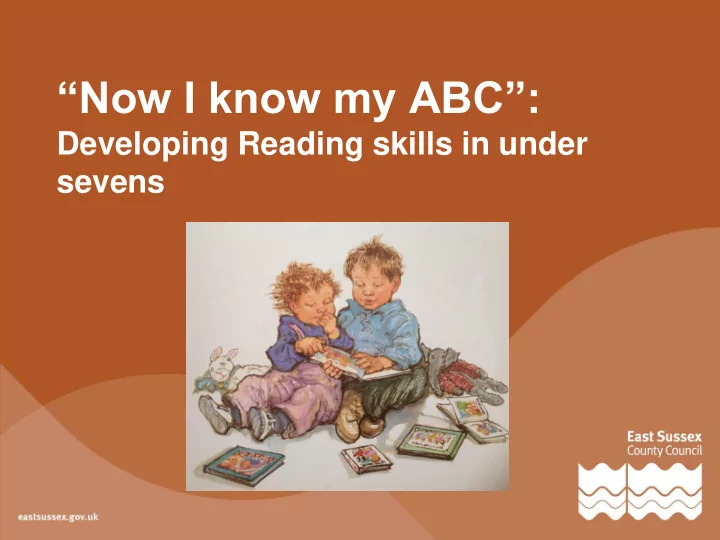
SLIDE 1
“Now I know my ABC”:
Developing Reading skills in under sevens
SLIDE 2 Books from our childhood…
What is your sensory memory of reading your favourite book as a child?
- Where did you read it and who with?
- What was your favourite book?
- How did the book affect the way you were
feeling?
SLIDE 3 A book from your childhood…
Where do you remember reading the book? What do you remember about the story? Why was it a favourite book?
SLIDE 4 The Leuven scale for Involvement
Level Well-being Signals 1 Extremely low Activity is simple, repetitive and passive. The child seems absent and displays no
- energy. They may stare into space or look around to see what others are doing.
2 Low Frequently interrupted activity. The child will be engaged in the activity for some
- f the time they are observed, but there will be moments of non-activity when they
will stare into space, or be distracted by what is going on around. 3 Moderate Mainly continuous activity. The child is busy with the activity but at a fairly routine level and there are few signs of real involvement. They make some progress with what they are doing but don’t show much energy and concentration and can be easily distracted. 4 High Continuous activity with intense moments. The child’s activity has intense moments and at all times they seem involved. They are not easily distracted. 5 Extremely high The child shows continuous and intense activity revealing the greatest
- involvement. They are concentrated, creative, energetic and persistent
throughout nearly all the observed period.
The Leuven Scale for Involvement
SLIDE 5
The Simple View of Reading
SLIDE 6 Read aloud
Choose stories or texts that respond to children's interests and experiences Introduce the book to the group Read with expression Build in time for listeners to respond along the way Encourage predictions Watch your audience Save time at the end of the story to get reactions Point out parts of the story you noticed or especially liked Remember that for some children, listening to stories is a new experience Encourage discussion about the story Have a good time!
SLIDE 7
“Reading aloud to children may be the single most important thing a teacher does.”
Anne Thomas
SLIDE 8
Reading aloud
Rate (pace): Does the speed of the reading match the
feeling or mood in the poem? Repetition: When you read the repetition, does it clarify to the listener what the author wants to emphasize? Onomatopoeia: Does the word sound like its meaning? Language: Does the reader use voice to identify character’s tone or mood? Rhythm: Is the reading ordered, predictable or conversational?
SLIDE 9 Which books do we choose?
What makes a quality text?
and illustration?
- Engage children?
- Have something valuable
to say to young children?
- Innovative and original?
- Books that stand the test
- f time?
- What are your criteria?
SLIDE 10 Development of reading
- Create a visual aid to show the development of
early reading
22-36 months 30-50 months 40-60 months ELG
SLIDE 11 22-36 months
stories, rhymes, songs, poems or jingles
phrases from familiar stories
word or phrase in a known rhyme, story or game
SLIDE 12 30-50 months
- Listens to and joins in with stories and poems, 1-1 and
also in small groups
- Joins in with repeated refrains and anticipates key
events and phrases in rhymes and stories
- Beginning to be aware of the way stories are structured
- Suggests how the story might end
- Listens to stories with increasing attention and recall
- Describes main story settings, events and principal
characters
- Looks at books independently
SLIDE 13
Making meaning
What does curious mean?
SLIDE 14 Introducing Fairy Tales
- The Three Bears
- Little Red Riding Hood
- The Three Little Pigs
- The Gingerbread Man
- The Three Billy Goats Gruff
- The Little Red Hen
SLIDE 15 40-60 months
forms of speech that are increasingly influenced by their experiences of books
range of books
SLIDE 16 Books about “Children like me”
Children of 40-60 months have a taste for realism – children who have the same concerns as them, e.g.:
- Losing favourite toys
- Being the youngest child
- A new baby
SLIDE 17
Learning how books and text work
SLIDE 18 30-50 months
- Shows interest in illustrations and print in books and
print in the environment
- Recognises familiar words and signs such as own
name and advertising logos
- Handles books carefully
- Knows information can be relayed in the form of
print
- Holds books the correct way up and turns the pages
- Knows that print carries meaning and, in English, is
read from top to bottom and left to right
SLIDE 19
Concepts of Print
SLIDE 20
Books and text everywhere
SLIDE 21
My name is special
SLIDE 22 40-60 months
- Links sounds to letters, naming and
sounding the letters of the alphabet
- Begins to read words and simple
sentences
- Knows that information can be retrieved
from books and computers
SLIDE 23
Learning about sounds
SLIDE 24 22-36 months
- Has some favourite (stories) rhymes,
songs, poems or jingles
- Fills in the missing word or phrase in a
known rhyme, story or game
SLIDE 25
Nursery Rhymes
http://wordsforlife.literacytrust.org.uk/songs
SLIDE 26 30-50 months
- Enjoys rhyming and rhythmic activities
- Shows awareness of rhyme and
alliteration
- Recognises rhythm in spoken words
SLIDE 27
Keeping the Beat
SLIDE 28
Letters and Sounds
SLIDE 29 40-60 months
- Continues a rhyming string
- Hears and says the initial sound in words
- Can segment the sounds in simple words
and blend them together and knows which letters represent some of them
SLIDE 30 Poetry
John had Great Big Waterproof Boots on: John had a Great Big Waterproof Hat: John had a Great Big Waterproof Mackintosh- And that (Said John) Is That.
SLIDE 31
Phonics
SLIDE 32
Homemade stories
SLIDE 33
Book talk
SLIDE 34 Skills to build in Key Stage One
- Visualising
- Vocabulary
- Empathising
- Predicting
- Inferring and deducing
- Interpreting
- Synthesising
- Develop a positive attitude to reading
SLIDE 35 Key themes Vocabulary Phonics Writing outcomes Pre--reading Resources
SLIDE 36 Prediction with a crunch
legs changes tiny eyes promise rainbow pearl Tadpole rainbow weather love black caterpillar help tadpole caterpillar promise promise love shiny willow tadpole beautiful water
SLIDE 37
SLIDE 38 Key themes Vocabulary Phonics Writing outcomes Pre--reading Resources
SLIDE 39
Book Talk
SLIDE 40
Literacy Rich Learning Environments
SLIDE 41
SLIDE 42
SLIDE 43
SLIDE 44
An example of Integrated English in Yr 1
SLIDE 45
SLIDE 46
SLIDE 47 Key elements
- Parental involvement
- Phonics in context
- Daily reading
- Book talk
- DEAR
SLIDE 48
SLIDE 49
- http://www.storytimeonline.co.uk/
- http://readingagency.org.uk/
- http://www.poetryline.org.uk/
- http://www.corebooks.org.uk
- http://por.clpe.org.uk/