1/ 26/ 2017 Know how. Know now. Know how. Know now. Purpose of the - - PDF document

1 26 2017
SMART_READER_LITE
LIVE PREVIEW

1/ 26/ 2017 Know how. Know now. Know how. Know now. Purpose of the - - PDF document

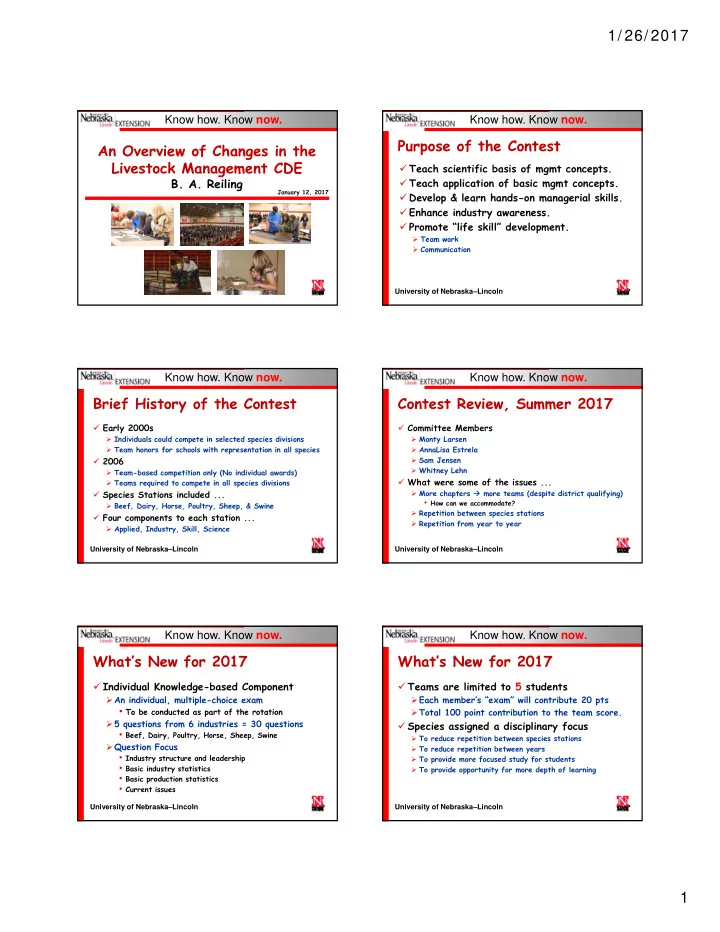
1/ 26/ 2017 Know how. Know now. Know how. Know now. Purpose of the Contest An Overview of Changes in the Livestock Management CDE Teach scientific basis of mgmt concepts. B. A. Reiling Teach application of basic mgmt concepts. January


slide-1
SLIDE 1

1/ 26/ 2017 1

Know how. Know now.

An Overview of Changes in the Livestock Management CDE

  • B. A. Reiling

January 12, 2017

University of Nebraska–Lincoln

Know how. Know now.

Purpose of the Contest

 Teach scientific basis of mgmt concepts.  Teach application of basic mgmt concepts.  Develop & learn hands-on managerial skills.  Enhance industry awareness.  Promote “life skill” development.

  • Team work
  • Communication

University of Nebraska–Lincoln

Know how. Know now.

Brief History of the Contest

 Early 2000s

  • Individuals could compete in selected species divisions
  • Team honors for schools with representation in all species

 2006

  • Team-based competition only (No individual awards)
  • Teams required to compete in all species divisions

 Species Stations included ...

  • Beef, Dairy, Horse, Poultry, Sheep, & Swine

 Four components to each station ...

  • Applied, Industry, Skill, Science

University of Nebraska–Lincoln

Know how. Know now.

Contest Review, Summer 2017

 Committee Members

  • Monty Larsen
  • AnnaLisa Estrela
  • Sam Jensen
  • Whitney Lehn

 What were some of the issues ...

  • More chapters  more teams (despite district qualifying)
  • How can we accommodate?
  • Repetition between species stations
  • Repetition from year to year

University of Nebraska–Lincoln

Know how. Know now.

What’s New for 2017

 Individual Knowledge-based Component

  • An individual, multiple-choice exam
  • To be conducted as part of the rotation
  • 5 questions from 6 industries = 30 questions
  • Beef, Dairy, Poultry, Horse, Sheep, Swine
  • Question Focus
  • Industry structure and leadership
  • Basic industry statistics
  • Basic production statistics
  • Current issues

University of Nebraska–Lincoln

Know how. Know now.

What’s New for 2017

 Teams are limited to 5 students

  • Each member’s “exam” will contribute 20 pts
  • Total 100 point contribution to the team score.

 Species assigned a disciplinary focus

  • To reduce repetition between species stations
  • To reduce repetition between years
  • To provide more focused study for students
  • To provide opportunity for more depth of learning
slide-2
SLIDE 2

1/ 26/ 2017 2

University of Nebraska–Lincoln

Know how. Know now.

What’s New for 2017

 2017 Disciplinary Focus

  • Beef – Breeding, Genetic, & Reproduction
  • Dairy – Nutrition
  • Horse – Nutrition
  • Poultry – Breeding, Genetic, & Reproduction
  • Sheep – Herd Health & Quality Assurance
  • Swine – Business, Marketing, and Product Eval

University of Nebraska–Lincoln

Know how. Know now.

Disciplinary Rotation Schedule

Species Year 1 (2017) Year 2 (2018) Year 3 (2019) Year 4 (2020) Beef B&G, Repro Health, QA Busn, Mkt Nutrition Dairy Nutrition B&G, Repro Health, QA Busn, Mkt Horse Nutrition B&G, Repro Health, QA Busn, Mkt Poultry B&G, Repro Health, QA Busn, Mkt Nutrition Sheep Health, QA Busn, Mkt Nutrition B&G, Repro Swine Busn, Mkt Nutrition B&G, Repro Health, QA

University of Nebraska–Lincoln

Know how. Know now.

What to Expect (Species Stations)

 Teams will have 13 minutes to complete station

  • May work together, as needed.
  • May wish to “divide and conquer” to complete station

 Three components to each species station

  • Science
  • Application
  • Skill (Hands-on)

 Two teams working at each station, simultaneously

  • For hands-on activities
  • May have dual sub-stations, or may limit time access.

University of Nebraska–Lincoln

Know how. Know now.

Species-based Webinars

 Will provide detailed listing of what to expect.  Will provide instruction and examples.

  • Listing of feedstuffs to identify/characterize.
  • Parts & function of digestive or reproductive tracts.
  • Listing of hormones; function & applicability to management
  • Example calculations & interpretations
  • of genetic data, performance records, marketing grids, etc.
  • For the hands-one, skill component
  • Provide up to 3 potential skills for students to perform
  • Provide listing of additional instructional resources
  • All questions should be answerable from resources provided.

University of Nebraska–Lincoln

Know how. Know now.

Questions & Discussion

University of Nebraska–Lincoln

Know how. Know now.

Thank You

slide-3
SLIDE 3

1/ 26/ 2017 3

University of Nebraska–Lincoln

Know how. Know now.

Extension is a Division of the Institute of Agriculture and Natural Resources at the University of Nebraska–Lincoln cooperating with the Counties and the United States Department of Agriculture. The Youth Development program abides with the nondiscrimination policies of the University of Nebraska–Lincoln and the United States Department

  • f Agriculture.