New York State HOME Local Program FY 2014-2015 Owner Occupied - - PowerPoint PPT Presentation

new york state
SMART_READER_LITE
LIVE PREVIEW

New York State HOME Local Program FY 2014-2015 Owner Occupied - - PowerPoint PPT Presentation

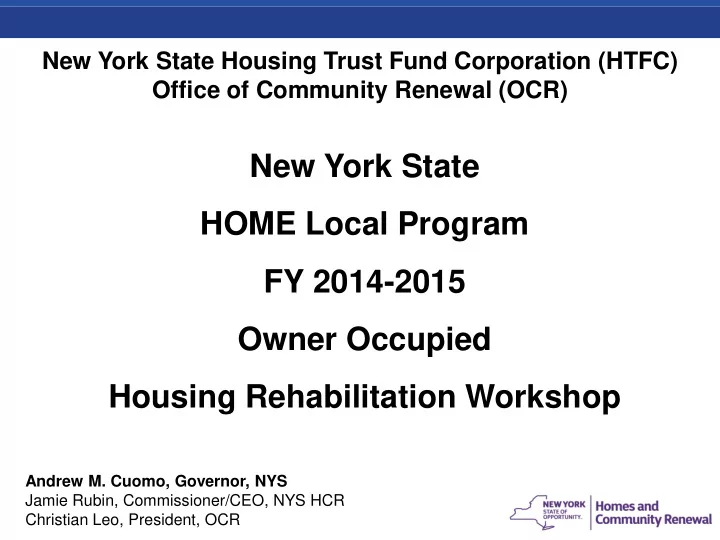
New York State Housing Trust Fund Corporation (HTFC) Office of Community Renewal (OCR) New York State HOME Local Program FY 2014-2015 Owner Occupied Housing Rehabilitation Workshop Andrew M. Cuomo, Governor, NYS Jamie Rubin,


slide-1
SLIDE 1

New York State Housing Trust Fund Corporation (HTFC) Office of Community Renewal (OCR)

New York State HOME Local Program FY 2014-2015 Owner Occupied Housing Rehabilitation Workshop

Andrew M. Cuomo, Governor, NYS Jamie Rubin, Commissioner/CEO, NYS HCR Christian Leo, President, OCR

slide-2
SLIDE 2
  • Welcome & Introductions
  • Facilities - Presentation & Recording Info
  • General Administrative Requirements
  • Project Requirements
  • 20 Minute Break
  • Project Requirements
  • Financial Management Requirements
  • Q & A Session

Agenda

slide-3
SLIDE 3

Welcome and Introductions Thank you for taking the time to participate!

Ann M. Petersen, LEED AP Director, NYS HOME Local Program Albany Regional Office ann.petersen@nyshcr.org Stephanie Galvin-Riley Assistant Director, NYS HOME Local Program Albany Regional Office stephanie.galvin-riley@nyshcr.org

slide-4
SLIDE 4

Michael Sullivan - NYC michael.sullivan@nyshcr.org Caillin Furnari - Albany caillin.furnari@nyshcr.org Emma Watson - Buffalo emma.watson@nyshcr.org Richard Baldwin - Syracuse richard.baldwin@nyshcr.org

NYS HOME Local Program Managers

slide-5
SLIDE 5

Administration - Albany Regional Office

NYS Homes and Community Renewal website: www.nyshcr.org

  • Alex Smith

Manager of Finance and Compliance alex.smith@nyshcr.org

  • Articia Hill

Administrative Operations articia.hill@nyshcr.org

slide-6
SLIDE 6
  • Now:
  • Resolutions accepting HOME Local Award and authorizing LPA to

execute contract with HTFC

  • By April 20th
  • Contracts, checklist of required documents mailed to LPA’s
  • Certification packets mailed to CHDO’s
  • By May 20th
  • All contracts, required documentation returned to HTFC
  • By June 20th
  • All contracts executed by HTFC and mailed back to LPA’s
  • By June 30th
  • Authority to use grant funds issued

Contract Execution Timeline

slide-7
SLIDE 7

Owner Occupied Housing Rehabilitation

slide-8
SLIDE 8

Owner Occupied Housing Rehabilitation

  • FY 2014 & 2015 HOME funds awarded:
  • 31 programs to deliver 453 HOME assisted

units.

  • 1 program includes owner unit and rental unit

rehabilitation.

slide-9
SLIDE 9

General Program Administrative Requirements

slide-10
SLIDE 10

Program Schedule

Period Estimate # of applicants qualified for assistance Estimate # of units with housing rehabilitation in progress Estimate # of units completed in IDIS Estimate total HOME expenditures Quarter 1 3 Quarter 2 3 Quarter 3 2 2 1 $40,000 Quarter 4 2 2 1 $40,000 Quarter 5 2 2 $80,000 Quarter 6 2 2 $80,000 Quarter 7 1 2 $80,000 Quarter 8 1 2 $80,000 TOTALS 10 10 10 $400,000

2 years = 8 Quarters Example below is a $400K award for 10 units @ $40k each

slide-11
SLIDE 11
  • LPA’s will be required to submit a quarterly report on

status of program activities.

  • Quarterly report forms will be e-mailed to the LPA at

contract execution.

  • The information submitted will assist Program Managers

to determine if an LPA is at risk of not completing the program according to the contract and schedule.

Quarterly Report

slide-12
SLIDE 12
  • The policy defines eligible costs that LPA’s can

invoice for in the program, based on HOME eligible activity.

  • If the budget submitted is not in compliance with the

policy, it must be corrected and re-submitted, prior to contract execution.

  • Please contact your Program Manager

for assistance.

Budget Policy

slide-13
SLIDE 13
  • Up to 5% of total award for administrative purposes.
  • Up to 13% of the total award for staff costs of project

delivery.

  • Consultants hired to administer the program on behalf
  • f an LPA may only be paid from administrative funds.

Eligible Administrative and Staff Cost of Project Delivery

slide-14
SLIDE 14
  • Project Costs
  • Project Soft Costs
  • Staff Costs of Project Delivery
  • Administrative Costs

Budget Categories

slide-15
SLIDE 15

Eligible Project Costs

  • Accessibility for disabled persons
  • Energy related improvements
  • Essential improvements
  • Lead based paint hazard reduction
  • Meeting applicable codes, standards and ordinances
  • Meeting the rehabilitation standards
  • Repair or replacement of major housing systems
  • Repairs, general property improvements of a non-luxury

nature

  • Site improvements and utility connections
slide-16
SLIDE 16

Eligible Project Soft Costs

  • Appraisals
  • Architectural/engineering fees to include specifications

and job progress inspections

  • Credit reports
  • Energy Audits
  • Environmental inspections/review
  • Financing fees
  • Lead based paint risk assessment
  • Legal and accounting fees
  • NYS Code inspection
  • Recordation fees, transaction taxes
  • Relocation
  • Title binders and insurance
slide-17
SLIDE 17

Eligible Staff Costs of Project Delivery

  • Applicant intake/eligibility review
  • Homeowner/contractor agreement execution
  • Housing rehabilitation job progress inspections
  • Preparation of cost estimate
  • Preparation of scope of work and specifications
  • Preparing for procurement and bidding process
slide-18
SLIDE 18

Staff Costs of Project Delivery

  • Must be tied to a specific unit address
  • Subject to maximum per unit assistance limits
  • In order to invoice, need to keep timesheets allocating

staff time to specific unit addresses

  • Must provide documentation of time sheets when

requesting payment

slide-19
SLIDE 19

Eligible Administrative Costs

  • Advisory Service for Relocation
  • Communication (postage, phone, website)
  • Consultant fees for administration
  • General management/oversight/coordination
  • Office insurance/utilities
  • Office supplies
  • Project Audit/CPA services
  • Purchase/rental of equipment
  • Staff Fringe
  • Staff Salaries/wages
  • Travel
slide-20
SLIDE 20

Affirmative Marketing Plan

  • Affirmative marketing steps consist of actions to

provide information and otherwise attract eligible persons in the housing market area to the available housing without regard to race, color, national origin, sex, religion, familial status or disability.

  • New in 2013 HOME Final Rule, each HOME

funded program must have and follow an affirmative marketing plan consistent with the HOME regulations at 24 CFR 02.351.

slide-21
SLIDE 21

What must LPA’s include in the Plan?

  • Identification of those persons across the

protected classes that are expected to be “least likely to apply.”

  • Description of how the LPA will inform potential

participants about fair housing and affirmative marketing policies.

slide-22
SLIDE 22

What must LPA’s include in the Plan?

  • Description of procedures or activities used

to inform and solicit applications from those "least likely to apply” without special

  • utreach.
  • Delineation of the records that will be kept to

document the affirmative efforts.

  • Description of how the LPA will assess the

results of the affirmative actions and make corrective actions if necessary.

slide-23
SLIDE 23

If the LPA targets a Special Needs Population the plan should describe:

  • How the program will be marketed across all protected

classes within the special need preference.

  • If the program targets persons with disabilities, how

the program will be marketed to all disabilities (however, advertisements can identify the specific services available based on the targeted disability).

slide-24
SLIDE 24

Written Agreements and Legal Documents

  • All households receiving assistance must execute a

written agreement for HOME program assistance with the LPA and Contractor that is consistent with HOME requirements at 92.504(c) (4).

  • The template for this agreement must be approved

by Program Managers prior to contract execution.

  • This agreement must be executed with the

homeowner, LPA and contractor, prior to setting up the unit in IDIS.

slide-25
SLIDE 25

Written Agreements and Legal Documents

  • LPA’s must secure the HOME funds invested by

placing a lien (note and mortgage) on the property.

  • LPA’s must use the HTFC provided Note and

Mortgage to secure the HOME investment, no

  • ther forms will be accepted.
  • The template for the note and mortgage will be

made available to LPA’s at contract execution.

  • The HTFC will provide LPA’s with an affidavit of

exemption that will exempt State filing fees for recording the note and mortgage.

slide-26
SLIDE 26
  • The term of the lien is for 5 years at 0% interest.
  • Principal reduced by 1/5th on anniversary date of

closeout of unit in IDIS.

  • No repayment required if remain principal resident

throughout POA.

  • If home is sold or the owner no longer resides as

principal resident during POA, the pro-rated portion of the lien must be repaid to the HTFC.

Written Agreements and Legal Documents

slide-27
SLIDE 27
  • The LPA must record the note and mortgage and have

the original document returned to the HTFC at the following address: Housing Trust Fund Corporation (HTFC) Office of Community Renewal NYS HOME Local Program Hampton Plaza 4th Floor South 38-40 State Street Albany, New York 12207

Written Agreements and Legal Documents

slide-28
SLIDE 28
  • The note and mortgage must be prepared by the LPA and

signed by the homeowner prior to beginning of any construction activities and before setting up the unit in IDIS.

  • Record lien immediately upon completion of construction

activities and after final sign off by the owner, the contractor and LPA that all work complete to satisfaction and unit is documented to meet NYS and/or Local Code.

  • If the home is sold during the POA to another HOME

eligible homeowner, the note and mortgage terms may be assumable.

Written Agreements and Legal Documents

slide-29
SLIDE 29

What should be included in the lien?

  • The lien amount should not include

administrative funds or staff costs of project delivery.

  • Why? - HUD is already paying LPAs to

administer the program through administrative and staff costs of project delivery, so the owner should not be charged.

  • Include only project costs and project soft costs

in the amount of the lien.

slide-30
SLIDE 30

Project Requirements

slide-31
SLIDE 31

Preferences and Priorities

  • Assistance can be limited to units within the

identified service area of the program in the application and contract.

  • Assistance cannot be limited to current or prior

residents of the jurisdiction of the target area.

  • Priorities or preferences for certain types of

housing or household type is only permissible to the extent that:

  • The priority or preference does not violate

nondiscrimination and fair housing requirements.

slide-32
SLIDE 32

Preferences and Priorities

  • The priority housing and household type has been

identified in the application and approved by HCR/HTFC at contract execution.

  • The priority or preference is fully disclosed in all

program documents, advertisements and presentations.

  • The HTFC may allow LPA’s to design eligible

program activities that may limit beneficiaries to veterans, the elderly, the physically disabled, and/or

  • r give preferences to persons in certain
  • ccupations, such as police officers, firefighters, or

teachers.

slide-33
SLIDE 33

Preferences and Priorities

  • If the program elects to serve a special needs

population, the LPA must have a current service provider agreement/MOU that will send direct referrals of clients to the HOME assisted program.

  • Any limitation or preference must not violate

nondiscrimination requirements in 24 CFR 92.350.

  • Limiting programs or giving preferences to students
  • r a group of all employees is not permitted.
  • The preference or limitation must be approved by the

HTFC at contract execution.

slide-34
SLIDE 34

Application Intake and Waiting Lists

  • Applications must be taken in a manner that that ensures

fair access, including reasonable time periods and methods of submission. Assistance must be offered to any household requesting assistance in completing the application.

  • The method for establishing the queue and waiting lists

must be disclosed and in application materials and briefings.

  • While priority or preference households may be placed on

a separate waiting list, and processed according to the priority, applications must be accepted from any household within the eligible service area.

slide-35
SLIDE 35

Application Intake and Waiting Lists

  • Waiting lists must be updated within the last 6 months,

maintained and available for inspection.

  • Income eligibility need not be verified to place an

applicant in the queue or on a waiting list.

  • Placement on the list can be based upon the applicant’s

representation of income, with disclosure that income will be verified prior to the offering of assistance.

  • LPA’s may use an already established wait list from a prior

program, however, all applicants must have been pre- qualified to be on the list within the past 6 months.

slide-36
SLIDE 36

Documenting Immigration Status

  • To receive HOME assistance, applicant must be a legal resident
  • f the US and be a US citizen or have Legal Resident Alien

status.

  • Applicant submits a signed declaration of US citizenship or US

nationality to LPA

  • LPA can request verification of the declaration by requiring the

presentation of a US passport or other appropriate documentation.

  • A qualified Alien is a non-citizen that can receive federal public

benefits and is defined as legal permanent resident (an alien admitted for lawful permanent residence) or a refugee (an alien who is admitted to the US under the Immigration and Nationality Act).

slide-37
SLIDE 37

Underwriting the HOME Assistance

  • Before committing funds to a project, the LPA

must ensure that no more HOME funds are invested than needed to provide quality, affordable, and financially viable housing throughout POA.

  • LPA must ensure that all sources are firmly

committed and the costs are necessary and reasonable.

slide-38
SLIDE 38

Underwriting the HOME Assistance

  • The amount of HOME funds, (in consideration of all

available sources, including other public sources) is reasonable and necessary to provide quality housing that is sustainable throughout the POA and is not excessive, and is within stated program guidelines.

  • The owner is reasonably expected to be able to handle all

existing obligations with respect to ownership including mortgage(s), property taxes, insurance and maintenance throughout the POA.

  • Evidence and documentation of this analysis must be

maintained in the project file.

slide-39
SLIDE 39

Feasibility Determination – Denial of Assistance

  • Properties/households should be assisted only if sufficient

funding exists to address all necessary items identified in the inspection and the household has the capacity to sustain the housing for the POA.

  • If inadequate funding exists, or the family is not expected to

be able to sustain the housing or it is determined that this is not a cost effective use of funds, the project should be determined infeasible and the infeasibility determination documented.

  • Any household denied assistance must be contacted in

writing with the reasons for denial disclosed and the process for appealing the denial identified.

slide-40
SLIDE 40

HOME Value Limits - After Rehab Value

  • The estimated value of the property after rehab cannot exceed

the HOME Maximum Purchase Price/after Rehab Value limit as published annually by HUD for the local jurisdiction at the time of commitment, available at: https://www.hudexchange.info/resource/2312/home-maximum- purchase-price-after-rehab-value/.

  • Maximum Property Value: The LPA shall comply with 24 CFR

92.254; qualification as affordable housing and will use the HUD determined limits for existing single-family housing units.

  • The LPA will ensure that the value of the unit after housing

rehabilitation does not exceed 95% of the median purchase price for the service area, as determined by the annually published HUD limits.

slide-41
SLIDE 41

Documenting After Rehab Value Limit

  • After-rehab value must be determined up front,

before work is started.

  • After rehab value must be considered when

determining the scope of work for the unit.

  • The cost to determine this value is a HOME

eligible expense and may be charged as a project soft cost.

slide-42
SLIDE 42

Documenting After Rehab Value Limit

  • HCR/HTFC requires an LPA to determine after

rehab value by using one of the following methods:

  • Licensed Appraisal
  • Real Estate Market Assessment
  • Independent estimate of value by

a “knowledgeable” professional

slide-43
SLIDE 43

Property Standards

  • All HOME assisted units must be determined

to meet NYS and/or Local Code upon completion of construction activities.

  • LPA must have inspection done to ensure that

the housing rehabilitation was done according to the scope of work.

slide-44
SLIDE 44

Property Standards - Meeting NYS CODE

  • Work with local code official in municipality where the

property is located to provide code inspection.

  • HQS inspection not eligible
  • Building Permits & Certificates of Completion
  • Certificates of Occupancy, Letter from Municipality
  • Need to document after rehabilitation with HOME funds,

that the housing has no current, visible health and safety hazards or code violations, is decent, safe and sanitary and appears to meet all applicable New York State and/or Local code requirements.

slide-45
SLIDE 45

Housing Rehab Order of Priority

  • Health and safety issues
  • NYS and/or Local code violations
  • Ensure major systems have a useful life of at least

5 years

  • Include disaster mitigation standards as necessary
  • Include weatherization and energy efficiency

measures in overall scope to deliver NYS and/or Local Code compliant unit

slide-46
SLIDE 46

Rehabilitation Scope of Work - Cost Estimate

  • 92.251(b) (2) requires LPA’s to develop a scope of

work and cost estimate, based on the housing rehab order of priority, in sufficient detail to be the basis for inspection to determine compliance with rehabilitation and property standards.

  • The LPA must prepare a written cost estimate for

rehabilitation, after determining that costs are reasonable.

  • How to determine? price quotes, cost estimating

rehabilitation specialists.

slide-47
SLIDE 47

Rehabilitation Scope of Work - Cost Estimate

  • All rehabilitation performed under this contract must be in

compliance with HTFC Housing Rehabilitation Standards for One- to Four-Unit Structures, available on the HCR HOME program website.

  • HOME rules require that each of the major systems in an

homebuyer occupied rehab must have a remaining useful life for a minimum of 5 years. If not, the major systems must be rehabilitated or replaced as part of the rehabilitation work.

  • Major systems include structural support; roofing;

cladding and weatherproofing (e.g., windows, doors, siding, gutters); plumbing; electrical; and heating, ventilation, and air conditioning.

slide-48
SLIDE 48

Weatherization

  • HOME Local and WAP partnering to provide weatherization

assistance for units at 50% or less of AMI.

  • To the extent resources are available, WAP funds &

construction services made available through the HCR WAP provider located in the service area.

  • LPA’s partner with WAP provider, ensure weatherization

measures incorporated into scope of work.

  • LPA’s and WAP’s must work together to develop the scope of

work prior to the start of construction activities.

slide-49
SLIDE 49
  • WAP provider will conduct energy audit prior to

developing scope of work.

  • When energy audit is complete, LPA and WAP need

to coordinate and develop scope of work together prior to the start of housing rehabilitation.

  • LPA and/or WAP may have applicants whose

homes don’t qualify, but combining the 2 programs may deliver a feasible project.

Weatherization

slide-50
SLIDE 50

Weatherization

  • Priority should be given to senior citizens, families

with children, and persons with disabilities.

  • If household member receives SSI, Public

Assistance, Food Stamps, or HEAP benefits, the household is automatically eligible for WAP.

  • HOME Local and WAP staff to assist LPA’s to

coordinate and execute a MOU with WAP providers to ensure weatherization assistance is included for all required units.

slide-51
SLIDE 51

Procurement and Contracting

  • The Super Circular – What Is It?
  • Made effective December 2014
  • Uniform Administrative Requirements, Cost Principles, and

Audit Requirements for Recipients of Federal Awards codified at 2 CFR Part 200

  • The combined Omni Circular replaces the former Parts 85

and 84 circulars and streamlines eight Federal regulations (including OMB Circulars A-110, A-122, and A-133) into a single, comprehensive policy guide

slide-52
SLIDE 52

Procurement and Contracting

  • Super Circular citation: 200.318 through 200.326
  • New provision covering conflict of interests with parent,

affiliate, or subsidiary organizations

  • Procurement records must be maintained sufficiently to detail

the history of procurement

  • Five methods prescribed in great detail:
  • Procurement by micro-purchase
  • Procurement by small purchase
  • Procurement by sealed bids (formal advertising)
  • Procurement by competitive proposal
slide-53
SLIDE 53

Procurement and Contracting

  • The LPA must receive a minimum of 3 bids for

all procured products and services to be paid with HOME funds and may select the lowest, responsible bidder.

  • LPA must follow Federal and State MWBE and

Section 3 Requirements

  • HOME Local to host upcoming technical

assistance webinar on meeting Federal and State MWBE and Section 3 requirements

slide-54
SLIDE 54

Required Construction Contract Provisions

  • Required contract provisions are attached to 2

CFR Part 200 as Appendix II.

  • A contract must be executed with each

contractor providing services.

  • The homeowner and contractor must be

signatories to the contract.

slide-55
SLIDE 55

Required Construction Contract Provisions

  • The LPA may be a third party to the contract,

able to approve construction progress inspections, payments to the contractor and mediate disputes, or be similarly authorized in the written agreement with the homeowner.

  • Bonding is not required for contracts under

$150,000.

  • LPA’s must hold back 10% of the final

payment to the contractor until after final completion of construction work and all required documentation has been submitted.

slide-56
SLIDE 56

Required Construction Contract Provisions

  • For each payment made to the contractor, the

homeowner, LPA and the contractor must sign

  • ff that the work has been completed

satisfactorily and meets all program requirements.

  • LPA’s must require that all contractors sign a

release of lien form for all construction activity completed and paid for with HOME funds.

slide-57
SLIDE 57

Required HOME Construction Contract Provisions

The following may be triggered:

  • Labor Standards: Davis-Bacon applies only to

single construction contracts of 12 or more HOME-assisted units (in a single contract for construction).

  • Section 3: Requirements for individual contractors

are triggered at $100,000.

  • Section 3 and MWBE reporting forms are

available at: http://www.nyshcr.org/Forms/FairHousing/.

slide-58
SLIDE 58

Inspections – LBP Clearance

slide-59
SLIDE 59

Inspections – LBP Clearance

  • Inspection to ensure that the work was done

and all debris and dust properly removed.

  • HUD requires clearance examination by a

qualified party that is independent of the renovator.

  • Clearance must be done by an EPA-certified

inspector, risk assessor or clearance technician.

slide-60
SLIDE 60

Inspections – LBP Clearance

  • A clearance examination involves a visual

assessment, dust, and soil testing to determine if the unit is safe for occupancy.

  • Lab-tested dust samples must be taken.
  • The clearance examiner must prepare a clearance

report in accordance with (24 CFR Part 35.1340) if lead hazard reduction activities other than abatement are performed.

  • Abatement activities are subject to EPA

requirements, not HUD requirements.

slide-61
SLIDE 61

Inspections – LBP Clearance

  • Clearance is best done immediately after

hazard reduction activities (including cleaning) are complete (allowing a few hours for the dust to settle).

  • HOME Local will pay for 1st clearance

inspection, if fails, contractor is responsible to re-clean and pay for all subsequent inspections until unit is cleared of LBP hazards

slide-62
SLIDE 62

Construction Management and Inspections

  • HOME rules require progress and final inspections

to determine that work was done in accordance with the work scope and contract and required property standards. All progress and final payments to contractors must be signed off by the LPA construction professional, homebuyer and contractor, if applicable.

  • If Lead based paint (LBP) is present, any hazard

control work must be cleared according to the requirements of Part 35.

slide-63
SLIDE 63

Construction Management and Inspections

  • The final inspection must certify completion of the

scope of work and that the property meets NYS and/ or Local Code.

  • The inspection must be performed by an

independent NYS Code certified inspector.

  • Documentation of this inspection must include a

signed and dated report from the inspector documenting the property meets the above requirements.

slide-64
SLIDE 64

Financial Management Requirements

slide-65
SLIDE 65

Uniform Administrative Requirements for Financial Management LPAs must have financial management systems that meet uniform federal administrative requirements (now restated at 2 CFR 200.301 - .316) that:

  • Provide effective control over and accountability for

all funds, property and other assets.

  • Identify the source and application of funds for

federally-sponsored activities including records and reports that verify the eligibility, reasonableness, allowability and allocability of costs.

slide-66
SLIDE 66

Uniform Administrative Requirements for Financial Management

  • Permit the accurate, complete and timely disclosure of

financial results in accordance with HUD reporting requirements or, for sub recipients, grantee reporting requirements.

  • Minimize the time elapsing between the transfer of funds

from the U.S. Treasury and disbursement by the grantee or sub recipient.

  • The LPA shall comply with the Uniform Administrative

Requirements as set forth in 2 CFR Part 200 and the Uniform Administrative Requirements, Cost Principals and Audit Requirements and as described in 24CFR Part 92.205, as applicable and as may be amended from time to time.
slide-67
SLIDE 67

Uniform Administrative Requirements for Financial Management

The financial management standards should provide for:

  • Internal Controls – the combination of

policies, procedures, job responsibilities, personnel and records that together create accountability in an organization’s financial system and safeguard its cash, property and other assets.

slide-68
SLIDE 68

Uniform Administrative Requirements for Financial Management

  • Budget Controls – procedures to compare and

control expenditures against approved budgets.

  • Accounting Records – records that sufficiently

identify the source and application of HOME funds provided.

  • Cash Management – procedures in place to

minimize the amount of time that elapses between receipt of HOME funds and the actual disbursement of those funds.

slide-69
SLIDE 69

Requests for Disbursements

  • The LPA shall not request disbursement of funds

under the contract until the funds are needed for payment of eligible costs. Advances of funds are not permitted.

  • Requests for disbursement of funds for owner-
  • ccupied housing rehabilitation will require

submission of a certification, signed by the LPA‘s construction professional, the homeowner and contractor, stating that the work has been satisfactorily completed.

slide-70
SLIDE 70

Requests for Disbursements

  • HCR/HTFC will not disburse funds if the LPA is in

default of any of the provisions of the contract.

  • The LPA shall commit all funds within 12 months
  • f the start date of the contract and expend all

funds within 24 months of the start date of the contract.

  • The LPA must submit an Authorized Signature

Form prior to contract execution; the form is available on the HCR HOME Program website.

slide-71
SLIDE 71

Requests for Disbursements

  • Disbursement requests must be submitted

in compliance with the instructions on the HCR HOME Program website.

  • Request for payment of administrative

funds must be within 15% of project cost expenditure.

slide-72
SLIDE 72

Integrated Disbursement Information System (IDIS)

  • The POA starts when the unit is completed in

IDIS; this requirement is referenced in the HTFC note and mortgage.

  • LPA’s must ensure unit completion in IDIS and

are required to submit the project completion report and documentation that unit meets code along with the request for final payment.

slide-73
SLIDE 73

Integrated Disbursement Information System (IDIS)

  • The IDIS Red Flag Report details infrequent draw status,

final draw for 30 days or more, auto cancellation pending within 30 days, auto cancellation pending within 90 days and auto cancelled within the past year.

  • LPA’s must respond immediately to Program Manager

requests to resolve issues and remove red flagged units from the report.

  • Due to IDIS automatically cancelling projects in the

system for no activity, LPA’s should not set up units in IDIS unless the project is ready to start construction and/or the LPA is ready request the first disbursement.

slide-74
SLIDE 74
  • This presentation and recording will be

made available on our website.

  • Please submit any questions on the

content of this presentation to: articia.hill@nyshcr.org

Wrap Up

slide-75
SLIDE 75

Questions?

slide-76
SLIDE 76

Please do not hesitate to contact your NYS HOME Local Program Manager with any questions.

Thank You for attending!