Motion capture Applications Systems Motion capture pipeline - - PowerPoint PPT Presentation

motion capture
SMART_READER_LITE
LIVE PREVIEW

Motion capture Applications Systems Motion capture pipeline - - PowerPoint PPT Presentation

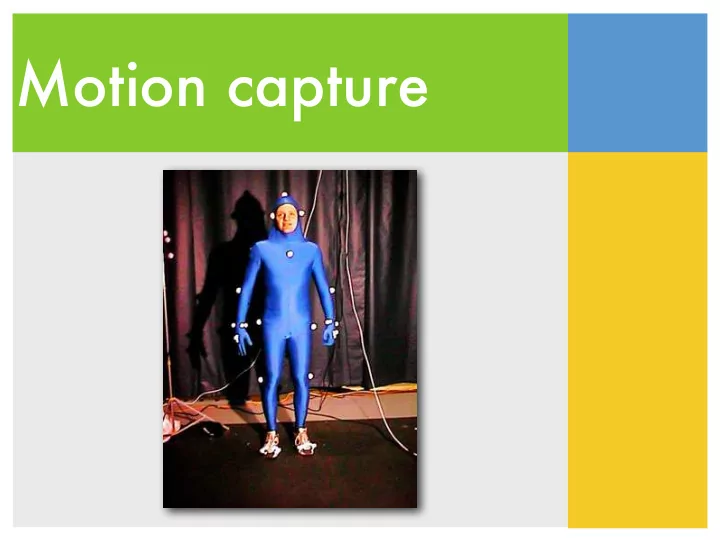
Motion capture Applications Systems Motion capture pipeline Biomechanical analysis Applications Computer animation Biomechanics Robotics Cinema Video games Anthropology What is captured? Objects Humans


slide-1
SLIDE 1

Motion capture

slide-2
SLIDE 2
  • Applications
  • Systems
  • Motion capture pipeline
  • Biomechanical analysis
slide-3
SLIDE 3

Applications

Biomechanics Computer animation Robotics Video games Anthropology Cinema

slide-4
SLIDE 4

What is captured?

Animals Humans Celebrities Objects

slide-5
SLIDE 5

What is captured?

Whole body Face Hands

slide-6
SLIDE 6

Pros and cons

  • Truthfully record all the fine details of the

natural motion

  • The captured motion is difficult to be
  • generalized
  • modified
  • controlled
slide-7
SLIDE 7

How to use the data?

  • Off-line
  • Motion libraries
  • Motion graphs
  • Training examples
slide-8
SLIDE 8
slide-9
SLIDE 9

How to use the data?

  • Off-line
  • Motion libraries
  • Motion graphs
  • Training examples
  • On-line
  • Drive characters based on the movement of the

actors in real time

slide-10
SLIDE 10
slide-11
SLIDE 11
  • Applications
  • Systems
  • Motion capture pipeline
  • Biomechanical analysis
slide-12
SLIDE 12

Types of Systems

  • Optical systems
  • Magnetic systems
  • Motion tapes
  • Vision-based systems
  • Inertial and ultrasonic systems
slide-13
SLIDE 13

Optical systems

  • Cameras
  • High temporal resolution (120+ fps)
  • Detect the locations of reflective markers
  • Markers
  • passive: sensitive to infrared
  • active: emit LED light
slide-14
SLIDE 14

Magnetic system

  • Cumbersome sensors (heavier and also

wired)

  • Smaller workspace
  • Record both position and orientation
  • Lower resolution (80 fps max)
  • Sensitive to EMI/metal in the environment
slide-15
SLIDE 15

Motion tapes

Contain optical fibers and sensors that can detect the bending and twisting Restriction of movement Need another technology for detecting root translation Measure the shape of surface precisely

slide-16
SLIDE 16

Markerless mocap

  • http://www.organicmotion.com/
  • Kinect
slide-17
SLIDE 17

Ultrasonic + Inertial

  • A wearable self-contained system
  • Inertial information is provided by

gyroscopes and accelerometers

  • Microphones are used to record the

distance between each pair of sensors

slide-18
SLIDE 18
slide-19
SLIDE 19

Body-mounted cameras

slide-20
SLIDE 20
  • Applications
  • Systems
  • Motion capture pipeline
  • Biomechanical analysis
slide-21
SLIDE 21

Motion capture pipeline

calibration capturing model building marker labeling inverse kinematics trajectory smoothing

slide-22
SLIDE 22

Motion capture pipeline

calibration capturing model building marker labeling inverse kinematics trajectory smoothing

slide-23
SLIDE 23

Calibration

  • Static calibration
  • Figure out where the

floor is

  • Dynamic calibration
  • Figure out the capture

volume

slide-24
SLIDE 24

Motion capture pipeline

calibration capturing model building marker labeling inverse kinematics trajectory smoothing

slide-25
SLIDE 25

Capturing

  • Marker placement
  • Markers should move rigidly

with joints

  • Asymmetric placement helps

in post-processing

  • T-pose and range of motion
  • Recording specific poses can

help estimating bone lengths

slide-26
SLIDE 26

3D marker position

  • In principle, two cameras are sufficient to

reconstruct the 3D location of a marker

  • In practice, more cameras can
  • reduce occlusion
  • increase precision
slide-27
SLIDE 27

Motion capture pipeline

calibration capturing model building marker labeling inverse kinematics trajectory smoothing

slide-28
SLIDE 28

Model building

  • Given recored marker positions, estimate the

dimension of each body part

  • Optimize both bone length and handle positions

at the same time

  • Templates and heuristics help
slide-29
SLIDE 29

Problem statement

generic skeleton rough handle positions specific pose used for calibration bone length handle offset

+

slide-30
SLIDE 30

Motion capture pipeline

calibration capturing model building marker labeling inverse kinematics trajectory smoothing

slide-31
SLIDE 31

Marker labeling

  • Ghost markers
  • Missing markers
  • Switching trajectories
slide-32
SLIDE 32

Raw data

3D locations of markers

slide-33
SLIDE 33

Motion capture pipeline

calibration capturing model building marker labeling inverse kinematics trajectory smoothing

slide-34
SLIDE 34

Inverse kinematics

  • Input: articulated body with handles + desired

handle positions

  • Joint angles that move handles to desired

positions

slide-35
SLIDE 35

Motion capture pipeline

calibration capturing model building marker labeling inverse kinematics trajectory smoothing

slide-36
SLIDE 36

Trajectory smoothing

  • Global optimization that minimizes the velocity
  • f the joint angles while staying as close as

possible to the desired handle positions

slide-37
SLIDE 37

Final motion

slide-38
SLIDE 38

Issues

The main problem with motion capture associated with characters has to do with mass distribution, weight and exaggeration. It is impossible for a performer to produce the kind of motion exaggeration that a cartoon character needs, and the mass and weight of the performer almost never looks good when applied to a character

  • f different proportions.

Eric Darnell, codirector of Antz

slide-39
SLIDE 39

Issues

The mapping of human motion to a character with non-human proportions doesn’t work, because the most important things you get out

  • f motion capture are the weight shifts and the

subtleties and that balancing act of the human body. If the proportions change, you throw all that out the door, so you might as well animate it.

Richard Chuang, VP at PDI