Visual Motion Motion illusions Uses for motion cues Optic flow - - PDF document

visual motion
SMART_READER_LITE
LIVE PREVIEW

Visual Motion Motion illusions Uses for motion cues Optic flow - - PDF document

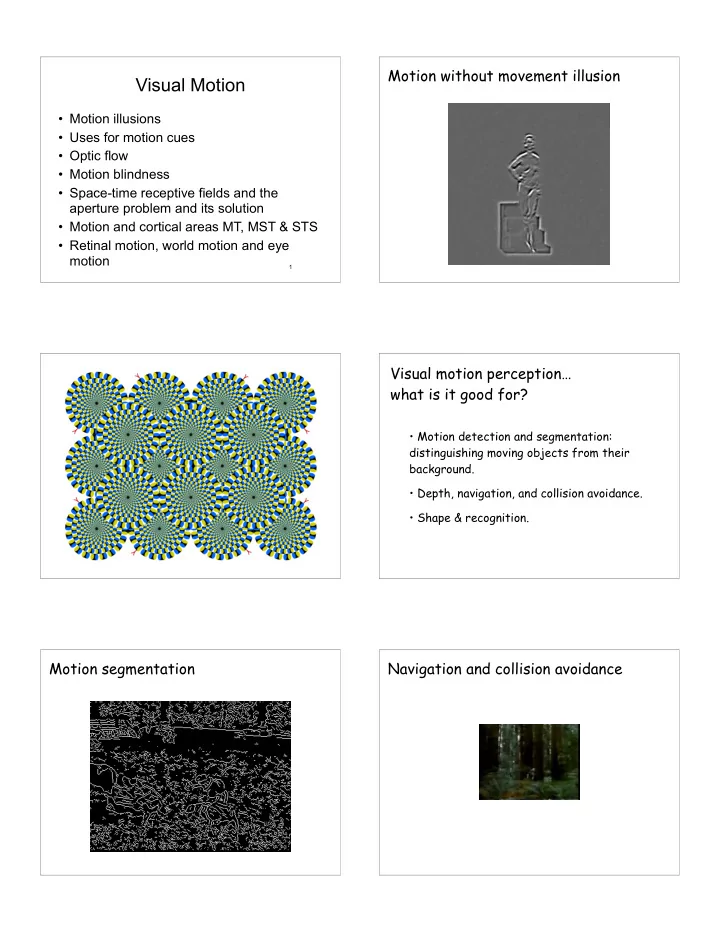
Motion without movement illusion Visual Motion Motion illusions Uses for motion cues Optic flow Motion blindness Space-time receptive fields and the aperture problem and its solution Motion and cortical areas MT, MST


slide-1
SLIDE 1

Visual Motion

  • Motion illusions
  • Uses for motion cues
  • Optic flow
  • Motion blindness
  • Space-time receptive fields and the

aperture problem and its solution

  • Motion and cortical areas MT, MST & STS
  • Retinal motion, world motion and eye

motion

1

Motion without movement illusion Visual motion perception… what is it good for?

  • Motion detection and segmentation:

distinguishing moving objects from their background.

  • Depth, navigation, and collision avoidance.
  • Shape & recognition.

Motion segmentation Navigation and collision avoidance

slide-2
SLIDE 2

Depth and motion parallax Optic flow James Gibson 3D Shape from motion Recognition & biological motion Akinetopsia (motion blindness)

slide-3
SLIDE 3

V1 V2 V3

MT

V3a MST

Visual area MT

MT

Cortical area MT is specialized for visual motion perception

  • Neurons in MT are selective for motion direction.
  • Neural responses in MT are correlated with the perception of motion.
  • Damage to MT or temporary inactivation causes deficits in visual

motion perception.

  • Electrical stimulation in MT causes changes in visual motion

perception.

  • Computational theory quantitatively explains both the responses of

MT neurons and the perception of visual motion.

  • Well-defined pathway of brain areas (cascade of neural

computations) underlying motion specialization in MT.

MT neurons are direction-selective

A Simple Way to Think About Motion: The Space/time Plot

t1

Space/time Plot

t2

Space/time Plot

t3

slide-4
SLIDE 4

Space/time Plot

t4

Space/time Plot

t5

Space/time Plot

t6

Space/time Plot

t7

Space/time Plot

t8

Space/time Plot

t9

slide-5
SLIDE 5

Space/time Plot

t10

Space/time Plot

t11

Space/time Plot

t12

Space/time Plot

time

Space/time Plot

time

Space/time Plot

Space time

slide-6
SLIDE 6

Space/time Plot

time Space

Real motion

Space/time Plot

time Space

Real motion

Space/time Plot

time Space

Real motion

Space/time Plot

time Space

No motion

How Can the Visual System Detect the “Orientation” of Motion Energy in Space/Time?

Does this remind you of another aspect

  • f neural processing that the visual

system accomplishes?

Space/time Plot

time Space

Real motion

++ +

! ! ! ! ! !

NOW

slide-7
SLIDE 7

Selectivity for motion direction Motion aftereffect

MAE Explanation

Before adaptation Up Down During adaptation Up Down After adaptation Up Down

Apparent Motion

frame 1

Apparent Motion

frame 2

slide-8
SLIDE 8

Motion perception depends on context

The “barber-pole” illusion

Motion Integration: Solve the Aperture Problem

Given two orientation- and direction-selective neurons: And one complex pattern moving rigidly: analyzes But it can only see: So its output is consistent with these velocities: analyzes But it can only see: So its output is consistent with these velocities: are then integrated to analyze Resulting in the correct velocity solution: The two neurons:

Locating Human MT

slide-9
SLIDE 9

Locating Human MT Columnar architecture in MT

no coherence 50% coherence 100% coherence

Motion stimulus Responses of MT neurons

Preferred direction

Motion coherence and MT neurons Motion coherence and MT neurons Monkeys and motion percepts

Microstimulate at a site in MT where the neurons prefer downward motion while monkeys make up/ down motion judgments for stimuli with various levels of coherence.

no coherence 50% coherence 100% coherence

Electrical stimulation in MT

slide-10
SLIDE 10

Microstimulation in MT changes motion perception

With stimulation No stimulation (note bias)

V2 V3 MT V3a

MST

Visual area MST and optic flow Visual area STS responds to biological motion

STS MT

Visual motion and eye movements