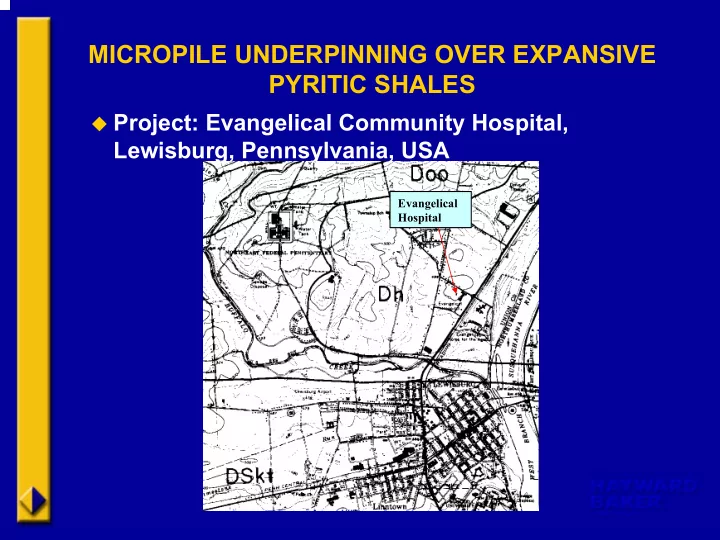
SLIDE 1 MICROPILE UNDERPINNING OVER EXPANSIVE PYRITIC SHALES
Project: Evangelical Community Hospital,
Lewisburg, Pennsylvania, USA
Evangelical Hospital
SLIDE 2
Trouble
Problems:
1) Cracked floor slab at 1982 and 1996 additions. 2) Displaced reinforced concrete walls and conventional spread footing foundations.
Cause:
Swelling of underlying fill materials and natural bedrock formation. Bedrock composed of Pyritic Shale from the Marcellus formation of the Hamilton group.
SLIDE 3 Expansive Pyritic Shales
Pyrite is found in black, carbonaceous shales
throughout the world.
Well-documented history of being potentially
- expansive. Heave due to the conversion of sulfides to
sulfates.
Pyrite oxidation occurs in two (2) settings:
1) Advective flow controls and oxygenated groundwater enters a layer containing pyrite. 2) Diffusive O-2 flow dominates in the unsaturated zone and resulting sulfate and iron concentrations are huge and pH decreases to values close to 2.
The low pH values cause a variety of minerals to
precipitate including gypsum and numerous ferric hydrosulfates.
SLIDE 4
Pyrite Location Plan
SLIDE 5
First floor transition between 1982 and 1996 additions.
SLIDE 6
In-Situ shale cross section.
SLIDE 7
Removed shale cross section.
SLIDE 8 Shale fragment showing evidence of replacement pyrite.
Replacement Pyrite
SLIDE 9
Options?
Since there is no known method of treating the shales to limit future movement, and the heterogeneous nature of the shales precludes estimation of when the shales might stop expanding, underpinning the conventional foundations was the only viable option.
SLIDE 10
Underpinning Methods Proposed
1) Underpin the reinforced concrete wall and
footing with tension and compression micropiles and a double C-channel cantilever.
2) Compression micropiles supporting C-channel
beams straddling bottom sides of thee reinforced concrete wall and column footing foundations.
3) Bond micropiles to exterior and interior column
footing foundations.
SLIDE 11 Underpinning Plan
Computer Room 1996 Addition 1996 Addition Main Bearing Wall Telephone Room Information Sciences 1982 Addition
SLIDE 12
Explosive Beginnings: Upward release of floor slab under pressure.
SLIDE 13
Telephone room underpinning detail.
SLIDE 14
Telephone Room. Drill and crew working in basement.
SLIDE 15
Telephone room. Underpinning excavation around cantilever C-channel beams.
SLIDE 16
Telephone room. Underpinning excavation around micropiles under adjacent footings.
SLIDE 17
Telephone room. Underpinning close up of cantilever.
SLIDE 18
Telephone room underpinning. Broad view.
SLIDE 19
Corridor (Method 2) Underpinning Wall and column/spread footing underpinning detail along 1982 addition.
SLIDE 20
- Corridor. Saddle underpinning view from top.
SLIDE 21
- Corridor. Saddle underpinning view from
bottom.
SLIDE 22
Isolated spread footings (Method 3) underpinning. Interior spread footing underpinning detail.
SLIDE 23
Shear rings were placed within the bond zone to allow for increased load transfer.
Shear ring detail.
SLIDE 24
Load Testing.
(2) load tests were run to determine the allowable
bond strength between the footing and the casing.
Footing bond for load test setup.
SLIDE 25
Load test, continued.
Load test at the 489 kN footing.
SLIDE 26 0.02 0.04 0.06 0.08 20 40 60 80 100 120 140 160 LOAD (KIPS) ELONGATION (IN
489 kN column footing bond stress load test results.
Recorded movement for the 489 kN (110 kip) column was 0.18 cm (0.071 in), with permanent set
(0.034 in).
MINIMUM ELONGATION PREDICTED = 80% PL/AE
SLIDE 27
Load test, continued.
Load test at the 1,285 kN footing.
SLIDE 28 Recorded movement for the 1,285 kN (289 kip) column was 0.33 cm (0.0129 in), with permanent set of .19 cm (0.076 in).
1,285 kN column footing bond stress load test results.
MINIMUM ELONGATION PREDICTED = 80% PL/AE
SLIDE 29
Load tests, cont.
The results of these tests were considered
satisfactory by the project team.
SLIDE 30 Unforseen Conditions
Overexcavation after micropile installation in the
Information Sciences room of the 1982 addition revealed:
1)
Footings were not poured symmetrically around the columns. Offset by as much as 30.5 cm from the locations on the project drawings.
2)
One of the footings was basically nonexistemt on the northern side of the reinforced concrete col.
3)
Four (4) of the seven (7) column footings had one
- r more locations where there was not sufficient
distance from the edge of the micropile to the edge of the footing.
SLIDE 31