Melnea Cass Boulevard Design Objectives Meeting March 15, 2012 - - PowerPoint PPT Presentation

melnea cass boulevard
SMART_READER_LITE
LIVE PREVIEW

Melnea Cass Boulevard Design Objectives Meeting March 15, 2012 - - PowerPoint PPT Presentation

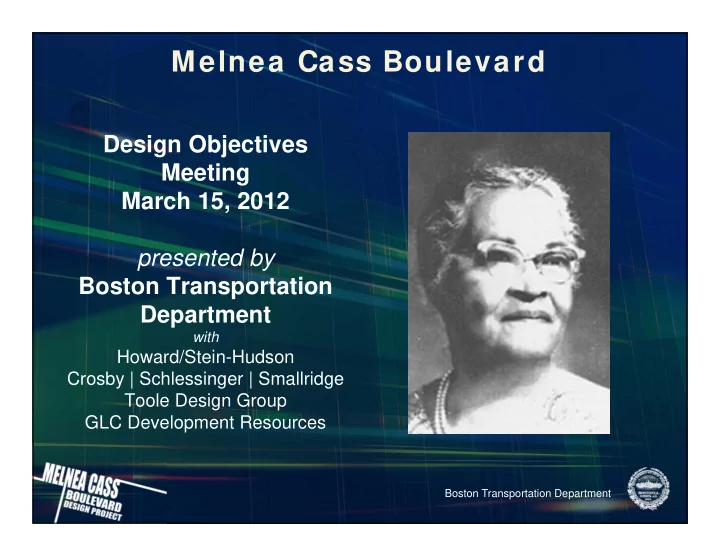
Melnea Cass Boulevard Design Objectives Meeting March 15, 2012 presented by Boston Transportation Department with Howard/Stein-Hudson Crosby | Schlessinger | Smallridge Toole Design Group GLC Development Resources Boston Transportation

slide-1
SLIDE 1

Boston Transportation Department

Melnea Cass Boulevard

Design Objectives Meeting March 15, 2012 presented by Boston Transportation Department

with

Howard/Stein-Hudson Crosby | Schlessinger | Smallridge Toole Design Group GLC Development Resources

slide-2
SLIDE 2

Boston Transportation Department

Part 1 – Presentation 6:00 – 6:30 PM

Introduction/Process What we have learned:

  • Community Vision
  • Design Directions

Complete Streets Principles Corridor-wide Framework

  • Melnea Cass Boulevard

by Area

Part 1 – Presentation 6:00 – 6:30 PM

Introduction/Process What we have learned:

  • Community Vision
  • Design Directions

Complete Streets Principles Corridor-wide Framework

  • Melnea Cass Boulevard

by Area

Part 2 – Framing Design Concepts 6:30 – 7:15 PM

  • Breakout Groups

Part 2 – Framing Design Concepts 6:30 – 7:15 PM

  • Breakout Groups

Part 3 – Breakout Group Reports/ Q & A – 7:15 – 8:00 PM

  • Group representatives give summaries of

breakout group discussion

  • Questions and answers

Part 3 – Breakout Group Reports/ Q & A – 7:15 – 8:00 PM

  • Group representatives give summaries of

breakout group discussion

  • Questions and answers

Agenda

slide-3
SLIDE 3

Boston Transportation Department

Project Area

slide-4
SLIDE 4

Boston Transportation Department

Project Tim eline

  • Initial Public Meeting – 10/11/2011
  • Introducing the project
  • Community Visioning Meeting – 12/14/2011
  • Envisioning success
  • Design Objectives Meeting – Tonight
  • Turning the vision into concepts
  • Sharing Initial Concepts – Spring 2012
  • Gaining consensus on Preferred Option –

Summer 2012

slide-5
SLIDE 5

Boston Transportation Department

W hat W e Heard From You - Vision

  • Safe, clean and beautiful
  • Well-maintained – snow and

litter consistently removed

  • All parcels owned and cared for
  • Safe for cyclists and pedestrians
  • Providing safe, effective transit

service

  • Moving calmed vehicular traffic

effectively

  • Fully integrated with its

surrounding neighborhood

  • A catalyst for neighborhood

economic development

slide-6
SLIDE 6

Boston Transportation Department

W hat W e Heard From You – Design Direction

  • Keep mature trees as part of new landscaping
  • Soften the Boulevard – reduce “highway feel”
  • Calm traffic – enhance pedestrian/cyclist safety
  • Connect to walking/cycling infrastructure beyond the corridor
  • Fully integrate the Boulevard with cross streets and

the neighborhood

  • Provide a gateway to Dudley Square
  • Design buildings for active street life
  • Safe and family-friendly
slide-7
SLIDE 7

Boston Transportation Department

W hat W e Learned – Econom ic Developm ent

Community Vision

Tighten connections to jobs:

  • Longwood Medical Area
  • Boston University

Medical Center

  • Southeast Expressway

Strengthen and grow retail center:

  • Improve connections between

Dudley Square and South End

  • Increase shopper population

Community Vision

Tighten connections to jobs:

  • Longwood Medical Area
  • Boston University

Medical Center

  • Southeast Expressway

Strengthen and grow retail center:

  • Improve connections between

Dudley Square and South End

  • Increase shopper population

Development Tools

Improve transit Keep, but calm, high traffic volumes Improve pedestrian environment Create attractive, high-quality environment Develop retail and commercial:

  • At major intersections
  • Visual connections between

Dudley Square and South End

  • Draw people across the

Boulevard

  • Create a sense of place

Development Tools

Improve transit Keep, but calm, high traffic volumes Improve pedestrian environment Create attractive, high-quality environment Develop retail and commercial:

  • At major intersections
  • Visual connections between

Dudley Square and South End

  • Draw people across the

Boulevard

  • Create a sense of place
slide-8
SLIDE 8

Boston Transportation Department

  • Complete Streets are designed and operated to

enable safe access for all users.

  • Pedestrians, bicyclists, motorists and transit riders of

all ages and abilities must be able to safely and comfortably move along and across a complete street.

Com plete Streets Principles

slide-9
SLIDE 9

Boston Transportation Department

  • Create vibrant public spaces
  • Respect and foster a

“sense of place”

  • Create opportunities for

healthy living and physical activity

  • Support economic

development

  • Design for sustainability
  • “Smart” in the use of

technology

Com plete Streets Principles

slide-10
SLIDE 10

Boston Transportation Department

  • Pedestrian
  • Safety
  • Accessible sidewalks
  • Appropriate degree of separation

from roadways

  • Lower motor vehicle speeds
  • Well-lit facilities
  • Pedestrian-friendly intersections
  • Shorter crossings
  • Minimal delay
  • Less exposure to conflicts
  • Frequent accessible

crossings

  • Comfort and Convenience
  • Street trees
  • Comfortable and inviting spaces

with amenities

  • Connections to other modes

Com plete Streets Principles

slide-11
SLIDE 11

Boston Transportation Department

[ Insert Assessment Map Here] Pedestrian Connectivity

slide-12
SLIDE 12

Boston Transportation Department

[ Insert Assessment Map Here] Pedestrian Connectivity

slide-13
SLIDE 13

Boston Transportation Department

  • Bicycle
  • Safety
  • Dedicated space
  • Degree of separation between modes
  • Lower motor vehicle speeds
  • Less exposure to conflicts
  • Well-lit facilities
  • Bicycle-friendly intersections
  • Minimum green intervals
  • Bicycle detection
  • Bicycle priority (i.e. signals, bicycle

boxes, etc.)

  • Comfort and Convenience
  • Consistent facility types
  • Connections to other modes
  • Access to shot term and long term parking
  • Wayfinding signage

Com plete Streets Principles

slide-14
SLIDE 14

Boston Transportation Department

[ Insert Assessment Map Here] Bicycle Connectivity

slide-15
SLIDE 15

Boston Transportation Department

  • Motor Vehicles
  • Safety
  • Designs that reduce conflicts and

the severity of crashes

  • Intuitive and clear geometry
  • Appropriate degree of separation

between modes

  • Safe options for turning movements
  • Well-lit facilities
  • Efficient intersection designs
  • Minimal delay
  • Coordinated signal timing
  • Comfort and Convenience
  • Well-maintained roadways
  • Clear guidance and Wayfinding
  • Access to parking

Com plete Streets Principles

slide-16
SLIDE 16

Boston Transportation Department

  • Transit
  • Safety
  • Safe and accessible transit stops
  • Appropriate sidewalk widths
  • Less conflicts with other modes
  • Well-lit facilities
  • Transit-friendly intersections
  • Minimal delay in service
  • Accessible crossings
  • Transit prioritization
  • Responsive signal design
  • Comfort and Convenience
  • Comfortable and inviting transit

stops with amenities

  • Well-maintained transit stops and

roadways

  • Connections to other modes
  • Real-time route information

Com plete Streets Principles

slide-17
SLIDE 17

Boston Transportation Department

[ Insert Assessment Map Here] MBTA Route 1

slide-18
SLIDE 18

Boston Transportation Department

MBTA Route 8

slide-19
SLIDE 19

Boston Transportation Department

MBTA Route 1 9

slide-20
SLIDE 20

Boston Transportation Department

MBTA Route 4 7

slide-21
SLIDE 21

Boston Transportation Department

MBTA Route CT3

slide-22
SLIDE 22

Boston Transportation Department

MBTA Routes and Stops

slide-23
SLIDE 23

Boston Transportation Department

The Urban Ring

slide-24
SLIDE 24

Boston Transportation Department

  • Frequent Service
  • Widely-spaced Stops
  • High-capacity Vehicles
  • Real-time Information
  • Traffic Signal Control
  • Dedicated Lanes

BRT ( Bus Rapid Transit)

slide-25
SLIDE 25

Boston Transportation Department

  • Safe Pedestrian Access
  • Easy Loading/Unloading
  • Comfort and Security

BRT Stations

slide-26
SLIDE 26

Boston Transportation Department

  • Curbside Bus Lanes
  • Buses mix with traffic
  • Parking conflicts
  • Right turn conflicts
  • Slower travel times

and less reliability

BRT Configurations

slide-27
SLIDE 27

Boston Transportation Department

  • Center Bus Lanes
  • Buses don’t mix with traffic
  • No parking conflicts and turning conflicts

managed through signal design

  • Faster travel times and increased reliability

BRT Configurations

slide-28
SLIDE 28

Boston Transportation Department

Center Bus Lanes

  • Urban Ring Phase 2 Locally Preferred Alternative
  • Reviewed by the Roxbury community including

RSMPOC

  • Typically most efficient design for BRT
  • Passengers exit onto median island station
  • Better access for new development

and curbside parking

BRT Alternatives

TRAVEL LANES STATION STATION TRAVEL LANES TRAVEL LANES

slide-29
SLIDE 29

Boston Transportation Department

Center Bus Lanes Curbside Bus Lanes Bus Lanes One Side

  • Bus stops next to curb for passenger

loading/unloading

  • Parking conflicts
  • Intersection conflicts
  • Passengers exit bus onto island and

curb stations

  • Parking access issues
  • Intersection challenges

TRAVEL LANES STATION STATION TRAVEL LANES TRAVEL LANES TRAVEL LANES STATION STATION STATION STATION TRAVEL LANES TRAVEL LANES

BRT Alternatives

TRAVEL LANES

  • Urban Ring Phase 2 Locally Preferred Alternative
  • Reviewed by the Roxbury community including

RSMPOC

  • Typically most efficient design for BRT
  • Passengers exit onto median island station
  • Better access for new development

and curbside parking

slide-30
SLIDE 30

Boston Transportation Department

Com plete Streets Com ponents

Exclusive Transit Lanes

slide-31
SLIDE 31

Boston Transportation Department

Com plete Streets Com ponents

Travel/ Parking Lanes Travel/ Parking Lanes Exclusive Transit Lanes

slide-32
SLIDE 32

Boston Transportation Department

Com plete Streets Com ponents

Bikes Travel Parking Lanes Travel Parking Lanes Exclusive Transit Lanes

slide-33
SLIDE 33

Boston Transportation Department

Com plete Streets Com ponents

Bikes Travel Parking Lanes Travel Parking Lanes Exclusive Transit Lanes Pedestrian Pedestrian

slide-34
SLIDE 34

Boston Transportation Department

Com m unity I nput

  • Vision of Success for Melnea Cass Boulevard:
  • Fully integrated with its surrounding neighborhood
  • Safe, clean and beautiful
  • Well-maintained – snow and litter consistently removed
  • All parcels owned and cared for
  • Safe for cyclists and pedestrians
  • Providing safe, effective transit service
  • Moving calmed vehicular traffic effectively
  • A catalyst for neighborhood economic development
slide-35
SLIDE 35

Boston Transportation Department

Urban Design Fram ew ork

slide-36
SLIDE 36

Boston Transportation Department

Com m unity Goals

  • Melnea Cass should be fully integrated with its

surrounding neighborhood, providing access to local side streets and a gateway to Dudley Square

  • Importance of connecting streets
slide-37
SLIDE 37

Boston Transportation Department

Urban Design Fram ew ork - Shaw m ut

slide-38
SLIDE 38

Boston Transportation Department

Tremont Street Columbus Avenue

slide-39
SLIDE 39

Boston Transportation Department

Shawmut Avenue Kerr Way

slide-40
SLIDE 40

Boston Transportation Department

Urban Design Fram ew ork - W ashington

slide-41
SLIDE 41

Boston Transportation Department

“… Dudley Square is turning out to be more than just a new place… it’s a perspective shift. Known as the heart of Roxbury, it is where the neighborhood’s major institutions and businesses are clustered in some of the city’s most beautiful historic buildings. It is also the busiest bus station in the public transit system. In this ‘grand central’ of communities, you can imagine that one encounters an incredible variety

  • f people.”

Historic Boston, Inc. Newsletter

slide-42
SLIDE 42

Boston Transportation Department

  • Parcel 10
  • Parcel 9
slide-43
SLIDE 43

Boston Transportation Department

Washington Street

slide-44
SLIDE 44

Boston Transportation Department

Urban Design Fram ew ork – Harrison

slide-45
SLIDE 45

Boston Transportation Department

Harrison Avenue Orchard Gardens

slide-46
SLIDE 46

Boston Transportation Department

Opportunities

slide-47
SLIDE 47

Boston Transportation Department

Area 1 – Colum bus Ave to Shaw m ut Ave

NORTH SIDE

  • Residential neighborhood

set back behind park land

  • Separated ped/bike

SOUTH SIDE

  • Residential neighborhood

set back behind park land

  • Separated ped/bike

OPPORTUNITIES

  • Intersection of Melnea Cass

and Tremont

  • Open space
slide-48
SLIDE 48

Boston Transportation Department

Existing

Area 1 – Colum bus Ave to Shaw m ut Ave

slide-49
SLIDE 49

Boston Transportation Department

Center Bus Lanes

Area 1 – Colum bus Ave to Shaw m ut Ave

Existing

slide-50
SLIDE 50

Boston Transportation Department Side Bus Lanes

Side Bus Lanes Center Bus Lanes

Area 1 – Colum bus Ave to Shaw m ut Ave

Existing

slide-51
SLIDE 51

Boston Transportation Department

Area 2 – Shaw m ut Ave to Harrison Ave

NORTH SIDE

  • Future building edge /

destination

  • Ped/bike use?

SOUTH SIDE

  • Future building edge /

destination

  • Sidewalk

OPPORTUNITIES

  • New development to front

Melnea Cass and Washington Street

  • Gateway connections to

Dudley Square

  • Innovative transportation

solutions

slide-52
SLIDE 52

Boston Transportation Department

Area 2 – Shaw m ut Ave to Harrison Ave

Existing

slide-53
SLIDE 53

Boston Transportation Department

Area 2 – Shaw m ut Ave to Harrison Ave

Existing Center Bus Lanes

slide-54
SLIDE 54

Boston Transportation Department

Area 2 – Shaw m ut Ave to Harrison Ave

Existing Side Bus Lanes Center Bus Lanes

slide-55
SLIDE 55

Boston Transportation Department

Area 3 – Harrison Ave to Albany Street

NORTH SIDE

  • Building set back behind

landscaped zone

  • Strong double row of trees at

road edge

  • Separated ped/bike use

SOUTH SIDE

  • Fenced parking / open areas -

future development sites

  • Single tree edge
  • Sidewalk

OPPORTUNITIES

  • Strengthen pedestrian

connections across Melnea Cass

  • Keep separated ped/bike
  • n north side
slide-56
SLIDE 56

Boston Transportation Department

Area 4 – Albany St to Massachusetts Ave

NORTH SIDE

  • Building set back behind

landscaped zone

  • Single tree edge
  • Separated ped/bike use

SOUTH SIDE

  • Fenced parking -

area / yards

  • Single tree edge
  • Sidewalk

OPPORTUNITIES

  • Strengthen gateway at

Mass Ave

  • South bay Harbor Trail as

designed on north side

  • Improved median treatment
slide-57
SLIDE 57

Boston Transportation Department

Area 4 – Albany St to Massachusetts Ave

Existing

slide-58
SLIDE 58

Boston Transportation Department

Area 4 – Albany St to Massachusetts Ave

Existing Concept

slide-59
SLIDE 59

Boston Transportation Department

Opportunities Sum m ary

Connections to SW Corridor Trail Commercial Gateway Improved Linear Park conditions Dudley Square connections Improved Harbor Trail Connection and Gateway at Intersection Median Improvements Strengthen Pedestrian Connections Strengthen Pedestrian Connections Improved Gateway Intersection

slide-60
SLIDE 60

Boston Transportation Department

Breakout Sessions

Thinking about Design Concepts

  • Develop evaluation criteria based on

community input

  • Review and discuss BRT options
slide-61
SLIDE 61

Boston Transportation Department

Breakout Sessions – 3 0 m in.

  • Break into small groups (number on handout)
  • Discussion in small groups
  • Each group should nominate a speaker to present a

summary of its discussion

  • Moderator will board comments/questions
slide-62
SLIDE 62

Boston Transportation Department

Next Steps

  • Review feedback from tonight’s meeting
  • Continue to develop and refine design

alternatives based on project goals and community feedback

  • Hold the next community meeting in late

April/early May