Med Cruise Development Course February 24, 2015 1 3/3/2015 - - PDF document

med cruise development course
SMART_READER_LITE
LIVE PREVIEW

Med Cruise Development Course February 24, 2015 1 3/3/2015 - - PDF document

3/3/2015 Med Cruise Development Course February 24, 2015 1 3/3/2015 Worldwide projects Worldwide Experience NORT H AME RICA INT E RNAT IONAL PORT E VE RGL ADE S, F L SINGAPORE ICT PORT OF MI AMI , F L


slide-1
SLIDE 1

3/3/2015 1

Med Cruise Development Course

February 24, 2015
slide-2
SLIDE 2

3/3/2015 2

Worldwide projects

  • NORT

H AME RICA

  • PORT

E VE RGL ADE S, F L

  • PORT

OF MI AMI , F L

  • PORT

OF T AMPA, F L

  • PORT

CANAVE RAL , F L

  • CIT

Y OF K E T CHIK AN

  • CIT

Y OF JUNE AU

  • E

NSE NADA, ME XI CO

  • PORT

OF SAN F RANCISCO, CA

  • PORT

OF SAN DIE GO, CA

  • L

OS ANGE L E S, CA

  • VANCOUVE

R PORT AUT HORIT Y

  • NE

W YORK CIT Y

  • BOST

ON (MASSPORT ), MA

  • NE

WF OUNDL AND AND L ABRADOR

  • MARYL

AND PORT AUT HORIT Y

  • CIT

Y OF NORF OL K , VA

  • PORT

OF NE W ORL E ANS, L A

  • PORT

OF CORPUS CHRIST I, T X

  • PORT

OF PHIL ADE L PHI A, PA

  • K

E Y WE ST

  • PORT

OF PAL M BE ACH, F L

  • NE

W JE RSE Y PORT AUT HORIT Y

  • HAL

IF AX PORT AUT HORIT Y

  • ST

AT E OF HAWAII

  • ASSOCIAT

IONS

  • ME

D CRUISE

  • ACCA
  • CRUISE

BC

  • INT

E RNAT IONAL

  • SINGAPORE

ICT

  • HONG K

ONG K AI T AK

  • ST

. PE T E RSBURG, RUSSIA

  • PORT

OF COPE NHAGE N

  • PORT

OF NICE

  • BE

RMUDA

  • DUBROVNIK

, CROAT IA

  • PORT

OF SAN JUAN

  • COZUME

L (VARIOUS)

  • PORT

OF CART AGE NA

  • ARUBA PORT

S AUT HORIT Y

  • PORT

OF MAL AGA

  • PORT

OF GRE NADA

  • PORT

OF VAL E NCIA

  • PORT

OF MUMBAI

  • E

GE PORT OF K USADASI

  • CRUISE

L INE S

  • CARNIVAL

CORPORAT ION

  • DISNE

Y CRUISE L INE S

  • HOL

L AND AME RI CA

  • RCCL
  • NCL
  • MSC
  • T

E RMINAL OPE RAT ORS

  • P&O PORT

S

  • HUT

CHISON PORT HOL DINGS

  • ICT

SI

  • DUBAI WORL

D

Worldwide Experience

slide-3
SLIDE 3

3/3/2015 3

Course overview, Session 1

 Interactive presentations and discussion

 Session 1 – Port operations and itinerary planning

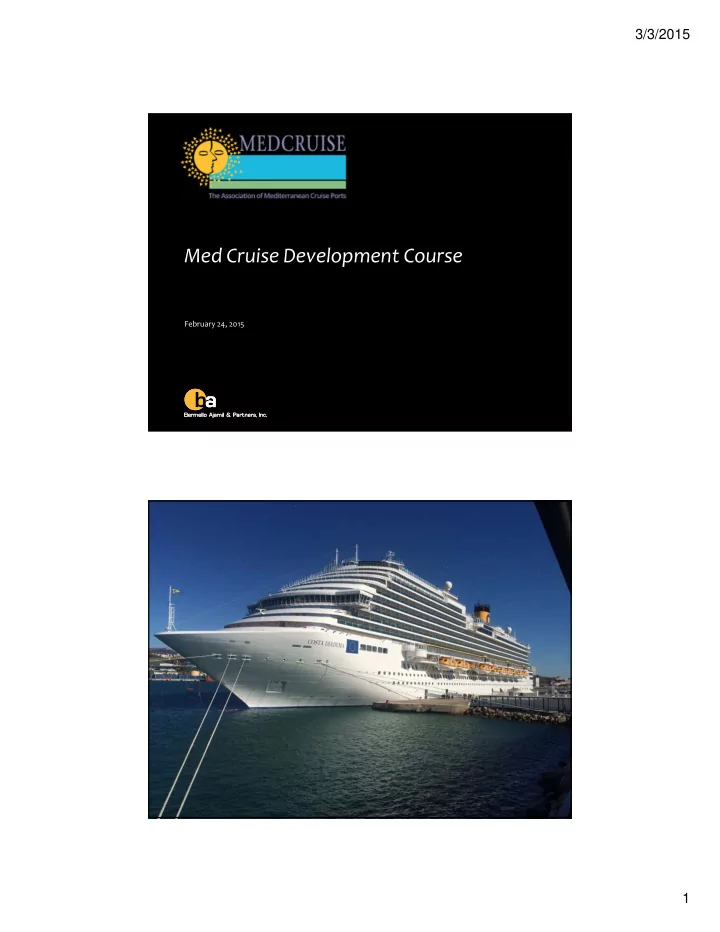
 Welcome to cruising in 2025 – where will the industry be, and how do you fit?  Homeport and port of call operations – technology revolution, are you ready?  Itinerary planning – consumer demand, demographics and profitability  Costa Diadema Captain Nicolò Alba – 30 minute session  Exercise 1: Itinerary planning (connecting the dots)

 Goal

 Increase…

 Cruise calls  Passenger throughput  Port and stakeholder revenues  Economic impacts to the community

 Objective

 Gather tools to assist in achieving this goal!

 Understanding of cruise line methodologies and practices  Future planning tools  Understanding cruise line decision‐makers

slide-4
SLIDE 4

3/3/2015 4

1

Future of Cruise in 2025 and beyond

Cruise passengers, 1995 – 2014

slide-5
SLIDE 5

3/3/2015 5

Top 25 worldwide attractions, 2014

Major cruise corporations worldwide capacity, 2014

slide-6
SLIDE 6

3/3/2015 6

European cruise brand passenger capacity, 2014 Success factors

  • New products that generate sustained interest in cruising

– New, exciting vessels, diverse on‐board products and services – New regions, itineraries and on‐shore product offerings

  • Converting land‐based resort guests into cruise passengers
  • High level of passenger satisfaction

– Leading to repeat clientele and lower conversion costs

  • Adapt quickly to changing market conditions

– Move a vessel to a new destination based on demand, operations cost, low shoreside profit options, other influences

  • Limited competition, reduced operational costs, and diversified

revenues

– Take advantage of brand fleet volumes in agreements & purchasing – Key is to make sure they do not compete against each other

slide-7
SLIDE 7

3/3/2015 7

Cruise vessel deliveries and orders, 1990 – 2020 Cruise vessel deliveries and orders, 2015 ‐ 2040

slide-8
SLIDE 8

3/3/2015 8

Cruise growth, 2015 – 2040 Cruise growth, 2015 – 2035

slide-9
SLIDE 9

3/3/2015 9

Regional competitive cruise deployments, 1997 – 2014 Regional cruise berth capacity deployments, 2014

Mediterranean

#2

Asia & Australasia

#3

Caribbean / Bahamas

#1

South America North / West Europe

#4

Alaska

#5

  • W. Coast / Mexico
slide-10
SLIDE 10

3/3/2015 10

Top 10 cruise passenger sourcing markets, 2014

Country/region Population (million) Global Passenger Share 5 Year Pct. Change (+) USA 320 51.7% 3.75% United Kingdom & Ireland 61 8.1% 16.4% Germany 82 7.7% 80.5% Italy 58 4.0% 26.1% Australia / New Zealand 22 3.6% 2.70% Brazil 201 3.4% 1.3% Canada 33 3.4% 2.42% Spain 40 2.8% 20.7% France 62 2.4% 67.7% Scandinavia & Finland 19 1.6% 184.6%

Cruise consumer market penetration, 30.7 million in 2025

Europe Pop: 515 million Cruisers: 10.3 million Penetration: 2.0% Asia Pacific Pop: 3.4 billion Cruisers: 3.4 million Penetration: 0.1% North America Pop: 350 million Cruisers: 14 million Penetration: 4.0% Australia Pop: 23 million Cruisers: 920,000 Penetration: 4.0% South America Pop: 400 million Cruisers: 2.0 million Penetration: 0.5%

slide-11
SLIDE 11

3/3/2015 11

Regional cruise berth capacity deployments, 2025

Mediterranean

#3

Asia & Australasia

#2

Caribbean / Bahamas

#1

South America North / West Europe

#4

Alaska

#5

  • W. Coast / Mexico

Section questions

 Who are your competitors in the future?  Who are your cruise line clients and what are their needs in 2025 & 2035?  What is the future landscape of cruise at a global level?  Where will the Mediterranean be compared to other cruising regions?

slide-12
SLIDE 12

3/3/2015 12

2

Port operations

Cruise port operations

 Homeport

 Meeting the needs and expectations of the cruise operator and passenger  Operating models

 Port of call

 Maximizing positive impacts – minimizing costs  Partnering to meet demands

 Future fit within a regional scheme

 Technology as an operations driver  Differentiation through port operations

 What do the cruise lines want from you as a port?

 Cruise line and passenger satisfaction  Operations costs vs. revenues

slide-13
SLIDE 13

3/3/2015 13

Operations

Marine Shore Excursions Security Port Fees Servicing Coaches & Taxis

Cruise vessel

slide-14
SLIDE 14

3/3/2015 14

  • Avg. passengers per ship by year of construction, 1999 – 2019

Projected Percentage of Passengers per Ship, 2015 – 2040

slide-15
SLIDE 15

3/3/2015 15

Percentage of Ships Over 300 Meters, 2015 – 2040 Design vessels

Type Design Vessel 1 (small) Design Vessel 2 (Panamax) Design Vessel (post‐Panamax) Design Vessel 3 (super post‐Panamax) Passengers 200 – 1,500 2,000 to 2,600 2,500 to 4,000 5,400 plus Crew 450 850 1,200 +1,200 GRT / Displacement Tons Up to 50,000 / + 20,000 Up to 100,000 / + 50,000 + 100,000 / + 50,000 + 150,000 / + 70,000 LOA (m) 125 to 250 275 to 300 300 to 345 350 plus Beam (m) Up to 28 Up to 36 Over 36 (generally 40 to 50) Over 40 Draft (m) Up to 6.5 Up to 8.5 8.5 to 10 + 8.6 Air Draft (m) Less than 50 Less than 60 Up to 62 Up to 62

slide-16
SLIDE 16

3/3/2015 16

Homeports

Homeport passenger movements, >2,000 passengers

TIME SEPARATION EMBARKATION DIS EMBARKATION

slide-17
SLIDE 17

3/3/2015 17

Homeport passenger movements, 2,500 passengers

PASSENGER HOLDING EMBARKATION DIS EMBARKATION

Homeport passenger movements, 3,000 passengers

EMBARKATION DIS EMBARKATION PASSENGER HOLDING

slide-18
SLIDE 18

3/3/2015 18

Homeport passenger movements, 5,400 passengers

PASSENGER HOLDING EMBARKATION DIS EMBARKATION

Major terminal functions

  • Operations

– Coordination – Berth scheduling – Setup / handover – Gangways (optional) – Traffic control

  • Maintenance

– Routine – Major

  • Housekeeping (janitorial)
  • Security

– Passenger – Terminal

  • Fiscal agent
  • Marketing / business development
  • Parking
  • Ground handling & Stevedoring (usually separate stakeholders)

ma rke ting

  • pe ra tio ns

ste ve do ring se c urity a g e nt Pa sse ng e r se rvic e s F isc a l a g e nt

slide-19
SLIDE 19

3/3/2015 19

Models

ma rke ting

  • p e ra tio ns

ste ve d o ring se c urity a g e nt Pa sse ng e r se rvic e s F isc a l a g e nt

Management model, port operated

  • Operator paid on a per passenger basis
  • Minimum guaranteed annual income
  • Operator may have other operations as a percentage of

income for:

– Parking – Secondary Uses – Other Income Clients

  • Cruise fees
  • Non‐cruise fees

Owner

  • pays operator fees
  • pays non‐operator fees

Owner • collects 100% profit

slide-20
SLIDE 20

3/3/2015 20

Lease model, private terminal operator

  • Annual payments to Owner
  • Covers all facility operations and maintenance

– Major issues covered by owner

  • Minimal control

– Use KPI’s to monitor Clients

  • Cruise fees
  • Non‐cruise fees

TO

  • pays operator fees
  • Owner pays non‐operator fees

Owner • collects rent

Mixed model, owner operated

  • May contract out key functions (income vs. cost)

– Maintenance – Security – Housekeeping – Parking

  • Less control / lower cost

– Non‐essential functions Clients

  • Cruise fees
  • Non‐cruise fees

Owner • pays contractor fees Owner • collects 100% profit

slide-21
SLIDE 21

3/3/2015 21

Performance standards

Performance standards

PASSE

NGE RS

SHI

P

Time in terminal (disembarkation) – 90% under 30 minutes Queuing ‐ 90% under 5 embarkation) Queuing ‐ 90% under 5 minutes (except embarkation)

Operational cycle – disembarkation 3.75 hours Operational cycle – embarkation 5 hours

Time in terminal (embarkation) – 90% under 15 minutes

slide-22
SLIDE 22

3/3/2015 22

  • Total embarkation / debarkation times

– GTA waiting – Walking distances (Curb to vessel) – Baggage drop off / pick up – Security screening – Check‐in – Gangway access – Baggage delivery

  • Other significant KPIs

– Financial – Safety / Security of passengers and staff – Cleanliness – daily and overall maintenance – Satisfaction – meet & greet, experience, friendliness, etc.

Key performance indicator coverage Approach

  • Identify the standards of operations
  • What Key Performance Indicator’s (KPIs) should be implemented

– If so, what are those standards for each?

  • Determine how each facility operates

– Standards should be compromised based upon the facility limitations

  • Establish KPIs

– Based upon operational model and division of responsibilities – Operational target or range – Service standards enforcement

slide-23
SLIDE 23

3/3/2015 23

RCCL KPI’s – line measurement standards (sample)

Sta nda rd * Me a sure Mitig a tion Pla n Re porting Me c ha nism

Se c ur ity Gue sts sho uld no t e xc e e d the e ntra nc e to the se c urity q ue ue . 5 minute wa it fro m q ue ue e ntra nc e to g ue st pro c e ssing (20 g ue sts pe r q ue ue ). Zo ne L e a d will re c o rd d a ily d a ta . Adjust se c urity te a m sta ffing to spe e d d o c ume nt c he c k a nd g ue st pre pa ra tio n to e nte r x-ra y a nd ma g ne to me te r ma c hine . Sp e c ia l lo g fo r OA re vie w me e ting a nd GPS Ve sse l T urn Re po rt if fa ilure o c c urs (will no te ma x # o f g ue sts e xc e e d ing the q ue ue e ntra nc e fo r e a c h e ve nt) Che c k- In Gue sts sho uld no t e xc e e d the e ntra nc e to the c he c k-in q ue ue . 5 minute wa it fro m q ue ue e ntra nc e to g ue st pro c e ssing (12 g ue sts pe r q ue ue ). Zo ne L e a d will re c o rd d a ily d a ta . Ad d GPS sta ff to wo rk q ue ue a nd pre pa re g ue sts fo r pro c e ssing . Ga ug e if the re a re e mpty / lig hte r line s to shift g ue sts. Adjust to 'd o ub le sta c king ' me tho d if ne c e ssa ry. Sp e c ia l lo g fo r OA re vie w me e ting a nd GPS Ve sse l T urn Re po rt if fa ilure o c c urs (will no te ma x # o f g ue sts e xc e e d ing the q ue ue e ntra nc e fo r e a c h e ve nt) Se aPass Gue sts sho uld no t e xc e e d the e ntra nc e to the se a p a ss q ue ue . 1 minute wa it fro m q ue ue e ntra nc e to g ue st pro c e ssing (6 g ue sts pe r q ue ue ). Zo ne L e a d will re c o rd d a ily d a ta . E va lua te ne e d to purc ha se pe rma ne nt e q uipme nt fo r pie r the n a ug me nt with ship e q uipme nt. Sp e c ia l lo g fo r OA re vie w me e ting a nd GPS Ve sse l T urn Re po rt if fa ilure o c c urs (will no te ma x # o f g ue sts e xc e e d ing the q ue ue e ntra nc e fo r e a c h e ve nt) De bar k (CBP) CBP me e ts sta nda rd if ne ve r

  • ve rflo ws the e ntra nc e o f the

'US / NON US' q ue ue . Ba la nc e e mp tying ship with g ue st e xpe rie nc e a nd c o mme nc e me nt o f e mb a rk pro c e ss. Ma ximum # o f g ue sts will fluc tua te pe r vo ya g e . Zo ne L e a d will re c o rd d a ily d a ta . Re vie w o pe ra tio ns with CBP ma na g e me nt to re q ue st a ppro p ria te sta ffing le ve ls if ne e d e d . Ad just ship c a ll o ff sc he d ule to impro ve g ue st flo ws. Add GPS sta ff to wo rk the q ue ue to pre pa re g ue sts fo r CBP pro c e ssing . Sp e c ia l lo g fo r OA re vie w me e ting a nd GPS Ve sse l T urn Re po rt if fa ilure o c c urs (will no te ma x # o f g ue sts e xc e e d ing the q ue ue e ntra nc e fo r e a c h e ve nt)

Marseilles assessment exercise

 Evaluate your passenger experience in Marseilles:  What did you observe?  Information (on ship, process, ports) ?  Boarding?  On board?

slide-24
SLIDE 24

3/3/2015 24

Port of Call

Port of call components

Se c ur ity Gr

  • und

T r anspor tation Site s, ve nue s, c omme r c ia l, r e tail, r e staur ant T

  • ur

ism We lc ome

slide-25
SLIDE 25

3/3/2015 25

Port of call movements, 15,000 passengers Port impacts

  • GTA operations

– Coaches operating simultaneously – Taxi operations with active curb – Limited private vehicles – Shuttle

  • Marshalling area

– Off‐site for easy access? – Depends on port configuration and space

  • Parking (cumulative impact)

– Primarily port staff (much higher for homeports)

  • Vessel servicing?

– Waste, fuel, services, stores

slide-26
SLIDE 26

3/3/2015 26

Passenger capacity impacts

  • Cumulative peaking effect

– Timing of berthing – Number of vessels (1 to ?) – Vessel capacity (500 or 5,400) – Rate of passenger flow (controlled at gangway, security) – Total time in port (4, 6, 8 or more hours)

  • Does port configuration affect impacts?

– Does a terminal provide a barrier or gateway? – Commercial vs. non‐commercial port

  • What are some examples?
  • Is it a choice of revenue for the port v. community? (what drives the choice?)
  • How are crew members dealt with in your port?

– Are you meeting their needs, providing services and capturing revenues?

5,909,236 8,650,000 337,475 1,900,000 1,000,000 2,000,000 3,000,000 4,000,000 5,000,000 6,000,000 7,000,000 8,000,000 9,000,000 10,000,000 2000 2001 2002 2003 2004 2005 2006 2007 2008 2009 2010 2011 2012 2013 2014 Ve nic e T

  • ur

ists Ve nic e Cr uise rs

slide-27
SLIDE 27

3/3/2015 27

Negative cruise tourism model

ST ART UP COMMUNI T Y SUPPORT ST ART UP COMMUNI T Y SUPPORT CRUI SE S BE GI N E VE RYONE L I K E S T HE M CRUI SE S BE GI N E VE RYONE L I K E S T HE M SUCCE SS OVE RCROWDI NG CAPI T AL NE E DS NE GAT I VE RE ACT I ONS SUCCE SS OVE RCROWDI NG CAPI T AL NE E DS NE GAT I VE RE ACT I ONS PASSE NGE R DI SSAT I SF ACT I ON CRUI SE L I NE DI SSAT I SF ACT I ON COMMUNI T Y BACK L ASH PASSE NGE R DI SSAT I SF ACT I ON CRUI SE L I NE DI SSAT I SF ACT I ON COMMUNI T Y BACK L ASH

Comprehensive approach to cruise operations

CRUISE L INE S AND ASSOCIAT E D SE RVICE PROVIDE RS VE NUE S & SIT E S T OURISM INF RAST RUCT URE : AIRPORT , HOT E L , T RANSPORT AT ION CIT Y

PORT

Cruise Tourism Delivery: Focus on Visitor Satisfaction

slide-28
SLIDE 28

3/3/2015 28

Managing the destination

  • This is the area where more change is needed
  • It is not just about a pier or dock or terminal

It is about the destination as a whole…

  • Meeting the needs and expectations of the visitor
  • Competing for economic and social impacts
  • Providing value for money
  • Managing resources today and for the future

– Not just stores, shops and restaurants – Historic and natural resources, roadways, ports, parking areas, environment, etc.

Managing the passenger experience exercise

 What may need to be done in the future to manage the passenger experience?  How to cope with crowding? (regional and port perspective)

slide-29
SLIDE 29

3/3/2015 29

Technology and Security

Industry trends and standards

  • “Highly Functional = World Class”

– Performance targets achieved – Limited queue time/length – Vessel and Brand as the “experience” – Minimized labor costs – Two level operations – Multiple gangways – Flexible for future reconfiguration

  • Next Level

– Space for any holding scenario – More comfort and amenities – airport model – Elevators, escalators – redundancy – Large investment in AV/IT – Terminal as part of the “experience”

slide-30
SLIDE 30

3/3/2015 30

  • Advanced Passenger Information System (APIS)

– e‐passport readers

  • Radio Frequency Identification (RFID)

– baggage tags

  • Biometric Identification Systems

– integrated Automated Fingerprint Identity (IAFIS)

  • Scrubber / shore power
  • Internet / smart phone Apps

– check‐in – tour options, ticketing, maps, guide links

New technology driving the industry Cape Liberty cruise terminal

slide-31
SLIDE 31

3/3/2015 31

Cape Liberty cruise terminal

  • Single terminal servicing multiple brands

– Airport style concept – Off site with vessel access

  • Overlapping operations

– Security portal – Centralized Customs & Immigration unit

  • Technology savvy space

– Back of house functions combined

  • Baggage screening with RFID
  • Cruise lines using more technology for check‐in / baggage

– Check‐in processes will disappear as we know it – Increase efficiencies / reduce costs

  • Smaller terminal spaces

– Relying on adjacencies, flow, technology and intuitive flow planning

Next generation cruise terminals will be…

slide-32
SLIDE 32

3/3/2015 32

Terminal for multiple users using efficiencies to control costs How will technology change the experience?

  • Expedite homeport processing

– provide advanced information about the terminal process – real time – check‐in, baggage and security

  • Changing port of call visits

– more accurate information about things to do and see – access to other shore excursion options – shrink the pool of shorex passengers, more independent operators

  • Traffic patterns will change
  • More emphasis on experience and immediate gratification

– more options for experiences for small groups / single persons – wider demographic and more knowledgeable on destination – do not forget powerful Wi‐Fi for passengers, crew and clients!

slide-33
SLIDE 33

3/3/2015 33

Security

  • Driven by world, regional and local threat assessment

– Affects deployments – Defines security level

  • Flexibility in security design and processing is required based on

– Threat level – Passenger throughput – Demographics

  • Likely to get more stringent for cruise over next decade

– U.S., Asia, Canada applies rules that require terminal security (FIS), as well as primary, secondary and support areas (5,000 sq. ft.) EURO 1.5 million

  • ISPS sets minimum standards

– In contrast to tighter security, access to the water’s edge is expanding!

  • Driven by world, regional and local threat assessment

– Affects deployments – Defines security level

  • Flexibility in security design and processing is required based on

– Threat level – Passenger throughput – Demographics

  • Likely to get more stringent for cruise over next decade

– U.S., Asia, Canada applies rules that require terminal security (FIS), as well as primary, secondary and support areas (5,000 sq. ft.) EURO 1.5 million

  • ISPS sets minimum standards

– In contrast to tighter security, access to the water’s edge is expanding!

Conflicting needs?

slide-34
SLIDE 34

3/3/2015 34

Trending to 2025 and beyond…

 Focus on creating a Huge consumer market in Asia

 New and expanded brands dedicated to the market sailing worldwide  New build market moves beyond Europe to fuel growth of the industry (China)

 Technology influences vessel and port operations

 Minimized or no check‐in counters (airport style)  On line check‐in, RFID baggage tags drive automation (decrease staffing)

 Security worldwide is a major issue for cruise operations

 Affecting deployments and movement of assets at sea / port  Increased terminal security processing throughout Europe / Middle East

 Building the backbone for the future through strategic planning

 Develop businesses & partnerships to control operations (shorex, pre/post, staff, stores)  Investment into key infrastructure is expedited (ports, terminals, private islands)

Section questions

 What technologies have you used as part of this cruise?  What was the affect?  How do you believe technology will influence your future operations?  Do you have any cost‐saving or experience enhancing examples of technology positively impacting your destination?

slide-35
SLIDE 35

3/3/2015 35

3

Itinerary planning

Deployment and Itinerary planning

 What is the primary driver of cruise line deployments to a region?  Is deployment planning the same as itinerary planning?

 How do they differ?  How are they similar?

 What factors influence cruise brand itineraries?  As a destination or port how can you best influence this planning effort?

slide-36
SLIDE 36

3/3/2015 36

Deployment

Alaska

5

Caribbean

1

Mediterranean

2

  • N. Europe

3

South America

6

Australasia

4

Seasonality

S E A S O N A L S E A S O N A L Y E A R R O U N D

slide-37
SLIDE 37

3/3/2015 37

Deployment and itinerary planning selection criteria

Marketing and sales Marine and operations  Consumer awareness  Access to consumers – sales chains  Marketability value for the consumer  Fit with cruise brand philosophy  Fit with consumer holiday patterns  Marine navigation and access  Security  Berth, apron and terminal features  Ground transportation areas  Provisioning  Landside – revenue opportunities  Airlift – capacity and cost  Lodging – capacity and cost  Consumer product satisfaction  Destination venue and tour capacities  Port charges  Labor, fuel and other operating costs  Regulatory and environmental issues  Maritime law  Emission Control Areas Logistics, air and shore excursions Finance and legal

Selection criteria

  • Varies by cruise line based upon consumer target

– Use yield management tools to identify pricing schemes

  • Operators place vessels in the most easy & profitable locations

– Driven by consumer demand – Need to balance fleet to capture new customers and keep loyal cruisers

  • Profitability

– Sales & Marketing costs vs. Ticket price – Onboard / shoreside revenue opportunities vs. Operational costs

slide-38
SLIDE 38

3/3/2015 38

Deployment drivers

  • Driven by profitability and net yields

– Provide what the consumer wants (based on vacation patterns) – Craft a product with marquee destinations, shipboard experience and intrigue with new ports (every demographic may be slightly different)

  • Limit time in ports while creating value experiences

– Critical on long‐haul itineraries (how many ports to visit?) – Revenue v. operations costs

  • Include destinations lines directly control or have deals with…

– Private islands, shorex sales, retail, guarantees

  • What other factors influence deployments in Europe?

Factors influencing European deployments

  • Homeland Market: Opens key national consumer markets
  • Target Market: What markets provide large volumes of cruisers?
  • Shorter Cruise Product: Ability of ships to reach marquee ports
  • Seasonality: No more winter cruising ‐ season is year round
  • Airlift: Out as large part of mix due to homeport options

(interporting, close to home)

  • Vessel Size/Capacity: Infrastructure to service vessels targeted
  • Homeland Market: Opens key national consumer markets
  • Target Market: What markets provide large volumes of cruisers?
  • Shorter Cruise Product: Ability of ships to reach marquee ports
  • Seasonality: No more winter cruising ‐ season is year round
  • Airlift: Out as large part of mix due to homeport options

(interporting, close to home)

  • Vessel Size/Capacity: Infrastructure to service vessels targeted
slide-39
SLIDE 39

3/3/2015 39

Why is deployment critical to success?

  • Drives profit and loss
  • Leverages expensive mobile assets
  • Fluid, complex issues affecting entirety of the corporation

– It is the heart and soul of the product!

Itinerary development considerations

  • Profitability

– Leverage consumer tastes and demands into revenues

  • Guest Appeal
  • Guest Sourcing

– Drives itinerary types, patterns, ports, etc.

  • Brand Positioning
  • T(time), S(speed), D(distance)
  • Business relationship with the destination

– Costs, contractual guarantees, revenue opportunities, etc.

slide-40
SLIDE 40

3/3/2015 40

What are other major considerations?

  • Infrastructure

– Does it support our ship?

  • Berthing availability and policies

– Confirmation policies and assignments – Tendering based upon vessel capacity

  • Fuel cost, type (low sulfur) and availability
  • Emission, discharge and wastewater regulations
  • Air lift availability & cost (dependent upon brand/itinerary)

Price comparison of itinerary patterns, 2014 sample

Vessel Homeport Itinerary Inside Outside Balcony Suite Notes

Grandeur Baltimore 8‐Night Bahamas $409 $539 $1,149 $1,349 Explorer Cape Liberty 7‐Night Bahamas $549 $749 $859 $1,049 Quantum Cape Liberty 7‐Night Bahamas $1,209 $1,249 $1,269 $1,789 2014 Serenade New Orleans 7‐Night Bahamas $549 $649 $849 $1,499 Pride Baltimore 7‐Day Bahamas $529 $649 $739 $1,389 Pride Baltimore 7‐Day E Caribbean $889 $989 $1,119 $1,549 Summer 2014 Fantasy Charleston 7‐Day E Caribbean $369 $529 $709 $1,109 Liberty Miami 7‐Day E Caribbean $369 $489 $679 $1,029 Splendor NYC 8‐Day E Caribbean $369 $479 $739 $1,149 Splendor NYC 8‐Day E Caribbean $919 $1,019 $1,299 $1,779 Summer 2014

slide-41
SLIDE 41

3/3/2015 41

Itinerary comparison conclusions, 2014 sample

  • Slightly higher fares for northeast ports vs. Florida

– $50 ‐ $100 per category – For Florida ports per diems made up for in lower fuel costs, more time in ports, more ports per sailing, etc.

  • Newer vessels get higher ticket prices

– Quantum, Breakaway and Epic

  • Higher pricing further out in sales cycle and reduces over time

– Revenue management model – Supply & demand would typically dictate increased pricing, but for cruise lower pricing is used to fill the ship

Deployment and Itinerary planning

 What is the primary driver of cruise line deployments to a region?  Is deployment planning the same as itinerary planning?

 How do they differ?  How are they similar?

 What factors influence cruise brand itineraries?  As a destination or port how can you best influence this planning effort?

slide-42
SLIDE 42

3/3/2015 42

Quick case study

Alaska market

10 15 20 25 30 35 40 45 50 200,000 400,000 600,000 800,000 1,000,000 1,200,000 Cruise Ships Cruise Passengers Passengers Ships

slide-43
SLIDE 43

3/3/2015 43

Port cruise traffic, 2004 ‐ 2015

60,475 103,044 3,366

20,000 40,000 60,000 80,000 100,000 120,000

What happened to the Port?

 The Port entered the cruise market in 2004 with the opening of its new cruise ship terminal.  At its peak, the port handled in excess of 60 cruise ship calls and 100,000 passengers with strong prospects for growth.  The port has seen a decline in the number of cruise calls since 2008.  In 2011, they lost the last remaining weekly call by Norwegian Cruise Line.  Over the past three years the port has handled between six to ten vessels per season and less than 10,000‐passengers.

 primarily made up of shoulder season repositioning calls  periodic calls from smaller cruise lines  small pocket exploration cruise ships

slide-44
SLIDE 44

3/3/2015 44

Impacts and next steps

 The impact of this deterioration caused an erosion of the shore excursion program, once a strength of the destination!  Decline of engagement from the business community and citizens as volunteers.  Sustained loss of traffic and revenue forced the organization to reassess the relevance and roll in the cruise sector.  What are the opportunities and challenges associated with development of cruise to support future planning initiatives.  The study should serve as the basis to profile what would be required to be competitive, create a basis for developing priorities and the development of an action plan.

SWOT assessment

slide-45
SLIDE 45

3/3/2015 45

Cruise projection composite, 2004 ‐ 2025

4

Captain’s Q&A

slide-46
SLIDE 46

3/3/2015 46

Q&A

 What are the main challenges that you encounter at a port?  What is key for the success of a port?

 Turnaround and port of call

 How do the Med ports compare to ports in other regions?  Can you provide any port best practices examples?  Any specific suggestions or recommendations for improvement?

5

Itinerary planning – connecting the dots

slide-47
SLIDE 47

3/3/2015 47

Assignment overview

 Divide into teams

 Each team will build a deployment model and itinerary for a brand

 45 minutes to work and 5 minutes to present followed by discussion

 Utilize the information provided as to the following:

 Deployment drivers  Seasonality (if any)  Itinerary balance, cost and revenues, etc.

 Prepare an itinerary for the following:

 Star Cruises  Oceania Cruises  Celebrity Cruises

 Consider the following elements:

 What is the brand and therefore the target market?  Whom is the passenger demographic?  Speed, distance and time in port (consider homeport operations)

TWO BERTHS ALTERNATIVES

Cruise Brand Typical Nationality Age Range Income Range Market Sector Notes

Carnival Cruise Line Primarily US 25 and up Avg. Contemporary 3, 4, 5, 7‐day sailings Younger middle class, couples and families Celebrity Cruises Primarily US and Canadian 35 and up USD $100,000 Premium 7‐day plus sailings Couples and families Holland America Line Primarily US 45 and up USD $75,000 Premium 7‐day plus sailings Couples and retired singles Norwegian Cruise Line Primarily US 35 and up Avg. Contemporary 7‐day plus sailings Younger couples, singles and families Royal Caribbean International US and Intl. (50% goal) 30 and up

  • Avg. to high

Contemporary / Premium Couples, families and singles Disney Cruise Line Us and Intl. mix 35 and up

  • Avg. to high

Contemporary / Premium Families and couples Princess Cruises Primarily US 35 and up

  • Avg. to high

Contemporary / Premium Predominantly couples and singles Crystal Cruises Us and Intl. mix 55 and up High Luxury 7‐day plus sailings Couples and retired singles Silversea Cruises Us and Intl. mix 55 and up High Luxury 7‐day plus sailings Small ship experience Couples and retired singles Seabourn Cruises Us and Intl. mix 55 and up High Luxury 7‐day plus sailings Small ship experience Couples and retired singles Regent Seven Seas Us and Intl. mix 45 and up Mid to high Affordable Luxury 7‐day plus sailings Small ship experience Couples and retired singles Oceania Cruises Us and Intl. mix 45 and up Mid to high Affordable Luxury 7‐day plus sailings Small ship experience Couples and retired singles MSC Cruises Primarily European mix 30 and up Avg. Contemporary 7‐day plus sailings Couples, singles and families Costa Cruises Primarily European mix 35 and up Avg. Contemporary 7‐day plus sailings Couples, singles and families Cunard Line UK and Intl. mix 50 and up Mid to high Premium / Luxury 7‐day plus sailings Couples and retired singles Hapag‐Lloyd Cruises Primarily German 50 and up Mid to high Premium / Luxury 7‐day plus sailings Couples and retired singles AIDA Cruises Primarily German 25 and up Avg. Contemporary 3, 4, 5, 7‐day plus sailings Couples, singles and families

slide-48
SLIDE 48

3/3/2015 48

Port Detail Arrival Departure

  • Day 1 Fort Lauderdale, Florida

4:00PM

  • Day 2 At Sea
  • Day 3 Grand Cayman

Tendered 8:00AM 5:00PM

  • Day 4 At Sea
  • Day 5 Cartagena, Colombia

Docked 7:00AM 4:00PM

  • Day 6 Colon, Panama

Docked 8:00AM 6:00PM

  • Day 7 Limon, Costa Rica

Docked 7:00AM 6:00PM

  • Day 8 At Sea
  • Day 9 Belize City, Belize

Tendered 9:30AM 6:00PM

  • Day 10 Cozumel, Mexico

Docked 8:00AM 5:00PM

  • Day 11 At Sea
  • Day 12 Fort Lauderdale, Florida 7:00AM

Celebrity Equinox, 11‐Night

slide-49
SLIDE 49

3/3/2015 49

Port Detail Arrival Departure

  • Fri

Copenhagen, Denmark 8 PM

  • Sat Berlin (Warnemunde), Germany

7 AM 11 PM

  • Sun Cruising the Baltic Sea
  • Mon Tallinn, Estonia

9 AM 6 PM

  • Tue St. Petersburg, Russia

9 AM

  • Wed St. Petersburg, Russia

8 PM

  • Thu Helsinki, Finland

10 AM 5 PM

  • Fri

Stockholm, Sweden Disembark 8 AM

Oceania Marina, 7‐Day

Port Arrival Departure

  • 13 Mar 2015 HONG KONG

2030

  • 14 Mar 2015 HIGH SEAS
  • 15 Mar 2015 HONG KONG

2000

  • 16 Mar 2015 HONG KONG

1400

Superstar Virgo, 3‐Night

slide-50
SLIDE 50

3/3/2015 50

Tools

 http://www.sea‐distances.org/

 Use voyage calculator (there is a complete template that can be used)  Presentation should discuss the following:  Cruise brand, consumer target market(s)  Deployment

 Vessel, capacity, LOA, etc.  Seasonality (if any)  Sailings (how many)  Cover the major deployment drivers in the presentation

 Itinerary

 Type (length)  Ports (explain the mix and reasoning using itinerary drivers in the presentation)  Speed & distance between ports  Time in port (discuss cost vs. revenue factors)

Discussion

  • How did the team do in terms of presenting the deployment and

itinerary plan?

  • Discuss the major elements presented and the reasoning
  • How does this exercise apply to port operations and marketing?
  • Can the process provide uses when developing presentations or

discussing issues with cruise line decision‐makers?

  • What are the key lessons learned from this exercise?
slide-51
SLIDE 51

3/3/2015 51

6

Course Key Takeaways

Course key takeaways

 Developing a mid‐ to long‐term strategy should:

 Identify and benchmark competition  Define port infrastructure requirements

 Larger vessels driving needs

 Define and expand upland soft infrastructure needs

 Attack congestion now for the future  Prepare for new consumer markets (China and others)

 Consider technology in all aspects of planning and delivery  Security and waterfront access will further define cruise infrastructure

 Establish key performance indicators

 Focus on…

 Passenger satisfaction  Cruise line services  Community impacts

slide-52
SLIDE 52

3/3/2015 52

Course key takeaways

 Define your future target markets (cruise brands)

 Understand their perspective of your region and port  Work together as a Unit to attract and retain cruise (Med Cruise)  Develop itinerary products, shore excursions and other revenue options

 To allow them to expand their presence  Develop additional revenues and passenger satisfaction levels

 Communicate regularly with cruise line personnel

 Survey and discuss their needs  Differentiate your destination

 Focus planning efforts on cruise passenger satisfaction

 Each destination is unique in its strategy for development and implementation

Med Cruise Development Course

February 24, 2015