
SLIDE 1
Ma Mary ry Le Lee Bu Burb rbank nk Sch chool
EXHIBIT C 2-7-17
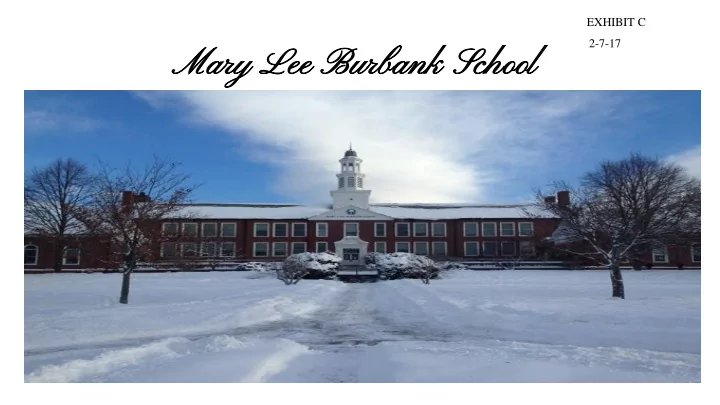
Ma Mary ry Le Lee Bu Burb rbank nk Sch chool PART A: School - - PowerPoint PPT Presentation
EXHIBIT C 2-7-17 Ma Mary ry Le Lee Bu Burb rbank nk Sch chool PART A: School Enrollment Burbank Enrollment Enrollment, October 1, 2010 327 Students Enrollment, October 1, 2016 373 Students ~+46 new students ~More complex profiles
EXHIBIT C 2-7-17
Enrollment, October 1, 2010 327 Students Enrollment, October 1, 2016 373 Students ~+46 new students ~More complex profiles (ELL students and 504 Plans) ~Added a fourth second grade class ~General Budget (paper, toner, staples, general supplies) ~Common areas (gym, cafeteria, playground, computer lab) ~Bus (parking, drop off and pick up, staff parking) ~After School Program ~Impact on support staff (special needs teachers, RTI, office staff, nurse, guidance counselor, school psychologist) ~Difficulty finding space for TMP, ACCESS Testing, MCAS testing (library/computer lab)
1.Completion of Open Circle Program 2.Burbank SEL Steering Committee 3.Small Group Instruction
Open Circle provides a unique, evidence-based social and emotional learning program for elementary schools. The Open Circle program delivers interactive, in-person professional development for all school staff. Open Circle curriculum proactively develops children’s social and emotional skills, including managing emotions, empathy, positive relationships and problem
cared for and engaged in learning.
Open Circle Curriculum Topics
Beginning Together Getting to Know Each Other Appreciating Difference Non-Negotiable Rules Nonverbal Signals Managing Ourselves Being Calm Listening Recognizing and Naming feelings Body Language Getting Calm When You Feel Upset Positive Self-Talk Strengthening Relationships Giving and Receiving Compliments Including One Another Cooperating Speaking Up Expressing Angry Feelings How to Sort Problems Dangerous and Destructive Behaviors Annoying Behavior Teasing Bullying Behavior Bystander and Ally Behavior Recognizing Discrimination
Open Circle Curriculum Topics
Problem Solving Identifying the Problem Deciding on a Positive Goal Brainstorming Solutions Evaluating Solutions Making a Plan and Trying It Overcoming Obstacles Being a Positive Leader
Teachers Agree that Open Circle
Reduces Bullying Behavior Reduces Physical Aggression Improves Problem Solving Increases Empathy Increases Cooperation Improves Teaching Practice
“One thing I learned was speaking up” “I learned about bullies, upstanders and bystanders” “I share my ideas and listen to other people's ideas”
“I learned that if I get mad at somebody I should use calm breathing to calm down” ”One thing I have learned is not to exclude people from games” “One thing I think I learned from Open Circle at Burbank and will use next year is expressing how I feel” “Think of everyone else”
Specific Focus: This year the SEL committee will focus on surveying the staff about any proposed changes to the Habits of Success assemblies to ensure any alignment that needs to happen between HOS and SEL standards/layers along with connecting the Open Circle themes and Burbank Core Values with the larger Burbank School Community.
~June-we had a staff meeting where we surveyed the staff about Habits of Success and ideas/suggestions/additions that we could make. ~June and August, members of the Burbank SEL Committee met and connected the work we did with Rachel Poliner to the school based SEL focus of redesigning
themes of Open Circle, and Burbank School Core Values.
October 21st 1:45-2:15 (SEL Committee) Beginning Together Whole Body Listening Larry by Elizabeth Sautter November 17th 8:55-9:25 (First Grade Team) Managing Ourselves (Managing Emotions) When Sophie Gets Angry by Molly Bang December 15th 8:55-9:25 (Kindergarten Team) Managing Ourselves (Mindfulness) Silence by Lemniscates February 17th 8:55-9:25 (Third Grade Team) Strengthening Relationships (Cooperating) Swimmy by Leo Leonni or What if Everyone Did That? by Ellen Javernick May 10th 8:55-9:25 (Second Grade Team) Problem Solving (Persistence, Multiple Solutions to a Problem)The Most Magnificent Thing, What Do You Do With a Problem, by Ashley Spires May 23rd 8:55-9:25 (Fourth Grade Team) How to Sort Problems (Teasing, Bullying, Bystander) The Invisible Boy by Patrice Barton
Small Group Instruction
Small Group Instruction
A two-year PLT was formed starting in the fall of
different instructional practices to improve our Reading Workshop, Mathematics Workshop and focus on small group instruction across the content areas in grade K-4. The first year the focus was on research and
video research, the focus has shifted to implementation at each grade level. Including Daily 5, Daily 3 and content area integration. . This year we are focusing on Lesson Study within our implementation of small group
professional development we are using to improve our teaching by incorporating new ideas and methods. Lesson Study is an approach using a small group of educators in a collaborative process. It is goal driven and involves teachers’ regular classroom work.
Small Group Instruction
Goals:
mini-lessons for the whole class and small group lessons for the remainder of the workshop.
workshop
we will work together to set goals, plan,
math, reading and in content areas with integration. Currently… Teachers are in full swing with Lesson Study- they are first planning the mini-lessons together, then trying them out (observing each other implementing the lessons), and then critiquing how the lesson went, both strengths and areas to improve. The focus on being how to best implement small group instruction, while fostering a workshop model.
Thank you!