SLIDE 1
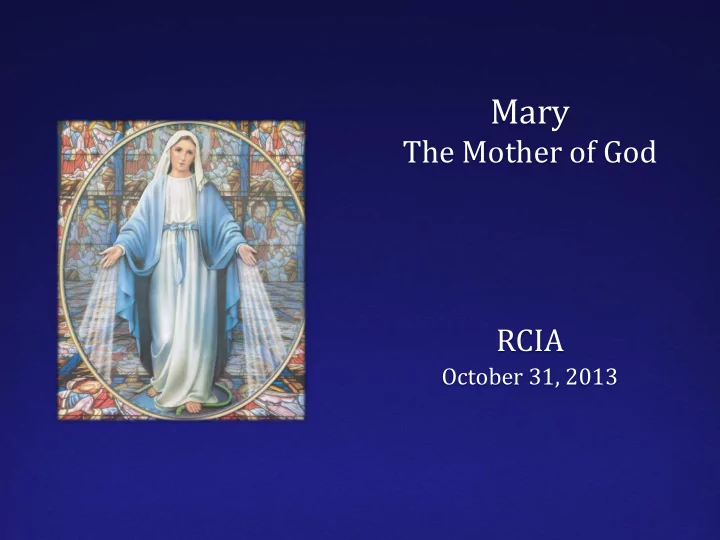
Mary
The Mother of God RCIA
October 31, 2013
SLIDE 2
Mary, the Mother of God
As we look at Mary, as with Jesus, we must realize that she was a true person in history We look at Mary from several perspectives which give us a fuller understanding: History Scripture Tradition Faith
SLIDE 3
The Historical Mary
Much of what is known about the Historical Mary comes from tradition and non-canonical sources Protoevangelium of James (125-145AD) Early Church Fathers
SLIDE 4
Mary’s Birth
Born to Joachim and Anne Joachim belonged to the royal family of David Anne was a descendant from the priestly family of Aaron
Christ the Eternal King and Priest came from both kingly and priestly family lines
SLIDE 5
Where was Mary Born?
Nazareth in Galilee (Luke 1:26 - Annunciation) Sephoris (Gospel of James) Jerusalem (Probatica) St Sophronius of Jerusalem 6 - 7th Century
SLIDE 6
Probatica – Pools of Bethseda
SLIDE 7
Birthplace ?
SLIDE 8 Presentation in Temple
Joachim and Anne, faithful to a vow they had made, presented the child Mary in the Temple when she was three years old Vow of Perpetual Virginity Mary remained in the Temple after her presentation in
- rder to be educated with other Jewish children
Church has remained silent on this issue The house of Joachim and Anna was not far from the Temple, it is possible that the holy child Mary was
- ften allowed to visit the sacred buildings in order to
satisfy her devotion.
SLIDE 9 Marriage to Joseph
According to Jewish custom, the union between Joseph and Mary had to be arranged by the parents of
As she had obeyed God's inspiration in making her vow, so she obeyed God's inspiration in becoming the bride of Joseph. Mary trusted the Divine guidance implicitly, and thus was certain that her vow would be kept even in her married state.
SLIDE 10 The Historical Mary
Mary was born during the reign of Herod the Great Mary, like her son Jesus, spoke Aramaic but she would have also been exposed to Latin (Roman
- ccupiers), Hebrew (synagogues) and Greek
(language of commerce) Most Jews lived as members of an extended family (as did Mary most likely) Most women of her day married around the age of thirteen
SLIDE 11
Where Did Mary Live?
Probably lived in or near Jerusalem May have lived with John in Ephesus temporarily She would have died (or been Assumed) before John’s exile to Patmos
SLIDE 12 Mary’s Death
48 AD - Eusebius, Clement of Alexandria, Apollonius Since the Middle Ages the view prevails that she died
- f love, her great desire to be united to her Son
Dormition Abbey
SLIDE 13
Dormition Abbey
SLIDE 14
Statue of Mary
SLIDE 15
The Scriptural Mary
In the Christian Scriptures Mary is mentioned: in the Gospels in other books of the Christian Scriptures
SLIDE 16
Gospel References
Mark 3: 31-35 Family Mark 6:1-6a … the son of Mary Matthew 1:1-17: The Genealogy of the Messiah, Jesus Christ (...Mary, of her was born Jesus... the Messiah”) Matthew 2:1-12: The Visitation of the Magi (“...and going into the house they saw the child with his mother Mary, and falling to their knees they did him homage.”) Matthew 2:13-18: Flight to Egypt (The Lord appeared to Joseph...and said, “...take the child and his mother...into Egypt”)
SLIDE 17
Gospel References - continued
Luke 1:39-45: Mary visits Elizabeth (“…And Elizabeth was filled with the Holy Spirit and exclaimed with a loud cry, "Blessed are you among women, and blessed is the fruit of your womb”.) Luke 1:46-56: The Magnificat: (“...Mary said, "My soul magnifies the Lord, and my spirit rejoices in God my Savior, for he has looked with favor on the lowliness of his servant. Surely from now on all generations will call me blessed”)
SLIDE 18 More Gospel References
Luke 2:1-7: Jesus’s Birth Luke 2:8-20: Shepherds /Angels Luke 2:21-40: The Naming of Jesus/the Presentation in the Temple Luke 2:41-52: Jesus in the Temple Luke 8:19-21: Jesus' Relatives; [cf. Matthew 12:46-50; Mark 3:31-35] Luke 11:27-28 Blessed is the womb that carried you… John 1:13 Born …not by a man’s decision but of God John 2:1-12: the Wedding at Cana John 6:42: Is this not the Son of Joseph? Do we not know his father and mother… John 7:41-43; 8:41 The origin of the Messiah John 19:25-28a: Mary at the foot of the Cross
SLIDE 19 New Testament
Acts 1:12-14
All those devoted themselves with one accord to prayer, together with some women, and Mary the Mother of Jesus…
Galatians 4:4
But when the fullness of time had come, God sent his Son, born of a woman…
Revelation 12: 1-2
A great sign appeared in the sky, a woman, clothed with the sun, with the moon under her feet… She was with child and wailed aloud in pain as she labored to give birth
SLIDE 20 Old Testament Prophecies of Mary
1st Prophecy: Genesis 3:15 “I will put enmity between
you and the woman, and between your offspring and hers; He will strike at your head, while you strike at his heel.”
SLIDE 21
2nd Prophecy of Mary
Isaiah 7: 14 “Therefore the Lord himself will give you this sign: The virgin shall be with child, and bear a son, and shall name him Immanuel.”
SLIDE 22
3rd Prophecy of Mary
Micah 5: 2-3 “But you Bethlehem-Ephrathah, too small to be among the clans of Judah, From you shall come forth … one who is to be ruler of Israel…” “Therefore the Lord will give them up, until the time when she who is to give birth has borne…”
SLIDE 23
4th Prophecy of Mary
Jeremiah 31:22 “The Lord has created a new thing upon the earth; the woman must encompass the man with devotion…”
SLIDE 24
Unlikely Sources
Quran Protestant reformers
Martin Luther John Calvin Ulrich Zwingli
SLIDE 25
Quran
The Quran speaks of Mary (called Miriam in Arabic) not only as the mother of Jesus, but as a righteous woman in her own right Quran devotes a whole chapter to Mary (Chapter 19) Angel to Mary: “I am only a messenger from your Lord, (to announce) to you the gift of a holy son.' She said, 'How shall I have a son, seeing that no man has touched me, and I am not unchaste?' He said, 'So (it will be). Your Lord says, 'That is easy for Me, and (We wish) to appoint him as a Sign unto men, and a Mercy from Us. It is a matter (so) decreed'" (19:16-21, the Chapter of Mary)
SLIDE 26
Quran continued
"Behold! The angels said, 'Oh Mary! God has chosen you and purified you, chosen you above the women of all nations. Oh Mary! Worship your Lord devoutly. Prostrate yourself, and bow down (in prayer) with those who bow down'" (3:42-43). "And (remember) she who guarded her chastity. We breathed into her of Our spirit, and We made her and her son a sign for all peoples (21:91). And Mary, the daughter of 'Imran, who guarded her chastity. And We breathed into (her body) of Our spirit. She testified to the truth of the words of her Lord and of His Revelations, and was one of the devout (servants)" (66:12).
SLIDE 27
What do Catholics Believe about Mary?
God chose Mary, a virgin, to be the Mother of God We do not hold Mary to be divine We do NOT worship Mary. Worship is withheld for God and God alone Mary is subordinate to Jesus but is above all other creatures We honor Mary because Mary was honored by God and to her a special grace was bestowed (see Luke 1:28)
SLIDE 28
Marian Dogma
Divine Motherhood Perpetual Virginity Immaculate Conception The Assumption
SLIDE 29
Divine Motherhood
Various titles: Mother of God Theotokos (Greek):
God bearer Birthgiver of God
SLIDE 30
Theotokos
Council of Ephesus 431 AD Responded to the Nestorian Heresy Nestorius Patriarch of Constantinople Mary was Christotokos not Theotokos Stated Mary gave birth to the Human aspect of Jesus but Not the Divine Nestorius was in essence denying the Hypostatic Union of Jesus’ two natures, God/man; Divine/Human, in One Person
SLIDE 31
Theotokos
Mary is not responsible for the Divinity of Jesus Jesus was eternally begotten of God the Father Theotokos refers to the Incarnation, when the Second Person of the Holy Trinity took on human nature in addition to his pre-existing divine nature, this being made possible through the cooperation of Mary.
SLIDE 32
Mary Ever-Virgin
SLIDE 33
Perpetual Virginity
The early baptismal formula (since the 3rd century) state Mary's virginity Council of the Lateran, 649 AD: Mary conceived "without any detriment to her virginity, which remained inviolate even after his birth” The Catholic Church holds as dogma that Mary was and is Virgin before, in and after Christ's birth.
SLIDE 34
Perpetual Virginity
Vatican II reiterated the teaching about Mary, the Ever- Virgin, by stating that Christ's birth did not diminish Mary's virginal integrity but sanctified it The Catechism of the Catholic Church (499-507) maintains that Jesus Christ was Mary's only child. The so-called "brothers and sisters" are close relations.
SLIDE 35
Mary “Ever-Virgin”
The early Church held that Mary had but one child, Jesus Their belief stemmed from witness and tradition This truth is found in the writings of the early Church fathers. In the days of St. Augustine, those who denied the virginity of Mary were labeled Heretics
SLIDE 36
Perpetual Virginity
Patristic fathers of the church call her:
…the tabernacle exempt from defilement and corruption (Hippolytus) …as innocent as Eve before her fall, a virgin most estranged from every stain of sin, more holy than the Seraphim, the sealed fountain of the Holy Spirit, the pure seed of God, ever in body and in mind intact and immaculate (St Ephraem)
SLIDE 37
Patristic Writings
Athanasius: (Discourses Against the Arians 2:70 [A.D. 360] Augustine: (Heresies 56 [A.D. 428] Others: Epipanius of Salamis, Jerome, Didymus the Blind, Ambrose of Milan, Pope Siricius I, Leporius, Cyril of Alexandria, Pope Leo I
SLIDE 38
Brothers and Sisters of Jesus
But scripture attest to the brothers and sisters of Jesus Matthew 12:46 :
“While he was still speaking to the crowd, his mother and brothers appeared outside wishing to speak to him”
SLIDE 39
Brothers and Sisters of Jesus
The culture at the time of Jesus was to have extended families living in one home Adelphoi (Greek) as used in the scriptures implies a broader sense of the term than simply siblings Brethren = Adelphoi The brothers to which Matthew refers were probably the sons of Joseph from a previous marriage or perhaps cousins
SLIDE 40
Ever Virgin
The early church took for granted the lone status of Jesus as the only son of Mary Jerome rebutted the proposal of Helvidius [A.D. 380] who held that the brothers in Matthew 13:55 meant Mary had other children.
SLIDE 41 Reformers
Calvin agreed with Jerome adding, “Helvidius has shown himself too ignorant…” Luther agreed in the perpetual virginity of Mary by agreeing with Calvin’s assessment of Helvidius
Zwingli remarked, “ I esteem immensely the Mother of God, the ever chaste, immaculate Virgin Mary”
SLIDE 42
John 19: 26-27
“When Jesus saw his mother and the disciple there whom he loved, he said to his mother, “Woman, behold, your son.” Then he said to the disciple, “Behold, your mother.” And from that hour the disciple took her into his home.” This act would conflict with 1st Century Jewish custom if Jesus had living brothers
SLIDE 43
Immaculate Conception
SLIDE 44 Immaculate Conception
We honor Mary because Mary was honored by God and to her a special grace was bestowed (see Luke 1:28) In Luke we see Gabriel greeting Mary with, “Hail, favored
- ne! The Lord is with you”. Using the word “kecharitomene”
Gabriel conveying an abundance or plenitude of grace This grace extended from the time of her conception and throughout her life Thus is the doctrine of the Immaculate Conception
SLIDE 45
Immaculate Conception
Refers to the conception of Mary NOT Jesus Proclaimed as dogma by Pope Pius IX on December 8, 1854 The dogma of the Immaculate Conception states "that the most Blessed Virgin Mary, from the first moment of her conception, by a singular grace and privilege from Almighty God and in view of the merits of Jesus Christ, was kept free of every stain of original sin.” The dogma declares that from her beginning Mary was exceptionally holy and in constant union with the sanctifying grace of the Holy Spirit.
SLIDE 46
Immaculate Conception
The dogma stresses the dignity and holiness required to become "Mother of God." The privilege of the Immaculate Conception is the source and basis for Mary's all-holiness as Mother of God.
SLIDE 47
The Assumption
SLIDE 48 The Assumption
Proclaimed by Pope Pius XII on November 1, 1950 Assumption not Ascension
Jesus Christ, Son of God and Risen Lord, ascended into heaven, a sign of divine power. Mary, on the contrary, was elevated or assumed into heaven by the power and grace of God. The dogma states that "Mary, Immaculate Mother of God ever Virgin, after finishing the course of her life on earth, was taken up in body and soul to heavenly glory."
SLIDE 49 The Assumption
This dogma has no direct basis in scripture. It was nonetheless declared "divinely revealed," meaning that it is contained implicitly in divine Revelation. The definition of the dogma does not say how the transition from Mary's earthly state to her heavenly state happened. However, the
- pinion that Mary passed through death as her Son did, has the
stronger support in tradition.
SLIDE 50
Marian Titles
Frequently used titles for Mary in the English-speaking world include The Virgin Mary The Blessed Virgin Mary The Blessed Mother Mother of God Immaculate Mary Saint Mary Holy Mary Holy Virgin Our Lady The Madonna Notre Dame Queen of Heaven
SLIDE 51
Hail Mary (Ave Maria)
Hail Mary, full of grace, the Lord is with thee Blessed art thou among women and blessed is the fruit of thy womb, Jesus Holy Mary, Mother of God Pray for us sinners Now and at the hour of our death Amen