Interview of Book Character Development Greta Stueckle and Mary - - PDF document

interview of book character development
SMART_READER_LITE
LIVE PREVIEW

Interview of Book Character Development Greta Stueckle and Mary - - PDF document

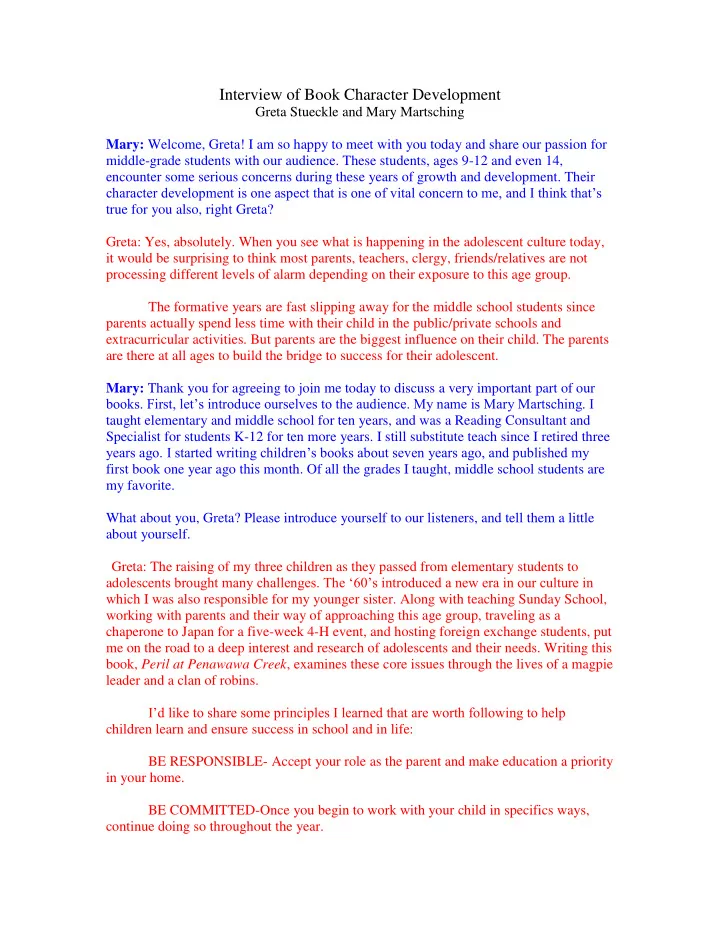
Interview of Book Character Development Greta Stueckle and Mary Martsching Mary: Welcome, Greta! I am so happy to meet with you today and share our passion for middle-grade students with our audience. These students, ages 9-12 and even 14,


slide-1
SLIDE 1

Interview of Book Character Development

Greta Stueckle and Mary Martsching Mary: Welcome, Greta! I am so happy to meet with you today and share our passion for middle-grade students with our audience. These students, ages 9-12 and even 14, encounter some serious concerns during these years of growth and development. Their character development is one aspect that is one of vital concern to me, and I think that’s true for you also, right Greta? Greta: Yes, absolutely. When you see what is happening in the adolescent culture today, it would be surprising to think most parents, teachers, clergy, friends/relatives are not processing different levels of alarm depending on their exposure to this age group. The formative years are fast slipping away for the middle school students since parents actually spend less time with their child in the public/private schools and extracurricular activities. But parents are the biggest influence on their child. The parents are there at all ages to build the bridge to success for their adolescent. Mary: Thank you for agreeing to join me today to discuss a very important part of our

  • books. First, let’s introduce ourselves to the audience. My name is Mary Martsching. I

taught elementary and middle school for ten years, and was a Reading Consultant and Specialist for students K-12 for ten more years. I still substitute teach since I retired three years ago. I started writing children’s books about seven years ago, and published my first book one year ago this month. Of all the grades I taught, middle school students are my favorite. What about you, Greta? Please introduce yourself to our listeners, and tell them a little about yourself. Greta: The raising of my three children as they passed from elementary students to adolescents brought many challenges. The ‘60’s introduced a new era in our culture in which I was also responsible for my younger sister. Along with teaching Sunday School, working with parents and their way of approaching this age group, traveling as a chaperone to Japan for a five-week 4-H event, and hosting foreign exchange students, put me on the road to a deep interest and research of adolescents and their needs. Writing this book, Peril at Penawawa Creek, examines these core issues through the lives of a magpie leader and a clan of robins. I’d like to share some principles I learned that are worth following to help children learn and ensure success in school and in life: BE RESPONSIBLE- Accept your role as the parent and make education a priority in your home. BE COMMITTED-Once you begin to work with your child in specifics ways, continue doing so throughout the year.

slide-2
SLIDE 2

BE POSITIVE-Praise goes a long way with children, especially with those who struggle in school. Provide positive feedback. BE PATIENT-Show your child you care through your commitment and encouragement. BE ATTENTIVE-Stop bad behavior immediately when it appears. Show him/her what to do and provide an opportunity to do it directly. Discipline should be appropriate and consistent. BE PRECISE-Provide clear instructions. BE MINDFUL OF MISTAKES-Look over all the work your child brings home from school and keep it in a folder. Help him/her correct any errors. BE RESULT-ORIENTED -Gather information on how your child is performing in school. Keep notes of conferences with teachers, request progress reports, and carefully read report cards and achievement test results. Ask questions about these results. BE DILIGENT-Work from the beginning to the end of the year with your child and teachers. BE INNOVATIVE-Keep the learning lively and dynamic. BE THERE-Just be there for your child to answer questions, to listen, to give advice, and to encourage positively about his life. Be there and support your child whenever needed. These are ways to build good character in your child. Who ever said raising a family is easy? It takes excellent character on a parent’s part to instill these traits in a son or daughter. Mary: Yes. One more suggestion is to be supportive. Parents need to commit to attending student activities in which their child chose to be involved. If we expect children to follow our expectations, we need to honor our student’s interests. First Greta, tell our listeners your full name, book title, and where they can find a copy. Greta: The first book in the Penawawa series is entitled “Peril at Penawawa Creek.” My full name is Greta Kay Stueckle, but I write under the name of Greta Kay. Peril should be

  • n the market through Amazon by May 2014, just around the corner.

Mary: Would you please tell us in a sentence or two what your book is about?

slide-3
SLIDE 3

Greta: It’s about risks and thrills, lies and corruption, failure and triumph, creating a conflict between the magpies and robins as eggs are stolen and manipulation of the truth becomes entrenched. One purpose of my book is to show the student that we all make mistakes, and getting a second chance gives hope. Character building requires time and many lessons. Now it’s your turn, Mary. What about your book? Mary: Thank you, Greta. My book is called Finding Heath Young Lighthouse Keeper. My full name is Mary Martsching, and my book can be found on Amazon.com, Barnes and Noble.com, and West Bow Press.com in hardback, soft cover, and e-book formats. My main character, Heath is fourteen years old. He struggles with feelings of guilt and

  • identity. His parents died in a shipwreck two years before, and he was the sole survivor.

He questions why he lived and his parents did not. He now lives with his estranged grandfather, a lighthouse keeper. Heath’s already tense situation increases with a school bully and a basketball coach. Later in the book, a severe storm incapacitates his grandfather, and he is faced with trying to rescue people out on the ocean. Greta: Both of our characters face temptations, problems, and decision-making concerns, right? Mary: Yes. These conflicts are common with many teens today. A unique opportunity authors have is, without sounding “preachy,” they can offer solutions to these shared problems through their book characters. This helps readers to see possible actions they can take to solve their own conflicts. This is called “bibliotherapy” since it offers therapy to the reader through the book. Greta, your book presents a unique way to portray these situations and conflicts in which teens find themselves at times. You use magpies as your characters. There is one who is tempted to steal. Many young people today face that temptation because of peer pressure, jealousy, to be mean to others, or out of genuine need. Greta: Yes. No matter the reason behind theft, there are always consequences that follow the actions. Mary: Another conflict teens face is appearance. Some feel ugly while others are

  • confident. Some are overly confident to the place of being prideful, boastful, and
  • conceited. These latter teens can strike out at those who aren’t as skilled, or developed, or

handsome, or pretty as someone else. They bully these students. Would you agree? Greta: The negative, aggressive acts of people who pass through our lives daily are easily read, and we avoid them. This is not always possible in school or home where bullying can become chronic. Most of the time bullying begins in childhood. But it can be learned

  • anywhere. Do some parents abuse their children? Are there some teachers who browbeat

and torment their students? Right now, unbridled intimidation is on all minds where youth are vulnerable, and the strong take advantage too often, resulting in suicide.

slide-4
SLIDE 4

Mary: Talk about how in your book one wrong decision leads to another, and even another one, and how this can affect others as well of the one making the bad decisions. Greta: When Leader steals the eggs, he unknowingly leaves clues that point to the

  • magpies. To divert attention away from himself, Leader accuses other birds. But a

footprint in the mud can’t tell lies, so Leader comes up with other solutions that drastically impact others, including his own family. Leader’s own bullying attitude and conceitedness finally takes its toll on his own children. Many suffer because of one greedy lawbreaker. Mary: Character development is extremely important with our readership since they are becoming young adults. Who these people befriend can either help, or hinder their decision-making process and actions. Their problems are real problems. All children face conflicts in the home, school, and extra-curricular activities. They struggle with what to do about them. Who influenced the main character in your book, and in what ways? Greta: Leader’s pride, basically, was the character trait that influenced his actions. It is the natural behavior of magpies to eat small birds and eggs from other species. But Leader thought he could do no wrong - just as it is the natural inclination of some people to climb the ladder of success on the backs of those bending over to help them. All the more important to become skillful at lifting others up. So, Mary, what conflicts did your main character face in your book, and how does he handle them? Mary: Heath faces several personal conflicts in my book about his identity - who he is, and who he should be- his guilt, faith, and his insecurity of failure. But the one I want to discuss today is his conflict with the school bully. Greta: Bullying is a prevalent problem in schools today. Mary: Yes, and not only at school, but in the home, at work, and relationships in general. Heath dislikes seeing weaker students picked on and pushed around, but he’s afraid to do anything about it. In my book, Kain and his friend, Rand, bully several people including Heath, my main character. Heath doesn’t know how to handle this problem, but he is tense at school because of them. One day Heath overhears Kain reading an assignment and realizes something about this bully. When a teacher belittles Kain in front of a science class, instinctively Heath helps Kain save face. From then on their relationship

  • changes. Consequences from a bad decision Kain made two years before caught up to

him, and he is reaping the consequences in several ways now. Thankfully, most of the time mistakes can be rectified and forgiven, and people can receive a second chance, but the consequences still occur. Greta: Mary, this is a wonderful story. One that all students can benefit from. It sounds like a real page turner, highly interesting and good conclusion.

slide-5
SLIDE 5

Well, Mary, thank you for talking with me today, and for sharing about your book. Mary: It’s been a pleasure, Greta. Thank you for discussing this topic today. Too many teens feel so frustrated and trapped in their problems and feelings that many commit

  • suicide. If our books can offer hope to some readers, one of our important goals for

writing for this age group is realized. Greta: Before we close, tell us the name of your book again and where our audience can find it, please. Mary: Certainly. My book is Finding Heath Young Lighthouse Keeper, and it can be found at Amazon.com, Barnes and Noble.com, and West Bow Press. My website is thehopebeacon.wordpress.com where people can read about my books and topics for

  • hope. What about yours, Greta?

Greta: Look for “Peril at Penawawa Creek” sometime this May, 2014, on Amazon.com, as an e-book and soft cover. Also my webpage is www.gretakay.com, and my email is silver@stjohncable.com. If you have any questions, you can call at 509-397-2239. Goodbye for now, everyone, and thank you for joining Mary and me today. Mary: Yes. Thank you so much, Greta, and for the interest and time of our listeners

  • today. Hopefully, hearts were encouraged, and we’ll be able to share again some time.