Curriculum on Character Development L1/A: Character in Leadership - - PowerPoint PPT Presentation

curriculum on
SMART_READER_LITE
LIVE PREVIEW

Curriculum on Character Development L1/A: Character in Leadership - - PowerPoint PPT Presentation

California Cadet Corps Curriculum on Character Development L1/A: Character in Leadership Character Development Agenda A1. Character defined A2. Core Values A3. Cadet Honor Code CHARACTER DEFINED A1. Define character as it relates


slide-1
SLIDE 1

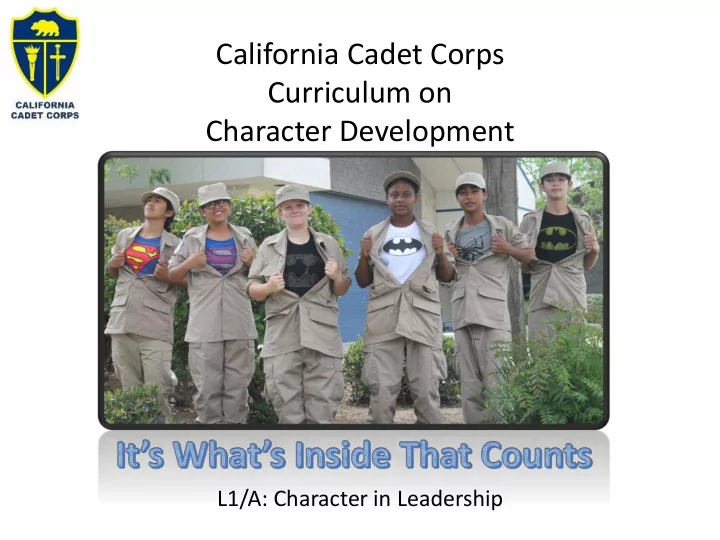
California Cadet Corps Curriculum on Character Development

L1/A: Character in Leadership

slide-2
SLIDE 2

Character Development Agenda

  • A1. Character defined
  • A2. Core Values
  • A3. Cadet Honor Code
slide-3
SLIDE 3

CHARACTER DEFINED

A1. Define character as it relates to leadership

slide-4
SLIDE 4

Character Development

Objectives Cadets will be able to:

  • 1. Define character as it relates to leadership
  • 2. Name the CA Cadet Corps Core Values and

why they’re important

  • 3. Recite the CA Cadet Corps Honor Code

Essential Question: How do you define character?

slide-5
SLIDE 5

Character Defined

  • Character:

– A person’s moral and ethical qualities – Helps determine how a person behaves – Link between values and behaviors

  • Generally, a person does what he/she

believes is the right thing

– The ‘right thing’ depends on your value system

slide-6
SLIDE 6

Character in Leadership

  • Character is core to leadership
  • A leaders’ character is his/her

license to lead, particularly in a volunteer organization

slide-7
SLIDE 7

Character in Leadership

A Good Leader: – Leads by example actions are more important than words – Puts unit’s needs before his/her own

slide-8
SLIDE 8

Character Traits Expected of Leaders

  • Selfless service
  • Integrity – doing what’s right even when

no one is looking

  • Respect for other people, property,

ideas, and differences

  • Honor - Not lying, cheating, or stealing
  • Courage - Facing fear, danger, adversity, and criticism

with a willingness to proceed

  • Loyalty to country, the CACC, your unit and cadets
  • Perseverance - Commitment to fulfill responsibilities
slide-9
SLIDE 9

More Character Traits Expected of Leaders

  • Empathy – acknowledging the needs and feelings
  • f others
  • Taking care of subordinates
  • Self-discipline
  • Expertise and professionalism; valuing education

and schooling

  • Commitment to the team
  • Promptness and good attendance
  • Not being a quitter
  • Patriotic spirit; defending the US Constitution
slide-10
SLIDE 10
  • Bearing – how you carry yourself
  • Courage – physical & moral
  • Decisiveness – make timely decisions
  • Dependability – people count on you
  • Judgement – clear headed, critical thinker
  • Justice – treating others fairly
  • Tact – show respect and be polite

More Character Traits Expected of Leaders

slide-11
SLIDE 11

What Leaders Do

  • Choose hard right over easy wrong
  • Resist temptation to act unethically
  • Make choices rooted in core values
  • Choose not to “go with the flow” of

“popular society”

  • Set high goals

➢Plan to achieve them ➢Work toward them

  • Solve problems
  • Make decisions
slide-12
SLIDE 12

Ethical Scenarios

What’s ‘the right thing to do’?

– Your friend copies off your paper on a Biology test – You need money to go to the next cadet event, your mom says no, and you see $10 sitting on her dresser – You forgot to put up the flag this morning and your commandant asks you why

slide-13
SLIDE 13

More Ethical Scenarios

What’s “the right thing to do’?

– A superior tells a racial joke – Your parents ask you to go right home after school to do chores, but you have been asked to be on the drill team – You are offered a vape?

slide-14
SLIDE 14

Can you come up with others?

Describe a situation when you had to be a person of character:

➢ What did you do? ➢ What values did you use? ➢ What was difficult about the situation? ➢ What could/should you have done differently?

slide-15
SLIDE 15

Check on Learning

  • 1. Character is a core element in
  • 2. T/F: Integrity is doing what’s right when

no one is looking

  • 3. List the traits of good leaders
slide-16
SLIDE 16

CORE VALUES OF THE CALIFORNIA CADET CORPS

  • A2. Name the CA Cadet Corps Core Values and why they’re important
slide-17
SLIDE 17

Character Development

Objectives 90% of Cadets will be able to:

  • 1. Define character as it relates to leadership
  • 2. Name the CA Cadet Corps Core Values and

why they’re important

  • 3. Recite the CA Cadet Corps Honor Code

Essential Question: What are the three CA Cadet Corps Values?

slide-18
SLIDE 18

Core Values

  • Core Values:

– Most important ideas we embrace as an organization – Help define who we are as an organization and as individuals

  • CACC members expected to display Core

Values

  • Prioritize our Core Values over other values
slide-19
SLIDE 19

Core Values of the Cadet Corps

  • Selfless Service
  • Integrity
  • Respect
slide-20
SLIDE 20

Selfless Service

  • As a leader, others come first
  • Team needs and desires take priority over

your own

Team = your unit, school, family

  • Service to school, community, and nation

is an important value in the CACC

slide-21
SLIDE 21

Integrity

  • Doing what’s right even when no one is

watching

  • Cadets:

– Do what is right, both legally and morally – Set an example for others to follow – Do not lie, cheat, or steal, nor tolerate those who do – Place high value on honesty

slide-22
SLIDE 22

Respect

  • Cadets live the “Golden Rule” to treat
  • thers the way they would like to be

treated

– Are good sports on the athletic field – Appreciate the diversity and contributions

  • f the many people in society

– Are friendly, tactful, and courteous – Polite and kind – Show high regard for self, others, and property

slide-23
SLIDE 23

Check on Learning

  • 1. What are the most important ideas the

CACC embraces?

  • 2. Fill in the blanks:

a) S b) I c) R

  • 3. Give an example of ‘the Golden Rule’
slide-24
SLIDE 24

CADET HONOR CODE

  • A3. Recite the CA Cadet Corps Honor Code
slide-25
SLIDE 25

Character Development

Objectives 90% of Cadets will be able to:

  • 1. Define character as it relates to leadership
  • 2. Name the CA Cadet Corps Core Values and

why they’re important

  • 3. Recite the CA Cadet Corps Honor Code

Essential Question: Explain the concepts of the CACC Honor Code

slide-26
SLIDE 26

CACC Honor Code

slide-27
SLIDE 27

What is an Honor Code?

  • A minimum standard of ethics expected of

cadets

  • A system of peer-enforced honorable

conduct

  • Allows every cadet to perform on an even

playing field

  • Encourages trust among the team
slide-28
SLIDE 28

Lying

  • Lying is deliberately deceive another by

stating an untruth or by any direct form of communication

  • This can include:

– the telling of a partial truth – the vague or ambiguous use of information – or language with the intent to deceive or mislead

slide-29
SLIDE 29

Cheating

Cheating is fraudulently acting out of self-interest or assisted another to do so with the intent to gain or to give an unfair advantage. Cheating includes:

  • Plagiarism

– presenting someone else's ideas, words, data, or work as

  • ne's own without documentation
  • Misrepresentation

– failing to document the assistance of another in the preparation, revision, or proofreading of an assignment, & – and using unauthorized notes

slide-30
SLIDE 30

Stealing

The wrongful:

  • taking, obtaining, or withholding money,

personal property, article, or service of value

  • f any kind,
  • with intent to permanently deprive or defraud

another person of the use and benefit of the property,

  • or to take it to for their own use or the use of

someone else

slide-31
SLIDE 31

Toleration

Cadets violate the Honor Code by tolerating if they fail to report an unresolved incident with honor implications to proper authority within a reasonable length of time. "Proper authority" includes:

  • Commandant
  • Principal
  • CACC Executive Officer
  • a tactical officer, teacher, or coach

A "reasonable length of time" is:

  • the time it takes to confront the Cadet suspected of the honor

violation and decide whether the incident was a misunderstanding

  • r a possible violation of the Honor Code
  • usually considered not to exceed 24 hours
slide-32
SLIDE 32

Violation of the Honor Code

To have violated the honor code, a Cadet must have lied, cheated, stolen, or attempted to do so, or tolerated such action on the part of another Cadet. The two elements that must be present for a Cadet to have committed an honor violation:

  • 1. the act
  • 2. the intent to commit that act

The latter does not mean intent to violate the Honor Code, but rather the intent to commit the act itself.

slide-33
SLIDE 33

Three Questions to Ask

1) Does this action attempt to deceive anyone

  • r allow anyone to be deceived?

2) Does this action gain or allow the gain of privilege or advantage to which I or someone else would not otherwise be entitled? 3) Would I be dissatisfied by the outcome if I were on the receiving end of this action?

slide-34
SLIDE 34

Consequences

  • Cadets enforce CACC honor code
  • Code violations:

– Commandants help cadet leaders in situations where code has been violated – Minor violations: cadet chain of command or Commandant determines outcome – Major violations: Principal has final say on

  • utcome
  • Cadets can be demoted or expelled from the

Cadet Corps

slide-35
SLIDE 35

Check on Learning

  • 1. Name the three violations of the honor

code.

  • 2. What are the two elements that must be

present for a Cadet to have committed an honor violation?