
SLIDE 1
2018 FIRST HALF RESULTS
1
www.grinshipping.com
2018 FIRST HALF RESULTS
AUGUST 2018
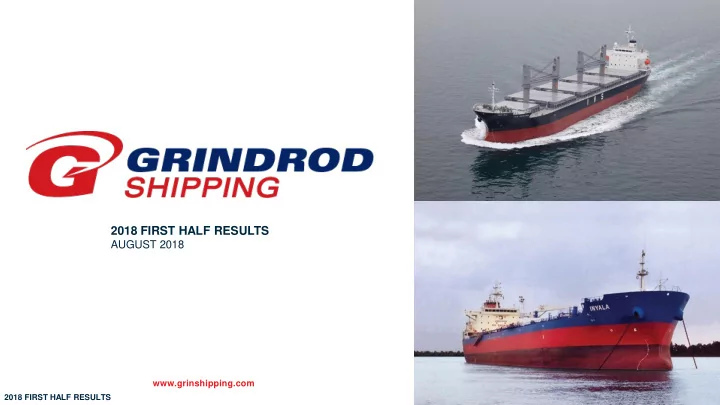
IMAGE HERE 2018 FIRST HALF RESULTS AUGUST 2018 - - PowerPoint PPT Presentation
1 IMAGE HERE 2018 FIRST HALF RESULTS AUGUST 2018 www.grinshipping.com 2018 FIRST HALF RESULTS 2 Forward-Looking Statements This presentation contains forward- looking statements with respect to Grindrod Shippings financial condition,
2018 FIRST HALF RESULTS
1
www.grinshipping.com
2018 FIRST HALF RESULTS
AUGUST 2018
2018 FIRST HALF RESULTS
2
Forward-Looking Statements This presentation contains forward-looking statements with respect to Grindrod Shipping’s financial condition, results of operations, cash flows, business strategies, operating efficiencies, competitive position, growth
These forward-looking statements, including, among others, those relating to future business prospects , revenues and income, wherever they may occur in this presentation, are necessarily estimates and involve a number of risks and uncertainties that could cause actual results to differ materially from those suggested by the forward-looking statements. As a consequence, these forward-looking statements should be considered in light of various important factors, including those set forth in Item 3. Key Information—Risk Factors” of Grindrod Shipping’s Registration Statement on Form 20-F filed with the U.S. Securities and Exchange Commission (the “SEC”). Words such as “may,” “expects,” “intends,” “plans,” “believes,” “anticipates,” “hopes,” “estimates,” and variations of such words and similar expressions are intended to identify forward-looking statements. These forward-looking statements are based on the information available to, and the expectations and assumptions deemed reasonable by Grindrod Shipping at the time these statements were made. Although Grindrod Shipping believes that the expectations reflected in such forward-looking statements are reasonable, no assurance can be given that such expectations will prove to have been correct. These statements involve known and unknown risks and are based upon a number of assumptions and estimates which are inherently subject to significant uncertainties and contingencies, many of which are beyond the control of Grindrod Shipping. Actual results may differ materially from those expressed or implied by such forward-looking statements. Important factors that could cause actual results to differ materially from estimates or projections contained in the forward-looking statements include, without limitation: Grindrod Shipping’s future operating or financial results; the strength of world economies, including, in particular, in China and the rest of the Asia-Pacific region; cyclicality of the drybulk and tanker markets, including general drybulk and tanker shipping market conditions and trends, including fluctuations in charter hire rates and vessel values; changes in supply and demand in the drybulk and tanker shipping industries, including the market for Grindrod Shipping’s vessels; changes in the value of Grindrod Shipping’s vessels; statements about business strategy and expected capital spending or
ability to employ Grindrod Shipping’s vessels in the spot market and Grindrod Shipping’s ability to enter into time charters after Grindrod Shipping’s current charters expire; general economic conditions and conditions in the oil and coal industry; Grindrod Shipping’s ability to satisfy the technical, health, safety and compliance standards of Grindrod Shipping’s customers, especially major oil companies and oil producers; the failure of counterparties to Grindrod Shipping’s contracts to fully perform their obligations with us; Grindrod Shipping’s ability to execute its growth strategy; international political conditions; potential disruption of shipping routes due to weather, accidents, political events, natural disasters or other catastrophic events; vessel breakdowns; corruption, piracy, military conflicts, political instability and terrorism in locations where we may operate; fluctuations in interest rates and foreign exchange rates; changes in the costs associated with owning and operating Grindrod Shipping’s vessels; changes in, and Grindrod Shipping’s compliance with, governmental, tax, environmental, health and safety regulations; potential liability from pending or future litigation; Grindrod Shipping’s ability to procure or have access to financing, Grindrod Shipping’s liquidity and the adequacy of cash flows for its operations; the continued borrowing availability under Grindrod Shipping’s debt agreements and its compliance with the covenants contained therein; Grindrod Shipping’s ability to fund future capital expenditures and investments in the construction, acquisition and refurbishment of its vessels; Grindrod Shipping’s dependence on key personnel; Grindrod Shipping’s expectations regarding the availability of vessel acquisitions and Grindrod Shipping’s ability to complete acquisitions as planned; adequacy of Grindrod Shipping’s insurance coverage; effects of new technological innovation and advances in vessel design; Grindrod Shipping’s ability to realize the benefits of the spin-off; unforeseen costs and expenses related to the spin-off; and Grindrod Shipping’s ability to operate as an independent entity. Grindrod Shipping undertakes no obligation to update publicly or release any revisions to these forward-looking statements to reflect events or circumstances after the date of this presentation or to reflect the occurrence
Market and Industry Data Unless otherwise indicated, information contained in this presentation concerning our industry and the market in which we operate, including our general expectations about our industry, market position, market
publications, reports by market research firms or other published independent sources. Internal data and estimates are based upon this information as well as information obtained from trade and business organizations and other contacts in the markets in which we operate and management’s understanding of industry conditions. This information, data and estimates involve a number of assumptions and limitations, are subject to risks and uncertainties, and are subject to change based on various factors, including those discussed above and in “Forward Looking Statements” above. You are cautioned not to give undue weight to such information, data and estimates. While we believe the market and industry information included in this presentation to be generally reliable, we have not independently verified any third-party information or verified that more recent information is not available.
2018 FIRST HALF RESULTS
3
2018 FIRST HALF RESULTS
4
HISTORY AND BACKGROUND
1910 and was until recently owned by Grindrod Limited, a holding company listed on the Johannesburg Stock Exchange (“JSE”) focused now on freight services and financial services
and a secondary listing on the JSE
growth strategies and allowing shareholders to value Grindrod Shipping separately from the remaining businesses of Grindrod
the Handysize/Supramax drybulk sectors and the medium range and small product tanker sectors
provide general management, financial management, and commercial and technical management
GRINDROD SHIPPING TODAY
2018 FIRST HALF RESULTS
5
a public company on April 25, 2018 with one promoter share initially
Shipping Pte. Ltd. and Grindrod Shipping (South Africa) Pty Ltd to Grindrod Shipping
shares at an implied value of $16.82 per share
2018 FIRST HALF RESULTS
6
carriers and 17 Supramax drybulk carriers, including 5 newbuilding Ultramaxes under construction
commodities, including ores, coal, grains, forestry products, steel products and fertilizers, along worldwide shipping routes
acquired a tanker of approximately 20,000 dwt
includes 11 medium range tankers and four small tankers
petrol, diesel, jet fuel and naptha, and dirty products, such as heavy fuel oil
liquid bulk vegetable oils, but do not carry crude oil
Roots in the shipping and transport industry go back more than 100 years Grindrod Shipping operates under two present-day brands, one for its drybulk carrier business (IVS) and one for its tankers business (Unicorn)
2018 FIRST HALF RESULTS
7
Grindrod Shipping Holdings Ltd. Core Fleet of 51 Vessels (1)
Fully Owned Fleet (1) 14 Drybulk 6 Tankers Long-Term TC- In Fleet (1) 9 Drybulk 3 Tankers 100% Commercial & Technical Management IVS Bulk JV 12 Drybulk Vessels 33.5% JV with Mitsui 1 Drybulk Vessel 51% JV with Vitol 4 Tanker Vessels JV with Engen 2 Tanker Vessels 50% 50%
(1) Including newbuildings under construction
2018 FIRST HALF RESULTS
8
July 2011 and is the Chief Executive Officer and a Director of Grindrod Shipping
Singapore
member of the advisory panel to the Singapore Maritime Foundation
April 2009 and is the Chief Financial Officer and a Director of Grindrod Shipping
was employed in a number of financial management roles
at Hudson, Langham, Morrison and Co.
Martyn Wade Grindrod Shipping Holdings Ltd. Chief Executive Officer Stephen Griffiths Grindrod Shipping Holdings Ltd. Chief Financial Officer
2018 FIRST HALF RESULTS
9
players
Long established track record in key markets Operating a modern fleet built in Japan & South Korea
Focus on versatile vessel classes
Experienced management team
2018 FIRST HALF RESULTS
10
million, after repayment of existing debt
shipyards, financial and industrial partners
party managers which allow for benchmarking
Significant in-house commercial & technical expertise Priority on risk management Revenue maximization through commercial pools & cargoes
(1) No outside commercial or technical management related party transactions. We have agreed a short-term transitional services agreement with Grindrod Limited on arms length terms as part of our spin-off to provide a number of administrative, financial, IT and other support services until December 31, 2019.
Strong balance sheet positioned for additional growth
asset market movements on our cargo contracts, cash flows, and balance sheet
2018 FIRST HALF RESULTS
11
Quality core drybulk fleet of 36 vessels built predominantly in Japan FOCUS ON ECO SUPRAMAX/ULTRAMAX & HANDYSIZE
and ports of call
triangulation and a high laden-to-ballast ratio
dry bulk trade volume of 5.1 billion tonnes
segments – ability to leverage customer relationships with key global and regional industry players
sustained growth in demand for minor bulks
commercial advantages post-IMO2020
(For full fleet details, see next page)
HANDYSIZE FLEET – 19 VESSELS
SUPRAMAX/ULTRAMAX FLEET – 17 VESSELS
expected to be chartered-in upon delivery in 2019/20 DRYBULK FLEET HIGHLIGHTS
and chartered-in long-term
construction expected to be delivered in 2019/20
years for worldwide drybulk fleet
2018 FIRST HALF RESULTS
12
HANDYSIZE – IVS Handysize Pool / IVS Management SUPRAMAX/ULTRAMAX – IVS Supramax Pool
(1) Includes purchase options for Grindrod Shipping. In case of IVS Augusta and IVS Pinehurst, Grindrod Shipping may select one of the vessels at its choice. Note: TC expiry range represents the earliest and latest redelivery periods due to extension options for Grindrod Shipping. Vessel Name Built Country of Build DWT Ownership Supramax/Ultramax - Eco IVS Sw inley Forest 2017 Japan 60,490 Ow ned (33.5%) IVS Gleneagles 2016 Japan 58,070 Ow ned (33.5%) IVS Hayakita 2016 Japan 60,400 TC-in (Expires 2023-2026) (1) IVS North Berw ick 2016 Japan 60,480 Ow ned (33.5%) IVS Windsor 2016 Japan 60,280 TC-in (Expires 2023-2026) IVS Augusta 2015 Philippines 57,800 TC-in (Expires 2020-2022) (1) IVS Bosch Hoek 2015 Japan 60,270 Ow ned (33.5%) IVS Hirono 2015 Japan 60,280 Ow ned (33.5%) IVS Pinehurst 2015 Philippines 57,810 TC-in (Expires 2020-2022) (1) IVS Wentw orth 2015 Japan 58,090 Ow ned (33.5%) IVS Crimson Creek 2014 Japan 57,950 TC-in (Expires 2019-2021) IVS Naruo 2014 Japan 60,030 TC-in (Expires 2021-2024) (1) Drybulk Carriers Under Construction Supramax/Ultramax - Eco IVS Okudogo 2H 2019 Japan 61,000 Ow ned IVS Prestw ick 2H 2019 Japan 61,000 Ow ned IVS To Be Named 2H 2019 Japan 60,000 TC-in (Expires 2022-2024) IVS Pebble Beach 2H 2020 Japan 62,000 TC-in (Expires 2022-2024) (1) IVS Atsugi 2H 2020 Japan 62,000 TC-in (Expires 2022-2024) (1) 17 Vessels 1,017,950 DWT Vessel Name Built Country of Build DWT Ownership Handysize IVS Merlion 2013 China 32,070 Ow ned IVS Raffles 2013 China 32,050 Ow ned IVS Ibis 2012 Japan 28,240 Ow ned IVS Kinglet 2011 Japan 33,130 Ow ned IVS Magpie 2011 Japan 28,240 Ow ned IVS Orchard 2011 China 32,530 Ow ned IVS Knot 2010 Japan 33,140 Ow ned IVS Sentosa 2010 China 32,700 Ow ned IVS Triview 2009 Japan 32,280 Ow ned (51%) IVS Kingbird 2007 Japan 32,560 Ow ned IVS Kaw ana 2005 Japan 32,640 Ow ned IVS Kanda 2004 Japan 32,620 Ow ned IVS Nightjar 2004 Japan 32,320 Ow ned Handysize - Eco IVS Tembe 2016 Japan 37,740 Ow ned (33.5%) IVS Sunbird 2015 Japan 33,400 Ow ned (33.5%) IVS Thanda 2015 Japan 37,720 Ow ned (33.5%) IVS Kestrel 2014 Japan 32,770 Ow ned (33.5%) IVS Phinda 2014 Japan 37,720 Ow ned (33.5%) IVS Sparrow haw k 2014 Japan 33,420 Ow ned (33.5%) Subtotal: 19 Vessels 627,290 DWT
2018 FIRST HALF RESULTS
13
Technically manage in-house the vast majority of the fleet from Singapore and Durban with the selective use of third party technical managers which allows for benchmarking
and chartered-in drybulk fleet are commercially managed in-house through the IVS Handysize and IVS Supramax pools
affreightment (COAs), time charters, and Forward Freight Agreements (FFAs), to reduce volatility
triangulate and optimize chartering activities
short-term charter-in vessels as needed to supplement core fleet in fulfilling cargo contracts
benchmarks
enjoying exposure to upside of spot market
leakage to outside related parties
comes from COAs and direct access to cargoes
houses COMPETITIVE ADVANTAGES EMPLOYMENT STRATEGY
2018 FIRST HALF RESULTS
14
Baltic Handysize TC Index (BHSI) (1)
$0 $2 000 $4 000 $6 000 $8 000 $10 000 $12 000
Baltic Supramax TC Index (BSI) (1)
(1) Baltic Handysize TC Index (“BHSI”) and Baltic Supramax TC Index (“BSI”) adjusted for 5% commissions to be comparable to Grindrod Shipping’s TCE per day. (2) TCE per day is a non-GAAP financial measure. For a reconciliation of TCE per day to the most directly comparable GAAP measure and a discussion of why management believes TCE per day is a useful measure, see “Non-GAAP Financial Measures.”
$0 $1 000 $2 000 $3 000 $4 000 $5 000 $6 000 $7 000 $8 000 $9 000 $10 000 Average BSI (1) Grindrod TCE Per Day (2) 2015 $6,594 $10,232 2016 $5,932 $7,861 2017 $8,727 $10,551 H1 2018 $10,287 $11,092 Average BHSI (1) Grindrod TCE per day (2) 2015 $5,098 $7,487 2016 $4,961 $5,881 2017 $7,276 $7,675 H1 2018 $8,287 $8,997
2018 FIRST HALF RESULTS
15
FOCUS ON MR PRODUCT TANKERS
tankers capitalizing on long standing relationships with strong trading partners
the highest product carrying and trading versatility
vegetable oils and light chemicals cargoes to a wider number of destinations
recent moderate demand growth
(For full fleet details, see next page)
Quality fleet of 15 product tankers built predominantly in South Korea MEDIUM RANGE FLEET – 11 VESSELS
SMALL TANKER FLEET – 4 VESSELS
PRODUCT TANKER FLEET HIGHLIGHTS
ventures and chartered-in long-term
years for worldwide product tanker fleet
2018 FIRST HALF RESULTS
16
(AS OF AUGUST 30, 2018)
MEDIUM RANGE FLEET SMALL TANKER FLEET
Note: Handy Tanker Pool and Brostrom Tanker Pool operated by Maersk. Matuku charter excludes charterer’s option to extend.
mainly in-house and through Joint Ventures with high quality trading partners
the world and one of our JV partners on four eco MRs, and Maersk commercially manage the majority of the fleet
the spot market
term charters, COAs, and spot charters
Vessel Name Built Country of Build DWT IMO Designation Ownership Employment Small Product Tankers Umgeni 2011 China 16,480 II, III Ow ned Brostrom Tanker Pool Kow ie 2010 China 16,890 II, III Ow ned Brostrom Tanker Pool Breede 2009 China 16,900 II, III Ow ned Spot Market and COA Berg 2008 China 16,900 II, III Ow ned (50%) Time Charter (Expires 2018) Subtotal: 4 Vessels 67,170 DWT Vessel Name Built Country of Build DWT IMO Designation Ownership Employment Medium Range Tankers Lavela 2010 South Korea 40,100 III Ow ned (50%) Handy Tanker Pool Rhino 2010 South Korea 39,710 II, III Ow ned Handy Tanker Pool Inyala 2008 South Korea 40,040 III Ow ned Handy Tanker Pool Coral Stars 2004 South Korea 40,000 III Chartered-in (Expires 2018) COA Medium Range Tankers - Eco Matuku 2016 South Korea 50,140 II, III Ow ned Bareboat Charter (Expires 2020) Doric Breeze 2013 South Korea 51,570 II, III Chartered-in (Expires 2020) Vitol Management Doric Pioneer 2013 South Korea 51,570 II, III Chartered-in (Expires 2020) Vitol Management Leopard Moon 2013 South Korea 50,000 III Ow ned (50%) Vitol Management Leopard Sea 2013 South Korea 50,000 III Ow ned (50%) Vitol Management Leopard Star 2013 South Korea 50,000 III Ow ned (50%) Vitol Management Leopard Sun 2013 South Korea 50,000 III Ow ned (50%) Vitol Management Subtotal: 11 Vessels 513,130 DWT
2018 FIRST HALF RESULTS
17
averages
Expansion of Drybulk Fleet Maintain a Strong Balance Sheet
to end users, together with charters, FFAs and COAs help manage exposure to volatile spot rates
Maximize Fleet Performance
Focus on Shareholder Value
2018 FIRST HALF RESULTS
18
2018 FIRST HALF RESULTS
19
2018 in anticipation of spin-off of shipping business
mutual dissolution of a joint venture with Mitsubishi Corp. for $10.3 million in aggregate (49% portion)
delivered in 3Q 2019 for $26.4 million each, including approx. $600k of upgrades per ship Executing on our Strategy of Focusing
Completed Spin-off and Listing Completed $100 Million Debt Refinancing
2018 FIRST HALF RESULTS
20
term charters-in)
the outstanding common shares of the Company
2018 FIRST HALF RESULTS
21
Supramax/Ultramax vessels increased to $8,997/day and $11,092/day, respectively
for the period also outperformed industry benchmarks(2) by $2,306/day, or 24.9%
after debt repayments and the $25.3 million in net proceeds from the sale of OACL and Unicorn Bunkers
2018, we have already secured the following TCEs per day thus far for the second half of 2018
(1) Baltic Handysize TC Index (“BHSI”) and Baltic Supramax TC Index (“BSI”) adjusted for 5% commissions to be comparable to Grindrod’s TCE per day. (2) Clarksons Average MR Clean Earnings TC Index of $9,264/day for the first half of 2018.
2018 FIRST HALF RESULTS
22
conditions across the industry
the trading patterns of some of our vessels
chartered-in at higher costs to deliver some of the cargo commitments
drybulk spot charter rates increased over the period
mitigated during our next round of renewals
NASDAQ & JSE
2018 FIRST HALF RESULTS
23
are accounted for
$thousands 6 Months 2018 6 Months 2017 Total Revenue 150,841 $ 194,053 $ Voyage expenses (71,513) (82,461) Vessel operating costs (16,344) (19,993) Charter hire (54,280) (64,248) Depreciation and amortization (6,649) (10,186) Other 354 (7,973) Cost of Sales (148,432) $ (184,307) $ Gross Profit 2,409 $ 9,746 $ Other operating income 8,032 1,902 Administrative expense (17,292) (13,535) Other operating expense (2,067) (2,162) Interest income 1,945 3,262 Interest expense (2,961) (3,079) Share of losses of joint ventures (1,372) (1,188) Loss before taxation (11,306) (5,054) Income Tax Expense (2,147) (1,898) Loss for the period (13,453) (6,952) Loss per share (Basic and diluted) ($) (0.71) $ (0.36) $
2018 FIRST HALF RESULTS
24
Six Months Ended June 30, HANDYSIZE SEGMENT 2018 2017 Revenue 53,828 54,408 Cost of sales (50,601) (55,646) Calendar days(2) 3,293 3,932 Available days(3) 3,183 3,863 Operating days(4) 3,129 3,833 Owned fleet operating days(5) 2,339 2,558 Long-term charter-in days(6) 181 181 Short-term charter-in days(7) 609 1,094 Fleet Utilization(8) 98.3% 99.2% Handysize Segment Average Daily Results TCE per day (9) 8,997 6,919 Vessel Operating costs per day(10) 5,238 4,944 Long-term charter-in costs per day(11) 8,600 8,600
(1) Segment results of operations include the proportionate share of joint ventures which is not reflected in our combined results of operations. (2) Calendar days: total calendar days the vessels were in our possession for the relevant period. (3) Available days: total number of calendar days a vessel is in our possession for the relevant period after subtracting off-hire days for scheduled drydocking and special surveys. We use available days to measure the number of days in a relevant period during which vessels should be available for generating revenues. (4) Operating days: the number of available days in the relevant period a vessel is controlled by us after subtracting the aggregate number of days that the vessel is off-hire due to a reason other than scheduled drydocking and special surveys, including unforeseen circumstances. We use operating days to measure the aggregate number of days in a relevant period during which vessels are actually available to generate revenues. (5) Owned fleet operating days: the number of operating days in which our owned fleet is operating for the relevant period. (6) Long-term charter-in days: the number of operating days in which our long-term charter-in fleet is operating for the relevant period. We regard chartered-in vessels as long-term charters if the period of the charter that we initially commit to is 12 months or more. Once we have included such chartered-in vessels in our Fleet, we will continue to regard them as part of our Fleet until the end
(7) Short-term charter-in days: the number of operating days for which we have chartered-in third party vessels for durations of less than one year for the relevant period. (8) Fleet utilization: the percentage of time that vessels are available for generating revenue, determined by dividing the number of operating days during a relevant period by the number of available days during that period. We use fleet utilization to measure a company’s efficiency in technically managing its vessels. (9) TCE per day: vessel revenues less voyage expenses during a relevant period divided by the number of operating days during the period. The number of operating days used to calculate TCE revenue per day includes the proportionate share of our joint ventures’ operating days and includes charter-in days. See “Non-GAAP Financial Measures” at the end of this press release. (10) Vessel operating costs per day: Vessel operating costs per day represents vessel operating costs divided by the number of calendar days for owned vessels. The vessel operating costs and the number of calendar days used to calculate vessel operating costs per day includes the proportionate share of our joint ventures’ calendar day and excludes charter-in costs and charter-in days. (11) Long-term charter-in costs per day: Charter hire expenses associated with long-term charter-in vessels divided by long-term charter-in days for the relevant period. (please refer to Annex A)
Six Months Ended June 30, SUPRAMAX / ULTRAMAX SEGMENT 2018 2017 Revenue 73,675 78,689 Cost of sales (74,755) (76,754) Calendar days(1) 3,471 3,838 Available days(2) 3,423 3,838 Operating days(3) 3,402 3,795 Owned fleet operating days(4) 343 343 Long-term charter-in days(5) 1,196 1,267 Short-term charter-in days(6) 1,863 2,185 Fleet Utilization(7) 99.4% 98.9% Supramax Segment Average Daily Results TCE per day (9) 11,092 10,462 Vessel Operating costs per day(10) 4,616 4,442 Long-term charter-in costs per day(11) 13,049 13,084
approximately $12,700/day. Our only long-term chartered-in Handysize (IVS Shikra) was redelivered on August 21, 2018.
2018 FIRST HALF RESULTS
25
Six Months Ended June 30, MEDIUM RANGE TANKERS SEGMENT 2018 2017 Revenue 18,921 23,585 Cost of sales (19,709) (23,500) Calendar days(2) 1,358 1,550 Available days(3) 1,346 1,539 Operating days(4) 1,311 1,534 Owned fleet operating days(5) 779 986 Long-term charter-in days(6) 532 548 Short-term charter-in days(7)
97.4% 99.6% Medium Range Tanker Segment Average Daily Results TCE per day (9) 11,570 12,742 Vessel Operating costs per day(10) 7,279 6,928 Long-term charter-in costs per day(11) 15,031 15,174
Six Months Ended June 30, SMALL TANKERS SEGMENT 2018 2017 Revenue 8,966 11,813 Cost of sales (8,378) (10,407) Calendar days(1) 634 815 Available days(2) 610 815 Operating days(3) 600 815 Owned fleet operating days(4) 600 634 Long-term charter-in days(5)
Short-term charter-in days(6)
98.4% 100.0% Small Tanker Segment Average Daily Results TCE per day (9) 11,323 12,672 Vessel Operating costs per day(10) 7,750 7,571 Long-term charter-in costs per day(11)
expected to be approximately $14,580/day. No long-term charter-in for the Small Tankers segment in 2018
(1) Segment results of operations include the proportionate share of joint ventures which is not reflected in our combined results of operations. (2) Calendar days: total calendar days the vessels were in our possession for the relevant period. (3) Available days: total number of calendar days a vessel is in our possession for the relevant period after subtracting off-hire days for scheduled drydocking and special surveys. We use available days to measure the number of days in a relevant period during which vessels should be available for generating revenues. (4) Operating days: the number of available days in the relevant period a vessel is controlled by us after subtracting the aggregate number of days that the vessel is off-hire due to a reason other than scheduled drydocking and special surveys, including unforeseen circumstances. We use operating days to measure the aggregate number of days in a relevant period during which vessels are actually available to generate revenues. (5) Owned fleet operating days: the number of operating days in which our owned fleet is operating for the relevant period. (6) Long-term charter-in days: the number of operating days in which our long-term charter-in fleet is operating for the relevant period. We regard chartered-in vessels as long-term charters if the period of the charter that we initially commit to is 12 months or more. Once we have included such chartered-in vessels in our Fleet, we will continue to regard them as part of our Fleet until the end
(7) Short-term charter-in days: the number of operating days for which we have chartered-in third party vessels for durations of less than one year for the relevant period. (8) Fleet utilization: the percentage of time that vessels are available for generating revenue, determined by dividing the number of operating days during a relevant period by the number of available days during that period. We use fleet utilization to measure a company’s efficiency in technically managing its vessels. (9) TCE per day: vessel revenues less voyage expenses during a relevant period divided by the number of operating days during the period. The number of operating days used to calculate TCE revenue per day includes the proportionate share of our joint ventures’ operating days and includes charter-in days. See “Non-GAAP Financial Measures” at the end of this press release. (10) Vessel operating costs per day: Vessel operating costs per day represents vessel operating costs divided by the number of calendar days for owned vessels. The vessel operating costs and the number of calendar days used to calculate vessel operating costs per day includes the proportionate share of our joint ventures’ calendar day and excludes charter-in costs and charter-in days. (11) Long-term charter-in costs per day: Charter hire expenses associated with long-term charter-in vessels divided by long-term charter-in days for the relevant period. (please refer to Annex A)
2018 FIRST HALF RESULTS
26
June 30, 2018 $million Cash and Bank Balances $ 54.1 Other Current Assets 84.8 Ships, Property, Plant and Equipment 262.4 Interest in Joint Ventures 62.7 Other Non-Current Assets 11.3 Total Assets $ 475.3 Current Portion of Long Term Debt $ 19.2 Other Current Liabilities 43.2 Long Term Debt 108.1 Other Non-Current Liabilities 2.5 Equity attributable to owners of the company 302.4 Total Equity & Liabilities $ 475.3
Debt Repayment Profile ($million) $10.0 $18.3 $18.3 $18.3 $30.1 $32.3 5 10 15 20 25 30 35 2H 2018 2019 2020 2021 2022 2023
2018 FIRST HALF RESULTS
27
2018 FIRST HALF RESULTS
28
Drybulk Fleet Development Handysize / Supramax Asset Prices (USD MM)
0.0% 5.0% 10.0% 15.0% 20.0% (60) (40) (20)
40 60 80 100 120 Fleet Growth (% Change) Million DWT Additions Deletions Fleet Growth Source: Clarkson Research Services Ltd., August 2018
Fleet growth has declined meaningfully in recent years as the
declined to below 10% of the fleet and scrapping picked up
$0.0 $5.0 $10.0 $15.0 $20.0 $25.0 $30.0 $35.0 $40.0 Supramax 5-Year Old Handysize 5-Year Old
Asset prices have been gradually recovering since Q1 2016 but remain below recent historical averages
2018 FIRST HALF RESULTS
29
Handysize / Supramax TC Rates (USD/Day) 1 000 2 000 3 000 4 000 5 000 6 000 Iron Ore Coal Grains Minor Bulks
Source: Clarkson Research Services Ltd., August 2018. Baltic Exchange $0 $5 000 $10 000 $15 000 $20 000 $25 000 $30 000 Baltic Handysize TC Average Baltic Supramax TC Average
Charter rates have been recovering since Q1 2016 due to a slowdown in vessel supply growth combined with a recovery in demand growth since 2015
2017 Growth – 4% 2018E Growth – 3% H1 2018 Supramax Avg - $10,828/day H1 2018 Handysize Avg - $8,635/day
Drybulk Trade Development (MM Tons)
2018 FIRST HALF RESULTS
30
Product Tanker Fleet Development (10K DWT+) Medium Ranger Tanker Asset Prices (USD MM)
0.0% 5.0% 10.0% 15.0% 20.0% (10) (5)
10 15 20 1996 1997 1998 1999 2000 2001 2002 2003 2004 2005 2006 2007 2008 2009 2010 2011 2012 2013 2014 2015 2016 2017 2018E Fleet Growth (% Change) Million DWT Additions Deletions Fleet Growth Source: Clarkson Research Services Ltd., August 2018
Fleet growth has declined as the orderbook has declined to below 10% of the fleet and scrapping has accelerated
$20.0 $22.0 $24.0 $26.0 $28.0 $30.0 $32.0 $34.0 MR Tanker 5-Year Old
Asset prices have been gradually recovering in anticipation of stronger markets despite currently weak charter market conditions
2018 FIRST HALF RESULTS
31
Tanker Trade Development (MM Tons) Medium Range Tanker Spot Earnings (USD/Day) 600 700 800 900 1 000 1 100 1 200 World Seaborne Products Trade
Source: Clarkson Research Services Ltd., August 2018 $0 $5 000 $10 000 $15 000 $20 000 $25 000 $30 000 $35 000 $40 000 MR Average Earnings
Spot earnings have remained weak as demand growth has been outpaced by robust supply growth
2017 Growth – 2% 2018E Growth – 1% H1 2018 Avg MR Earnings- $9,264/day
2018 FIRST HALF RESULTS
32
The financial information included in this presentation includes certain ‘‘non-GAAP financial measures’’ as such term is defined in SEC regulations governing the use of non-GAAP financial measures. Generally, a non-GAAP financial measure is a numerical measure of a company’s operating performance, financial position or cash flows that excludes or includes amounts that are included in, or excluded from, the most directly comparable measure calculated and presented in accordance with IFRS. For example, non-GAAP financial measures may exclude the impact of certain unique and/or non-operating items such as acquisitions, divestitures, restructuring charges, large write-offs or items outside of management’s control. Management believes that the non-GAAP financial measures described below provide investors and analysts useful insight into our financial position and operating performance. TCE Revenue and TCE per day TCE revenue is defined as vessel revenues less voyage expenses. Such TCE revenue, divided by the number of our operating days during the period, is TCE per day. Vessel revenues and voyage expenses as reported for our operating segments include a proportionate share of vessel revenues and voyage expenses attributable to our joint ventures based on our proportionate ownership of the joint ventures. The number of
TCE per day is a common shipping industry performance measure used primarily to compare daily earnings generated by vessels on time charters with daily earnings generated by vessels on voyage charters, because charter hire rates for vessels on voyage charters have to cover voyage costs and are generally not expressed in per-day amounts while charter hire rates for vessels on time charters do not cover voyage costs and generally are expressed in per day amounts. Below is a reconciliation from TCE revenue to revenue: *Vessel revenue earned and voyage expenses incurred by the joint ventures are included within the operating segment information on a proportionate consolidation basis. Accordingly, joint ventures proportionate financial information are adjusted out to reconcile to the unaudited condensed consolidated financial statements.
Six Months ended June 30, (In thousands of U.S. dollars) 2018 2017 Revenue Voyage Expenses TCE Revenue Revenue Voyage Expenses TCE Revenue Vessel Revenue Handysize 52,955 (24,805) 28,150 53,734 (27,211) 26,52 Supramax/ultramax 73,082 (35,344) 37,738 78,303 (38,595) 39,70 Medium Range Tankers 18,946 (3,773) 15,173 23,718 (4,177) 19,54 Small Tankers 8,966 (2,169) 6,797 11,813 (1,492) 10,32 Other drybulk carriers 1,215 29,359 Other tankers 2,570 6,899 Other revenue 2,730 1,832 Adjustments* (9,623) (11,605) Revenue 150,841 194,053
2018 FIRST HALF RESULTS
33
EBITDA and Adjusted EBITDA EBITDA is defined as earnings before interest income, interest expense, income tax expense or credit, depreciation and amortization, and share of loss in joint ventures. Adjusted EBITDA is EBITDA adjusted to exclude the items set forth in the table below , which represent certain non-recurring, non-operating or other items that we believe are not indicative of the
EBITDA and Adjusted EBITDA are used by analysts in the shipping industry as common performance measures to compare results across peers. EBITDA and Adjusted EBITDA are not items recognized by IFRS, and should not be considered in isolation or used as alternatives to loss for the period or any other indicator of our operating performance. Our presentation of EBITDA and Adjusted EBITDA is intended to supplement investors' understanding of our operating performance by providing information regarding our ongoing performance that exclude items we believe do not directly affect our core operations and enhancing the comparability of our ongoing performance across periods. Our management considers EBITDA and Adjusted EBITDA to be useful to investors because such performance measures provide information regarding the profitability of our core operations and facilitate comparison of our operating performance to the operating performance of our peers. Additionally, our management uses EBITDA and Adjusted EBITDA as measures when reviewing
Adjusted EBITDA used by us may not be comparable to similar measures used by other companies. The table at right presents the reconciliation between loss for the period to EBITDA and Adjusted EBITDA for the six month period ended June 30, 2018 and the comparative period June, 30 2017:
Six Months ended June 30, (In thousands of U.S. dollars) 2018 2017 Loss for the Period ...................... (13,453) (6,952) Adjusted for: ....................................................... Income tax expense ..................................... 2,147 1,898 Interest income ............................................ (1,945) (3,262) Interest expense ........................................... 2,961 3,079 Share of losses in joint ventures ................... 1,372 1,188 Depreciation and amortization .................... 6,763 10,186 EBITDA ............................................................ (2,155) 6,137 Adjusted for Listing costs ................................................. 4,079
....................... (3,255)
joint venture interest ..................................... (324) ADJUSTED EBITDA ....................................... (1,655) 6,137
2018 FIRST HALF RESULTS
34
The table below presents the breakdown of charter hire expense into long-term charter hire expense and short term charter hire expense:
* Charter hire cost incurred by the joint ventures are included within the operating segment information on a proportionate
consolidation basis. Accordingly, joint ventures proportionate financial information are adjusted out to reconcile to the unaudited interim condensed consolidated financial statements.
Six Months ended June 30, (In thousands of U.S. dollars) 2018 2017
Long-term Short-term Charter Hire Expense Long-term Short-term Charter Hire Expense
Handysize $1,556 $6,862 $8,418 $1,556 $8,581 $10,137 Supramax/ultramax 15,607 21,073 36,680 16,577 19,032 35,609 Medium Range Tankers 7,990
8,317
Small Tankers
Others 1,468 8,567 Adjustments* (276) (355) 54,280 64,248
2018 FIRST HALF RESULTS
35
Company Contact: Martyn Wade / Stephen Griffiths CEO / CFO Grindrod Shipping Holdings Ltd. 200 Cantonment Road, #03-01 Southpoint Singapore, 089763 Email: ir@grindrodshipping.com Website: www.grinshipping.com Investor Relations / Media Contact: Nicolas Bornozis / Daniela Guerrero Capital Link, Inc. 230 Park Avenue, Suite 1536 New York, N.Y. 10169 Tel.: (212) 661-7566 Fax: (212) 661-7526 E-Mail: grindrod@capitallink.com