SLIDE 1
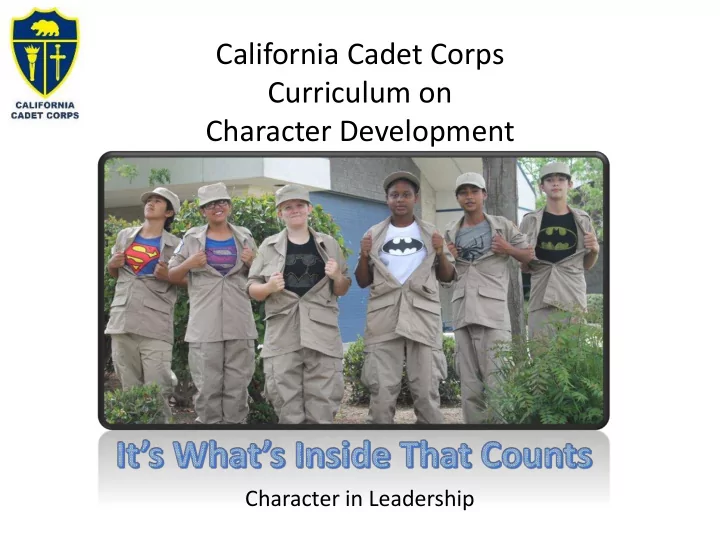
California Cadet Corps Curriculum on Character Development
Character in Leadership
SLIDE 2 Character Development Agenda
- A1. Character defined
- A2. Core Values
- A3. Cadet Honor Code
SLIDE 3 CHARACTER DEFINED
A1. Define character as it relates to leadership
SLIDE 4 Character Defined
– A person’s moral and ethical qualities – Helps determine how a person behaves – Link between values and behaviors
- Generally, a person does what he/she
believes is the right thing
– The ‘right thing’ depends on your value system
SLIDE 5 Character in Leadership
- Character is core to leadership
- A leaders’ character is his/her
license to lead, particularly in a volunteer organization
SLIDE 6
Character in Leadership
A Good Leader: – Leads by example actions are more important than words – Puts unit’s needs before his/her own
SLIDE 7 Character Traits Expected of Leaders
- Selfless service
- Integrity – doing what’s right even when
no one is looking
- Respect for other people, property,
ideas, and differences
- Honor - Not lying, cheating, or stealing
- Courage - Facing fear, danger, adversity, and criticism
with a willingness to proceed
- Loyalty to country, the CACC, your unit and cadets
- Perseverance - Commitment to fulfill responsibilities
SLIDE 8 More Character Traits Expected of Leaders
- Empathy – acknowledging the needs and feelings
- f others
- Taking care of subordinates
- Self-discipline
- Expertise and professionalism; valuing education
and schooling
- Commitment to the team
- Promptness and good attendance
- Not being a quitter
- Patriotic spirit; defending the US Constitution
SLIDE 9
- Bearing – how you carry yourself
- Courage – physical & moral
- Decisiveness – make timely decisions
- Dependability – people count on you
- Judgement – clear headed, critical thinker
- Justice – treating others fairly
- Tact – show respect and be polite
More Character Traits Expected of Leaders
SLIDE 10 What Leaders Do
- Choose hard right over easy wrong
- Resist temptation to act unethically
- Make choices rooted in core values
- Choose not to “go with the flow” of
“popular society”
➢Plan to achieve them ➢Work toward them
- Solve problems
- Make decisions
SLIDE 11
Ethical Scenarios
What’s ‘the right thing to do’?
– Your friend copies off your paper on a Biology test – You need money to go to the next cadet event, your mom says no, and you see $10 sitting on her dresser – You forgot to put up the flag this morning and your commandant asks you why
SLIDE 12
More Ethical Scenarios
What’s “the right thing to do’?
– A superior tells a racial joke – Your parents ask you to go right home after school to do chores, but you have been asked to be on the drill team – You are offered a cigarette
SLIDE 13
Can you come up with others?
Describe a situation when you had to be a person of character:
➢ What did you do? ➢ What values did you use? ➢ What was difficult about the situation? ➢ What could/should you have done differently?
SLIDE 14 Check on Learning
- 1. Character is a core element in
- 2. T/F: Integrity is doing what’s right when
no one is looking
a) Choose the right over the wrong b) Make choices rooted in c) Solve and make
SLIDE 15 CORE VALUES OF THE CALIFORNIA CADET CORPS
- A2. Name the CA Cadet Corps Core Values and why they’re important
SLIDE 16 Core Values
– Most important ideas we embrace as an organization – Help define who we are as an organization and as individuals
- CACC members expected to display Core
Values
- Prioritize our Core Values over other values
SLIDE 17 Core Values of the Cadet Corps
- Selfless Service
- Integrity
- Respect
SLIDE 18 Selfless Service
- As a leader, others come first
- Team needs and desires take priority over
your own
Team = your unit, school, family
- Service to school, community, and nation
is an important value in the CACC
SLIDE 19 Integrity
- Doing what’s right even when no one is
watching
– Do what is right, both legally and morally – Set an example for others to follow – Do not lie, cheat, or steal, nor tolerate those who do – Place high value on honesty
SLIDE 20 Respect
- Cadets live the “Golden Rule” to treat
- thers the way they would like to be
treated
– Are good sports on the athletic field – Appreciate the diversity and contributions
- f the many people in society
– Are friendly, tactful, and courteous – Polite and kind – Show high regard for self, others, and property
SLIDE 21 Check on Learning
- 1. What are the most important ideas the
CACC embraces?
a) S b) I c) R
- 3. Give an example of ‘the Golden Rule’
SLIDE 22 CADET HONOR CODE
- A3. Recite the CA Cadet Corps Honor Code
Source: Wikipedia “Cadet Honor Code”, taking information from West Point, Norwich, Citadel, Texas A&M, & the Air Force Academy honor code documents.
SLIDE 23
CACC Honor Code
SLIDE 24 What is an Honor Code?
- A minimum standard of ethics expected of
cadets
- A system of peer-enforced honorable
conduct
- Allows every cadet to perform on an even
playing field
- Encourages trust among the team
SLIDE 25 Lying
Cadets violate the Honor Code by lying if they deliberately deceive another by stating an untruth or by any direct form of communication to include the telling of a partial truth and the vague or ambiguous use
- f information or language with the intent to
deceive or mislead
SLIDE 26 Cheating
A violation of cheating would occur if a Cadet fraudulently acted out of self-interest or assisted another to do so with the intent to gain or to give an unfair advantage. Cheating includes:
- Plagiarism (presenting someone else's ideas, words,
data, or work as one's own without documentation)
- Misrepresentation (failing to document the assistance
- f another in the preparation, revision, or proofreading
- f an assignment), and using unauthorized notes
SLIDE 27 Stealing
The wrongful taking, obtaining, or withholding by any means from the possession of the owner
- r any other person any money, personal
property, article, or service of value of any kind, with intent to permanently deprive or defraud another person of the use and benefit of the property, or to appropriate it to either their own use or the use of any person other than the
SLIDE 28 Toleration
Cadets violate the Honor Code by tolerating if they fail to report an unresolved incident with honor implications to proper authority within a reasonable length of time. "Proper authority" includes the Commandant, the Principal, the CACC Executive Officer, a tactical officer, teacher, or coach. A "reasonable length of time" is the time it takes to confront the Cadet suspected of the honor violation and decide whether the incident was a misunderstanding or a possible violation of the Honor Code. A reasonable length
- f time is usually considered not to exceed 24 hours.
SLIDE 29 Violation of the Honor Code
To have violated the honor code, a Cadet must have lied, cheated, stolen, or attempted to do so, or tolerated such action on the part of another Cadet. The procedural element of the Honor System examines the two elements that must be present for a Cadet to have committed an honor violation:
- 1. the act and
- 2. the intent to commit that act
The latter does not mean intent to violate the Honor Code, but rather the intent to commit the act itself.
SLIDE 30 Three Questions to Ask
1) Does this action attempt to deceive anyone
- r allow anyone to be deceived?
2) Does this action gain or allow the gain of privilege or advantage to which I or someone else would not otherwise be entitled? 3) Would I be dissatisfied by the outcome if I were on the receiving end of this action?
SLIDE 31 Consequences
- Cadets enforce CACC honor code
- Code violations:
– Commandants help cadet leaders in situations where code has been violated – Minor violations: cadet chain of command or Commandant determines outcome – Major violations: Principal has final say on
- utcome
- Cadets can be demoted or expelled from the
Cadet Corps
SLIDE 32 Check on Learning
- 1. Name the three violations of the honor
code.
- 2. What are the two elements that must be
present for a Cadet to have committed an honor violation?