
SLIDE 1
Teresa (Frances) Ball ll
1794 - 1861
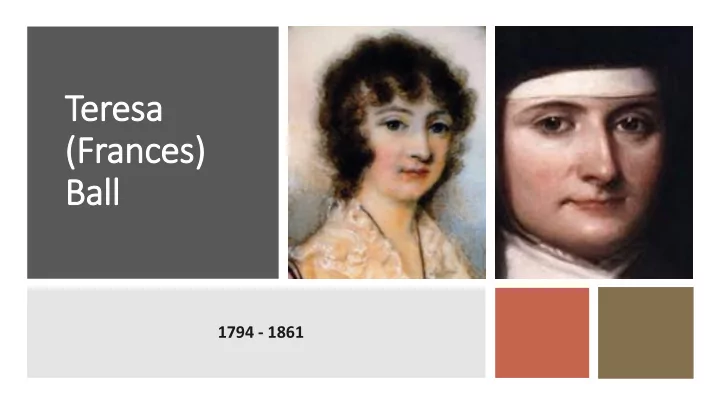
Teresa (Frances) Ball ll 1794 - 1861 Teresa Ball continues the - - PowerPoint PPT Presentation
Teresa (Frances) Ball ll 1794 - 1861 Teresa Ball continues the vision of Mary Ward In In the footsteps of Mary ry Ward https://www.youtube.com/watch?v=w99rpo8V wbM (synopsis of the life of Mary Ward) Fran ances Ba Ball ll Family
1794 - 1861
https://www.youtube.com/watch?v=w99rpo8V wbM (synopsis of the life of Mary Ward)
Fran ances Ba Ball ll – Family ily Tree and Ch Child ildhood
Occupation: Silk merchant
Galway
Anna Marie, Isabella, Nicholas
Ursuline Sister and founded the Ursuline house in Blackrock, Cork.
England 1798 – 1803. Co Foundress of the Religious Sisters of Charity with Mary Aikenhead. Anne Marie founded an Orphanage in Harold’s Cross, Dublin and a refuge for women in the Coombe.
1798 - 1803
England, Trinity College and Kings Inn and became a
three children. Anne became a religious sister in Cork, Mary in York and his son became an Oratian priest.
The apple of her father’s eye, Frances was very upset when she was sent to school in York. She tried to have herself expelled by behaving
although greatly saddened by her bereavement, Frances settled down in school. She was an intelligent, artistic and popular
death of her husband and decided to bring Frances back to Ireland in 1808. Frances did not wish to end her studies and her brother, Nicholas, promised to continue her education himself.
How did you feel leaving the comfort of Primary School and starting your second level education? What did you learn from that experience?
Have you any experience of education in a different country? Can you explain to your classmates how this differs from school life in your present school? Would you like to study abroad in the future? Have you any relatives living abroad? What do they miss or not miss about Ireland? Is distance still as much of an issue as it was in Frances’ time?
country how do you think you would recognise it as a Loreto school? Read the websites of Loreto schools around the world and identify what you feel they have in common. (Website links…..)
‘Ar scáth a chéile a mhaireann na daoine.’ ‘No person is an island.’ Is this true? Do we all need someone in whom to confide? What can be the consequences of not talking about a concern? To whom can you speak about a concern?
Debutantes’ Ball. Frances had completed 6 years as a student in York.
that she could continue, as her father did, to help the poor
It was while she was dancing that Frances had an experience that was to change the rest of her life. She heard a voice saying ‘Seek first the kingdom of God and his justice and all things else shall be added unto you.’ The next day Frances went to Mass and later spoke to her close friend Father Daniel Murray. He advised her to pray to understand better the meaning behind these words.
Frances’ mother and brother had an expectation that Frances would marry a suitable husband. Her mother would not countenance France returning to York as a novice. One morning Frances and her mother went to Mass in a different church to usual. The priest spoke about parents who block God’s plans in their children who wish to follow Him. Frances’s mother thought these words were meant for her. She relented and allowed Frances to go to York.
would come back and set up a community of the I.B.V.M. in Dublin. The Leader of the community in York, Mother Coyney, agreed to train Frances and a few other Irish girls and allow them to return. She did not feel that, given the political situation at the time, a group of English educators would be welcome in Dublin.
I listened to God’s deep dream for us and felt a desire to respond to this invitation
Is the ‘Debs’ an important occasion for young people nowadays? In what way? From your study of the New Testament, can you identify any time when God was heard to speak? In this era of Face Book, Twitter, Instagram etc. means of communication are constantly evolving. How do you think God speaks to us today? Does he speak to everyone in the same manner? Can you identify any time in your life so far when you could feel the presence of God in a decision you made either at that time or in retrospect?
very well known for his kindness and fairness to his employees. The poor of Dublin turned out in great numbers at his funeral as a sign of their respect for him. She experienced his acceptance of her impetuous personality and his respect for all the women in his life. His death had a huge effect on her. She was subsequently unable to pass on bad news to anyone concerning the death of a loved one.
from York in 1808. He insisted that her education continue and that she be widely read, versed in the classics and excelled in public speaking.
returned as a novice.
Sister – Anne Marie Anne Marie was a strong defender of the
founded an Orphanage in Harold’s Cross and a refuge for women in the Coombe. She was the co-foundress with Mary Aikenhead of the Irish Sisters of Charity. Frances accompanied her
experiences may have inspired Frances to open a free school beside every fee - paying school she founded.
1809 became Co-Adjutor Bishop of Dublin. He was famous for his oratory. He laid the foundation stone of the Pro Cathedral in 1815 and was responsible for the
encouraged the founding of the Irish Sisters of Charity he was instrumental in Frances bringing the Loreto Order to
missionary priests, was attributed to him and he introduced the Society of St Vincent de Paul to Ireland.
his dream was that Frances, once trained in the spirituality of the I.B.V.M., would bring that to Ireland to provide an education for Irish children.
consider necessary in a mentor?
mentor(s) in your life?
mentored?
remained strong. She took the name Teresa after Teresa of Avila.
later joined her as novices in Rathfarnham, Dublin, or sent their own children to be educated with her.
in York. She took as her motto ‘the mercies of the Lord I will sing forever.’
Is there a difference between choosing a career path and having a vocation?
Teresa Ball) in 1819. Another girl arrived from Ireland. She was Anne Therry from Cork and the following October another young woman presented herself in York. Her name was Eleanor Arthur, originally from Limerick.
Murray had purchased a run- down house and 40 acres of land in Rathfarnham, Dublin for Frances, (Mother Teresa) and her fellow two sisters, Sister Baptist Therry and Sister Ignatius Arthur, to establish a convent and
school in the Bar Convent and seven subsequent years preparing for this endeavour.
It seems that Frances fortuitously refused to go
Ireland as that ship subsequently sank with all
Frances began her journey by reciting the Litany of
place that Mary Ward had gone to on her way to see the Pope in Rome.
Frances returns to Ireland (2)
house in Rathfarnham was not habitable, so Frances accepted and invitation from Mary Aikenhead of the Sisters of Charity to stay with them in Stanhope Place until Rathfarnham was made ready.
after the Holy House of Loreto and that is what this new congregation became known as in Ireland and as they moved to other parts of the world. In Pontifical terms the congregation was known as the Irish Branch
Virgin Mary)
being made ready the three sisters rented a house in Harolds Cross in Dublin. In May 1822 they opened the first IBVM convent in Ireland there. On 04 November 1822 they finally moved into Rathfarmham.
Anna Maria and Isabella, her brother Nicolaus, the sister and husband of Eleanor Arthur (Sister Ignatius), an old friend of Frances, and the 13 boarders from their temporary school in Harolds Cross.
local Protestant Minister and she had to take an oath of allegiance to the King of England.
Spirit was guiding Frances not to embark on the designated ship. Have you ever felt you had a lucky escape? How did you react?
What’s in a Name?! Please view this short film on the History of the Shrine in Loreto, Italy. It was in honour of this shrine that Frances Ball named the house in Rathfarnham, Dublin and all subsequent convents and schools founded by sisters from Rathfarnham. https://www.youtube.com/watch?v=2hswvJ2uurk
new facility in an existing school is always a memorable occasion. What might Frances have written in her diary on the evening of the
Imagine that you are asked to give a speech at the opening of your new school/school wing/facility. What would you say to the school community?
The school system of the time bore some similarities to the school curriculum today but there were many differences too. French was the official language of instruction. Languages, drama, music and art were studied by all. Needlework was encouraged. The students did not return home for Christmas . Frances (Mother Teresa) advised her teachers to be tender in their treatment of the pupils but firm at the same time. There were awards for good behaviour distributed at assembly.
the small group of Sisters as postulants/novices. Between 1828 and 1833 sixteen girls who had been educated in the Abbey Rathfarnham joined the order. Frances (Mother Teresa) trained the novices herself. She planned courses for them in languages, Art, History, Music and other areas of the curriculum that were considered important at the time. She also included skills related to administration and care of the sick.
Most of the wealthy families in Dublin were from the Protestant Ascendency. The Balls were amongst the few wealthy catholic families in the city. There were several Protestant schools in the city and the administrators of these schools feared losing some of their catholic students to schools such as Loreto Rathfarnham. Rumours were spread about how badly the school was being run. However, despite this opposition and the financial challenges the school faced it continued to flourish. Frances opened a school for the poor alongside the fee- paying school.
Rathfarnham spread far and
received constant requests to found schools in other parts of Ireland and abroad.
Expansion (2)
Mother Teresa was requested to open a school in Navan, Co Meath. The house being provided in Navan was in a very poor state. Mother Teresa took on the challenge and managed to have the place ready to open on 31 July 1833. The new school was called St Anne’s. A boarding school was later added called St Michael’s. It was the first school to be opened from Loreto Abbey Rathfarnham and also the first Catholic day school run by religious in Ireland. On 05 September 1833 another school was opened in Harcourt Street, Dublin. In 1841 the school moved to the house of Lord Charleville in St Stephen’s Green
Expansion (3)
request to send some of the Sisters to India. A small group set off for Calcutta, present day Kolkata in 1841. They sailed from Dunlaoghaire and it was reported that Mother Teresa watched them from the top
Bullock Harbour, Dalkey. It was highly unlikely that any
return to Ireland .
1841 Calcutta (Kolkata) First oversees mission 1833 1843 Gorey Dalkey 1856 1872 Wexford Enniscorthy 1845 Mauritius Gibralter 1847 Canada Clontarf Dublin 1850 Bray 1851 England Spain 1852 Lough Cooter (2 years) 1853 Fermoy 1854 Letterkenny 1855 Omagh 1857 Balbriggan 1859 Borris 1860 Killarney
Expansion (4)
19th May 1861 in Loreto Dalkey, Mother Teresa had founded 37 communities around the world. She is buried in the grounds of the Abbey, Rathfarnham.
❖What do you know about the early days of your
School?
What is the definition
What qualities are required in a pioneer? Who else do you admire in this respect and why? Can you create a picture or word collage illustrating the qualities of such a person?
Dublin, followed her heart and in so doing ultimately created an amazing legacy.
spirit continues in all Loreto ventures throughout the world.
http://www.loreto.org.au/ https://www.loretorumbek.ie/ http://www.loreto.in/