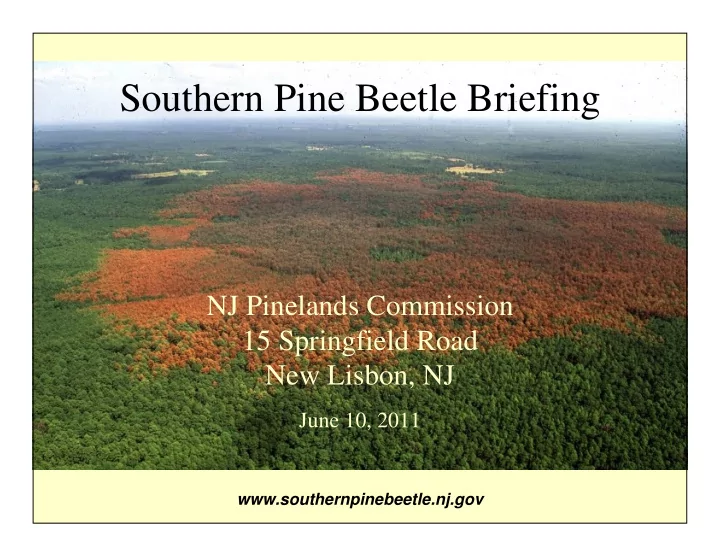
SLIDE 1 Southern Pine Beetle Briefing
NJ Pinelands Commission 15 Springfield Road New Lisbon, NJ
June 10, 2011
www.southernpinebeetle.nj.gov
SLIDE 2 History
- Active populations for decades in
Southeastern U.S.
- In 2001, a consultant forester
reported an insect problem in NJ.
- SPB identification was made by
NJFS and USFS.
- Likely migrated to NJ via wind
and/or interstate commerce.
(Dendroctonus frontalis)
SLIDE 3 Source: NJ Forest Service 2010
SLIDE 4
SPB trapping program monitors SPB populations
SLIDE 5 SPB General Movement
Egg Harbor River
2009 2010 2002 -2007
Mullica River
SLIDE 6 Data and Mapping
Digital Aerial Mapping Systems
aerial imagery.
SPB infestations detected through aerial flights are confirmed through ground verification as SPB.
SLIDE 7
Large Aggressive Spots Multiple Heads
March 22, 2011 Early during leaf out May 23, 2011 60 days later
SLIDE 8
Verification following aerial detection
SLIDE 9
Characteristic pitch tubes from adult Southern Pine Beetle attack
SLIDE 10 SPB Life Cycle
1 Photo provided by the USFS 2 Photo provided by Bugwood.org 3 Photo provided by Gerald Lenhard
Egg (1) Larva (2) Pupa (2) Adult (3)
SLIDE 11
SPB Life History
Multiple generations each year in same area
SPB Adult (left), rice grain, turpentine beetle Most of the larvae are concealed within bark
SLIDE 12
S-shaped galleries and pupa chambers on the underside of infested bark
SLIDE 13
SLIDE 14
SLIDE 15
SLIDE 16
SLIDE 17
SLIDE 18
SLIDE 19
SLIDE 20
SLIDE 21
Indian Mounds Wilderness in Texas February 1993
SLIDE 22
SLIDE 23
SLIDE 24
SLIDE 25
SPB severe outbreak (Tennessee)
SLIDE 26
Approximately 389 recorded infestations (14,100 acres) in the NJ Pinelands region in 2010
8 Years of SPB Mortality
SLIDE 27
Hardings Run Apartment Complex in Mays Landing
SLIDE 28
Winslow Wildlife Management Area
SLIDE 29
Glassboro Wildlife Management Area with feed strip
SLIDE 30
Union Lake Wildlife Management Area
SLIDE 31
Clarks Landing with Mullica River in background
SLIDE 32
Clarks Landing with Mullica River in background
SLIDE 33
Clarks Landing with Mullica River in background
SLIDE 34
Clarks Landing looking south past the Mullica River
SLIDE 35
Pine Plains…
SLIDE 36 Current Strategies
- Aerial survey flights – Once a week
- SPB spots detected and ground verified
- Foresters prepare and submit a report
- T&E species; Inter-agency review process
- Coordinate with the Pinelands Commission
- State certified sawyer crews scheduled to
perform suppression activities (cut and leave)
- Site is monitored after treatment via air and
ground
SLIDE 37
SPB suppression activities by State Forest Fire Service certified sawyer crews.
SLIDE 38
SLIDE 39 Small Spot Treatment
- Limited number of trees
- Generally located
around lightning strikes
- r stressed trees
- Minimal environmental impact
SLIDE 40
SLIDE 41 Ad Hoc Advisory Committee
- Emile DeVito - NJ Conservation Foundation
- John Bunnell– Pinelands Commission
- Kim Laidig - Pinelands Commission
- Troy Ettel - NJ Audubon
- George Zimmermann – Stockton College
- Mark Vodak – Rutgers University
- Matthew Ayres - Dartmouth College
- Ronald Billings - Texas Forest Service
- Bill Oldland - USFS
- Stephen Clarke - USFS
- James Meeker – USFS
- Bob Williams - Land Dimensions
- Mayor Pikolycky of Woodbine Borough
- Thomas Bullock – NJ Forestry Association
- Brad Rosenthal – Cape May County
- Tom Hirshblond - Industry Representative
- Matt Simons - Atlantic City Electric
- Richard Reenstra – Ocean County
- Ken Taaffe - NRCS
- Roger Smith - Fort Dix
SLIDE 42
Percent Mortality Projections 2006-2020
SLIDE 43 Impacts to the Pinelands
- Rapid conversion of pine forests to hardwoods.
- Loss of critical habitat for T & E species.
- Watershed and riparian deterioration.
- Loss of aesthetics and recreational
- pportunities.
- Increased wildfire risk to lives and property.
- Increased danger from hazard tree failure.
SLIDE 44 Critical Needs
- Partnership with the Pinelands Commission for
SPB suppression.
- Temporary emergency action creating an
expedited review and permitting process (five working days or less) for SPB cut and leave suppression activities.
SLIDE 45 Critical Needs
- Meet with Pinelands Commission staff to
develop a specific implementation and permitting process.
- Monthly updates to the Pinelands
Commission outlining suppression progress and beetle populations dynamics.
SLIDE 46