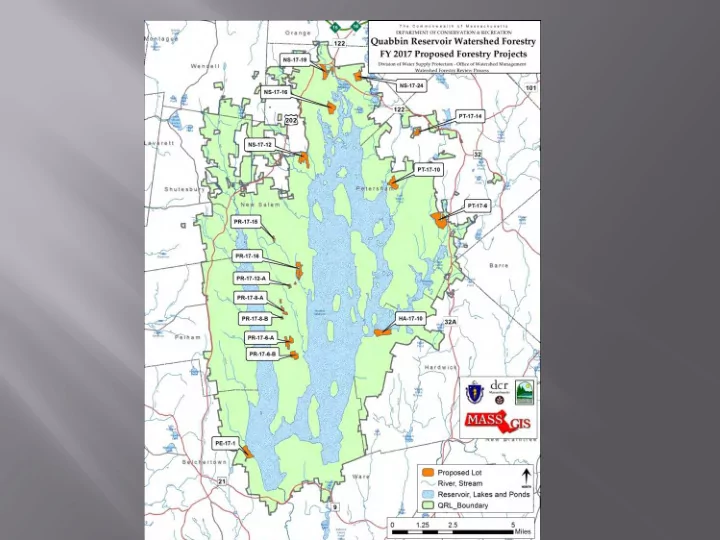
SLIDE 1
SLIDE 2 97 acres Red Pine, Oak\pine,
0.3 – 3.5 acre openings Harvest primarily red
pine and poorly formed white pine
Vernal pools Partially constructed
railroad bed
SLIDE 3
94 acres Hemlock/ Hardwood
forest type
Harvest primarily
declining hemlock, trees with poor stem structure and areas with advance regeneration
Cultural resources vernal pools Unusual species
(spleenwort)
SLIDE 4
76 acres
Red pine, white pine / hemlock, and red oak forest types
Harvest most of the red pine
- plantation. In other forest types
- penings up to 2 acres in size
will be located in declining hemlock, groups of poorly formed stems or areas with advance regeneration. No treatment in areas dominated by healthy well formed oaks.
Acidic rocky outcrop natural community on top of hill will be enhanced by the reduction of the white pine component.
SLIDE 5
80 acres White pine and red pine
forest types.
Red pine and low quality
white pine will be harvested in groups up to 2 acres in size releasing advance regeneration
NHESP habitat Area heavily used by
walkers and road bicyclists.
SLIDE 6
57 acres White pine / hemlock
and white pine/ hardwood forest types.
Forest openings up to 2
acres in size will be created in areas poorly formed white pine, declining hemlock and areas with advance regeneration.
SLIDE 7
80 acres White pine /
hardwood, oak/ hardwood and red maple forest types.
Openings up to 2 acres
in size will be created in areas dominated by poorly formed stems or advance regeneration.
Vernal pool Cellar holes
SLIDE 8 113 acres Red pine, white pine
and oak/ hardwood forest types.
Removal of the 10 acre
declining red pine plantation is planned, pending approval of the DCR Commissioner.
Releasing advance
regeneration in
also planned
SLIDE 9 29 acres Red pine/ white pine
plantation forest type.
Declining red pine
will be harvested in
acres pending approval of DCR Commissioner.
SLIDE 10
6 acres Red pine/ white pine
plantation
One 5 acre opening is
planned to salvage declining red pine.
SLIDE 11
13 acres Red pine plantation Openings up to 5
acres are planned to salvage declining red pine.
Black bear rub trees in
section B
SLIDE 12
11 acres Red pine plantation Openings up to 5
acres are planned to salvage declining red pine.
Cellar hole
SLIDE 13
73 acres
Mixed oak, red oak and
This project proposes about 10 acres of thinning (primarily in the red oak type) as well as openings up to 2 acres (primarily in the mixed oak and oak/ pine types).
Openings will be placed in areas with poorly formed stems and/or advance regeneration.
Stream crossing
SLIDE 14 158 acres Hemlock, mixed oak
and white pine forest types.
Openings up to 2 acre
are proposed in areas with declining hemlock and/or poorly formed stems of oak and pine.
Some thinning between
proposed.
Vernal pools
SLIDE 15
76 acres
White pine, oak / hardwood, hemlock/ hardwood and red pine forest types.
Openings up to 2 acres are proposed for areas with declining red pine and hemlock and white pine /oak areas with poor form/ vigor or advance regeneration
Stream/ wetland complex functioning as vernal pool.
SLIDE 16
35 acres
Oak/ hardwood and hemlock/ hardwood forest types.
Forest health concerns include, hemlock wooly adelgid, hemlock elongate scale, nectria canker, beech bark disease and ash decline.
Openings up to 2 acres are proposed for areas with forest health issues and/ advance regeneration.
SLIDE 17 FY-16 proposal Originally
proposed as
acres
Now proposed
as openings up to 16 acres pending DCR Commissioner approval
SLIDE 18 1.
Produce illustrated plain-language summaries of Land Management Plans to increase their accessibility to the general public
2.
Explore new approaches and continue to enhance source water protection
- n the Wachusett Reservoir watershed
3.
Re-start active forest management using methods that eliminate the geometric patch cut approach in favor of irregular-shaped regeneration
- penings and specialized thinning techniques. Consider creating both Early
Successional and Old Growth conditions on limited areas.
4.
Monitor the effectiveness of Best Management Practices using established protocols and post time-sequence photography online
5.
Monitor hydrologic and water quality effects of forest management above and below, and before and after harvesting operations
SLIDE 19
Will produce accessible LMP summaries, per recommendations
Is continuing to build watershed protection for Wachusett Reservoir
Is continuing to refine lot review process and public awareness, via public meetings,
- nline postings, and on-site tours and signage
Plans to restart forest management primarily using small, irregularly shaped regeneration openings, with green retention in larger openings
Is working to implement USDA FS Best Mgt Practices monitoring protocol and will establish photo points on some harvest lots, and post images online
Is committed to a greater level of routine water quality monitoring within harvest areas, and is refining both short and long-term monitoring programs
Has released Terrestrial Invasive Plants Management Strategy, online @ http://www.mass.gov/eea/agencies/dcr/water-res-protection/watershed- mgmt/plans.html
The DCR Division of Water Supply Protection, Office of Watershed Management