The Berry College Longleaf Pine Project Restoration of Mountain - - PowerPoint PPT Presentation

the berry college longleaf pine project
SMART_READER_LITE
LIVE PREVIEW

The Berry College Longleaf Pine Project Restoration of Mountain - - PowerPoint PPT Presentation

The Berry College Longleaf Pine Project Restoration of Mountain Longleaf Pine on the Worlds Largest College Campus Martin L. Cipollini, PhD. Dana Professor of Biology Berry College Origins of the Berry College Longleaf Pine Project 1995


slide-1
SLIDE 1

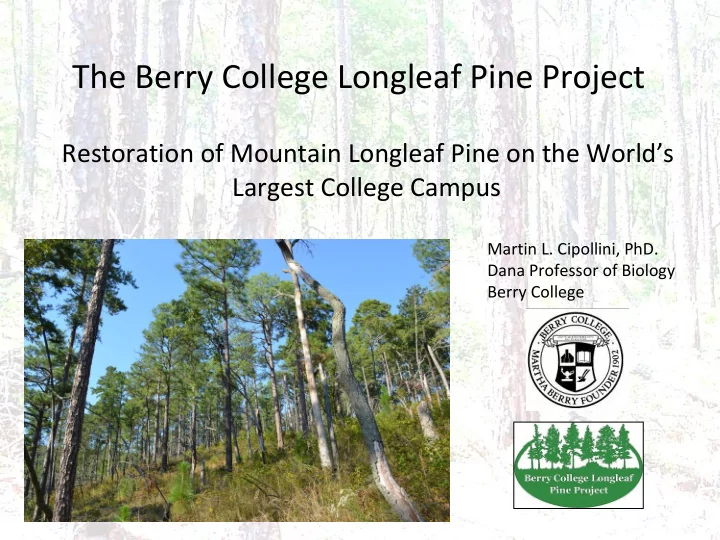
The Berry College Longleaf Pine Project

Restoration of Mountain Longleaf Pine on the World’s Largest College Campus

Martin L. Cipollini, PhD. Dana Professor of Biology Berry College
slide-2
SLIDE 2

Origins of the Berry College Longleaf Pine Project

  • 1995 Roger Birkhead’s independent study showed we had trees >

200 years old

  • 1999 Plant Ecology class initiated long-term census work
  • 2001 SAVE club responded to logging with a tree planting event
  • 2002 management plan developed by Karen Vaughn as an

extension of a Plant Ecology project

slide-3
SLIDE 3

Why develop a management plan?

  • Longleaf pine is an ICUN Red List Endangered Species, occupying
  • nly about 2% of their original 92 million acre range.
  • Old trees and late 1800’s maps suggested widespread longleaf pine

community on Lavender Mountain.

  • Few new trees since 1920s-1930s – local population was in decline.
  • Burning had been restricted for 60-70 yrs, resulting in hardwood

encroachment, fuel buildup, and near total loss of understory plants.

  • Most of mountain was never plowed, suggesting that recovery of

understory plants might be possible (seed bank).

  • Southern Pine Beetle (SPB) and wildfires are common problems with

loblolly and shortleaf pine forests on campus.

  • Most importantly, the college campus context gave an excellent
  • pportunity to engage in a variety of service-learning opportunities.
slide-4
SLIDE 4
slide-5
SLIDE 5
slide-6
SLIDE 6

Longleaf Pine Life Cycle

Seeds germinate on bare soil Remain in “grass” stage for several years Only grows upward in open conditions Can live up to 500 years

slide-7
SLIDE 7

Longleaf Pine is adapted to periodic surface fires

  • Causes of fire
  • Lightning strikes
  • Native Americans and post

1830s settlers

  • Adaptations
  • Resistant grass stage
  • Fast height growth
  • Thick bark
  • High sap and needle

production

slide-8
SLIDE 8

Seedlings and fire

  • Seeds require bare soil to germinate
  • Needles protect bud
  • Fire kills hardwoods and other

competitors

  • Fire protects seedlings from some

diseases (e.g., brown leaf spot).

slide-9
SLIDE 9

The decline of Longleaf Pine

  • Fire suppression!
  • Timber harvesting
  • Tapping for turpentine
  • Replacement with faster growing

pines like loblolly

  • Combined factors have contributed

to a decline from +/- 90 million acres throughout the south to less than 2% of the original range!

U.S. Forest Service

slide-10
SLIDE 10
slide-11
SLIDE 11

And then came the “Smoky the Bear” campaign…

U.S. Forest Service

slide-12
SLIDE 12

A Changing Message….

slide-13
SLIDE 13

Most longleaf is in the Coastal Plain Longleaf Pine on Berry’s Lavender Mountain

Regional mountains harbor “Montane” Longleaf Pine

slide-14
SLIDE 14

Management plan overview

  • 2001 – began planting seedlings
  • 2003 – began restoring burning regime on 3-5 year frequency
  • 2005 – began controlling hardwoods and invasive species via

removal and herbicide application

  • 2005 – began establishing local seed sources via cone collection

and seed orchard development

  • Along the way - research, education, and outreach
  • Help from Berry’s Land Resources, Student Work, Volunteer

Services, Berry Longleaf Network, Interagency Burn Team, and various internal and external grants.

slide-15
SLIDE 15
slide-16
SLIDE 16
slide-17
SLIDE 17

Management: Planting

  • Most planting done in SPB clear- and selective-cuts, followed by

burning

  • Some in areas with hardwood canopy reduced via herbicide

injection and burning

  • Focus is on low density “conservation” plantings.
  • Everybody loves to plant trees!
slide-18
SLIDE 18
slide-19
SLIDE 19
slide-20
SLIDE 20

Management: Burning

  • Fuel reduction/restoration burns done in “old growth” areas – some

areas burned four times since 2003

  • Raking around bases of old growth trees was necessary to control

effects of duff smoldering.

  • Most planted areas have been burned at least twice since planting.
slide-21
SLIDE 21

Management: Student Burn Team

  • Trained to meet USFS guidelines.
  • S130/S190 Fire Behavior and Safety
  • Southern Company/NFWF grant provided needed equipment
slide-22
SLIDE 22
slide-23
SLIDE 23
slide-24
SLIDE 24
slide-25
SLIDE 25
slide-26
SLIDE 26

Management: Herbicides

  • Direct injection for hardwood control in core management area.
  • Directed spray for hardwoods and blackberry in SPB cuts.
  • Cut-stump and basal bark spray for hardwoods and shrubs in logged

areas.

slide-27
SLIDE 27
slide-28
SLIDE 28
slide-29
SLIDE 29
slide-30
SLIDE 30

Management: Grafted seed orchard

  • Offsite source longleaf pine rootstock planted spring 2003.
  • Grafting work initiated winter 2005.
  • About 100 trees successfully grafted in 2.5 acre orchard; orchard

now used in agroforestry project (sheep)

  • First cones in 2011.
slide-31
SLIDE 31
slide-32
SLIDE 32

Management: Seedling seed orchard

  • 530 seedlings from 50 maternal trees grown in pots in summer of

2007

  • Planted on a 4-acre clear cut in 2008 – 2009.
  • Early growth rates of individuals have been monitored.
slide-33
SLIDE 33
slide-34
SLIDE 34

Research and Monitoring

  • Plant/Forest Ecology classes: Population dynamics, post-fire

mortality, soil chemistry, changes in tree community over time

  • Berry Student Work program: Fuel loads, carbon storage, seedling

survivorship, herbaceous plants and grasses, birds, reptiles and amphibians

  • External research (Univ. West GA, Georgia State, VA Tech,

Clemson, etc.) fine root regeneration, soil nutrient dynamics, mycorrhizae, dendrochronology, forest structure

  • Berry NSF-REU Program: herbicides and prescribed burning

effects, total carbon, herbaceous plants and grasses.

slide-35
SLIDE 35

Public Education and Outreach

  • Communications majors: helped develop PR plan and website.
  • GFC Healthy Forests grant: funded video, pamphlets, other PR
  • GA-DNR Interpretive Trails grant: funded Longleaf Trail
  • Dozens of service/learning experiences have involved 100s of

primary- and secondary-school students, Berry College students, and members of the general public.

slide-36
SLIDE 36

Public Education and Outreach

slide-37
SLIDE 37

For more information:

www.berrylongleaf.com