WSUD: Utilising Permeable Pavements to Influence Tree Growth Dr J. - - PowerPoint PPT Presentation

wsud utilising permeable pavements to influence tree
SMART_READER_LITE
LIVE PREVIEW

WSUD: Utilising Permeable Pavements to Influence Tree Growth Dr J. - - PowerPoint PPT Presentation

WSUD: Utilising Permeable Pavements to Influence Tree Growth Dr J. Mullaney jenniferm@covey.com.au Urbanisation Population centres rural to urban Increase in population of 44% by 2100 Urban areas decrease space, increase


slide-1
SLIDE 1

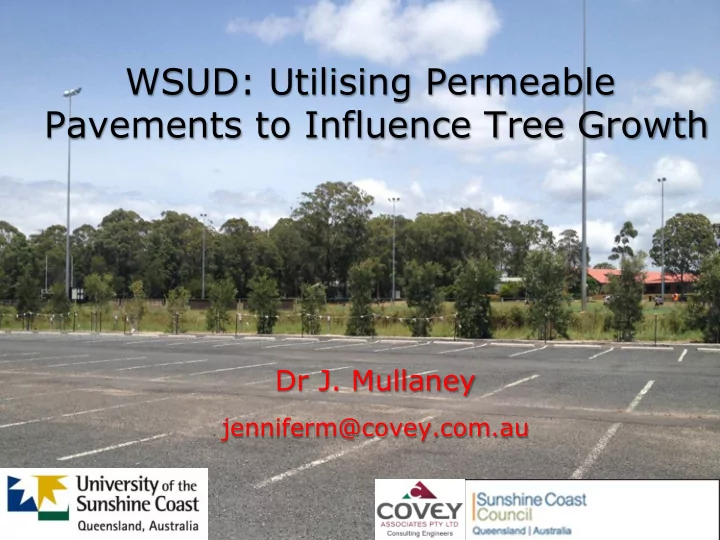
WSUD: Utilising Permeable Pavements to Influence Tree Growth

Dr J. Mullaney

jenniferm@covey.com.au

slide-2
SLIDE 2

Urbanisation

§ Population centres rural to urban § Increase in population of 44% by 2100 § Urban areas decrease space, increase pressure on urban green spaces and increase impervious surfaces § Trees increasingly viewed as assets § Growth is limited in urban areas § Highly modified soils

§ Compaction § Decreased soil moisture § Increased temperature § Decreased oxygen

slide-3
SLIDE 3

§ Lack of water, nutrients and oxygen prevent significant challenges for trees to survive and grow § Increased soil temperature can limit tree growth and physiological processes § Health and condition decrease as distance between tree and pavement decreases § Conflict increases as distance is less than 3m

slide-4
SLIDE 4

Conflict

slide-5
SLIDE 5
  • Conflicts ¡are ¡high ¡when ¡the ¡following ¡are ¡present: ¡
  • Large ¡or ¡fast ¡growing ¡tree ¡species ¡
  • Restricted ¡planting ¡volume ¡
  • Shallow ¡top ¡soil ¡
  • Regular ¡shallow ¡irrigation ¡events ¡
  • Distance ¡between ¡tree ¡and ¡footpath ¡is ¡less ¡than ¡2-­‑3 ¡meters ¡
  • Trees ¡are ¡older ¡than ¡15-­‑20 ¡yrs ¡
  • US$70 ¡million ¡spent ¡in ¡California ¡as ¡a ¡result ¡of ¡conflicts, ¡US

$23 ¡million ¡on ¡pavement ¡repairs ¡and ¡US$6.9 ¡million ¡on ¡trip ¡ and ¡fall ¡claims ¡(McPherson ¡et ¡al, ¡2000) ¡

  • In ¡Cincinnati, ¡Ohio, ¡US$ ¡2 ¡million ¡annually ¡on ¡pavement ¡

repairs ¡caused ¡by ¡damage ¡from ¡tree ¡roots ¡

slide-6
SLIDE 6

One potential approach is permeable pavements and street trees

For trees and pavements to co-exist a paradigm shift in managing urban infrastructure is required Challenge to provide a functioning natural environment in urban area

slide-7
SLIDE 7

WSUD and Permeable Pavements

  • WSUD embraces integrated water and

land management

  • Water quality improvement
  • V e g e t a t e d m e a s u r e s : s w a l e s ,

bioretention basins, wetlands, street tree pods

  • Non-vegetated: permeable pavements,

settlement ponds, gpt’s

  • Limited space in urban areas
slide-8
SLIDE 8

Permeable Pavements

  • No increase in land uptake
  • Promote infiltration
  • Reduce runoff volume & risk of

flood

  • Reduced effective imperviousness
  • f street by 42%
  • Increase water quality
  • Heavy metals
  • Oils
  • TSS
slide-9
SLIDE 9
slide-10
SLIDE 10

PP and Street Trees

§ Increased water availability § Reduce summer water stress by decreasing impervious coverage § Provide water detention § Reduce the need for extra constructed detention/ water quality structures on site § Provide water quality treatment

slide-11
SLIDE 11

§ Previous research has indicated a potential to increase tree health using pervious surfaces (Volder et al., 2009; Morgenroth and Visser, 2011). § Trees 28% taller in porous than non porous in sand (Morgenroth and Visser, 2011) § Deeper roots with a base-layer (Morgenroth, 2011)

slide-12
SLIDE 12

USC Research Project

§ Tree Species

  • Melaleuca quinquenervia

§ 2 Different Soil Types

  • Sandy
  • Clay

§ 4 Paving Treatments, 4 replicates

  • Conventional asphalt surface control (AC)
  • Permeable paving no sub-base (PP)
  • Permeable paving with 100mm base layer

(PP-100)

  • Permeable paving with 300mm base layer

(PP-300)

slide-13
SLIDE 13

Pavement Treatments

slide-14
SLIDE 14
slide-15
SLIDE 15

Experiments

  • 1. Soil moisture and temperature
  • 2. Tree growth – height and DBH
  • 3. Leaf nutrient concentrations
  • 4. Tree ecophysiological status

I. Photosynthesis, stomatal conductance, iWUE

  • II. Leaf δ15N and δ13C (δ15N and δ13C indicate water

stress level of the tree)

slide-16
SLIDE 16
slide-17
SLIDE 17

Tree Height Increment - Sand

Height increment (cm) 50 100 150 200 250 300 AC PP PP-100 PP-300 Pavement treatment

Tree Height Increment - Clay

Height increment (cm) 50 100 150 200 250 300 AC PP PP-100 PP-300 a ab b a b c ab a

Tree Height Increment

slide-18
SLIDE 18

Tree DBH Increment

Tree DBH Increment - Sand

DBH increment (mm) 20 40 60 80 AC PP PP-100 PP-300 Pavement treatment

Tree DBH Increment - Clay

DBH increment (mm) 20 40 60 80 AC PP PP-100 PP-300 b a b b b b a a

slide-19
SLIDE 19

Tree Canopy Area

Tree Canopy Area - Sand

Canopy area (m2) 2 4 6 8 AC PP PP-100 PP-300 Pavement treatment

Tree Canopy Area - Clay

Canopy area (m2) 2 4 6 8 AC PP PP-100 PP-300 ab a b ab ab b ab a

slide-20
SLIDE 20

Other Results

  • Soil moisture increased in pp with base layer in sand and

decreased in clay

  • Soil temperature decreased as base depth increased
  • Increase in Sulphur in clay soils supported theory that

base layer important to maintain tree growth.

  • Improved growth in pp

with increasing depth of base layer in clay a s s o c i a t e d w i t h increased K, ,Mg, Na.

slide-21
SLIDE 21

Discussion

  • Trees in sand soil had the greatest DBH growth and

canopy area in permeable pavements with no sub-base – supports Morgenroth and Visser, 2011

  • Trees in clay soil height growth, DBH growth and canopy

area in permeable pavements with a deep sub-base – supports Volder et al., 2009

Permeable pavements can increase street tree growth but the

  • ptimal pavement design was dependent on the soil type
slide-22
SLIDE 22

Conclusion

  • PP can improve tree growth in

urban environments

  • Increase use of permeable

pavements in local areas

  • Utilise all uses of permeable

pavements not just detention capabilities

slide-23
SLIDE 23

Thank you!

jenniferm@covey.com.au

slide-24
SLIDE 24

Publications

  • Mullaney, J & Lucke, T 2014, ‘Practical Review of Pervious Paving

Designs’, CLEAN – Soil, Air, Water, vol. 42, no. 2, pp. 111-124.

  • Mullaney, J, Lucke, T & Trueman, SJ 2015, ‘A review of benefits

and challenges in growing street trees in paved urban environments’, Landscape and Urban Planning, vol. 134, no. 1,

  • pp. 157-166.
  • Mullaney, J, Lucke, T & Trueman, SJ 2015, ‘The effect of

permeable pavements with an underlying base layer on the growth and nutrient status of urban trees’, Urban Forestry & Urban Greening, vol. 14, no. 1, pp. 19-29.

  • Mullaney, J, Trueman, SJ, Lucke, T & Hosseini Bai, S 2015, ‘The

effect of permeable pavements with an underlying base layer on the ecophysiological status of urban trees’, Urban Forestry & Urban Greening, vol 14, pp.686-693.