
SLIDE 1
Permeable Pavement Parking
Morton Arboretum, Lisle, IL
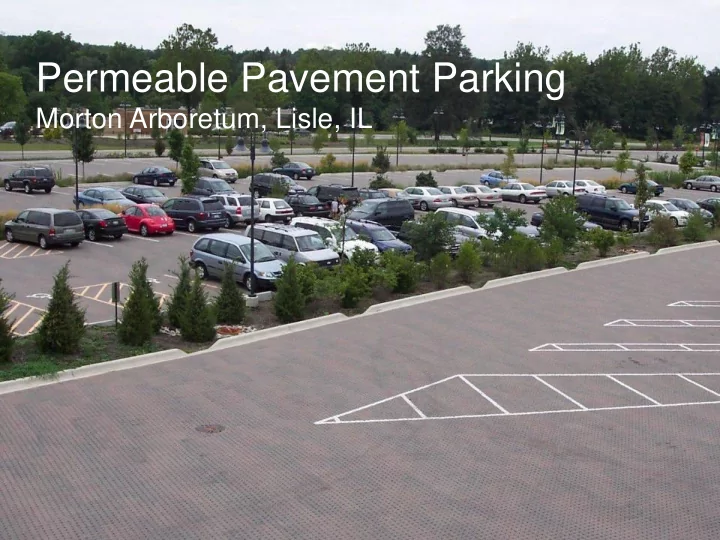
Permeable Pavement Parking Morton Arboretum, Lisle, IL Permeable - - PowerPoint PPT Presentation
Permeable Pavement Parking Morton Arboretum, Lisle, IL Permeable Pavements Porous Asphalt Permeable Concrete Street Retrofits Seattle Street - Before Seattle Street After Retrofit Seattle street retrofit monitoring results for two
Morton Arboretum, Lisle, IL
Permeable Concrete
Permeable Pavements
Porous Asphalt
Seattle street retrofit monitoring results for two years:
reduction in total runoff volume
A Commercial Street
State Capitol Tetra Tech
Before
TetraTech and C2AE
Tetra Tech
(25-year event)
Tetra Tech
After
island effects in the summer
relatively fixed in its capacity
cities to complement and add to the effectiveness of wet weather infrastructure
12
Applying a financing lens across sectors . . .
Twenty communities Diverse drivers, geography, scales, approach
Telling the financing story through the use
Population – 400 full time residents plus another 300 seasonal. Demographics – Older and wealthier individuals with lots of time for family, friends, and community. Economy – Historically focused on boating and fishing, now thrives on real estate, sailing, and tourism. Incorporated Municipality – One of 4 municipalities in Talbot County, MD.
Stormwater Project 2013 Summer Event Series
the Port
Oxford and the Oxford Stormwater Task Force for an interactive event series
solutions to stormwater management in the community and
yourpersonalproperty.Thesummereventswillfeaturestepsresidentscan take to reduce stormwater concerns in Oxford, Maryland.
April 27 Oxford Day
Stormwater Information Table Rain Barrel Demonstration Visit the Stormwater Task Force table in the waterfrontparkonOxfordDay.Telluswhatsteps thePortofOxfordcantaketoreducestormwater concerns.Entertowinarainbarrelpaintedbyan Oxford artist, come see a rain barrel demonstration
challenges
town maps.
May 31 River Appreciation Week in Oxford
4:30pm @ Oxford Community Center Join the University of Maryland Extension and TalbotCountyMasterGardenersforatourof Oxford’s rain barrels and rain gardens followed by a living shoreline kayak excursion along the Strand.
410-822-1244 (Ext. 12).
June 19 Rain Barrel and Garden Workshop
7:00pm @ Oxford Community Center Learn how rain barrels and gardens can be used to manage stormwater and how to install them at this evening workshop. For more information, contact Sean Williamson at 802-578-5399.
July 17 French Drain Workshop
7:00pm @ Oxford Community Center Learn from an Oxford homeowner about his experience designing and installing a French drain for managing stormwater
his property. For more information, contact Sean Williamson at 802-578- 5399.
August 24 Workshop
Stormwater Systems
@ The Preservation Green Horticultural Center
Mill St (101 Mill St) Philip Logan, AIA, LEED AP, will share his experience in designing and installing stormwater control and filtration systems. This will include a study
the green roof now in its 2nd year, rainwater filtration & cistern storage systems, pervious vs impervious surfaces, bio swales and a discussion
general stormwater management principles. For more information, contact Philip Logan at 212 358-0538.
September 28 Bank Street Bio Swale Volunteer Day
are invited to get their hands dirty as the community finishes installation
a bio swale
Bank Street by planting native species. For more information, Contact: Sean Williamson at 802-578- 5399.
Oxford Stormwater Feasibility Study is sponsored by the National Fish and Wildlife Foundation
assistance from Oxford Stormwater Project Partners
Low Cost, Low Impact Stormwater Program High Cost, High Impact Stormwater Program Current Program – Making due with limited resources, but sometimes deferring stormwater projects while the situation does not visibly improve, and potentially worsens. The Cadillac Program – Investing in all large-scale capital improvement projects that drastically improve high water situation, but do not stop flooding all together and come with significant cost. Goldilocks Program – Selectively investing in capital improvement projects and management strategies with the greatest impact while keeping costs down. Emphasis on getting “the most bang for the buck.” Where Oxford is Where Oxford should be
Budget Number and Name Description 5-YR Cost Impact on Pollution and Flooding
1: Basic Program Includes all currently scheduled repairs and construction described above. $506 K Least impact – Addresses current system repairs. 2: Option 1 + mapping + planning Includes all currently scheduled projects plus development of infrastructure map and master plan plus funds for education and outreach $630 K Small direct impact, but indirectly, planning will position Oxford for success. 3: Option 2 + mapping + planning + Causeway road elevation + pumps Includes all currently scheduled projects, plus master plan, plus major capital improvement projects at the Causeway (Pumps and rd. elevation) $1.5 M Greater direct impact as a result of new capital improvement project plus planning benefits 4: Option 3 + wetland and investment in shoreline buffers Includes constructing a 5 acre wetland, installing storm pumps, expanding coastal buffer, plus all existing projects and a master plan $2.3 M Greatest impact
23
Federalsburg, MD: Understanding Infrastructure Before Making Investments
Existing stormwater program:
city manager
In recent years, very common things were happening to stormwater program:
Painesville paid Lake County Stormwater Department $53,000 to provide:
and enforcement
Painesville also paid LCSWCD $3,000 to provide:
development issues
Covers all permit requirements and needs: Data collection and management Planning, design and construction of regional drainage systems Assistance with operations and maintenance Direct billing of stormwater customers More grant opportunities Administrative and reporting assistance Capital investments in infrastructure
Project Design Construction Cost/Funding Cedarbrook Basin 2015 2016 $1.7 M Cedarbrook Dr. Inlet 2015 2016 20 year bond Maplewood 2015 2016 $288k Mentor/Jackson 2018 2019 $1,174k Gingerbread 2019 2020 $640k Nelson 2012 2022 $606k
A New Stormwater Program - Now a Model Community for Managing Stormwater!
Connecting Communities with Common Concerns: Narragansett Bay and the City of Annapolis Coastal Flooding Infrastructure needs Stormwater permits Green Infrastructure Sustainability
31
32
33