
SLIDE 1
1
Designing for Permeable Pavement: Long‐Term Performance and Cost Efficiency
David Hein, P.Eng. Principal Engineer Vice‐President, Transportation
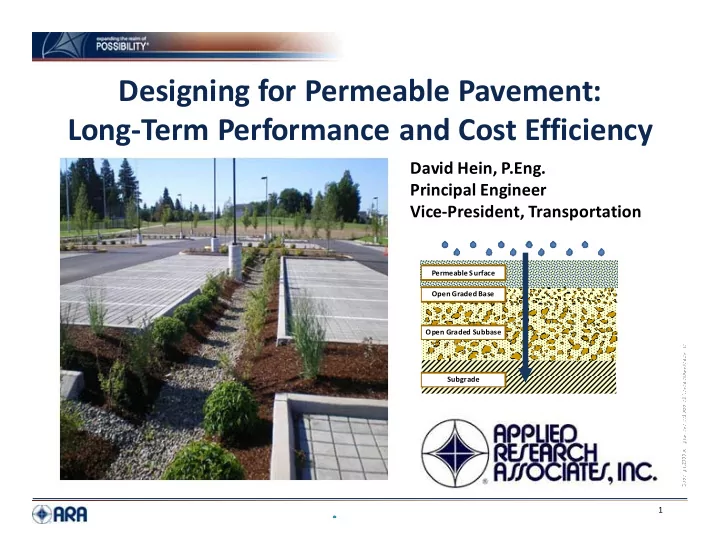
Permeable Surface Open Graded Base Open Graded Subbase Subgrade
Designing for Permeable Pavement: Long Term Performance and Cost - - PowerPoint PPT Presentation
Designing for Permeable Pavement: Long Term Performance and Cost Efficiency David Hein, P.Eng. Principal Engineer Vice President, Transportation Permeable Surface Open Graded Base Open Graded Subbase Subgrade 1 Long Term Performance
1
David Hein, P.Eng. Principal Engineer Vice‐President, Transportation
Permeable Surface Open Graded Base Open Graded Subbase Subgrade
2
3
4
Urban Area Flooding
5
6
7
Pavement system designed to permit the infiltration of surface water
8
9
10
11
Permeable Surface Open Graded Base Open Graded Subbase Subgrade Permeable Surface Open Graded Base Open Graded Subbase Subgrade
Outlet Pipe
Permeable Surface Open Graded Base Open Graded Subbase Subgrade
Outlet Pipe
12
13
14
15
16
17
18
19
20
21
22
Considerations Description Availability of capital funding The initial capital construction cost of permeable pavement is typically higher than for conventional pavement. Overall long‐term life‐cycle costs can be very competitive if consideration is given to stormwater quality and quantity benefits are taken into account. Status of environmental approval In some jurisdictions, permeable pavement may not be permitted or may require additional environmental approvals. Proximity to environmentally sensitive areas The presence of protected watersheds, cold water streams, marshland, etc. may preclude the use of permeable pavement systems or require more extensive treatments. Safety Ability to accommodate safety features such as rumble strips, vegetative growth, areas subjected to rapid icing, etc. Significant longitudinal grades Not recommended for grades of more than 5 percent as sheet flow may overload the ability of the permeable shoulder to infiltrate water which may cause localized flooding. Depth of water table Permeable pavements should not be used in areas where the water table is within 0.6 m (2ft) of the top of the soil subgrade. It must be possible to drain water entering the subgrade. Significant use of sand and/or salt for winter maintenance Melting salt will result in higher concentrations of chlorides in the water which may hinder plant growth. Winter sand may clog permeable pavement systems resulting in reduced system permeability. Risk of accidental chemical spill Is the permeable pavement location in an area where hazardous chemical transportation is present.
23
Considerations Description Amount and intensity of precipitation May not be suitable in areas of frequent, high intensity storms. Presence of utilities The design and construction of permeable shoulders may be problematic in areas where utilities are present along the roadway shoulders. Risk of flooding Areas subject to frequent flooding may require supplemental drainage features to ensure that the roadway surface is properly drained. Mandates for water quality Permeable pavements may contribute substantially to water quality improvement. Mandates for stormwater management Permeable pavements provide stormwater management alternatives to more costly or complicated practices. Maintenance protocols Permeable pavement systems require mandatory non‐traditional maintenance practices such as vacuum sweeping. Shoulder utilization Some shoulders are used as driving lanes for specification conditions
for passing, high occupancy vehicle routes, emergency vehicles, etc. Interest in innovation Utilizing traditional impermeable surfaces for stormwater management provides opportunities for innovation. Complexity of geometric conditions Geometric constraints such as horizontal or vertical grades, presence
Impact of unknown site conditions Variability of soil conditions, presence of organics, potential for frost heave, etc. may impact shoulder pavement performance. Owner experience and resources The use of permeable pavements for roadway shoulder is very limited a present.
24
Part A Weighting: 60 Consideration Rating Weighting Weighted Value Low Medium High Availbility of Capital Funding Medium 20.0 12.0 No specific funding available Need to justify funding Project funded Status of Environmental Approval Medium 20.0 12.0 Application required Approval pending Approved Prox imity to Enviornmentally Sensitive Areas Low 20.0 4.0 Adjacent Within watershed area Outside of watershed area Safety High 10.0 10.0 Significant safety issues Safety issues can be addressed Minimal safety issues Significant Grades High 10.0 10.0 Grades > 5 percent Grades of 3 to 4 percent Grades < 3 percent Depth of Water Table Medium 20.0 12.0 Water table < 0.6 m below subgrade Water table 0.6‐0.9 m below subgrade Water table > 0.9 m below subgrade Total 100.0 60.0 Weighted Total: 36.0
Part B Weighting: 30 Consideration Rating Weighting Weighted Value Low Medium High Salt/Sand use for Winter Maintenance High 10.0 10.0 Used for >4 months Used 1 to 4 months/year Used < 1 month/year Risk of Accidental Chemical Spill High 10.0 10.0 Located in chemical/industrial area On major trucking route Limited exposure Amount and Intensity of Precipitation Medium 15.0 9.0 Intense storms Moderate frequency/intensity Frequent/non‐intense storm Presence of Utilities High 10.0 10.0 Critical utilities Non‐critical utilties None Risk of Flooding Medium 10.0 6.0 Frequent Occasional None Mandates for Water Quality High 10.0 10.0 No concerns Some water quality issues Water quality concerns Mandates for Stormwater Management High 15.0 15.0 No concerns Some stormwater management issues Stormwater management concerns Maintenance Protocols Low 10.0 2.0 Minimal maintenance Reactive maintenance Proactive maintenance Traffic Utilization High 10.0 10.0 Heavy traffic use Occassional traffic use Use for emergency use only Total 100.0 82.0 Weighted Total: 24.6
Part C Weighting: 10 Consideration Rating Weighting Weighted Value Low Medium High Interest in Innovation Low 25.0 5.0 Minimal interest Innovation encouraged Regular innovation implementation Complex ity of Geometric Conditions High 25.0 25.0 Significant geometric restrictions Some geometric challenges Minimal geometric restrictions Impact of Unknown Site Conditions Medium 25.0 15.0 No site specific information available Some site information available Site conditions well known Owner Experience and Resources Low 25.0 5.0 No owner experience Limited owner experience Significant owner experience Total 100.0 50.0 Weighted Total: 5.0
Sub Totals
60 36.0 From To Implement Alternative
30 24.6 65 No
10 5.0 65 75 Can Consider Grand Total 100 65.6 75 100 Yes Decision Can Consider Weighting Guidelines Weighting Guidelines Weighting Guidelines Decision Range
25
Part A Weighting: 60 Consideration Rating Weighting Weighted Value Availbility of Capital Funding Medium 20.0 12.0 Status of Environmental Approval Medium 20.0 12.0 Proximity to Enviornmentally Sensitive Areas Low 20.0 4.0 Safety High 10.0 10.0 Significant Grades High 10.0 10.0 Depth of Water Table Medium 20.0 12.0 Total 100.0 60.0 Weighted Total: 36.0
Low Medium High No specific funding available Need to justify funding Project funded Application required Approval pending Approved Adjacent Within watershed area Outside of watershed area Significant safety issues Safety issues can be addressed Minimal safety issues Grades > 5 percent Grades of 3 to 4 percent Grades < 3 percent Water table < 0.6 m below subgrade Water table 0.6‐0.9 m below subgrade Water table > 0.9 m below subgrade Weighting Guidelines
26
Decision Range
Considerations 60 36.0 From To Implement Alternative
Considerations 30 24.6 65 No
Considerations 10 5.0 65 75 Can Consider Grand Total 100 65.6 75 100 Yes Decision Can Consider
27
28
Pavers + (50 mm ASTM #8) Base (100 mm ASTM #57) Subbase (200 mm ASTM #2) Subbase (125 mm CDOT Class 5)
29
30
– Local DOT aggregate specifications – Industry recommendations – Local aggregate sources
– No standard Proctor density – Establish target density – Roller versus plate compactor (parking lot/driveway) – Lift thickness
31
32
33
34
35
construction time
to traffic
www.icpi.org
36
37
38
39
40
41
42
50
51
52
53
54
55
56
57
58
59
60
61
62
63
64
Main Street ‐ Fort Morgan, Colorado
65
66
67
68
69
70
71
72
73
74
75
76
Subgrade Impermeable Liner (Optional) Drainage Pipe
Lane Permeable Shoulder
Dense Graded Subbase Surface Course Dense Graded Base Perforated Channel
77
78
79
80
81
82
83
84
85
86
87
88
89
90
91
92
93
94
95
96
97
98
99
100
101