Living Shorelines Development of a General Permit & Integrated - - PowerPoint PPT Presentation

living shorelines
SMART_READER_LITE
LIVE PREVIEW

Living Shorelines Development of a General Permit & Integrated - - PowerPoint PPT Presentation

Living Shorelines Development of a General Permit & Integrated Guidance Planning for the Future Workshop VIMS, May 24, 2012 SENATE BILL NO. 964 A BILL to amend and reenact 28.2-1100 of the Code of Virginia and to amend the Code


slide-1
SLIDE 1

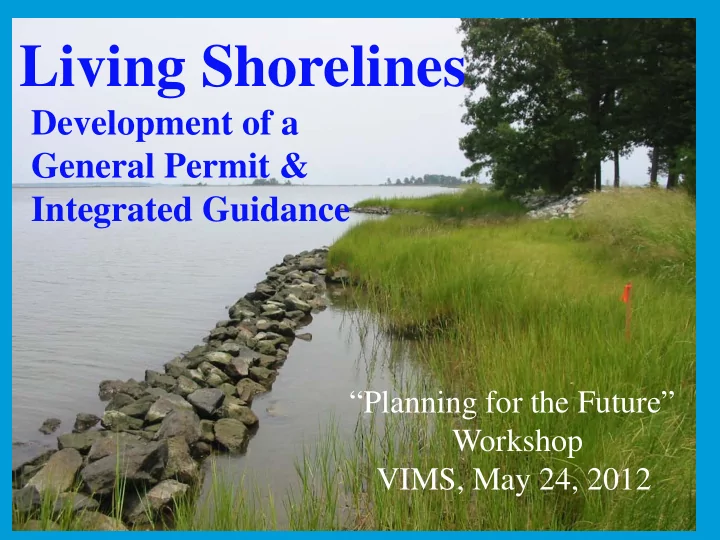
Living Shorelines

Development of a General Permit & Integrated Guidance

“Planning for the Future” Workshop VIMS, May 24, 2012

slide-2
SLIDE 2
slide-3
SLIDE 3

SENATE BILL NO. 964

A BILL to amend and reenact § 28.2-1100 of the Code of Virginia and to amend the Code of Virginia by adding sections numbered 15.2-2223.2 and 28.2-104.1, relating to Marine Resources Commission; Virginia Institute of Marine Science; coastal resource management.

slide-4
SLIDE 4

Senate Bill 964 does five important things:

  • 1. Defines Living Shorelines
  • 2. Requires the Commission in cooperation with DCR and

technical assistance from VIMS to develop a general permit 3 Requires the Commission in cooperation with DCR and technical assistance from VIMS to develop integrated guidance for the management of tidal shoreline systems

  • 4. Requires VIMS to develop comprehensive coastal

resource management guidance by 12/30/2012.

  • 5. Directs Tidewater localities to incorporate the

comprehensive guidance developed by VIMS into their comprehensive plans starting in 2013 with VIMS, VMRC and DCR providing technical assistance

slide-5
SLIDE 5

"Living shoreline" means a shoreline management practice that provides erosion control and water quality benefits; protects, restores or enhances natural shoreline habitat; and maintains coastal processes through the strategic placement of plants, stone, sand fill, and other structural and organic materials.

slide-6
SLIDE 6

The Commission, in cooperation with the Department of Conservation and Recreation and with technical assistance from the Virginia Institute of Marine Science, shall establish and implement a general permit regulation that authorizes and encourages the use of living shorelines as the preferred alternative for stabilizing tidal shorelines in the Commonwealth. In developing the general permit, the Commission shall consult with the U.S. Army Corps of Engineers to ensure the minimization of conflicts with federal law and regulation.

Legislation requires implementation

  • f a General Permit
slide-7
SLIDE 7

§ 28.2-104.1. Living shorelines; development of general permit; guidance (under general powers and duties)

  • General permit and guidance will apply to Title 28.2 of the

Code of Virginia – Chapter 12 (Submerged Lands) – Chapter 13 (Wetlands) – Chapter 14 (Sand Dunes and Beaches)

slide-8
SLIDE 8

General Permit Development

slide-9
SLIDE 9

General Permit Considerations

  • What’s Covered ?

– Vegetation, Fiber Logs, Sills, Fill, Bank Grading, Oyster Reefs, Breakwaters, Consistent with a Shoreline Plan

  • Review Procedures ?

– Board Hearing, Chairman, Board Staff, VMRC, VIMS

  • Notice ?

– Agencies, APO

  • Fees ?

– Board, VMRC

  • Application ?

– JPA, New Form, Reporting/Non-reporting

  • Tiered approach?
slide-10
SLIDE 10
slide-11
SLIDE 11
slide-12
SLIDE 12
slide-13
SLIDE 13

Integrated Guidance

slide-14
SLIDE 14
slide-15
SLIDE 15

The Commission, in cooperation with the Department of Conservation and Recreation and with technical assistance from the Virginia Institute of Marine Science, shall develop integrated guidance for the management of tidal shoreline systems to provide a technical basis for the coordination of permit decisions required by any regulatory entity exercising authority over a shoreline management project. The guidance shall: 1. Communicate to stakeholders and regulatory authorities that it is the policy

  • f the Commonwealth to support living shorelines as the preferred

alternative for stabilizing tidal shorelines; 2. Identify preferred shoreline management approaches for the shoreline types found in the Commonwealth; 3. Explain the risks and benefits of protection provided by various shoreline system elements associated with each management option; and 4. Recommend procedures to achieve efficiency and effectiveness by the various regulatory entities exercising authority over a shoreline management project.

Legislation requires development

  • f Integrated Guidance
slide-16
SLIDE 16

Guidance Considerations

  • General Criteria

– Overall Goal – Preference – Where Appropriate

  • Specific Criteria

– Make use of information in documents such as Living Shoreline Design Guidelines for Shore Protection in Virginia's Estuarine Environments

slide-17
SLIDE 17

Coordination Considerations

  • DCR Cooperation
  • VIMS Technical Assistance
  • Consult w/ U. S. Army Corps of Engineers
  • Wetland Board Input
  • Ad-Hoc Committee
  • Habitat Mangement Advisory Committee
  • Public Comment
  • Commission Hearing
slide-18
SLIDE 18

Questions for Local Wetlands Boards

What incentives can be used to encourage living shorelines? Should fees be reduced or waived? Should a public hearing be required? What type of notice should be required? Public Notice? APOs? What types of living shoreline projects should qualify for a general permit (GP)? Should wetland vegetation be a component of all living shoreline projects? Would a certification for agents or contractors be appropriate to qualify for the GP? Should there be threshold dimensions to qualify for the GP? Should there be multiple GPs to accommodate a variety of living shoreline projects? Should there be a tiered system based on the project complexity?

slide-19
SLIDE 19

Questions for LWBs - Continued

Should a decision tree be incorporated into the GP process? VIMS has prepared shoreline management plans for several localities. Should there be a requirement that the project be consistent with the recommendations in the management plan to qualify for the GP? Should there be success criteria and monitoring? When and by whom? When multiple jurisdictions are involved, which organization should make the determination that a project qualifies for a GP? Who should determine if a project qualifies? Chairman? Staff? Should a site visit be required? Should there be a permit expiration? What type of maintenance should be allowed?

slide-20
SLIDE 20

What incentives can be used to encourage living shorelines?

  • Monetary incentives.
  • Speed of permit processing.
  • Certification process for contractors/agents/owners.
  • Easier permit process.
  • No public hearing, staff issue based on established criteria – reports provided at

meeting.

  • VMRC should promote concept through property owners, wetland professionals

and contractors.

  • Waive in-lieu fees for incidental impacts associated with living shoreline projects.
  • Workshops and published materials.
  • Promote through Master Gardener organizations (Northern Neck Master

Gardeners I-SEA program).

  • Wetlands credits.
  • Tax breaks or incentives.
  • Allowance for channelward encroachment on constrained lots.
  • Eliminate advertising fee.
  • Exemption from separate/redundant CBPA review.
  • Grant funds.
  • Self mitigating
slide-21
SLIDE 21
  • Should fees be reduced or waived?
  • Raise fees for other non-living shoreline permits and waive fees for living

shoreline projects.

  • No, since the locality still has expenses associated with the review.
  • Reduced to minimum required to cover staff review costs.
  • Yes.
  • Reduce application fee and eliminate permit fee.
  • Eliminate royalties for submerged land fill/encroachment.
  • Eliminate advertising and associated cost.
  • Not yet.
  • Reasonable fee should be established throughout the State.
slide-22
SLIDE 22
  • Should a public hearing be required?
  • No but taken to Wetlands Board for information or reported to Board.
  • Yes.
  • Not required but at the option of locality and VMRC.
  • No.
  • No, just notify APOs.
  • Yes, initially but within 30 days.
  • Only if an objection is received.
  • Perhaps depending on size.
slide-23
SLIDE 23
  • What type of notice should be required? Public Notice? APO?
  • No public hearing. Report to Wetlands Board.
  • Yes to both. Public input is important.
  • Not in newspaper, just APOs.
  • None.
  • Certified Mail.
  • Not if application is prepared by certified personnel.
  • APOs on small projects. Public notice on large projects.
  • Post only on locality’s website.
slide-24
SLIDE 24
  • What types of living shoreline projects should qualify for a general

permit?

  • Those that follow design principles of the decision tree.
  • All types.
  • All types that meet established guidelines/criteria.
  • Vegetated areas to rebuild shoreline.
  • Residential properties only.
  • Those prepared by certified personnel.
  • Only those where the only goal is to protect or enhance wetlands, create

wetlands through conversion of non-vegetated areas or grading of upland.

  • Those that are 100% living (riprap, oyster shell, wetland planting).
  • Generally low to moderate energy situations using nonstructural and

hybrid approaches.

  • Those that meet the VIMS definition and do not sever the natural

processes and connections between upland and aquatic areas.

  • Marinas, seawalls, wharves, jetties, any structures built along the

shoreline, fill dirt and structures not exempt within the 100 foot RPA.

slide-25
SLIDE 25
  • Should wetland vegetation be a component of all living shoreline

projects?

  • In most cases and upland riparian vegetation should be incorporated into the

design.

  • Yes.
  • No – if design will encourage natural expansion of wetland vegetation.
  • Maybe not – beach nourishment.
  • Yes – if possible.
  • Would a certification for agents or contractors be appropriate to qualify

for the GP?

  • No.
  • Yes. Would improve design and long term maintenance, should include

standards of conduct that could lead to revocation if violated.

  • No, but locality could provide lists of qualified contractors that have

successfully created living shorelines.

  • Yes and regulatory staff should also be trained wetland professionals.
  • No, since no training on living shorelines is available.
slide-26
SLIDE 26
  • Should there be threshold dimensions to qualify for the GP?
  • No.
  • Not a strict threshold but a guide.
  • Yes – some projects should not qualify for GP, should be large enough to

accommodate residential lots.

  • Not if it meets proper design criteria.
  • Should there be multiple GPs to accommodate a variety of living

shoreline projects?

  • No. Need to keep simple. One abbreviated application.
  • No – the living shoreline aspect should be incorporated into the JPA and

applicants should demonstrate why a living shoreline approach is not being proposed.

  • Yes.
  • Maybe two. One for those that do not include structural components and

should also be exempted from CBPA review. A second for those that involve filling and planting.

  • Not yet.
slide-27
SLIDE 27
  • Should there be a tiered system based on project complexity?
  • No – keep simple.
  • Yes – would allow for different levels of scrutiny.
  • Not yet.
  • Possibly.
  • Should a decision tree be incorporated into the GP process?
  • Yes. The online application should have a link to the decision tree.
  • No. design should rely on trained professionals.
  • Yes, but a more basic one with flexibility.
  • In some cases.
slide-28
SLIDE 28
  • VIMS has prepared shoreline management plans for several
  • localities. Should there be a requirement that the project be

consistent with the recommendations in the management plan to qualify for the GP?

  • Not a requirement but as a recommendation. Could be used to

streamline review.

  • Yes and they should be prepared for all localities.
  • Yes but there should be some flexibility.
  • No, since the plan is a snapshot in time and shoreline is ever-

changing.

  • In some cases.
slide-29
SLIDE 29
  • Should there be success criteria and monitoring? When and by

whom?

  • Yes, by wetlands board staff, 1 year, VMRC or DCR, or 3rd party.
  • Yes, by VIMS after 5 years.
  • Yes, with results published.
  • Yes, Semi-annually by wetlands staff, for at least 2 years.
  • Yes, if the project requires grading or filling. Should be monitored for

2 growing seasons with goal of 80% survival rate. Monitoring should be conducted by project engineer or certified individual with reports submitted to the board.

  • Yes, but it needs to be simple with no added expense unless the owner

is allowed to sell wetland credits.

  • Yes, by applicant with a reviewer.
  • Yes, but only if it is for mitigation.
slide-30
SLIDE 30
  • When multiple jurisdictions are involved, which organization

should make the determination that a project qualifies for a GP?

  • Locality/wetlands board.
  • VMRC, since they already serve as the clearinghouse for the

application.

  • Lowest branch involved.
  • VMRC or DCR.
  • All the organizations involved.
  • VMRC and LWB.
  • Who should determine if a project qualifies? Chairman? Staff?
  • Wetlands board staff, with established criteria and decision tree.
  • VMRC staff then sent to locality for building permit or CBPA waiver

if necessary.

  • Qualified wetlands board staff.
  • Both LWB Chairman and staff.
slide-31
SLIDE 31
  • Should a site visit be required?
  • Yes – by local staff, by local staff and VIMS, by staff with option for

LWB.

  • Not if application is adequate and photos are provided (only 1reply).
  • Should there be a permit expiration?
  • Yes, 1 year, but no fee for extensions
  • Yes, 3 years with extensions for maintenance
  • Yes, at least 3 years with maintenance provisions/requirements
  • Yes, 5 or 10 years
  • Yes, 2 or 3 years.
slide-32
SLIDE 32
  • What type of maintenance should be allowed?
  • All within scope and footprint provided permit still valid.
  • Replanting (perhaps an option for traditional hardening if living

shoreline doesn’t work).

  • It should maintain itself.
  • Minimal with little disturbance of sediment.
  • All necessary to maintain.
  • Anything covered by the original permit should be allowed as

maintenance.

  • Within same footprint with notification.
  • Invasive species control, E&S repairs, plant replacement, debris

removal, predator exclusion repairs, landward extension of piers to accommodate sea level rise, restoration of damaged areas, re-anchoring

  • f biologs or oyster bags and cages.
  • Should be required.
  • Storm repair.
slide-33
SLIDE 33
  • Other comments:
  • Happy to see a streamlined approach
  • Wants to see as optional not a requirement
  • Will VMRC provide design standards and requirements?
  • There is a need for annual workshops and easier to use decision tree

for homeowners.

slide-34
SLIDE 34
slide-35
SLIDE 35

Comprehensive Coastal Resource Management Guidance

VIMS shall develop comprehensive coastal resource management guidance for local governments to foster sustainability of shoreline resources by December 30, 2012. The guidance shall identify preferred options for shoreline management and taking into consideration the resource condition, priority planning, and forecasting of the condition of the Commonwealth’s shoreline with respect to projected sea-level rise.

slide-36
SLIDE 36
slide-37
SLIDE 37
slide-38
SLIDE 38