
SLIDE 1
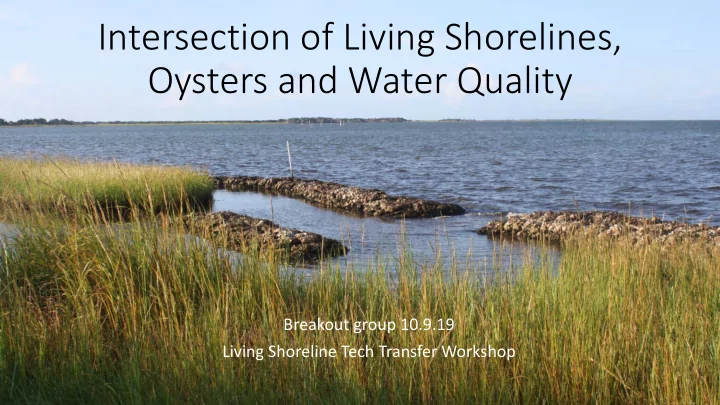
Intersection of Living Shorelines, Oysters and Water Quality
Breakout group 10.9.19 Living Shoreline Tech Transfer Workshop
Intersection of Living Shorelines, Oysters and Water Quality - - PowerPoint PPT Presentation
Intersection of Living Shorelines, Oysters and Water Quality Breakout group 10.9.19 Living Shoreline Tech Transfer Workshop Living Shorelines Water Oysters Quality Chesapeake Bay Louisiana North Carolina Your Experience Common
Breakout group 10.9.19 Living Shoreline Tech Transfer Workshop
North Carolina Louisiana Chesapeake Bay
Experience Common Challenges Solutions
Hierarchy of Erosion Control Options
No Action Relocation of Threatened Structures Non-Structural Stabilization Measures (Slope Grading, Marsh Creation, Bio-Engineering) Combination Approaches (Sills, Stone containment cells, breakwaters with plantings) Hardening Structures (Groins, Revetments, Bulkheads)
Functions and Values of a Living Shoreline
Enhancement
Stabilization
Value and Importance of Oysters
Coastal Culture, Heritage and Economy
Water Quality
Currently in the Third Edition
Larger scale oyster sanctuaries are constructed throughout North Carolina’s sounds. These sanctuaries are typically closed to harvest, but open to hook and line fishing. They are strategically located and designed to as a reliable oyster larvae seed source for the wild population and cultch planted areas.
To create reefs, the N.C. Division of Marine Fisheries (DMF) annually deposits tens of thousands of bushels of oyster shell, marine limestone and/or clam shell – called “cultch” – in shellfish waters. The cultch is colonized by oyster larvae that attach and grow to three- inch harvest size in 18-24 months. Cultch planting sites are open to public harvest once
Oyster farming or mariculture has the potential to provide numerous benefits including increased water filtration and additional habitat for fish and other estuarine species. Oyster mariculture also has the potential to reduce harvest pressure off the native population while acting as an oyster larvae seed source to the surrounding waters.
Water ershed d res estoration pl plans a s are i e in n dev evel elopm pmen ent for
rly a a dozen c coa
watersheds
We work l k local ally t to craft ft an and implement t these p
They f focu cus o
improving ng water er q qua uality by by r restoring ng h hydrology and w d wet etlands ds a and p d providi ding storm
mana nagemen ent.
These are typically smaller scale restoration efforts carried out by nonprofit
for shoreline protection and oyster habitat creation. They range in size from a tenth of an acre to two acres.