Pearl Oysters ( Pinctada spp.) Pearl Oysters ( Pinctada ) of - - PDF document

pearl oysters pinctada spp pearl oysters pinctada of
SMART_READER_LITE
LIVE PREVIEW

Pearl Oysters ( Pinctada spp.) Pearl Oysters ( Pinctada ) of - - PDF document

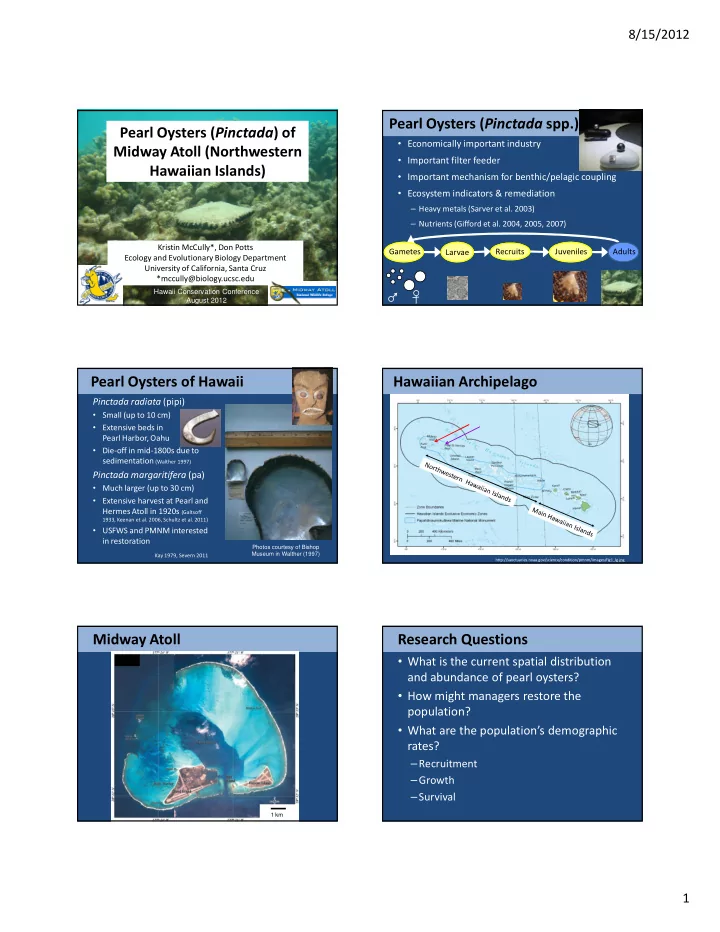
8/15/2012 Pearl Oysters ( Pinctada spp.) Pearl Oysters ( Pinctada ) of Economically important industry Midway Atoll (Northwestern Important filter feeder Hawaiian Islands) Important mechanism for benthic/pelagic coupling Ecosystem


slide-1
SLIDE 1

8/15/2012 1

Pearl Oysters (Pinctada) of Midway Atoll (Northwestern Hawaiian Islands)

Kristin McCully*, Don Potts Ecology and Evolutionary Biology Department University of California, Santa Cruz *mccully@biology.ucsc.edu

Hawaii Conservation Conference August 2012

Pearl Oysters (Pinctada spp.)

  • Economically important industry
  • Important filter feeder
  • Important mechanism for benthic/pelagic coupling
  • Ecosystem indicators & remediation

– Heavy metals (Sarver et al. 2003) – Nutrients (Gifford et al. 2004, 2005, 2007) Gametes Larvae Recruits Juveniles Adults

Pearl Oysters of Hawaii

Pinctada radiata (pipi)

  • Small (up to 10 cm)
  • Extensive beds in

Pearl Harbor, Oahu

  • Die-off in mid-1800s due to

sedimentation (Walther 1997)

Pinctada margaritifera (pa)

  • Much larger (up to 30 cm)
  • Extensive harvest at Pearl and

Hermes Atoll in 1920s (Galtsoff

1933, Keenan et al. 2006, Schultz et al. 2011)

  • USFWS and PMNM interested

in restoration

Photos courtesy of Bishop Museum in Walther (1997) Kay 1979, Severn 2011

http://sanctuaries.noaa.gov/science/condition/pmnm/images/fig1_lg.jpg

Hawaiian Archipelago Midway Atoll

1 km

Research Questions

  • What is the current spatial distribution

and abundance of pearl oysters?

  • How might managers restore the

population?

  • What are the population’s demographic

rates?

–Recruitment –Growth –Survival

slide-2
SLIDE 2

8/15/2012 2

Distribution: Habitats

N NW Deep S SE E SW

Based on: NOAA.

  • 2003. Draft atlas of

the shallow-water benthic habitats of the NWHI.

Legend Forereef Backreef Patch reef Sand

Distribution: Methods

Legend 2009 2011 Habitat Backreef Forereef Patch reef Sand n = 108 surveys

Distribution: Results

500 m

Restoration? Phylogeny

  • Nuclear marker ITS1

(Yu & Chu 2006 )

  • Midway samples

– Definitely not P. margaritifera – Likely P. maculata

  • Currently sequencing

mitochondrial cytochrome oxidase I (cox1) marker

(Cunha et al. 2010)

Pteria penguin

  • P. albina (2)
  • P. chemnitzi (2)
  • P. fucata

P.f. martensi (3)

  • P. fucata (3)
  • P. imbricata
  • P. martensi

0.05 substitutions/site

99/100 85/73 66/98

ML/Bayesian PP

  • P. nigra
  • P. margaritifera (4)
  • P. maxima
  • P. maculata (3)

18 Midway samples

18S 5.8S

ITS1

Conclusions

  • Pearl oysters are important and efficient filter-

feeders

  • P. margaritifera is very rare at Midway, but is

most common on patch reefs in central lagoon

  • Most recruits are likely P. maculata, a species

not previously recorded in Hawaii

  • Potentially very difficult to restore P.

margaritifera

  • More studies of pearl oyster biology

needed at Pearl & Hermes Atoll

slide-3
SLIDE 3

8/15/2012 3

Thank you!

  • Wendy Cover
  • Anne Warner
  • Helen O’Brien
  • Rachel Fabian
  • Beth Bastiaans
  • Norah Saarman
  • Maria Haws (UH Hilo)
  • Tim Tinker
  • Laurel Fox
  • Pete Raimondi
  • Jack Horner (WHS)
  • John Klavitter (USFWS)
  • Matt Brown (USFWS)
  • Pete Leary (USFWS)
  • Sue Schulmeister (USFWS)
  • Kate Schoenrock
  • Jamie Barlow
  • Jessica Lee
  • Danica Zupic
  • Mitsubishi volunteers

(2007-2011)

NSF GK-12

Pearl Oysters (Pinctada) of Midway Atoll (Northwestern Hawaiian Islands)

Kristin McCully*, Don Potts Ecology and Evolutionary Biology Department University of California, Santa Cruz *mccully@biology.ucsc.edu