Pearl Oysters ( Pinctada spp.) Pearl Oysters ( Pinctada ) of - - PDF document

pearl oysters pinctada spp pearl oysters pinctada of
SMART_READER_LITE
LIVE PREVIEW

Pearl Oysters ( Pinctada spp.) Pearl Oysters ( Pinctada ) of - - PDF document

8/15/2012 Pearl Oysters ( Pinctada spp.) Pearl Oysters ( Pinctada ) of Economically important industry Midway Atoll (Northwestern Important filter feeders Hawaiian Islands) Ecosystem indicators Heavy metals Nutrients Gametes


slide-1
SLIDE 1

8/15/2012 1

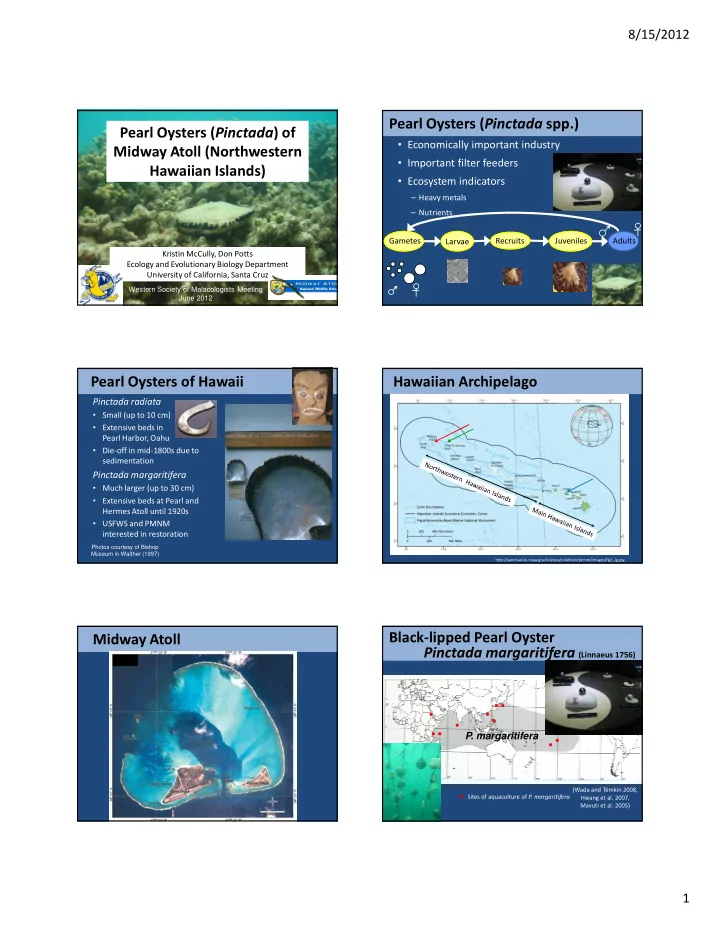
Pearl Oysters (Pinctada) of Midway Atoll (Northwestern Hawaiian Islands)

Kristin McCully, Don Potts Ecology and Evolutionary Biology Department University of California, Santa Cruz

Western Society of Malacologists Meeting June 2012

Pearl Oysters (Pinctada spp.)

  • Economically important industry
  • Important filter feeders
  • Ecosystem indicators

– Heavy metals – Nutrients Gametes Larvae Recruits Juveniles Adults

Pearl Oysters of Hawaii

Pinctada radiata

  • Small (up to 10 cm)
  • Extensive beds in

Pearl Harbor, Oahu

  • Die-off in mid-1800s due to

sedimentation

Pinctada margaritifera

  • Much larger (up to 30 cm)
  • Extensive beds at Pearl and

Hermes Atoll until 1920s

  • USFWS and PMNM

interested in restoration

Photos courtesy of Bishop Museum in Walther (1997)

http://sanctuaries.noaa.gov/science/condition/pmnm/images/fig1_lg.jpg

Hawaiian Archipelago Midway Atoll

(Wada and Tëmkin 2008, Hwang et al. 2007, Mavuti et al. 2005) Sites of aquaculture of P. margaritifera

  • P. margaritifera

Black-lipped Pearl Oyster Pinctada margaritifera (Linnaeus 1756)

slide-2
SLIDE 2

8/15/2012 2

Overall Questions

  • What is the current spatial distribution of

pearl oysters (and other large bivalves)?

  • How might managers restore the

population?

  • What are their demographic rates?

– Recruitment – Growth – Survival

Midway Atoll Distribution: Habitats

N NW Deep S SE E SW

Based on: NOAA.

  • 2003. Draft atlas of

the shallow-water benthic habitats of the NWHI.

Legend Forereef Backreef Patch reef Sand

Distribution: Survey Sites

Legend 2009 2011 Habitat Backreef Forereef Patch reef Sand n = 108 surveys

Baggy pen shell Streptopinna saccata Cliff oyster Spondylus violacescens Black-lipped pearl oyster Pinctada margaritifera Jewel oyster Chama iostoma

Distribution: P. margaritifera

500 m

slide-3
SLIDE 3

8/15/2012 3

1 2 3 4 5 6 7 8 Spondylus Chama Streptopinna Average Number of Bivalves per 100 sq m (± SE) Species Fore Back Patch Sand

Distribution: Other Bivalves

Habitat:

Restoration?

Spat collector

Recruitment: Methods Predation on P. margaritifera

  • Highest risk of mortality as juveniles
  • Escape size 80-100 mm

(Crossland 1957 in Gervis and Sims 1992)

  • Potential predators (Gervis and Sims 1992)

– Fish – Octopus – Predatory gastropods – Sea stars – Crabs

Juvenile Growth, Survival, & Predation

Site: WB No Mesh Large Mesh X 4 tiles X 4 tiles X 3 juveniles X 3 juveniles PP WB Site: PP No Mesh Large Mesh X 4 tiles X 4 tiles X 3 juveniles X 3 juveniles

Juvenile Survival & Predation: Results

0% 10% 20% 30% 40% 50% 60% 70% Open Closed Percent Survival for 38 days (±SE) Cage Status

slide-4
SLIDE 4

8/15/2012 4

Adult Growth and Survival

500 m

Molecular Species Identification: Methods

  • Very hard to identify Pinctada

species morphologically (particularly juveniles)

  • Collected about 100 juveniles at

Midway

  • Variety of coloration, location,

size, dates collected, methods

  • f preservation
  • Marker: ITS1 between nuclear

rDNA genes (Yu and Chu 2006

Biochemical Systematics and Ecology) 18S 5.8S

ITS1

Pinctada Phylogeny

Cunha et al. (2011) Marine Biotech Photo courtesy of Bishop Museum, Honolulu in Walther 1997

Phylogeny

  • Midway samples

– Definitely not P. margaritifera – Likely P. maculata

  • Working on

sequencing mitochondrial cytochrome

  • xidase I (cox1)

marker

Pteria penguin

  • P. albina1
  • P. albina2
  • P. chemnitzi1
  • P. chemnitzi2
  • P. fucata1

P.f. martensi1 P.f. martensi2

  • P. fucata2
  • P. fucata3
  • P. imbricata
  • P. martensi

0.05 substitutions/site 99/99/97/100 85/82/75/73 66/66/60/98 ML/MP/NJ/BPP

  • P. margaritifera2
  • P. maxima
  • P. margaritifera1
  • P. margaritifera3
  • P. margaritifera4
  • P. maculata1
  • P. maculata2
  • P. maculata3

18 Midway samples

  • P. nigra

Model: Goals

  • To determine most important data to collect

in the Hawaiian archipelago

  • To establish priority life stages and

demographic processes for managers

  • To estimate probable impacts of

management options, including restoration

Model: Life Cycle Diagram

Gametes Larvae Recruits Juveniles Adults

slide-5
SLIDE 5

8/15/2012 5

Male Large Adults

Model: Life Cycle Diagram

Juveniles Female Large Adults Male Small Adults Time Step: 1 year Female Small Adults

Model: Transition Matrix

FROM 1 2m 2f 3m 3f TO 1

s1(1-g1) f2s0 f3s0

2m

s1g1(1-sx2) s2(1-g2)(1-sx2)

2f

s1g1sx2 s2(1-g2)sx2 s2(1-g2)

3m

s2g2(1-sx3) s3(1-sx3)

3f

s2g2sx3 s2g2 s3sx3 s3

Model: Vital Rates

Description VR

Probability of survival s0 s1 s2 s3 Probability of growth transition g1 g2 Fecundity of females f2 f3 Probability of becoming female sx2 sx3

Conclusions and Next Steps

  • P. margaritifera is very rare at Midway, but is

most common on patch reefs in central lagoon

  • Other bivalves are more common on forereef
  • Very difficult to restore P. margaritifera, given

biology and regulatory climate

  • Next steps:

– Confirm species identity of recruits – Use molecular techniques to check species identity of pearl oysters in Main Hawaiian Islands – Further develop and analyze mathematical model

Acknowledgments: Funding

  • Mitsubishi Corporation Global Coral Reef

Conservation Program

  • U.S. Fish and Wildlife Service
  • Midway Atoll National Wildlife Refuge
  • Friends of Long Marine Lab
  • UCSC Center for the Dynamics and Evolution of the

Land-Sea Interface (CDELSI)

  • DoD National Defense Science and Engineering

(NDSEG) Fellowship

  • UCSC NSF GK-12 grant SCWIBLES

Acknowledgments: People

  • Advisor: Don Potts
  • Proposal committee:

Laurel Fox Tim Tinker Maria Haws (UHawaii)

  • Statistics help: Pete Raimondi
  • Labmates:

Wendy Cover, Anne Warner, Helen O’Brien, Rachel Fabian

  • Lab volunteer: Ryan Harry

30

slide-6
SLIDE 6

8/15/2012 6

Acknowledgments: Midway Team

  • Field assistants:

– Kate Schoenrock – Jamie Barlow

  • Field volunteers:

– Jessica Lee – Mitsubishi volunteers (2008-11)

  • John Klavitter &

Matt Brown (USFWS)

31