Linear Model using Excel 2013 Trendline XL2A 4/3/2017 V0L XL2A - - PDF document

linear model using excel 2013 trendline xl2a 4 3 2017 v0l
SMART_READER_LITE
LIVE PREVIEW

Linear Model using Excel 2013 Trendline XL2A 4/3/2017 V0L XL2A - - PDF document

Linear Model using Excel 2013 Trendline XL2A 4/3/2017 V0L XL2A V0L Model Trendline Linear Excel 2013 1 XL2A V0L Model Trendline Linear Excel 2013 2 Model using Trendline Goal: Summarize association (Linear) in Excel 2013


slide-1
SLIDE 1

Linear Model using Excel 2013 Trendline XL2A 4/3/2017 V0L www.StatLit.org/pdf/Excel2013-Model-Trendline-Linear-Slides.pdf 1

Model Trendline Linear Excel 2013 XL2A V0L

1

by Milo Schield Member: International Statistical Institute US Rep: International Statistical Literacy Project Director, W. M. Keck Statistical Literacy Project

Slides at: www.StatLit.org/pdf /Excel2013-Model-Trendline-Linear-Slides.pdf

Model using Trendline (Linear) in Excel 2013

Model Trendline Linear Excel 2013 XL2A V0L

2

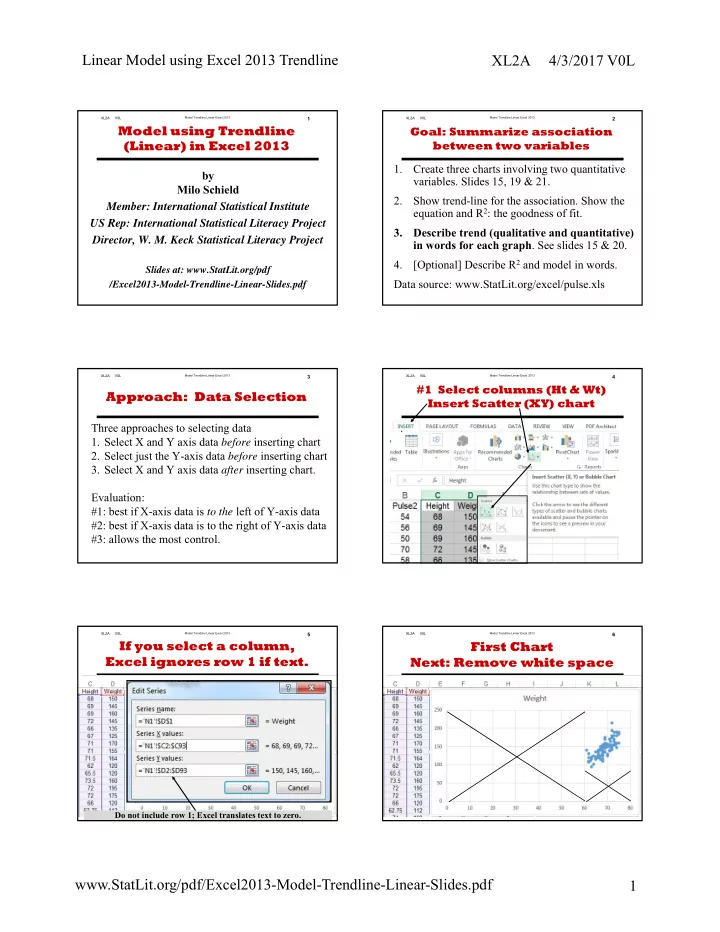
Goal: Summarize association between two variables 1. Create three charts involving two quantitative

  • variables. Slides 15, 19 & 21.

2. Show trend-line for the association. Show the equation and R2: the goodness of fit. 3. Describe trend (qualitative and quantitative) in words for each graph. See slides 15 & 20. 4. [Optional] Describe R2 and model in words. Data source: www.StatLit.org/excel/pulse.xls

Model Trendline Linear Excel 2013 XL2A V0L

3

Approach: Data Selection

Three approaches to selecting data

  • 1. Select X and Y axis data before inserting chart
  • 2. Select just the Y-axis data before inserting chart
  • 3. Select X and Y axis data after inserting chart.

Evaluation: #1: best if X-axis data is to the left of Y-axis data #2: best if X-axis data is to the right of Y-axis data #3: allows the most control.

Model Trendline Linear Excel 2013 XL2A V0L

4

#1 Select columns (Ht & Wt) Insert Scatter (XY) chart .

Model Trendline Linear Excel 2013 XL2A V0L

5

If you select a column, Excel ignores row 1 if text.

Do not include row 1; Excel translates text to zero.

Model Trendline Linear Excel 2013 XL2A V0L

6

First Chart Next: Remove white space

slide-2
SLIDE 2

Linear Model using Excel 2013 Trendline XL2A 4/3/2017 V0L www.StatLit.org/pdf/Excel2013-Model-Trendline-Linear-Slides.pdf 2

Model Trendline Linear Excel 2013 XL2A V0L

7

Format X Axis

Point at horizontal axis; Press right mouse; Select “Format Axis”

Model Trendline Linear Excel 2013 XL2A V0L

8

Format X Axis

Change Minimum from zero to 60

Model Trendline Linear Excel 2013 XL2A V0L

9

Format X Axis: Result

Model Trendline Linear Excel 2013 XL2A V0L

10

Format Y Axis:

Point at vertical axis; Press right mouse; Select “Format Axis”

Model Trendline Linear Excel 2013 XL2A V0L

11

Format Y Axis: Result

Change Y-Minimum from zero to 90

Model Trendline Linear Excel 2013 XL2A V0L

12

Insert Trend-line & Formulas

Select Chart Elements

slide-3
SLIDE 3

Linear Model using Excel 2013 Trendline XL2A 4/3/2017 V0L www.StatLit.org/pdf/Excel2013-Model-Trendline-Linear-Slides.pdf 3

Model Trendline Linear Excel 2013 XL2A V0L

13

Insert Trend-line & Formulas

Check “Trendline” (Linear is default); Select “More Options”

Model Trendline Linear Excel 2013 XL2A V0L

14

Select Column Chart Icon; Check Linear Equation & R2

Check “Display Equation”; Check “Display R-squared value”

Display Equation Display R-squared

Model Trendline Linear Excel 2013 XL2A V0L

15

Edit Headings; Match This

Optional: Marker & Line Styles

Model Trendline Linear Excel 2013 XL2A V0L

16

Describe Slope (Qual+Quant) & Fit

On spreadsheet; not in graph Slope (Qualitative. Use either one):

  • Taller people weigh more [than shorter people]
  • As height increases, weight increases (a positive association).

Slope (Quantitative. Use either one):

  • As height increases by 1 inch, weight increases by 5.1 pounds.
  • Weight increases by 5.1 pounds for every 1” increase in height.
  • Quality of the Model (Fit) using R-squared [Optional]
  • 62% of variation in weight is eliminated (explained) by height.

Linear model of Weight based on Height: [Optional]

  • Predicted weight = (5.1#/inch)*Height(inches) – 240#
  • Mean height is 65”; Mean weight is 150#.
  • Predicted weight = AveWt + (5.1#/inch)(Ht – AveHt)
Model Trendline Linear Excel 2013 XL2A V0L

.

17

#2a Select Pulse1 (column A) #2b Insert XY Plot

Model Trendline Linear Excel 2013 XL2A V0L

18

#2c Right-mouse on the data. Select “Select Data” .

slide-4
SLIDE 4

Linear Model using Excel 2013 Trendline XL2A 4/3/2017 V0L www.StatLit.org/pdf/Excel2013-Model-Trendline-Linear-Slides.pdf 4

Model Trendline Linear Excel 2013 XL2A V0L

.

19

#2d Select “Edit Data” #2e In Series X, select Weight

Note: Do not include row 1: the heading row

Model Trendline Linear Excel 2013 XL2A V0L

20

#2f Format Axis & Title. Add Trendline, Equation & R2

Formatting of trend line and markers is optional

Model Trendline Linear Excel 2013 XL2A V0L

21

Describe slope (Qual+Quant) & Fit

  • n spreadsheet; not in graph

Slope (Qualitative, Use either one):

  • Heavier people have a lower rest pulse rate [than lighter people]
  • As weight increases, rest pulse decreases.
  • There is a negative association between rest pulse and weight.

Slope (Quantitative, Use either one):

  • As weight increases by 1#, rest pulse decreases by 0.09 BPM.
  • Rest pulse decreases by 0.09 bpm for every extra # of weight.
  • Quality of the Model (Fit) using R-squared [Optional]
  • 4% of variation in rest pulse is eliminated (explained) by weight

Linear model of Rest Pulse based on Weight: [Optional]

  • Predicted rest pulse = [-0.094 bpm/#]*Weight(#) + 86.5 bpm
  • Predicted weight = AveWeight + [5.1#/inch][Height – AveHt]
Model Trendline Linear Excel 2013 XL2A V0L

22

#3: Duplicate previous graph but with Height on X-Axis

Erase old Trendline; Create new one In Select Data, replace D with C

Model Trendline Linear Excel 2013 XL2A V0L

23

#3b: Describe Slope and Fit

On spreadsheet; not in graph

Required: [See slide 21 for examples]

  • 1. Give a qualitative description of the trend.
  • 2. Give a quantitative description of the trend.

Optional:

  • 1. Give an algebraic description of the relationship.
  • 2. Give an arithmetic description of the fit.

Use the value of R-squared, but do not use that phrase.

  • 3. Describe the linear model in words (no symbols)
Model Trendline Linear Excel 2013 XL2A V0L

24

Compare Models [Not Required]

R-squared: quality of the model.

  • 62% of weight variation is explained by height
  • 4.1% of Pulse1 variation explained by Weight
  • 4.5% of Pulse1 variation explained by Height

Conclusions: Height is a fair predictor (R2 ~ 60%) of weight. Height and weight are poor predictors (R2 < 5%)

  • f rest pulse (Pulse1)
slide-5
SLIDE 5

Model Trendline Linear Excel 2013

XL2A V0L

1

by Milo Schield Member: International Statistical Institute US Rep: International Statistical Literacy Project Director, W. M. Keck Statistical Literacy Project

Slides at: www.StatLit.org/pdf /Excel2013-Model-Trendline-Linear-Slides.pdf

Model using Trendline (Linear) in Excel 2013

slide-6
SLIDE 6

Model Trendline Linear Excel 2013

XL2A V0L

2

Goal: Summarize association between two variables 1. Create three charts involving two quantitative

  • variables. Slides 15, 19 & 21.

2. Show trend-line for the association. Show the equation and R2: the goodness of fit. 3. Describe trend (qualitative and quantitative) in words for each graph. See slides 15 & 20. 4. [Optional] Describe R2 and model in words. Data source: www.StatLit.org/excel/pulse.xls

slide-7
SLIDE 7

Model Trendline Linear Excel 2013

XL2A V0L

3

Approach: Data Selection

Three approaches to selecting data

  • 1. Select X and Y axis data before inserting chart
  • 2. Select just the Y-axis data before inserting chart
  • 3. Select X and Y axis data after inserting chart.

Evaluation: #1: best if X-axis data is to the left of Y-axis data #2: best if X-axis data is to the right of Y-axis data #3: allows the most control.

slide-8
SLIDE 8

Model Trendline Linear Excel 2013

XL2A V0L

4

#1 Select columns (Ht & Wt) Insert Scatter (XY) chart .

slide-9
SLIDE 9

Model Trendline Linear Excel 2013

XL2A V0L

5

If you select a column, Excel ignores row 1 if text.

Do not include row 1; Excel translates text to zero.

slide-10
SLIDE 10

Model Trendline Linear Excel 2013

XL2A V0L

6

First Chart Next: Remove white space

slide-11
SLIDE 11

Model Trendline Linear Excel 2013

XL2A V0L

7

Format X Axis

Point at horizontal axis; Press right mouse; Select “Format Axis”

slide-12
SLIDE 12

Model Trendline Linear Excel 2013

XL2A V0L

8

Format X Axis

Change Minimum from zero to 60

slide-13
SLIDE 13

Model Trendline Linear Excel 2013

XL2A V0L

9

Format X Axis: Result

slide-14
SLIDE 14

Model Trendline Linear Excel 2013

XL2A V0L

10

Format Y Axis:

Point at vertical axis; Press right mouse; Select “Format Axis”

slide-15
SLIDE 15

Model Trendline Linear Excel 2013

XL2A V0L

11

Format Y Axis: Result

Change Y-Minimum from zero to 90

slide-16
SLIDE 16

Model Trendline Linear Excel 2013

XL2A V0L

12

Insert Trend-line & Formulas

Select Chart Elements

slide-17
SLIDE 17

Model Trendline Linear Excel 2013

XL2A V0L

13

Insert Trend-line & Formulas

Check “Trendline” (Linear is default); Select “More Options”

slide-18
SLIDE 18

Model Trendline Linear Excel 2013

XL2A V0L

14

Select Column Chart Icon; Check Linear Equation & R2

Check “Display Equation”; Check “Display R-squared value”

Display Equation Display R-squared

slide-19
SLIDE 19

Model Trendline Linear Excel 2013

XL2A V0L

15

Edit Headings; Match This

Optional: Marker & Line Styles

slide-20
SLIDE 20

Model Trendline Linear Excel 2013

XL2A V0L

16

Describe Slope (Qual+Quant) & Fit

On spreadsheet; not in graph Slope (Qualitative. Use either one):

  • Taller people weigh more [than shorter people]
  • As height increases, weight increases (a positive association).

Slope (Quantitative. Use either one):

  • As height increases by 1 inch, weight increases by 5.1 pounds.
  • Weight increases by 5.1 pounds for every 1” increase in height.
  • Quality of the Model (Fit) using R-squared [Optional]
  • 62% of variation in weight is eliminated (explained) by height.

Linear model of Weight based on Height: [Optional]

  • Predicted weight = (5.1#/inch)*Height(inches) – 240#
  • Mean height is 65”; Mean weight is 150#.
  • Predicted weight = AveWt + (5.1#/inch)(Ht – AveHt)
slide-21
SLIDE 21

Model Trendline Linear Excel 2013

XL2A V0L

.

17

#2a Select Pulse1 (column A) #2b Insert XY Plot

slide-22
SLIDE 22

Model Trendline Linear Excel 2013

XL2A V0L

18

#2c Right-mouse on the data. Select “Select Data” .

slide-23
SLIDE 23

Model Trendline Linear Excel 2013

XL2A V0L

.

19

#2d Select “Edit Data” #2e In Series X, select Weight

Note: Do not include row 1: the heading row

slide-24
SLIDE 24

Model Trendline Linear Excel 2013

XL2A V0L

20

#2f Format Axis & Title. Add Trendline, Equation & R2

Formatting of trend line and markers is optional

slide-25
SLIDE 25

Model Trendline Linear Excel 2013

XL2A V0L

21

Describe slope (Qual+Quant) & Fit

  • n spreadsheet; not in graph

Slope (Qualitative, Use either one):

  • Heavier people have a lower rest pulse rate [than lighter people]
  • As weight increases, rest pulse decreases.
  • There is a negative association between rest pulse and weight.

Slope (Quantitative, Use either one):

  • As weight increases by 1#, rest pulse decreases by 0.09 BPM.
  • Rest pulse decreases by 0.09 bpm for every extra # of weight.
  • Quality of the Model (Fit) using R-squared [Optional]
  • 4% of variation in rest pulse is eliminated (explained) by weight

Linear model of Rest Pulse based on Weight: [Optional]

  • Predicted rest pulse = [-0.094 bpm/#]*Weight(#) + 86.5 bpm
  • Predicted weight = AveWeight + [5.1#/inch][Height – AveHt]
slide-26
SLIDE 26

Model Trendline Linear Excel 2013

XL2A V0L

22

#3: Duplicate previous graph but with Height on X-Axis

Erase old Trendline; Create new one In Select Data, replace D with C

slide-27
SLIDE 27

Model Trendline Linear Excel 2013

XL2A V0L

23

#3b: Describe Slope and Fit

On spreadsheet; not in graph

Required: [See slide 21 for examples]

  • 1. Give a qualitative description of the trend.
  • 2. Give a quantitative description of the trend.

Optional:

  • 1. Give an algebraic description of the relationship.
  • 2. Give an arithmetic description of the fit.

Use the value of R-squared, but do not use that phrase.

  • 3. Describe the linear model in words (no symbols)
slide-28
SLIDE 28

Model Trendline Linear Excel 2013

XL2A V0L

24

Compare Models [Not Required]

R-squared: quality of the model.

  • 62% of weight variation is explained by height
  • 4.1% of Pulse1 variation explained by Weight
  • 4.5% of Pulse1 variation explained by Height

Conclusions: Height is a fair predictor (R2 ~ 60%) of weight. Height and weight are poor predictors (R2 < 5%)

  • f rest pulse (Pulse1)