Hypothesis Tests using Z.TEST function in Excel 2008 V1c 11/16/2012 - - PDF document

hypothesis tests using z test function in excel 2008 v1c
SMART_READER_LITE
LIVE PREVIEW

Hypothesis Tests using Z.TEST function in Excel 2008 V1c 11/16/2012 - - PDF document

Hypothesis Tests using Z.TEST function in Excel 2008 V1c 11/16/2012 Hypothesis Tests [Excel 2008]: Function-ZTEST Hypothesis Tests [Excel 2008]: Function-ZTEST 1 2 Hypothesis Tests using Function: ZTEST Excel Z.TEST Function Purpose:


slide-1
SLIDE 1

Hypothesis Tests using Z.TEST function in Excel 2008 V1c 11/16/2012 www.StatLit.org/pdf/ZTEST-Function-Excel-2008-6up.pdf 1

Hypothesis Tests [Excel 2008]: Function-ZTEST

1

by Milo Schield Member: International Statistical Institute US Rep: International Statistical Literacy Project Director, W. M. Keck Statistical Literacy Project

Slides and audio at: www.StatLit.org/ pdf/ZTEST-Function-Excel-2008-6up.pdf Audio/ZTEST-Function-Excel-2008.mp3

Hypothesis Tests using Excel Z.TEST Function

Hypothesis Tests [Excel 2008]: Function-ZTEST

2

Function: ZTEST

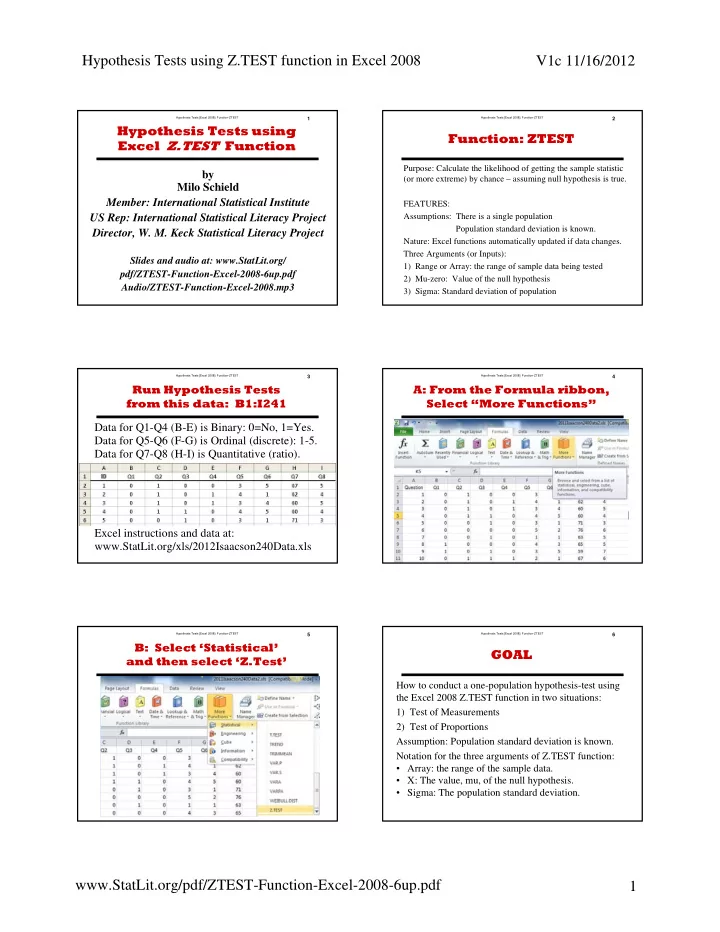
Purpose: Calculate the likelihood of getting the sample statistic (or more extreme) by chance – assuming null hypothesis is true. FEATURES: Assumptions: There is a single population Population standard deviation is known. Nature: Excel functions automatically updated if data changes. Three Arguments (or Inputs): 1) Range or Array: the range of sample data being tested 2) Mu-zero: Value of the null hypothesis 3) Sigma: Standard deviation of population

Hypothesis Tests [Excel 2008]: Function-ZTEST

3

Run Hypothesis Tests from this data: B1:I241 Data for Q1-Q4 (B-E) is Binary: 0=No, 1=Yes. Data for Q5-Q6 (F-G) is Ordinal (discrete): 1-5. Data for Q7-Q8 (H-I) is Quantitative (ratio). Excel instructions and data at: www.StatLit.org/xls/2012Isaacson240Data.xls

Hypothesis Tests [Excel 2008]: Function-ZTEST

4

A: From the Formula ribbon, Select “More Functions” .

Hypothesis Tests [Excel 2008]: Function-ZTEST

5

B: Select ‘Statistical’ and then select ‘Z.Test’ .

Hypothesis Tests [Excel 2008]: Function-ZTEST

6

GOAL

How to conduct a one-population hypothesis-test using the Excel 2008 Z.TEST function in two situations: 1) Test of Measurements 2) Test of Proportions Assumption: Population standard deviation is known. Notation for the three arguments of Z.TEST function:

  • Array: the range of the sample data.
  • X: The value, mu, of the null hypothesis.
  • Sigma: The population standard deviation.
slide-2
SLIDE 2

Hypothesis Tests using Z.TEST function in Excel 2008 V1c 11/16/2012 www.StatLit.org/pdf/ZTEST-Function-Excel-2008-6up.pdf 2

Hypothesis Tests [Excel 2008]: Function-ZTEST

7

1a Z.Test for Measures: Sigma is known (entered)

Sample mean is 63 P-value is 0.315...

Hypothesis Tests [Excel 2008]: Function-ZTEST

8

1b Z.Test for Measures: Sigma is estimated from sample

Sample standard deviation is 3.605551 Note: the p-value is still 0.315 (with n=3) Leave blank

Hypothesis Tests [Excel 2008]: Function-ZTEST

9

1c Z.Test for Measures: Summary

The sample standard deviation can be used to estimate the population standard deviation. There is no adjustment for this new source of variation. This modified Z.TEST is not the same as a T-TEST. Using the sample standard deviation for small samples (n < 30) can result in p-values that smaller than those given by a T-Test. This increases false positives.

Hypothesis Tests [Excel 2008]: Function-ZTEST

10

2a: Test for Proportions Sigma is entered

This analysis assumes the data are zeros and ones. In this case, the mean is always the proportions of ones. Sample mean is 0.28 P-value is 0.1574…

Hypothesis Tests [Excel 2008]: Function-ZTEST

11

2b: Test for Proportions Sigma is estimated from sample

Sample mean (p) is 0.28. p*q = 0.2016 Sample Std Dev = Sqrt(p*q) = Sqrt(0.2016) = .4495 P-value is 0.1574…. Leave blank

Hypothesis Tests [Excel 2008]: Function-ZTEST

12

Conclusions

Excel 2008 offers a single-population Z-Test function for measures and proportions. It does not

  • ffer a single-population T-Test.

To use this function for proportions, the outcomes must be coded as zero and one. Excel can do this test when the proportions are coded differently from zero and one. Showing how is beyond the scope of this presentation. Excel does allow for two-tail tests, but that is more

  • involved. See the Excel Help system for details.
slide-3
SLIDE 3

Hypothesis Tests using Z.TEST function in Excel 2008 V1c 11/16/2012 www.StatLit.org/pdf/ZTEST-Function-Excel-2008-6up.pdf 3

Hypothesis Tests [Excel 2008]: Function-ZTEST

13

B: From “More Functions”, select “Statistical” .

Hypothesis Tests [Excel 2008]: Function-ZTEST

14

C: From “Statistical”, select “Z.Test” .

Hypothesis Tests [Excel 2008]: Function-ZTEST

15

2c Z.Test for Proportions: Summary

Z.TEST is a good hypothesis test of proportions in a single population if the data is coded as zero and one.

slide-4
SLIDE 4

Hypothesis Tests [Excel 2008]: Function-ZTEST

1

by Milo Schield Member: International Statistical Institute US Rep: International Statistical Literacy Project Director, W. M. Keck Statistical Literacy Project

Slides and audio at: www.StatLit.org/ pdf/ZTEST-Function-Excel-2008-6up.pdf Audio/ZTEST-Function-Excel-2008.mp3

Hypothesis Tests using Excel Z.TEST Function

slide-5
SLIDE 5

Hypothesis Tests [Excel 2008]: Function-ZTEST

2

Function: ZTEST

Purpose: Calculate the likelihood of getting the sample statistic (or more extreme) by chance – assuming null hypothesis is true. FEATURES: Assumptions: There is a single population Population standard deviation is known. Nature: Excel functions automatically updated if data changes. Three Arguments (or Inputs): 1) Range or Array: the range of sample data being tested 2) Mu-zero: Value of the null hypothesis 3) Sigma: Standard deviation of population

slide-6
SLIDE 6

Hypothesis Tests [Excel 2008]: Function-ZTEST

3

Run Hypothesis Tests from this data: B1:I241 Data for Q1-Q4 (B-E) is Binary: 0=No, 1=Yes. Data for Q5-Q6 (F-G) is Ordinal (discrete): 1-5. Data for Q7-Q8 (H-I) is Quantitative (ratio). Excel instructions and data at: www.StatLit.org/xls/2012Isaacson240Data.xls

slide-7
SLIDE 7

Hypothesis Tests [Excel 2008]: Function-ZTEST

4

A: From the Formula ribbon, Select “More Functions” .

slide-8
SLIDE 8

Hypothesis Tests [Excel 2008]: Function-ZTEST

5

B: Select ‘Statistical’ and then select ‘Z.Test’ .

slide-9
SLIDE 9

Hypothesis Tests [Excel 2008]: Function-ZTEST

6

GOAL

How to conduct a one-population hypothesis-test using the Excel 2008 Z.TEST function in two situations: 1) Test of Measurements 2) Test of Proportions Assumption: Population standard deviation is known. Notation for the three arguments of Z.TEST function:

  • Array: the range of the sample data.
  • X: The value, mu, of the null hypothesis.
  • Sigma: The population standard deviation.
slide-10
SLIDE 10

Hypothesis Tests [Excel 2008]: Function-ZTEST

7

1a Z.Test for Measures: Sigma is known (entered)

Sample mean is 63 P-value is 0.315...

slide-11
SLIDE 11

Hypothesis Tests [Excel 2008]: Function-ZTEST

8

1b Z.Test for Measures: Sigma is estimated from sample

Sample standard deviation is 3.605551 Note: the p-value is still 0.315 (with n=3) Leave blank

slide-12
SLIDE 12

Hypothesis Tests [Excel 2008]: Function-ZTEST

9

1c Z.Test for Measures: Summary

The sample standard deviation can be used to estimate the population standard deviation. There is no adjustment for this new source of variation. This modified Z.TEST is not the same as a T-TEST. Using the sample standard deviation for small samples (n < 30) can result in p-values that smaller than those given by a T-Test. This increases false positives.

slide-13
SLIDE 13

Hypothesis Tests [Excel 2008]: Function-ZTEST

10

2a: Test for Proportions Sigma is entered

This analysis assumes the data are zeros and ones. In this case, the mean is always the proportions of ones. Sample mean is 0.28 P-value is 0.1574…

slide-14
SLIDE 14

Hypothesis Tests [Excel 2008]: Function-ZTEST

11

2b: Test for Proportions Sigma is estimated from sample

Sample mean (p) is 0.28. p*q = 0.2016 Sample Std Dev = Sqrt(p*q) = Sqrt(0.2016) = .4495 P-value is 0.1574…. Leave blank

slide-15
SLIDE 15

Hypothesis Tests [Excel 2008]: Function-ZTEST

12

Conclusions

Excel 2008 offers a single-population Z-Test function for measures and proportions. It does not

  • ffer a single-population T-Test.

To use this function for proportions, the outcomes must be coded as zero and one. Excel can do this test when the proportions are coded differently from zero and one. Showing how is beyond the scope of this presentation. Excel does allow for two-tail tests, but that is more

  • involved. See the Excel Help system for details.
slide-16
SLIDE 16

Hypothesis Tests [Excel 2008]: Function-ZTEST

13

B: From “More Functions”, select “Statistical” .

slide-17
SLIDE 17

Hypothesis Tests [Excel 2008]: Function-ZTEST

14

C: From “Statistical”, select “Z.Test” .

slide-18
SLIDE 18

Hypothesis Tests [Excel 2008]: Function-ZTEST

15

2c Z.Test for Proportions: Summary

Z.TEST is a good hypothesis test of proportions in a single population if the data is coded as zero and one.