Statistical Literacy: Scanlans Paradox V1C V1C V1C Schield: 2020 - - PDF document

statistical literacy scanlan s paradox v1c
SMART_READER_LITE
LIVE PREVIEW

Statistical Literacy: Scanlans Paradox V1C V1C V1C Schield: 2020 - - PDF document

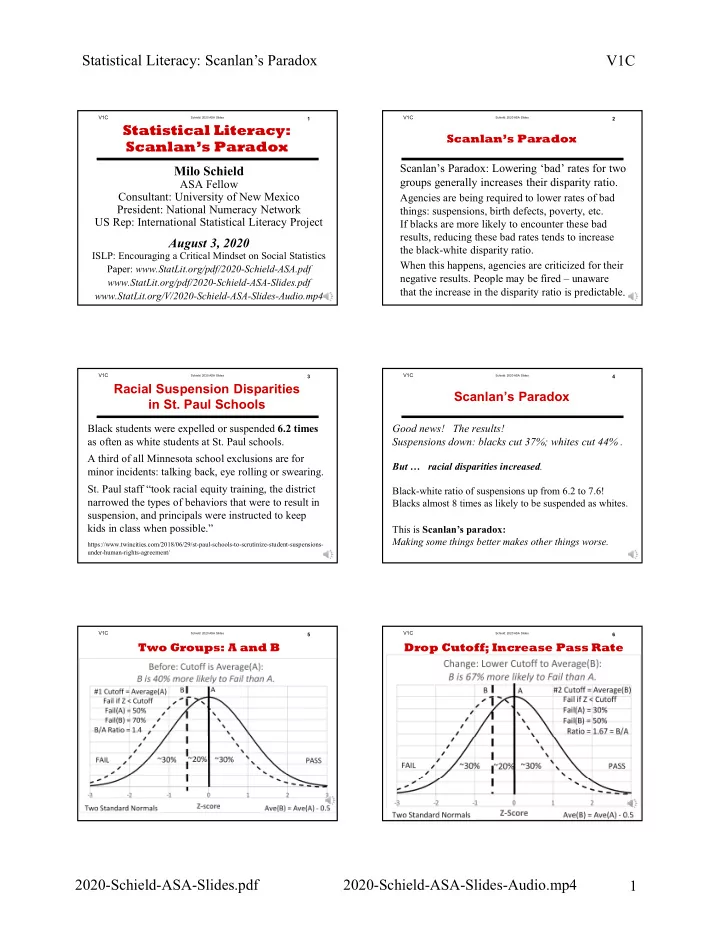
Statistical Literacy: Scanlans Paradox V1C V1C V1C Schield: 2020 ASA Slides 1 Schield: 2020 ASA Slides 2 Statistical Literacy: Scanlans Paradox Scanlans Paradox Scanlans Paradox: Lowering bad rates for two Milo Schield


slide-1
SLIDE 1

Statistical Literacy: Scanlan’s Paradox V1C 2020-Schield-ASA-Slides.pdf 2020-Schield-ASA-Slides-Audio.mp4 1

Schield: 2020 ASA Slides

V1C 1

Milo Schield

ASA Fellow Consultant: University of New Mexico President: National Numeracy Network US Rep: International Statistical Literacy Project

August 3, 2020

ISLP: Encouraging a Critical Mindset on Social Statistics Paper: www.StatLit.org/pdf/2020-Schield-ASA.pdf www.StatLit.org/pdf/2020-Schield-ASA-Slides.pdf www.StatLit.org/V/2020-Schield-ASA-Slides-Audio.mp4

Statistical Literacy: Scanlan’s Paradox

Schield: 2020 ASA Slides

V1C

Scanlan’s Paradox: Lowering ‘bad’ rates for two groups generally increases their disparity ratio.

Agencies are being required to lower rates of bad things: suspensions, birth defects, poverty, etc. If blacks are more likely to encounter these bad results, reducing these bad rates tends to increase the black-white disparity ratio. When this happens, agencies are criticized for their negative results. People may be fired – unaware that the increase in the disparity ratio is predictable.

2

Scanlan’s Paradox

Schield: 2020 ASA Slides

V1C 3

Black students were expelled or suspended 6.2 times as often as white students at St. Paul schools. A third of all Minnesota school exclusions are for minor incidents: talking back, eye rolling or swearing.

  • St. Paul staff “took racial equity training, the district

narrowed the types of behaviors that were to result in suspension, and principals were instructed to keep kids in class when possible.”

https://www.twincities.com/2018/06/29/st-paul-schools-to-scrutinize-student-suspensions- under-human-rights-agreement/

Racial Suspension Disparities in St. Paul Schools

Schield: 2020 ASA Slides

V1C 4

Good news! The results! Suspensions down: blacks cut 37%; whites cut 44% .

Scanlan’s Paradox

But … racial disparities increased. Black-white ratio of suspensions up from 6.2 to 7.6! Blacks almost 8 times as likely to be suspended as whites. This is Scanlan’s paradox: Making some things better makes other things worse.

Schield: 2020 ASA Slides

V1C

.

5

Two Groups: A and B

Schield: 2020 ASA Slides

V1C

.

6

Drop Cutoff; Increase Pass Rate B is 67% more likely to fail than A!

slide-2
SLIDE 2

Statistical Literacy: Scanlan’s Paradox V1C 2020-Schield-ASA-Slides.pdf 2020-Schield-ASA-Slides-Audio.mp4 2

Schield: 2020 ASA Slides

V1C

.

7

Disparity Ratio: Closer to 1 is the goal

Decrease Failing Increase Passing

Schield: 2020 ASA Slides

V1C

Scanlan: “the less prevalent the condition, the …

  • 1. “greater the disparity in experiencing the condition”
  • 2. “larger will be the proportion of those experiencing

the condition [that are] comprised by the more susceptible group.”

8

Scanlan Rules: As rates decreases …

Schield: As a condition becomes rarer, the bigger the …

  • 1. … relative difference (disparity ratio).
  • 2. … share of the more susceptible [among susceptible].

Paradox: Making things absolutely better for both groups can make things relatively worse for one group.

Schield: 2020 ASA Slides

V1C

.

9

Decrease Infant Death Rates: Blacks Worse Off (Relatively)

Decrease Mortality Increase Survival

Schield: 2020 ASA Slides

V1C

.

10

Reduce the Poverty Rate: Blacks Worse Off (Relatively)

Decrease Below- Poverty Increase Above- Poverty

Schield: 2020 ASA Slides

V1C 11

Formal Cause: Confounding

Suppose 20% of B failed (10% of A): a 2:1 B-A ratio.

  • 1. If A failures are cut in half, the ratio increases: 4:1.
  • 2. If B failures are cut in half, the ratio decreases: 1:1.
  • 3. If both are cut in half, the ratio is unchanged: 2:1.

The change in the disparity ratio is determined by whether the rates are cut proportionately. Confounding: The relationship between the rate cuts and the change in the disparity ratio is confounded by the size

  • f the rate cuts relative to the size of the initial rates.
Schield: 2020 ASA Slides

V1C

As society eliminates bad things, we can expect: 1. the more susceptible group is increasingly subject to the bad thing – relative to the less susceptible group.

  • 2. the more susceptible group to be an increasing share
  • f those experiencing the bad outcome.
  • 3. the improvements in – and the differences between –

the good things to become smaller.

12

Conclusion

Scanlan’s paradox

  • is socially (journalistically) significant
  • should be in statistical literacy (social statistics) courses
slide-3
SLIDE 3

Schield: 2020 ASA Slides

V1C 1

Milo Schield

ASA Fellow Consultant: University of New Mexico President: National Numeracy Network US Rep: International Statistical Literacy Project

August 3, 2020

ISLP: Encouraging a Critical Mindset on Social Statistics Paper: www.StatLit.org/pdf/2020-Schield-ASA.pdf www.StatLit.org/pdf/2020-Schield-ASA-Slides.pdf www.StatLit.org/V/2020-Schield-ASA-Slides-Audio.mp4

Statistical Literacy: Scanlan’s Paradox

slide-4
SLIDE 4

Schield: 2020 ASA Slides

V1C

Scanlan’s Paradox: Lowering ‘bad’ rates for two groups generally increases their disparity ratio.

Agencies are being required to lower rates of bad things: suspensions, birth defects, poverty, etc. If blacks are more likely to encounter these bad results, reducing these bad rates tends to increase the black-white disparity ratio. When this happens, agencies are criticized for their negative results. People may be fired – unaware that the increase in the disparity ratio is predictable.

2

Scanlan’s Paradox

slide-5
SLIDE 5

Schield: 2020 ASA Slides

V1C 3

Black students were expelled or suspended 6.2 times as often as white students at St. Paul schools. A third of all Minnesota school exclusions are for minor incidents: talking back, eye rolling or swearing.

  • St. Paul staff “took racial equity training, the district

narrowed the types of behaviors that were to result in suspension, and principals were instructed to keep kids in class when possible.”

https://www.twincities.com/2018/06/29/st-paul-schools-to-scrutinize-student-suspensions- under-human-rights-agreement/

Racial Suspension Disparities in St. Paul Schools

slide-6
SLIDE 6

Schield: 2020 ASA Slides

V1C 4

Good news! The results! Suspensions down: blacks cut 37%; whites cut 44% .

Scanlan’s Paradox

But … racial disparities increased. Black-white ratio of suspensions up from 6.2 to 7.6! Blacks almost 8 times as likely to be suspended as whites. This is Scanlan’s paradox: Making some things better makes other things worse.

slide-7
SLIDE 7

Schield: 2020 ASA Slides

V1C

.

5

Two Groups: A and B

slide-8
SLIDE 8

Schield: 2020 ASA Slides

V1C

.

6

Drop Cutoff; Increase Pass Rate B is 67% more likely to fail than A!

slide-9
SLIDE 9

Schield: 2020 ASA Slides

V1C

.

7

Disparity Ratio: Closer to 1 is the goal

Decrease Failing Increase Passing

slide-10
SLIDE 10

Schield: 2020 ASA Slides

V1C

Scanlan: “the less prevalent the condition, the …

  • 1. “greater the disparity in experiencing the condition”
  • 2. “larger will be the proportion of those experiencing

the condition [that are] comprised by the more susceptible group.”

8

Scanlan Rules: As rates decreases …

Schield: As a condition becomes rarer, the bigger the …

  • 1. … relative difference (disparity ratio).
  • 2. … share of the more susceptible [among susceptible].

Paradox: Making things absolutely better for both groups can make things relatively worse for one group.

slide-11
SLIDE 11

Schield: 2020 ASA Slides

V1C

.

9

Decrease Infant Death Rates: Blacks Worse Off (Relatively)

Decrease Mortality Increase Survival

slide-12
SLIDE 12

Schield: 2020 ASA Slides

V1C

.

10

Reduce the Poverty Rate: Blacks Worse Off (Relatively)

Decrease Below- Poverty Increase Above- Poverty

slide-13
SLIDE 13

Schield: 2020 ASA Slides

V1C 11

Formal Cause: Confounding

Suppose 20% of B failed (10% of A): a 2:1 B-A ratio.

  • 1. If A failures are cut in half, the ratio increases: 4:1.
  • 2. If B failures are cut in half, the ratio decreases: 1:1.
  • 3. If both are cut in half, the ratio is unchanged: 2:1.

The change in the disparity ratio is determined by whether the rates are cut proportionately. Confounding: The relationship between the rate cuts and the change in the disparity ratio is confounded by the size

  • f the rate cuts relative to the size of the initial rates.
slide-14
SLIDE 14

Schield: 2020 ASA Slides

V1C

As society eliminates bad things, we can expect: 1. the more susceptible group is increasingly subject to the bad thing – relative to the less susceptible group.

  • 2. the more susceptible group to be an increasing share
  • f those experiencing the bad outcome.
  • 3. the improvements in – and the differences between –

the good things to become smaller.

12

Conclusion

Scanlan’s paradox

  • is socially (journalistically) significant
  • should be in statistical literacy (social statistics) courses