Levels in Processor Design Circuit design Keywords: transistors, - - PDF document

levels in processor design
SMART_READER_LITE
LIVE PREVIEW

Levels in Processor Design Circuit design Keywords: transistors, - - PDF document

Levels in Processor Design Circuit design Keywords: transistors, wires etc.Results in gates, flip-flops etc. Logical design Putting gates (AND, NAND, ) and flip-flops together to build basic blocks such as registers, ALUs


slide-1
SLIDE 1

1

2/2/99 CSE378 Single cycle implementation. 1

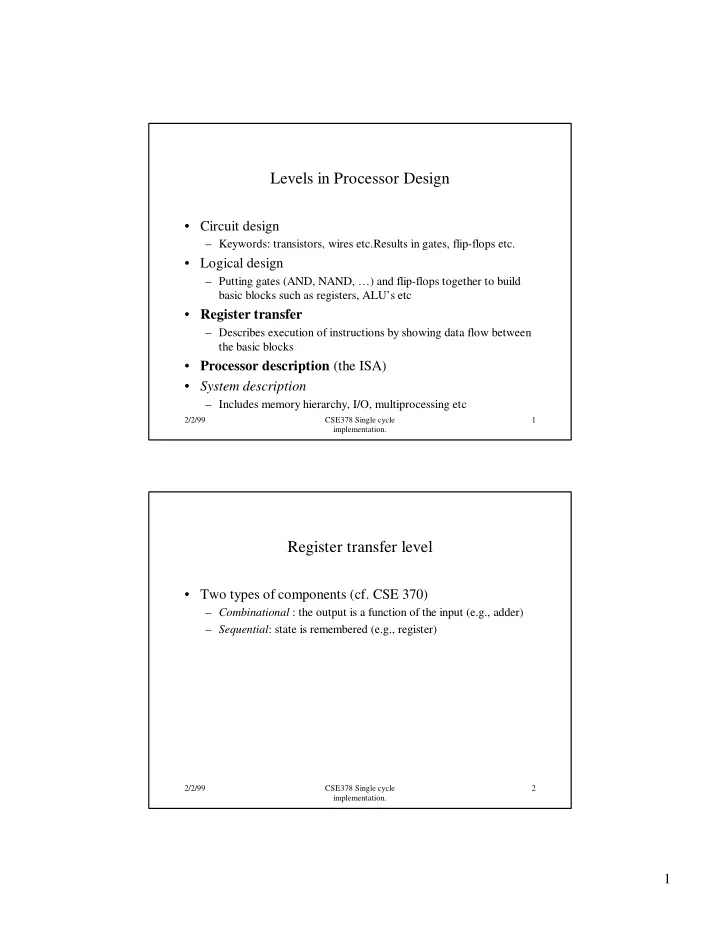
Levels in Processor Design

  • Circuit design

– Keywords: transistors, wires etc.Results in gates, flip-flops etc.

  • Logical design

– Putting gates (AND, NAND, …) and flip-flops together to build basic blocks such as registers, ALU’s etc

  • Register transfer

– Describes execution of instructions by showing data flow between the basic blocks

  • Processor description (the ISA)
  • System description

– Includes memory hierarchy, I/O, multiprocessing etc

2/2/99 CSE378 Single cycle implementation. 2

Register transfer level

  • Two types of components (cf. CSE 370)

– Combinational : the output is a function of the input (e.g., adder) – Sequential: state is remembered (e.g., register)

slide-2
SLIDE 2

2

2/2/99 CSE378 Single cycle implementation. 3

Synchronous design

  • Use of a periodic clock

– edge-triggered clocking determines when signals can be read and when the output of circuits is stable – Values in storage elements can be updated only at clock edges – Clock tells when events can occur, e.g., when signals sent by control unit are obeyed in the ALU

  • Stor. Elem 1
  • Stor. Elem 2

Comb.logic Clock cycle

Note: the same storage element can be read/written in the same cycle

2/2/99 CSE378 Single cycle implementation. 4

  • Stor. Elem 1
  • Stor. Elem 2

Comb.logic

Write signal Write signal Logic may need several cycles to propagate values

slide-3
SLIDE 3

3

2/2/99 CSE378 Single cycle implementation. 5

Processor design: data path and control unit

Memory hierarchy control ALU Registers PC state Memory bus CPU Data path

Combinational Sequential

2/2/99 CSE378 Single cycle implementation. 6

Processor design

  • Data path

– How does data flows between various basic blocks – What operations can be performed when data flows – What can be done in one clock cycle

  • Control unit

– Sends signals to data path elements – Tells what data to move, where to move it, what operations are to be performed

  • Memory hierarchy

– Holds program and data

slide-4
SLIDE 4

4

2/2/99 CSE378 Single cycle implementation. 7

Data path basic building blocks. Storage elements

  • Basic building block (at the RT level) is a register
  • In our mini-MIPS implementation registers will be 32-bits
  • A register can be read or written

Input bus Output bus Write enable signal Register

2/2/99 CSE378 Single cycle implementation. 8

Register file

  • Array of registers (32 for the integer registers in MIPS)
  • ISA tells us that we should be able to:

– read 2 registers, write one register in a given instruction (at this point we want one instruction per cycle) – Register file needs to know which registers to read/write

Write register number Write enable Write data input bus Read data output bus 0 Read data output bus 1 Read register number bus 0 Read register number bus 1

Register file

slide-5
SLIDE 5

5

2/2/99 CSE378 Single cycle implementation. 9

Memory

  • Conceptually, like register file but much larger
  • Can only read one location or write to one location per

cycle

Write enable Write data bus Read data bus Read control signal Write memory address Read memory address

Memory

2/2/99 CSE378 Single cycle implementation. 10

Combinational elements

Multiplexor (Mux): selects the value of one of its inputs to be routed to the output

Input busses Output bus Select control signal

Demultiplexor (selector): routes its inputs to one of its outputs

Select control signal Output busses Input bus

Mux Sel

slide-6
SLIDE 6

6

2/2/99 CSE378 Single cycle implementation. 11

Arithmetic and Logic Unit (ALU - combinational)

  • Computes (arithmetic or logical operation) output from its

two inputs

ALU

Input bus 0 Input bus 1 Output bus Zero result bit ALU control (opcode/function)

2/2/99 CSE378 Single cycle implementation. 12

Putting basic blocks together (skeleton of data path for arith/logical operations)

Write register number Write enable Write data input bus Read data 0 Read data 1 Read register number bus 0 Read register number bus 1

Register file

Zero result bit ALU control (opcode/function)

ALU

slide-7
SLIDE 7

7

2/2/99 CSE378 Single cycle implementation. 13

Introducing instruction fetch

Read data 0 Read data 1

Zero result bit ALU control (opcode/function)

Read Reg #0 Read Reg #1 Write Reg # Write data

  • Reg. File

ALU

PC

Instruction address

  • Instr. memory

2/2/99 CSE378 Single cycle implementation. 14

PC has to be incremented (assume no branch)

PC

Instruction address

  • Instr. memory

4

ALU

Instruction

slide-8
SLIDE 8

8

2/2/99 CSE378 Single cycle implementation. 15

Load-Store instructions

Read Reg #0 Read Reg #1 Write Reg #

  • Reg. File

ALU Instruction

Data from “load”

Data memory

16-bit offset 32-bit

Sign. ext

Read data 0 “store” data R/W address Read enable Write enable 2/2/99 CSE378 Single cycle implementation. 16

Data path for straight code(reg-reg,imm,load/store)

Read Reg #0 Read Reg #1 Write Reg #

  • Reg. File

ALU Instruction

Data for result register

Data memory

16-bit offset 32-bit

Sign. ext

Read data 0 “store” data R/W address Read enable Write enable Read data 1

Mux

slide-9
SLIDE 9

9

2/2/99 CSE378 Single cycle implementation. 17

Branch data path

PC

4

Inst. memory

ALU ALU

32-bit 16-bit Sign. ext Sftl 2 Instruction