
Datorteknik F1 bild 1
The Big Picture: Where are We Now?
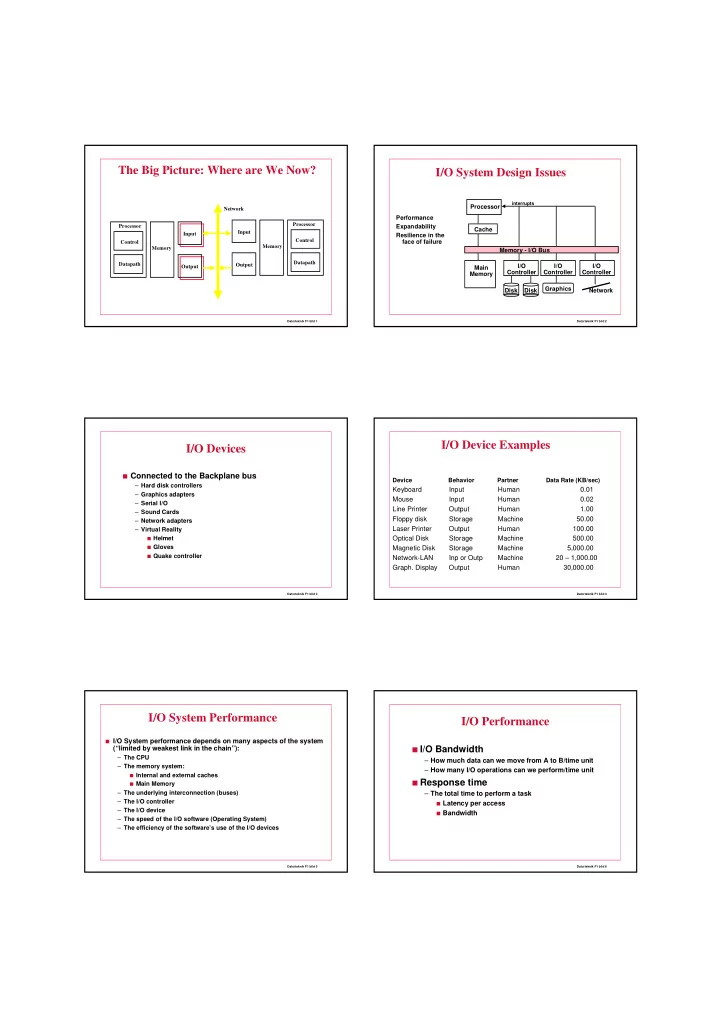
Control Datapath Memory Processor Input Output Control Datapath Memory Processor Input Output Network
Datorteknik F1 bild 2
I/O System Design Issues
Processor Cache Memory - I/O Bus Main Memory I/O Controller Disk Disk I/O Controller I/O Controller Graphics Network
interrupts
Performance Expandability Resilience in the face of failure
Datorteknik F1 bild 3
I/O Devices
■ Connected to the Backplane bus – Hard disk controllers – Graphics adapters – Serial I/O – Sound Cards – Network adapters – Virtual Reality
■ Helmet ■ Gloves ■ Quake controller
Datorteknik F1 bild 4
I/O Device Examples
Device Behavior Partner Data Rate (KB/sec)
Keyboard Input Human 0.01 Mouse Input Human 0.02 Line Printer Output Human 1.00 Floppy disk Storage Machine 50.00 Laser Printer Output Human 100.00 Optical Disk Storage Machine 500.00 Magnetic Disk Storage Machine 5,000.00 Network-LAN Inp or Outp Machine 20 – 1,000.00
- Graph. Display
Output Human 30,000.00
Datorteknik F1 bild 5
I/O System Performance
■ I/O System performance depends on many aspects of the system
(“limited by weakest link in the chain”):
– The CPU – The memory system:
■ Internal and external caches ■ Main Memory
– The underlying interconnection (buses) – The I/O controller – The I/O device – The speed of the I/O software (Operating System) – The efficiency of the software’s use of the I/O devices
Datorteknik F1 bild 6
I/O Performance
■ I/O Bandwidth – How much data can we move from A to B/time unit – How many I/O operations can we perform/time unit ■ Response time – The total time to perform a task
■ Latency per access ■ Bandwidth