Outline The big picture 1 Grounds for rebuttal 2 Structuring - - PowerPoint PPT Presentation

outline
SMART_READER_LITE
LIVE PREVIEW

Outline The big picture 1 Grounds for rebuttal 2 Structuring - - PowerPoint PPT Presentation

The big picture Grounds for rebuttal Structuring rebuttal Definitional rebuttal R EBUTTAL www.learndebating.com R EBUTTAL The big picture Grounds for rebuttal Structuring rebuttal Definitional rebuttal Outline The big


slide-1
SLIDE 1

The ‘big picture’ Grounds for rebuttal Structuring rebuttal Definitional rebuttal

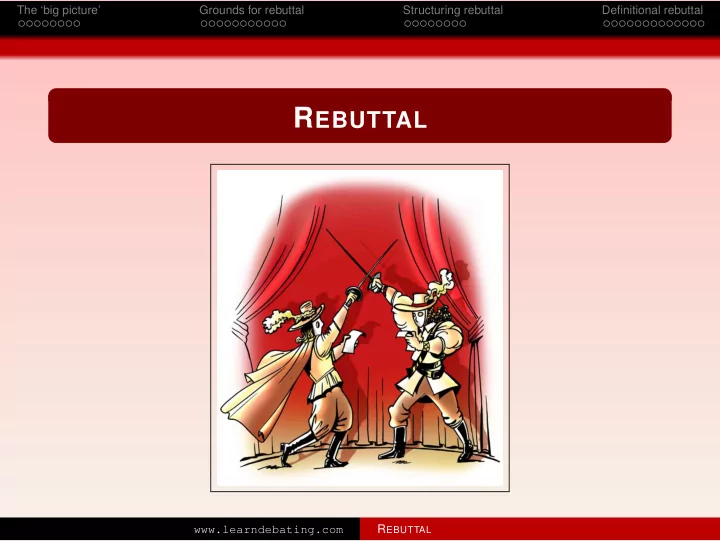
REBUTTAL

www.learndebating.com REBUTTAL
slide-2
SLIDE 2

The ‘big picture’ Grounds for rebuttal Structuring rebuttal Definitional rebuttal

Outline

1

The ‘big picture’

2

Grounds for rebuttal

3

Structuring rebuttal

4

Definitional rebuttal

www.learndebating.com REBUTTAL

slide-3
SLIDE 3

The ‘big picture’ Grounds for rebuttal Structuring rebuttal Definitional rebuttal

Outline

1

The ‘big picture’

2

Grounds for rebuttal

3

Structuring rebuttal

4

Definitional rebuttal

www.learndebating.com REBUTTAL

slide-4
SLIDE 4

The ‘big picture’ Grounds for rebuttal Structuring rebuttal Definitional rebuttal

Why rebut?

A debate is not just two opposing cases. Every debate needs interaction between the cases: clash between ideas. Rebuttal — attacking your opponent’s arguments — provides this interaction Rebuttal is therefore vital for debating.

www.learndebating.com REBUTTAL

slide-5
SLIDE 5

The ‘big picture’ Grounds for rebuttal Structuring rebuttal Definitional rebuttal

Why rebut?

A debate is not just two opposing cases. Every debate needs interaction between the cases: clash between ideas. Rebuttal — attacking your opponent’s arguments — provides this interaction Rebuttal is therefore vital for debating.

www.learndebating.com REBUTTAL

slide-6
SLIDE 6

The ‘big picture’ Grounds for rebuttal Structuring rebuttal Definitional rebuttal

Why rebut?

A debate is not just two opposing cases. Every debate needs interaction between the cases: clash between ideas. Rebuttal — attacking your opponent’s arguments — provides this interaction Rebuttal is therefore vital for debating.

www.learndebating.com REBUTTAL

slide-7
SLIDE 7

The ‘big picture’ Grounds for rebuttal Structuring rebuttal Definitional rebuttal

What should you rebut?

In short, you should rebut everything!! Convincing the audience that your opposition is wrong includes attacking anything that you believe to be incorrect about their case. Of course, there are techniques to develop regarding the appropriate emphasis to place on different parts of your

  • pposition’s case. However, nothing is ‘untouchable’.

www.learndebating.com REBUTTAL

slide-8
SLIDE 8

The ‘big picture’ Grounds for rebuttal Structuring rebuttal Definitional rebuttal

What should you rebut?

In short, you should rebut everything!! Convincing the audience that your opposition is wrong includes attacking anything that you believe to be incorrect about their case. Of course, there are techniques to develop regarding the appropriate emphasis to place on different parts of your

  • pposition’s case. However, nothing is ‘untouchable’.

www.learndebating.com REBUTTAL

slide-9
SLIDE 9

The ‘big picture’ Grounds for rebuttal Structuring rebuttal Definitional rebuttal

Rebuttal specifics — the case line

There is a difference between merely rebutting your

  • pposition’s case line and rebutting the ideas, assumptions

and logic lying behind the theme (a much stronger approach!). That is, you should focus energy on identifying and then attacking the core structures behind the theme, not just the wording of the theme itself.

www.learndebating.com REBUTTAL

slide-10
SLIDE 10

The ‘big picture’ Grounds for rebuttal Structuring rebuttal Definitional rebuttal

Rebuttal specifics — the case line

There is a difference between merely rebutting your

  • pposition’s case line and rebutting the ideas, assumptions

and logic lying behind the theme (a much stronger approach!). That is, you should focus energy on identifying and then attacking the core structures behind the theme, not just the wording of the theme itself.

www.learndebating.com REBUTTAL

slide-11
SLIDE 11

The ‘big picture’ Grounds for rebuttal Structuring rebuttal Definitional rebuttal

Rebuttal specifics — examples and statistics

There is a common misconception that you ‘should not rebut examples’; however, this is wrong. However, you should always remember: examples and statistics prove nothing by themselves. Therefore, when rebutting examples and statistics, you must constantly analyse their relevance and context in the debate.

www.learndebating.com REBUTTAL

slide-12
SLIDE 12

The ‘big picture’ Grounds for rebuttal Structuring rebuttal Definitional rebuttal

Rebuttal specifics — examples and statistics

There is a common misconception that you ‘should not rebut examples’; however, this is wrong. However, you should always remember: examples and statistics prove nothing by themselves. Therefore, when rebutting examples and statistics, you must constantly analyse their relevance and context in the debate.

www.learndebating.com REBUTTAL

slide-13
SLIDE 13

The ‘big picture’ Grounds for rebuttal Structuring rebuttal Definitional rebuttal

Rebuttal specifics — rebutting rebuttal

Although this sounds complicated, it merely involves responding to your opposition’s rebuttal. The decision whether or not to rebut rebuttal is quite a strategic one. Sometimes, if it is a crucial point, rebutting rebuttal may be

  • essential. However, it is strategically weak to spend a long

time doing so because you will appear too defensive. Generally, if you think it is necessary to rebut rebuttal, do so quickly and efficiently.

www.learndebating.com REBUTTAL

slide-14
SLIDE 14

The ‘big picture’ Grounds for rebuttal Structuring rebuttal Definitional rebuttal

Rebuttal specifics — rebutting rebuttal

Although this sounds complicated, it merely involves responding to your opposition’s rebuttal. The decision whether or not to rebut rebuttal is quite a strategic one. Sometimes, if it is a crucial point, rebutting rebuttal may be

  • essential. However, it is strategically weak to spend a long

time doing so because you will appear too defensive. Generally, if you think it is necessary to rebut rebuttal, do so quickly and efficiently.

www.learndebating.com REBUTTAL

slide-15
SLIDE 15

The ‘big picture’ Grounds for rebuttal Structuring rebuttal Definitional rebuttal

Being thorough in rebuttal

Although you may have a clear idea of the main issues of the debate, the adjudicator may not agree! Therefore, it is important that your team deals with every argument, example or significant idea raised by your

  • pposition.

Third speakers must work hard to ‘mop up’ anything not already rebutted by their team.

www.learndebating.com REBUTTAL

slide-16
SLIDE 16

The ‘big picture’ Grounds for rebuttal Structuring rebuttal Definitional rebuttal

Being thorough in rebuttal

Although you may have a clear idea of the main issues of the debate, the adjudicator may not agree! Therefore, it is important that your team deals with every argument, example or significant idea raised by your

  • pposition.

Third speakers must work hard to ‘mop up’ anything not already rebutted by their team.

www.learndebating.com REBUTTAL

slide-17
SLIDE 17

The ‘big picture’ Grounds for rebuttal Structuring rebuttal Definitional rebuttal

Being thorough in rebuttal

Although you may have a clear idea of the main issues of the debate, the adjudicator may not agree! Therefore, it is important that your team deals with every argument, example or significant idea raised by your

  • pposition.

Third speakers must work hard to ‘mop up’ anything not already rebutted by their team.

www.learndebating.com REBUTTAL

slide-18
SLIDE 18

The ‘big picture’ Grounds for rebuttal Structuring rebuttal Definitional rebuttal

Preparing for rebuttal

Pre-prepared rebuttal is perhaps the worst method of rebuttal preparation! Good rebuttal is about attacking your opposition’s arguments as they were presented in the debate. Pre-prepared rebuttal risks rebutting an argument subtly different to the argument presented by your opposition. This is a weak approach.

www.learndebating.com REBUTTAL

slide-19
SLIDE 19

The ‘big picture’ Grounds for rebuttal Structuring rebuttal Definitional rebuttal

Preparing for rebuttal

Pre-prepared rebuttal is perhaps the worst method of rebuttal preparation! Good rebuttal is about attacking your opposition’s arguments as they were presented in the debate. Pre-prepared rebuttal risks rebutting an argument subtly different to the argument presented by your opposition. This is a weak approach.

www.learndebating.com REBUTTAL

slide-20
SLIDE 20

The ‘big picture’ Grounds for rebuttal Structuring rebuttal Definitional rebuttal

Preparing for rebuttal

The best way to prepare rebuttal is to consider the kinds of arguments and examples that may arise, and then plan a general response to those arguments and examples. Critically, this method allows for flexibility in rebuttal.

www.learndebating.com REBUTTAL

slide-21
SLIDE 21

The ‘big picture’ Grounds for rebuttal Structuring rebuttal Definitional rebuttal

Preparing for rebuttal

The best way to prepare rebuttal is to consider the kinds of arguments and examples that may arise, and then plan a general response to those arguments and examples. Critically, this method allows for flexibility in rebuttal.

www.learndebating.com REBUTTAL

slide-22
SLIDE 22

The ‘big picture’ Grounds for rebuttal Structuring rebuttal Definitional rebuttal

Outline

1

The ‘big picture’

2

Grounds for rebuttal

3

Structuring rebuttal

4

Definitional rebuttal

www.learndebating.com REBUTTAL

slide-23
SLIDE 23

The ‘big picture’ Grounds for rebuttal Structuring rebuttal Definitional rebuttal

Outline

1

The ‘big picture’

2

Grounds for rebuttal

3

Structuring rebuttal

4

Definitional rebuttal

www.learndebating.com REBUTTAL

slide-24
SLIDE 24

The ‘big picture’ Grounds for rebuttal Structuring rebuttal Definitional rebuttal

Grounds for rebuttal

The most common grounds and techniques for rebuttal are: logical irrelevance; insignificance; concession; factual inaccuracy; unsubstantiated assertions; underlying assumptions; causation errors; contradictions; and misrepresentation. Let’s consider each in turn. . .

www.learndebating.com REBUTTAL

slide-25
SLIDE 25

The ‘big picture’ Grounds for rebuttal Structuring rebuttal Definitional rebuttal

Grounds for rebuttal

The most common grounds and techniques for rebuttal are: logical irrelevance; insignificance; concession; factual inaccuracy; unsubstantiated assertions; underlying assumptions; causation errors; contradictions; and misrepresentation. Let’s consider each in turn. . .

www.learndebating.com REBUTTAL

slide-26
SLIDE 26

The ‘big picture’ Grounds for rebuttal Structuring rebuttal Definitional rebuttal

Grounds for rebuttal

The most common grounds and techniques for rebuttal are: logical irrelevance; insignificance; concession; factual inaccuracy; unsubstantiated assertions; underlying assumptions; causation errors; contradictions; and misrepresentation. Let’s consider each in turn. . .

www.learndebating.com REBUTTAL

slide-27
SLIDE 27

The ‘big picture’ Grounds for rebuttal Structuring rebuttal Definitional rebuttal

Grounds for rebuttal

The most common grounds and techniques for rebuttal are: logical irrelevance; insignificance; concession; factual inaccuracy; unsubstantiated assertions; underlying assumptions; causation errors; contradictions; and misrepresentation. Let’s consider each in turn. . .

www.learndebating.com REBUTTAL

slide-28
SLIDE 28

The ‘big picture’ Grounds for rebuttal Structuring rebuttal Definitional rebuttal

Grounds for rebuttal

The most common grounds and techniques for rebuttal are: logical irrelevance; insignificance; concession; factual inaccuracy; unsubstantiated assertions; underlying assumptions; causation errors; contradictions; and misrepresentation. Let’s consider each in turn. . .

www.learndebating.com REBUTTAL

slide-29
SLIDE 29

The ‘big picture’ Grounds for rebuttal Structuring rebuttal Definitional rebuttal

Grounds for rebuttal

The most common grounds and techniques for rebuttal are: logical irrelevance; insignificance; concession; factual inaccuracy; unsubstantiated assertions; underlying assumptions; causation errors; contradictions; and misrepresentation. Let’s consider each in turn. . .

www.learndebating.com REBUTTAL

slide-30
SLIDE 30

The ‘big picture’ Grounds for rebuttal Structuring rebuttal Definitional rebuttal

Grounds for rebuttal

The most common grounds and techniques for rebuttal are: logical irrelevance; insignificance; concession; factual inaccuracy; unsubstantiated assertions; underlying assumptions; causation errors; contradictions; and misrepresentation. Let’s consider each in turn. . .

www.learndebating.com REBUTTAL

slide-31
SLIDE 31

The ‘big picture’ Grounds for rebuttal Structuring rebuttal Definitional rebuttal

Grounds for rebuttal

The most common grounds and techniques for rebuttal are: logical irrelevance; insignificance; concession; factual inaccuracy; unsubstantiated assertions; underlying assumptions; causation errors; contradictions; and misrepresentation. Let’s consider each in turn. . .

www.learndebating.com REBUTTAL

slide-32
SLIDE 32

The ‘big picture’ Grounds for rebuttal Structuring rebuttal Definitional rebuttal

Grounds for rebuttal

The most common grounds and techniques for rebuttal are: logical irrelevance; insignificance; concession; factual inaccuracy; unsubstantiated assertions; underlying assumptions; causation errors; contradictions; and misrepresentation. Let’s consider each in turn. . .

www.learndebating.com REBUTTAL

slide-33
SLIDE 33

The ‘big picture’ Grounds for rebuttal Structuring rebuttal Definitional rebuttal

Grounds for rebuttal

The most common grounds and techniques for rebuttal are: logical irrelevance; insignificance; concession; factual inaccuracy; unsubstantiated assertions; underlying assumptions; causation errors; contradictions; and misrepresentation. Let’s consider each in turn. . .

www.learndebating.com REBUTTAL

slide-34
SLIDE 34

The ‘big picture’ Grounds for rebuttal Structuring rebuttal Definitional rebuttal

Grounds for rebuttal

The most common grounds and techniques for rebuttal are: logical irrelevance; insignificance; concession; factual inaccuracy; unsubstantiated assertions; underlying assumptions; causation errors; contradictions; and misrepresentation. Let’s consider each in turn. . .

www.learndebating.com REBUTTAL

slide-35
SLIDE 35

The ‘big picture’ Grounds for rebuttal Structuring rebuttal Definitional rebuttal

Logical irrelevance

This is one of the simplest problems that a case can suffer! For example, suppose that a debate is about banning junk food, and that the proposition speaks about the health risks of junk food, without explaining why this ought to bring about a ban. Then the opposition may attack this health argument for being logically irrelevant to the issue. This approach is usually very effective, but can often be tricky to spot! It may help to ask: what is the opposition not saying?

www.learndebating.com REBUTTAL

slide-36
SLIDE 36

The ‘big picture’ Grounds for rebuttal Structuring rebuttal Definitional rebuttal

Logical irrelevance

This is one of the simplest problems that a case can suffer! For example, suppose that a debate is about banning junk food, and that the proposition speaks about the health risks of junk food, without explaining why this ought to bring about a ban. Then the opposition may attack this health argument for being logically irrelevant to the issue. This approach is usually very effective, but can often be tricky to spot! It may help to ask: what is the opposition not saying?

www.learndebating.com REBUTTAL

slide-37
SLIDE 37

The ‘big picture’ Grounds for rebuttal Structuring rebuttal Definitional rebuttal

Marginalisation

‘Marginalisation by distinction’ argues that a point is insignificant because there is some distinguishing factor that makes it unsuitable for comparison. It is very important to have a strong, logical reason why the

  • pposition’s point is insignificant.

www.learndebating.com REBUTTAL

slide-38
SLIDE 38

The ‘big picture’ Grounds for rebuttal Structuring rebuttal Definitional rebuttal

Concession

Concession is a rebuttal technique, rather than a ground for rebuttal. By conceding a point, you agree with the opposition that the argument is correct but insufficient to win the issue. It is potentially a very effective response to arguments that are logically irrelevant (as we discussed earlier). However, you need to be careful not to: Concede too much; or Contradict your team by later rebutting something you have conceded to be true!

www.learndebating.com REBUTTAL

slide-39
SLIDE 39

The ‘big picture’ Grounds for rebuttal Structuring rebuttal Definitional rebuttal

Concession

Concession is a rebuttal technique, rather than a ground for rebuttal. By conceding a point, you agree with the opposition that the argument is correct but insufficient to win the issue. It is potentially a very effective response to arguments that are logically irrelevant (as we discussed earlier). However, you need to be careful not to: Concede too much; or Contradict your team by later rebutting something you have conceded to be true!

www.learndebating.com REBUTTAL

slide-40
SLIDE 40

The ‘big picture’ Grounds for rebuttal Structuring rebuttal Definitional rebuttal

Concession

Concession is a rebuttal technique, rather than a ground for rebuttal. By conceding a point, you agree with the opposition that the argument is correct but insufficient to win the issue. It is potentially a very effective response to arguments that are logically irrelevant (as we discussed earlier). However, you need to be careful not to: Concede too much; or Contradict your team by later rebutting something you have conceded to be true!

www.learndebating.com REBUTTAL

slide-41
SLIDE 41

The ‘big picture’ Grounds for rebuttal Structuring rebuttal Definitional rebuttal

Concession

Concession is a rebuttal technique, rather than a ground for rebuttal. By conceding a point, you agree with the opposition that the argument is correct but insufficient to win the issue. It is potentially a very effective response to arguments that are logically irrelevant (as we discussed earlier). However, you need to be careful not to: Concede too much; or Contradict your team by later rebutting something you have conceded to be true!

www.learndebating.com REBUTTAL

slide-42
SLIDE 42

The ‘big picture’ Grounds for rebuttal Structuring rebuttal Definitional rebuttal

Factual inaccuracy

Factual inaccuracies are quite common in debates. Identifying a factual error in the opposition’s case might make you look smart. But this is usually not enough to make a strong rebuttal point. For a strong rebuttal point, the factual inaccuracy must substantially affect the argument being made. (Of course, a factual inaccuracy can still be used for a one-line attack on the opposition’s credibility.)

www.learndebating.com REBUTTAL

slide-43
SLIDE 43

The ‘big picture’ Grounds for rebuttal Structuring rebuttal Definitional rebuttal

Factual inaccuracy

Factual inaccuracies are quite common in debates. Identifying a factual error in the opposition’s case might make you look smart. But this is usually not enough to make a strong rebuttal point. For a strong rebuttal point, the factual inaccuracy must substantially affect the argument being made. (Of course, a factual inaccuracy can still be used for a one-line attack on the opposition’s credibility.)

www.learndebating.com REBUTTAL

slide-44
SLIDE 44

The ‘big picture’ Grounds for rebuttal Structuring rebuttal Definitional rebuttal

Unsubstantiated assertions

If your opposition presents an argument without examples, statistics or some other form of evidence, they are making an assertion that can be attacked. However, merely pointing out that your opposition’s argument is an assertion shows nothing — your rebuttal may become an unsubstantiated assertion itself!! So, when rebutting an unsubstantiated assertion, always provide evidence that opposes the opposition’s assertion.

www.learndebating.com REBUTTAL

slide-45
SLIDE 45

The ‘big picture’ Grounds for rebuttal Structuring rebuttal Definitional rebuttal

Unsubstantiated assertions

If your opposition presents an argument without examples, statistics or some other form of evidence, they are making an assertion that can be attacked. However, merely pointing out that your opposition’s argument is an assertion shows nothing — your rebuttal may become an unsubstantiated assertion itself!! So, when rebutting an unsubstantiated assertion, always provide evidence that opposes the opposition’s assertion.

www.learndebating.com REBUTTAL

slide-46
SLIDE 46

The ‘big picture’ Grounds for rebuttal Structuring rebuttal Definitional rebuttal

Unsubstantiated assertions

If your opposition presents an argument without examples, statistics or some other form of evidence, they are making an assertion that can be attacked. However, merely pointing out that your opposition’s argument is an assertion shows nothing — your rebuttal may become an unsubstantiated assertion itself!! So, when rebutting an unsubstantiated assertion, always provide evidence that opposes the opposition’s assertion.

www.learndebating.com REBUTTAL

slide-47
SLIDE 47

The ‘big picture’ Grounds for rebuttal Structuring rebuttal Definitional rebuttal

Underlying assumptions

Every argument rests on numerous underlying assumptions. For example, the assumption that killing is bad, or that racism if wrong, or that democracy is good. . . Usually, there is nothing wrong with arguments resting on such assumptions. But there are occasions where attacking underlying assumptions is strategically advantageous. Of course, unless you are prepared to argue the other side of the assumption, you cannot criticise your opposition for relying upon it. . . only attack assumptions that you are prepared to refute!

www.learndebating.com REBUTTAL

slide-48
SLIDE 48

The ‘big picture’ Grounds for rebuttal Structuring rebuttal Definitional rebuttal

Underlying assumptions

Every argument rests on numerous underlying assumptions. For example, the assumption that killing is bad, or that racism if wrong, or that democracy is good. . . Usually, there is nothing wrong with arguments resting on such assumptions. But there are occasions where attacking underlying assumptions is strategically advantageous. Of course, unless you are prepared to argue the other side of the assumption, you cannot criticise your opposition for relying upon it. . . only attack assumptions that you are prepared to refute!

www.learndebating.com REBUTTAL

slide-49
SLIDE 49

The ‘big picture’ Grounds for rebuttal Structuring rebuttal Definitional rebuttal

Underlying assumptions

Every argument rests on numerous underlying assumptions. For example, the assumption that killing is bad, or that racism if wrong, or that democracy is good. . . Usually, there is nothing wrong with arguments resting on such assumptions. But there are occasions where attacking underlying assumptions is strategically advantageous. Of course, unless you are prepared to argue the other side of the assumption, you cannot criticise your opposition for relying upon it. . . only attack assumptions that you are prepared to refute!

www.learndebating.com REBUTTAL

slide-50
SLIDE 50

The ‘big picture’ Grounds for rebuttal Structuring rebuttal Definitional rebuttal

Causation errors

It is very common for speakers to confuse causation with

  • correlation. Of course, just because two phenomena often

happen at the same time does not mean that one causes the

  • ther.

Simply identifying an issue of causation is not particularly effective: instead, you should try to provide and support an alternative explanation for why different phenomena occur together.

www.learndebating.com REBUTTAL

slide-51
SLIDE 51

The ‘big picture’ Grounds for rebuttal Structuring rebuttal Definitional rebuttal

Causation errors

It is very common for speakers to confuse causation with

  • correlation. Of course, just because two phenomena often

happen at the same time does not mean that one causes the

  • ther.

Simply identifying an issue of causation is not particularly effective: instead, you should try to provide and support an alternative explanation for why different phenomena occur together.

www.learndebating.com REBUTTAL

slide-52
SLIDE 52

The ‘big picture’ Grounds for rebuttal Structuring rebuttal Definitional rebuttal

Contradictions

Contradictions can occur between speakers or within one

  • speech. They can be either explicit or implicit.

As a result, contradictions can sometimes be difficult to spot. This is one reason that you should pay careful attention to the

  • pposition’s stance on each issue.

Again, it is not enough merely to point out a contradiction; you should go on to explain state your team’s stance on the issue.

www.learndebating.com REBUTTAL

slide-53
SLIDE 53

The ‘big picture’ Grounds for rebuttal Structuring rebuttal Definitional rebuttal

Contradictions

Contradictions can occur between speakers or within one

  • speech. They can be either explicit or implicit.

As a result, contradictions can sometimes be difficult to spot. This is one reason that you should pay careful attention to the

  • pposition’s stance on each issue.

Again, it is not enough merely to point out a contradiction; you should go on to explain state your team’s stance on the issue.

www.learndebating.com REBUTTAL

slide-54
SLIDE 54

The ‘big picture’ Grounds for rebuttal Structuring rebuttal Definitional rebuttal

Contradictions

Contradictions can occur between speakers or within one

  • speech. They can be either explicit or implicit.

As a result, contradictions can sometimes be difficult to spot. This is one reason that you should pay careful attention to the

  • pposition’s stance on each issue.

Again, it is not enough merely to point out a contradiction; you should go on to explain state your team’s stance on the issue.

www.learndebating.com REBUTTAL

slide-55
SLIDE 55

The ‘big picture’ Grounds for rebuttal Structuring rebuttal Definitional rebuttal

Misrepresentation

Misrepresentation is a very weak rebuttal tactic that involves twisting your opposition’s words. When rebutting an opposition’s arguments, you should be very careful to ensure that you explain the arguments precisely as they were intended. Your opposition should never think, “We never said that!”,

  • r even

“That’s not what we meant when we said that!”. Instead, they should think, “That’s precisely our argument, and we didn’t spot all these problems with it!”

www.learndebating.com REBUTTAL

slide-56
SLIDE 56

The ‘big picture’ Grounds for rebuttal Structuring rebuttal Definitional rebuttal

Misrepresentation

Misrepresentation is a very weak rebuttal tactic that involves twisting your opposition’s words. When rebutting an opposition’s arguments, you should be very careful to ensure that you explain the arguments precisely as they were intended. Your opposition should never think, “We never said that!”,

  • r even

“That’s not what we meant when we said that!”. Instead, they should think, “That’s precisely our argument, and we didn’t spot all these problems with it!”

www.learndebating.com REBUTTAL

slide-57
SLIDE 57

The ‘big picture’ Grounds for rebuttal Structuring rebuttal Definitional rebuttal

Cumulative rebuttal

Cumulative rebuttal involves combining numerous levels of

  • rebuttal. This may involve an ‘even if’ rebuttal technique. For

example, consider a debate about whether the war against Iraq was justified. . .

www.learndebating.com REBUTTAL

slide-58
SLIDE 58

The ‘big picture’ Grounds for rebuttal Structuring rebuttal Definitional rebuttal

Outline

1

The ‘big picture’

2

Grounds for rebuttal

3

Structuring rebuttal

4

Definitional rebuttal

www.learndebating.com REBUTTAL

slide-59
SLIDE 59

The ‘big picture’ Grounds for rebuttal Structuring rebuttal Definitional rebuttal

Outline

1

The ‘big picture’

2

Grounds for rebuttal

3

Structuring rebuttal

4

Definitional rebuttal

www.learndebating.com REBUTTAL

slide-60
SLIDE 60

The ‘big picture’ Grounds for rebuttal Structuring rebuttal Definitional rebuttal

Internal structure of rebuttal points

Rebuttal must be clear and targetted, sufficient in depth, and relate back to your own case. With this in mind, the following four-step guide is worth following:

1

what they said;

2

why it’s wrong;

3

what we say; and

4

why it’s right. The second step is the fundamental part of rebuttal — but all steps are important for presenting rebuttal effectively.

www.learndebating.com REBUTTAL

slide-61
SLIDE 61

The ‘big picture’ Grounds for rebuttal Structuring rebuttal Definitional rebuttal

Internal structure of rebuttal points

Rebuttal must be clear and targetted, sufficient in depth, and relate back to your own case. With this in mind, the following four-step guide is worth following:

1

what they said;

2

why it’s wrong;

3

what we say; and

4

why it’s right. The second step is the fundamental part of rebuttal — but all steps are important for presenting rebuttal effectively.

www.learndebating.com REBUTTAL

slide-62
SLIDE 62

The ‘big picture’ Grounds for rebuttal Structuring rebuttal Definitional rebuttal

Overall structure of rebuttal — starting rebuttal

Every speech should start with rebuttal (except First Proposition, of course!). A good way to plan this introduction is to consider the question: “If I only had time to make one brief point in my speech, what would it be?” Ideally, this introduction encapsulates and attacks your opposition’s entire approach.

www.learndebating.com REBUTTAL

slide-63
SLIDE 63

The ‘big picture’ Grounds for rebuttal Structuring rebuttal Definitional rebuttal

Overall structure of rebuttal — allocation of time

There are two principles to remember when allocating time to rebuttal:

1

More important rebuttal should come before less important rebuttal; and

2

More important rebuttal should be allocated more time than less important rebuttal. ‘More important’ doesn’t mean ‘easier’; this should be judged by whether rebuttal deals with more contentious issues in the debate. Remember: definitional rebuttal must always come first!

www.learndebating.com REBUTTAL

slide-64
SLIDE 64

The ‘big picture’ Grounds for rebuttal Structuring rebuttal Definitional rebuttal

Overall structure of rebuttal — allocation of time

There are two principles to remember when allocating time to rebuttal:

1

More important rebuttal should come before less important rebuttal; and

2

More important rebuttal should be allocated more time than less important rebuttal. ‘More important’ doesn’t mean ‘easier’; this should be judged by whether rebuttal deals with more contentious issues in the debate. Remember: definitional rebuttal must always come first!

www.learndebating.com REBUTTAL

slide-65
SLIDE 65

The ‘big picture’ Grounds for rebuttal Structuring rebuttal Definitional rebuttal

Individual speaker rebuttal structure

There are two different ways of organising rebuttal into a speech:

1

Rebuttal for first and second speakers; and

2

Rebuttal for third speakers. We will examine these structures in turn.

www.learndebating.com REBUTTAL

slide-66
SLIDE 66

The ‘big picture’ Grounds for rebuttal Structuring rebuttal Definitional rebuttal

First and second speaker rebuttal structure

As a first or second speaker, you should usually structure your rebuttal like this:

1

If possible, try to start with an ethos attack. This need

  • nly be one or two sentences long.

2

Move on to your rebuttal points. Aim for two, three or four distinct ideas. If you have more than four, try to group them together into issues.

3

Finally, continue to your substantive case. Efficiency is important for all speakers — but is particularly critical for first and second speaker rebuttal; don’t spend too long rebutting!

www.learndebating.com REBUTTAL

slide-67
SLIDE 67

The ‘big picture’ Grounds for rebuttal Structuring rebuttal Definitional rebuttal

First and second speaker rebuttal structure

As a first or second speaker, you should usually structure your rebuttal like this:

1

If possible, try to start with an ethos attack. This need

  • nly be one or two sentences long.

2

Move on to your rebuttal points. Aim for two, three or four distinct ideas. If you have more than four, try to group them together into issues.

3

Finally, continue to your substantive case. Efficiency is important for all speakers — but is particularly critical for first and second speaker rebuttal; don’t spend too long rebutting!

www.learndebating.com REBUTTAL

slide-68
SLIDE 68

The ‘big picture’ Grounds for rebuttal Structuring rebuttal Definitional rebuttal

Third speaker rebuttal structure

As a third speaker, you have two roles:

1

Rebut the opposition; and

2

Summarise the opposition case. The more important task — by far! — is rebuttal. The summary should usually occur only after the warning bell.

www.learndebating.com REBUTTAL

slide-69
SLIDE 69

The ‘big picture’ Grounds for rebuttal Structuring rebuttal Definitional rebuttal

Third speaker rebuttal structure — clarity

The easiest structure for rebuttal is to plough through your points as if they are items on a shopping list. However, this approach almost always lacks clarity. The better method is to group rebuttal points by their common ideas and then move through your rebuttal as a few key issues. It will also help to provide a brief outline and summary of these issues.

www.learndebating.com REBUTTAL

slide-70
SLIDE 70

The ‘big picture’ Grounds for rebuttal Structuring rebuttal Definitional rebuttal

Third speaker rebuttal structure — clarity

The easiest structure for rebuttal is to plough through your points as if they are items on a shopping list. However, this approach almost always lacks clarity. The better method is to group rebuttal points by their common ideas and then move through your rebuttal as a few key issues. It will also help to provide a brief outline and summary of these issues.

www.learndebating.com REBUTTAL

slide-71
SLIDE 71

The ‘big picture’ Grounds for rebuttal Structuring rebuttal Definitional rebuttal

Third speaker rebuttal structure — creating issues

One method of creating rebuttal issues is this: Write each rebuttal point onto a separate palm card; Then place your palm cards onto the table and group similar ideas together. Add labels, cards for outline and summary, and you are ready! It is usually sensible to address these issues in the order of

  • importance. However, your primary goal is to lead your

adjudicator and audience through the debate in the most logical and clear method as possible.

www.learndebating.com REBUTTAL

slide-72
SLIDE 72

The ‘big picture’ Grounds for rebuttal Structuring rebuttal Definitional rebuttal

Third speaker rebuttal structure — creating issues

One method of creating rebuttal issues is this: Write each rebuttal point onto a separate palm card; Then place your palm cards onto the table and group similar ideas together. Add labels, cards for outline and summary, and you are ready! It is usually sensible to address these issues in the order of

  • importance. However, your primary goal is to lead your

adjudicator and audience through the debate in the most logical and clear method as possible.

www.learndebating.com REBUTTAL

slide-73
SLIDE 73

The ‘big picture’ Grounds for rebuttal Structuring rebuttal Definitional rebuttal

Outline

1

The ‘big picture’

2

Grounds for rebuttal

3

Structuring rebuttal

4

Definitional rebuttal

www.learndebating.com REBUTTAL

slide-74
SLIDE 74

The ‘big picture’ Grounds for rebuttal Structuring rebuttal Definitional rebuttal

Outline

1

The ‘big picture’

2

Grounds for rebuttal

3

Structuring rebuttal

4

Definitional rebuttal

www.learndebating.com REBUTTAL

slide-75
SLIDE 75

The ‘big picture’ Grounds for rebuttal Structuring rebuttal Definitional rebuttal

Definitional rebuttal

In most debates, each team will have the same definition, so there is no need for definitional rebuttal. Unfortunately, this is not always the case. When teams disagree over the definition, there is a standard rebuttal approach expected of each team.

www.learndebating.com REBUTTAL

slide-76
SLIDE 76

The ‘big picture’ Grounds for rebuttal Structuring rebuttal Definitional rebuttal

Definitional rules

There are two definitional rules:

1

No exclusive right of definition; and

2

An exclusive right of definition. The choice of which team’s definition is ‘better’ depends on which rules applies. Different tournaments use different rules.

www.learndebating.com REBUTTAL

slide-77
SLIDE 77

The ‘big picture’ Grounds for rebuttal Structuring rebuttal Definitional rebuttal

No exclusive right of definition

If the rules state that there is no exclusive right of definition, there are two tests for deciding which definition is preferable. They are:

1

Which definition is more reasonable?

2

Which definition is closer to the plain meaning of the words of the motion?

www.learndebating.com REBUTTAL

slide-78
SLIDE 78

The ‘big picture’ Grounds for rebuttal Structuring rebuttal Definitional rebuttal

An exclusive right of definition

If the rules state that there is an exclusive right of definition, there are two different tests:

1

Is the proposition’s definition reasonable?

2

Is the proposition’s definition reasonably close to the plain meaning of the words of the motion?

www.learndebating.com REBUTTAL

slide-79
SLIDE 79

The ‘big picture’ Grounds for rebuttal Structuring rebuttal Definitional rebuttal

Deciding to rebut your opposition’s definition

Debating is designed for interesting argument about issues posed by a motion — it is not designed for petty disagreement over the meaning of a few words! For this reason, you should only rebut your opposition’s definition when such rebuttal is absolutely necessary! But when is it ‘absolutely necessary’. . . ?

www.learndebating.com REBUTTAL

slide-80
SLIDE 80

The ‘big picture’ Grounds for rebuttal Structuring rebuttal Definitional rebuttal

Deciding to rebut your opposition’s definition

Debating is designed for interesting argument about issues posed by a motion — it is not designed for petty disagreement over the meaning of a few words! For this reason, you should only rebut your opposition’s definition when such rebuttal is absolutely necessary! But when is it ‘absolutely necessary’. . . ?

www.learndebating.com REBUTTAL

slide-81
SLIDE 81

The ‘big picture’ Grounds for rebuttal Structuring rebuttal Definitional rebuttal

Deciding to rebut your opposition’s definition

The most important practical question to consider is: can we continue with our case under this definition? Usually, the answer will be ‘yes’, in which case you need not change your case, nor rebut the definition. But if the answer is ‘no’, you must change something! The table on the next slide summarises your options. . .

www.learndebating.com REBUTTAL

slide-82
SLIDE 82

The ‘big picture’ Grounds for rebuttal Structuring rebuttal Definitional rebuttal

Deciding to rebut your opposition’s definition

The most important practical question to consider is: can we continue with our case under this definition? Usually, the answer will be ‘yes’, in which case you need not change your case, nor rebut the definition. But if the answer is ‘no’, you must change something! The table on the next slide summarises your options. . .

www.learndebating.com REBUTTAL

slide-83
SLIDE 83

The ‘big picture’ Grounds for rebuttal Structuring rebuttal Definitional rebuttal

Deciding to rebut your opposition’s definition

DEFINITIONAL RULE: PROBLEM: No exclusive right Exclusive right You cannot argue against the Proposition Case. Challenge, on the basis that their definition is un- reasonable Challenge, on the ba- sis that Proposition defi- nition is unreasonable. The Proposition definition relates to different issues, but is not unreasonable. Challenge, on the ba- sis that your definition is closer to the plain mean- ing of the motion. Cannot challenge — you may have to abandon your case!

www.learndebating.com REBUTTAL

slide-84
SLIDE 84

The ‘big picture’ Grounds for rebuttal Structuring rebuttal Definitional rebuttal

Deciding to rebut your opposition’s definition

Remember, if you rebut the definition incorrectly or poorly you will often lose as a result! You should only rebut the definition when you feel confident that you cannot continue under the proposition’s approach!

www.learndebating.com REBUTTAL

slide-85
SLIDE 85

The ‘big picture’ Grounds for rebuttal Structuring rebuttal Definitional rebuttal

How to rebut the definition

Rebuttal of the definition requires a special structure. The most important requirement of definitional rebuttal is clarity! There are four parts to rebutting the definition:

1

Make your intention to challenge the definition very clear.

2

Explain how the Proposition definition is wrong.

3

Replace the Proposition definition with your own definition.

4

Briefly explain how your definition avoids the problems of your opposition’s definition.

www.learndebating.com REBUTTAL

slide-86
SLIDE 86

The ‘big picture’ Grounds for rebuttal Structuring rebuttal Definitional rebuttal

How to rebut the definition

A definitional challenge may change the entire course of a debate. Therefore, there are some important principles to remember. . .

A team that does not state whether or not it accepts its

  • pponent’s definition is assumed to accept.

Definitions should be challenged by the First Opposition or not at all. Given the serious nature of a definitional challenge in a debate, all subsequent speakers should defend their team’s position if a definitional challenge occurs. If there is an exclusive right of definition, the Proposition need

  • nly defend its definition — rather than attack its opposition’s

definition.

www.learndebating.com REBUTTAL

slide-87
SLIDE 87

The ‘big picture’ Grounds for rebuttal Structuring rebuttal Definitional rebuttal

How to rebut the definition

A definitional challenge may change the entire course of a debate. Therefore, there are some important principles to remember. . .

A team that does not state whether or not it accepts its

  • pponent’s definition is assumed to accept.

Definitions should be challenged by the First Opposition or not at all. Given the serious nature of a definitional challenge in a debate, all subsequent speakers should defend their team’s position if a definitional challenge occurs. If there is an exclusive right of definition, the Proposition need

  • nly defend its definition — rather than attack its opposition’s

definition.

www.learndebating.com REBUTTAL

slide-88
SLIDE 88

The ‘big picture’ Grounds for rebuttal Structuring rebuttal Definitional rebuttal

How to rebut the definition

A definitional challenge may change the entire course of a debate. Therefore, there are some important principles to remember. . .

A team that does not state whether or not it accepts its

  • pponent’s definition is assumed to accept.

Definitions should be challenged by the First Opposition or not at all. Given the serious nature of a definitional challenge in a debate, all subsequent speakers should defend their team’s position if a definitional challenge occurs. If there is an exclusive right of definition, the Proposition need

  • nly defend its definition — rather than attack its opposition’s

definition.

www.learndebating.com REBUTTAL

slide-89
SLIDE 89

The ‘big picture’ Grounds for rebuttal Structuring rebuttal Definitional rebuttal

How to rebut the definition

A definitional challenge may change the entire course of a debate. Therefore, there are some important principles to remember. . .

A team that does not state whether or not it accepts its

  • pponent’s definition is assumed to accept.

Definitions should be challenged by the First Opposition or not at all. Given the serious nature of a definitional challenge in a debate, all subsequent speakers should defend their team’s position if a definitional challenge occurs. If there is an exclusive right of definition, the Proposition need

  • nly defend its definition — rather than attack its opposition’s

definition.

www.learndebating.com REBUTTAL

slide-90
SLIDE 90

The ‘big picture’ Grounds for rebuttal Structuring rebuttal Definitional rebuttal

The definitional ‘even if’

A definitional ‘even if’ involves rebutting the opposition’s substantive case, regardless of the fact that you disagree with their definition. This can be complicated; see www.learndebating.com for details!

www.learndebating.com REBUTTAL

slide-91
SLIDE 91

The ‘big picture’ Grounds for rebuttal Structuring rebuttal Definitional rebuttal

The definitional ‘even if’

A definitional ‘even if’ involves rebutting the opposition’s substantive case, regardless of the fact that you disagree with their definition. This can be complicated; see www.learndebating.com for details!

www.learndebating.com REBUTTAL

slide-92
SLIDE 92

The ‘big picture’ Grounds for rebuttal Structuring rebuttal Definitional rebuttal

Dealing with an unreasonable definition

If your opposition’s definition is such that you can’t argue against it, it is not enough simply to accuse them of defining you out of the debate. Instead, you should always explain carefully why your

  • pposition’s definition is unreasonable!!

www.learndebating.com REBUTTAL

slide-93
SLIDE 93

The ‘big picture’ Grounds for rebuttal Structuring rebuttal Definitional rebuttal

Parallel cases

Sometimes, due to an error in interpreting the motion, it is possible that both teams may be arguing substantially the same case. If this situation ever arises, it is necessary to have a twofold response:

1

Acknowledge that there are parallel cases; and

2

Show, using the methods of definitional rebuttal, that your interpretation of the topic is the correct one.

www.learndebating.com REBUTTAL

slide-94
SLIDE 94

The ‘big picture’ Grounds for rebuttal Structuring rebuttal Definitional rebuttal

Outline

1

The ‘big picture’

2

Grounds for rebuttal

3

Structuring rebuttal

4

Definitional rebuttal

www.learndebating.com REBUTTAL

slide-95
SLIDE 95

The ‘big picture’ Grounds for rebuttal Structuring rebuttal Definitional rebuttal

Outline

1

The ‘big picture’

2

Grounds for rebuttal

3

Structuring rebuttal

4

Definitional rebuttal

www.learndebating.com REBUTTAL

slide-96
SLIDE 96

The ‘big picture’ Grounds for rebuttal Structuring rebuttal Definitional rebuttal

REBUTTAL

Slides by Andrew Quinn and Simon Quinn. Artwork by Armand Homsi for the Arabic translation, ‘The Complete Guide to the Art of Debate’, published by QatarDebate.

www.learndebating.com REBUTTAL